

Beyond the Clinical 'Blind Box': What CNS Pipelines Are MNCs Willing to Pay For?

Takeda
Biopharmaceutical Manufacturer

Biogen
New Drug Developer

Alloy
Remote Medical Service Provider

2026Year4Month, Global CNS Innovative Drug TrackReleasing Two Industry Signals with Completely Different Directions. On one hand isTakedaAnnouncing the Termination ofDenali TherapeuticsIn Frontotemporal Dementia Candidate DrugsDNL593On the collaboration, return all rights entirely; on the other hand, the veteran neurology giantBiogenHigh-profile announcement withAlloy TherapeuticsAchieve multi-target strategic cooperation, utilizing the latter'sAntiClastic ASOThe platform is vigorously advancing to a new generationCentral Nervous SystemDevelopment of Antisense Oligonucleotide Drugs.
This retreat and advancePipeline Adjustment, is by no means a mere isolated incident. InCNSThe clinical failure rate is as high as90%In the aforementioned Valley of Death, multinational pharmaceutical companies are fundamentally restructuring their criteria for early-stage pipeline projects and their payment logic.
01
TakedaStrategic Retreat andBiogenBottom Line Add Position
To understand the currentMNCInCNSThe due diligence and M&A logic in the field must first peel away the scientific and commercial appearances of these two recent landmark events.
TakedaThe returnedDNL593(PTV:PGRN) is a protein replacement therapy aimed at treating frontotemporal dementia caused by mutations in the progranulin gene. According toDenaliSubmittedSECDocument, the reason for the return is purely strategic considerations, rather than any negative signal based on safety or efficacy data (currently in clinical trials).I/IIPeriodDNL593In40No serious safety signals were observed in the subjects, and preliminary evidence suggests it can reach the brain).
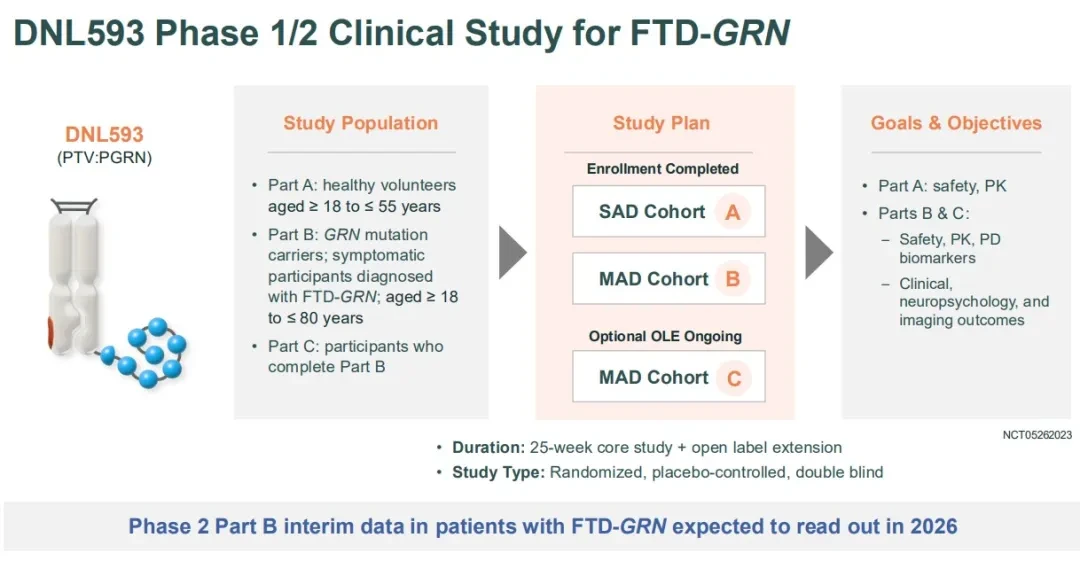
DNL593TheI/IIPhase Clinical Design
However, if we extend the timeline, this strategic retreat is not surprising. As early as2023Year8Month,TakedaAndDenaliOnce halted the treatment for Alzheimer's diseaseTREM2AgonistDNL919The core reason for the development lies in the clinical aspect.IPeriod DataDisplayDNL919The therapeutic window is extremely narrow.
This reveals receptor-mediated endocytosis (such as targetingTfR1) The underlying pain point of transporting macromolecular drugs across the blood-brain barrier. From the intersection perspective of medicinal chemistry and translational medicine,TfRThe mediated delivery system faces three major insurmountable obstacles:
·Peripheral Target Sink: TfRNot only exists inBBB, it is also widely expressed in peripheral tissues such as the liver and red blood cells. High-affinity binding tends to result in significant drug consumption in the periphery, leading to systemic toxicity.
·The Paradox of Receptor Binding Kinetics:Medications not only need toBBBStrong binding to the luminal receptor is required, as well as efficient shedding on the brain parenchyma side. Excessive affinity may cause the drug to become trapped in endothelial cells and unable to release; insufficient affinity may fail to initiate transcytosis.
·Unpredictable off-target toxicity:Non-specific distribution and accumulation of large engineered fusion proteins in brain tissue often occur in the early stages in rodents or non-human primates (NHP) model are difficult to detect until entering human clinical trialsIThe outbreak occurred during the period.
While the intracerebral delivery of large protein molecules has repeatedly hit roadblocks,Biogenbut chose toCNSContinue to heavily invest in small nucleic acids.2026Year4Month7Announced on [Date]BiogenAndAlloy TherapeuticsThe cooperation, the core demand is very clear: throughAntiClastic ASOPlatform, achieving higher efficacy, lower immunogenicity, and more precise tissue targeting.
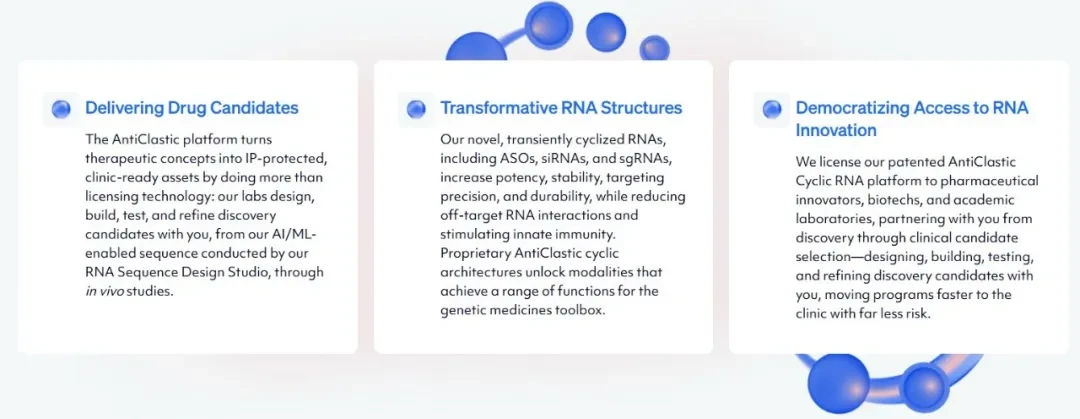
AlloyCompany'sAntiClastic ASOPlatform
BiogenForASO's favor has a deep historical foundation. From relying on blockbuster drugs worth billions for spinal muscular atrophySpinraza(Nusinersen) Became Legendary in One Battle, and Later AgainstSOD1MutationALSPatient'sTofersenApproved,BiogenProfoundly verified in practiceASOUnique Advantages in Neurodegenerative Diseases.
This advantage is first reflected in the ability to directly intervene in the root causes of diseases: compared with traditional large-molecule drugs, which can only clear aggregated proteins that have already formed outside of cells,ASOAble to directly reach the interior of the cell nucleus, utilizing steric hindrance effects for regulationmRNASplicing, or throughRNase HMechanism-mediated precise degradation of pathogenic factorsmRNA. This radical intervention approach, for genetic mechanisms that are clearly defined,CNSThe disease offers extremely high certainty for drug development. Meanwhile,ASOIt also shows great application potential in pharmacokinetics. Through intrathecal injection, it can not only cleverly bypass the blood-brain barrier to directly enter the cerebrospinal fluid, but also maintain an ultra-long half-life lasting for several months within the brain tissue.
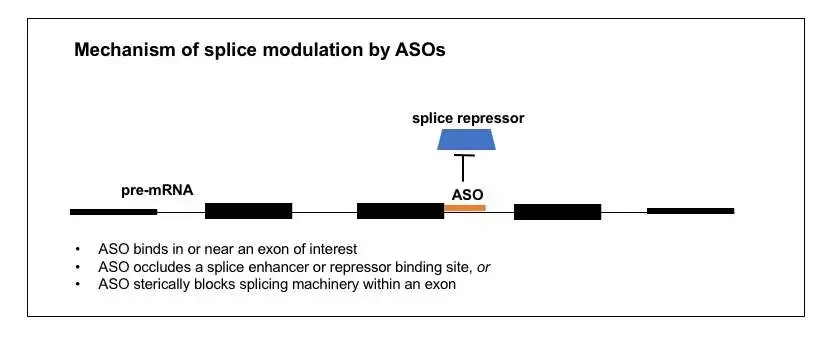
ASOMechanism of Action
But this does not mean the existingASOThe technology has reached perfection.BiogenThis time, we have chosen to introduceAlloyThe technology platform is designed to fundamentally unravel traditionalASOThe key deadlock faced during project initiation and development. For a long time, traditionalASOThe phosphorothioate backbone widely used in molecules is highly prone to trigger non-specific protein binding, which can lead to challenging neuroinflammatory toxicity; andBiogenIt is precisely hoped that by leveragingAlloyThe platform's innovative main chain modification technology and spatial conformation design have completely overcome this safety issue.Question, thereby for its next generationCNSPipeline paves the way.
02
Crossing the Valley of Death:POCFatal Flaw in the Stage
For those engaged in early drug incubationBiotechFor, placing oneCNSCandidate molecules fromPCCMove to ClinicalI/IIThe process is like dancing on the tip of a knife. Why do so many molecules that perform perfectly in animal models,but unable to cross overPhase I Clinical TrialThe Valley of Death? The root cause lies in the underestimation of critical flaws during the proof-of-concept phase.
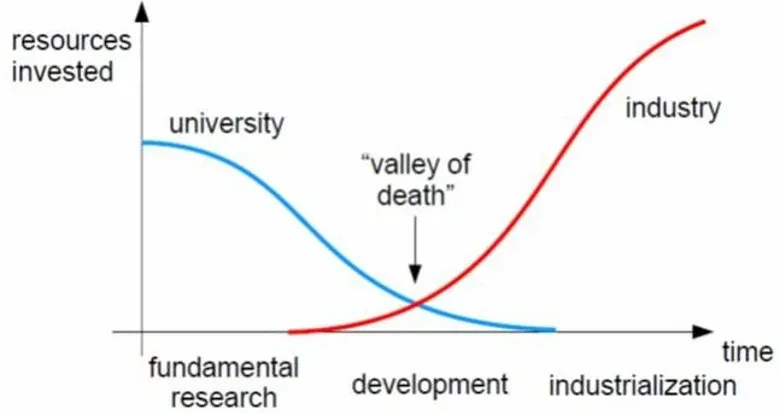
The Valley of Death in New Drug Development
2.1 Systematic Deception in Animal Models
CNSDisease is the area with the poorest predictive ability of animal models across all therapeutic fields.
ØThe Gap Between Anatomy and Fluid Mechanics:Rodents not only lack gyri, but the total volume and turnover rate of their cerebrospinal fluid also differ by an order of magnitude from those in humans. A drug that can be evenly distributed to the cortex through intrathecal injection in a mouse modelASOMolecules, after entering the extremely complex subarachnoid space and ventricular system of humans, may only deposit near the injection site and fail to reach the deep target brain regions.
ØSimplification of Pathological Mechanisms:The vast majority of genetically modified mouse models (such asAPP/PS1Mice) can only simulateCNSA specific segment of the disease, unable to reproduce the complex network woven by human aging, metabolic disorders, and chronic neuroinflammation.
2.2 Nucleic Acid Sequences and Modifications: The Hidden Bomb
In the early development of small nucleic acids, chemical modifications of nucleic acids are a double-edged sword that can determine success or failure. To resist nuclease degradation and prolong the half-life in vivo, modifications are typically introduced.2'-O-Methoxyethyl (2'-MOE) Modification and Full Sulfurization (PS) Main chain. However, excessivePSModification can greatly increase the hydrophobicity and polyanionic properties of oligonucleotides. At the clinical translation stage, thisPossibleLeading to two fatal consequences:
Off-target Toxicity and Hepatorenal Accumulation:Even with intrathecal administration, small nucleic acids will still flow throughout the body via the meningeal lymphatic system. Non-specific protein binding can lead to severe thrombocytopenia or renal tubular toxicity.
Intracerebral Inflammatory Cascade:Certain specificASOThe sequence abnormally activates microglia and astrocytes inTollreceptors, triggering a severe cytokine storm. InNHPIn the experiment, this microscopic neuroinflammation may only manifest asCSFA very slight increase in white blood cells, but once entering human clinical trials, it may quickly evolve into life-threatening aseptic meningitis.
03
MNCWilling to do whatCNSPipelinePay up?
Back to the essence of business, the current capital market can no longer tolerate durations of eight to ten years.CNSDrugIIIBlind box in the clinical stage. Therefore, in the past two yearsMNCIn the early stages of introductionCNSWhen it comes to pipelines, the focus of due diligence has shifted fundamentally: they no longer simply pay for theoretical mechanisms and improvements in animal behavior but instead only recognize...BiomarkerEvidence chain closed loop driven.
When conducting licensing negotiations for early pipelines,BiotechThe following three dimensions of hardcore evidence must be presented in the data package:
3.1 Clear Target Occupation
For large pharmaceutical companies, aCNSIf a drug fails, it must be a clear and unequivocal failure.,That is, the mechanism was proven ineffective, rather than the drug failing to reach the target. ForASOOr small molecule pipeline,WeThe data package must answer: Did the drug reach humans as expected?/NHPSpecific brain regions? In the cerebrospinal fluid, can the drug concentration and the downregulation of the target protein be precisely quantified?PK/PDRelationship?
Even if your clinicalIThe trial period is less than20A patient, but if you can prove that through some innovative delivery technology (or likeAlloySuchAntiClasticConformation), makingCSFThe pathogenic proteins showed a strong, dose-dependent downregulation, making this asset capable of reaching tens of millions of dollars.UpfrontThe confidence.
3.2 Complete Chain of Translational Medicine
MNCWhen reviewing early projects, what we look for is a tight logical chain: genome/Transcriptomic Intervention——>Decrease in Core Pathological Protein Levels——>Neuroinflammation/Improvement in Degenerative Markers——>Radiology/EEG Changes——>Final Clinical Behavior Score Improvement。
Many failuresBiotechProjects often fall through in the middle stages. For example,ASOThe target was indeed knocked down.mRNA, but due to the existence of compensatory mechanisms, the levels of downstream neurotoxic proteins did not substantially decrease; or the protein levels decreased, but the neurofilament light chain, a golden indicator of neuronal damage, showedCSFBut instead increased,Indicates that the drug itself has neurotoxicity.
3.3 Quantifiable Margin of Safety
Due toCNSThe particularity of anatomical structures and the absence of repair capability,MNCThe tolerance for neurotoxicity is much lower than that for tumors. In the filingINDIn the data, it must be presented based onNHPDetailed toxicology data of long-term toxicity. InBDIn negotiations, able to provide clearNOAEL, and demonstrate a sufficiently wide therapeutic window between it and the expected human clinical effective dose, is to push the deal intoTerm SheetThe premise.
In conclusion
TakedaOfWithdrawalAndBiogenThe increase in holdings is merely a move by global pharmaceutical giants inCNSA microcosm of adjusting course on the vast star map. Macromolecule penetrationBBBThe mystery is still in the process of being unraveled, and withASORepresenting the small nucleic acid therapy is ushering in its new era based on the next-generation underlying chemical architecture.2.0Era.
InCNSIn this R&D deep-water zone with extremely high trial-and-error costs and an extremely low error tolerance, there has never been any shortcut. Only those who show reverence for the underlying biological mechanisms, are well-versed in the closed loop of translational medicine, and can withstand scrutiny during the early project initiation stage will succeed.MNCOnly innovators who can withstand logical interrogation will ultimately cross the "valley of death" in the clinical stage, realizing the ultimate value of technological innovation in this trillion-dollar blue ocean.。
Ref:
DNLI CORPORATE PRESENTATION - JANUARY 2026
https://www.cureffi.org/
https://www.fiercebiotech.com/biotech/biogen-links-alloy-platform-boost-aso-drug-development
https://alloytx.com/genetic-medicines/
https://biovox.eu/augustine-therapeutics-bridging-the-valley-of-death/

Click "Medicines" below”, follow more exciting content
Disclaimer
The push rules of WeChat Official Accounts have changed again. If you don't tap"Under observation"Or not set to"Star Mark", we might just dissipate in the vast sea of literature~ Click here, don't miss out on the latest news from PharmaDJ!??