

Pulse Biosciences Bets on nsPFA Technology to Drive Growth in Cardiovascular Market After Pivoting from Dermatology

Pulse Biosciences
Bioelectronic Medicine Product Developer
Atrial fibrillation (AFib) is the most common sustained cardiac arrhythmia. In severe cases, it can lead to complications such as thromboembolism, stroke, and heart failure, with its incidence typically increasing exponentially with age. Currently, the mainstream clinical treatment for AFib is catheter ablation, including radiofrequency ablation, cryoablation, and pulsed field ablation (PFA).
From the perspective of clinical therapeutic efficacy and practical operation, traditional radiofrequency ablation and cryoablation both have certain limitations, as both are temperature-dependent. Excessive energy delivery can easily lead to complications such as pulmonary vein stenosis, atrio-esophageal fistula, and phrenic nerve injury; whereas insufficient energy delivery results in incomplete ablation and a high risk of recurrence.
The emerging pulsed field ablation (PFA) technology primarily works by disrupting the cell membrane, thereby disturbing intracellular homeostasis and ultimately leading to apoptosis. PFA can lesion the atrial myocardium at the pulmonary vein antrum, blocking electrical conduction from the pulmonary veins and thereby achieving the therapeutic goal of treating atrial fibrillation.
In contrast, PFA offers two primary advantages: first, it exhibits tissue selectivity, sparing surrounding blood vessels, nerves, and the esophagus, and employs a non-thermal ablation mechanism, thereby minimizing collateral tissue damage associated with high temperatures or cryoablation; second, its short discharge duration significantly enhances procedural safety and reduces operation time.
Pulse Biosciences (hereinafter referred to as “Pulse”) is an emerging bioelectronic medicine company. Its sole commercial product is the CellFX System, which leverages the company’s proprietary nanosecond Pulsed Field Ablation (nsPFA) technology.
VCBeat has learned that on May 1, 2023, Pulse (NASDAQ: PLSE) entered into an agreement with Robert Duggan, the company’s Executive Chairman. Under the terms of the agreement, Mr. Duggan will purchase 10,022,937 shares of common stock at a price of $6.51 per share. The proceeds from this transaction were used to repay the $65 million loan extended by Mr. Duggan to the company in September 2022. Following the announcement, the company’s stock price trended upward.Peaked at $9.36 on May 4。
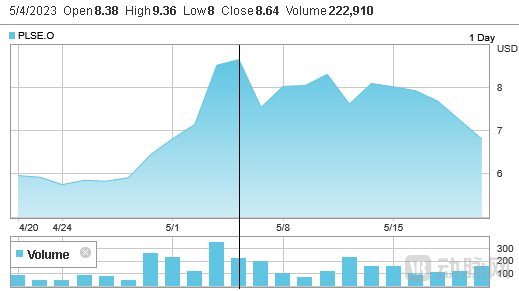
Stock Chart. Source: Pulse Official Website
Most current pulsed field ablation (PFA) systems operate at the microsecond level, which can stimulate skeletal muscles during use, causing patient pain and spasms and necessitating general anesthesia. As a next-generation PFA technology, nanosecond PFA (nsPFA) features shorter pulse durations, effectively addressing the high anesthesia requirements and patient pain associated with existing PFA technologies.
Pulse’s proprietary technology is Nano-Pulse Stimulation (NPS), which delivers nanosecond-scale electrical energy pulses to non-thermally permeabilize cells while sparing adjacent non-cellular tissues, with pulse durations ranging from one-billionth to one-millionth of a second. When NPS technology is used for ablating cellular tissue, it is referred to as nanosecond Pulsed Field Ablation (nsPFA) technology.
When applied to target tissues, nsPFA energy pulses enter cells and alter the function of intracellular organelles such as mitochondria and the endoplasmic reticulum. Subsequent intracellular cascade disruption leads to regulated cell death (RCD), thereby eliminating diseased cellular tissue. RCD is an essential homeostatic mechanism for maintaining tissue morphology and function.
Based on nsPFA, the company launched its first commercialized product, the CellFX System. The CellFX System consists of a console, handpiece, and tip, with a focus on dermatological conditions such as sebaceous hyperplasia, seborrheic keratosis, non-genital cutaneous warts, and acne.
Treatment using the CellFX System based on nsPFA,It can preserve skin collagen during treatment, reduce the risk of scarring, and avoid trauma to the treated tissue., which is also the advantage of nsPFA over conventional PFA.
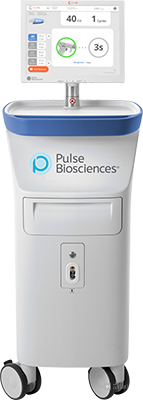
CellFX System. Image source: Pulse official website
In 2021, CellFX received clearance from the U.S. FDA for dermatological procedures requiring tissue ablation and remodeling. In the same year, the system obtained regulatory approvals in Europe, Canada, and Australia, enabling its commercial launch in dermatology for the treatment of benign skin lesions. In 2022, it received U.S. FDA approval to expand the energy settings range of its handpiece, facilitating treatment of a broader spectrum of lesion tissues. To date, the CellFX System has been used to safely and effectively treat more than 6,000 patients outside of cardiology.
However, in September 2022,Pulse Announces Cessation of All Commercial Sales and Marketing of the CellFX System in Dermatology, Shifting Therapeutic Focus from Dermatology to Cardiovascular Care and Expanding Application Development in Cardiology, Oncology, Gastroenterology, Gynecology, and Other Fields。
Headquartered in Hayward, California, USA, Pulse was founded in 2014 and went public in 2016, representing the groundbreaking research findings on Nano-Pulse Stimulation (NPS) by researchers from Old Dominion University and the University of Southern California. In 2021, Pulse was named among the Top 100 Global MedTech Companies. To date,Pulse holds more than 130 patents worldwide。
Due to excessively high operating expenses, Pulse has adjusted and restructured its corporate structure alongside a shift in therapeutic focus. The measures include adjustments to the leadership team and layoffs in the sales department, aimed at increasing the utilization rate of commercial clinics while reducing emphasis on system sales. The $65 million loan repayment agreement signed with Duggan was intended to support the implementation of this strategy.
Former Chief Business Officer Kevin Danahy will succeed Darrin Uecker as Chief Executive Officer. Kevin joined Pulse in February 2022. Previously, he held positions at Zimmer Biomet, Medtronic, Johnson & Johnson, and Intuitive Surgical, accumulating extensive experience across multiple fields, including the research and development of orthopedic devices and surgical robots, as well as the treatment of chronic diseases.
Darrin Uecker has transitioned to the role of Chief Technology Officer at the company, focusing on technology R&D and product development. With over 25 years of experience in the medical device industry, he holds more than 70 U.S. patents. Prior to joining the company, Uecker served as President and Chief Operating Officer of Progyny, a digital health company that developed Eeva, the first FDA-approved embryo viability testing system. Uecker also previously served as Vice President of R&D at Gynesonics, a women’s healthcare company, where he led the development of the world’s first intrauterine ultrasound system integrated with radiofrequency ablation for incision-free treatment of uterine fibroids.
In addition, Joe Talarico, currently Vice President of North American Sales, will assume the role of Vice President of Business Development. Robert Duggan, Chairman of the Board, will serve as the company’s newly created Executive Chairman. Since 2015, Duggan has served as Chief Executive Officer of Duggan Investments, a venture capital and public equity investment firm. Currently,Duggan is the largest shareholder of Pulse, holding approximately 69% of the shares.。

From left to right: Kevin Danahy, Darrin Uecker, Robert Duggan
To date, Pulse’s revenue and profitability have been entirely dependent on the CellFX System and its proprietary nanosecond pulsed field ablation (nPFA) technology. The CellFX System entered the dermatology market in 2021, generating its first revenues; however, these were modest, amounting to only $1.418 million for the full year. The strategic shift in 2022 had a significant impact on the company’s financial performance.
According to Pulse’s financial report, the company generated no revenue in the first quarter of 2023. Its total revenue for 2022 amounted to $700,000, representing a 50.63% year-over-year decline from 2021, primarily attributable to the halt in expansion within the dermatology market.
In terms of operating expenses, R&D expenses decreased by $7.801 million compared to 2021, primarily due to changes in senior management that led to reductions in stock-based compensation and employee salaries. Cost of revenue increased by nearly $10 million, driven by an $8.5 million write-off of excess and obsolete inventory to advance research into therapeutic areas beyond dermatology.
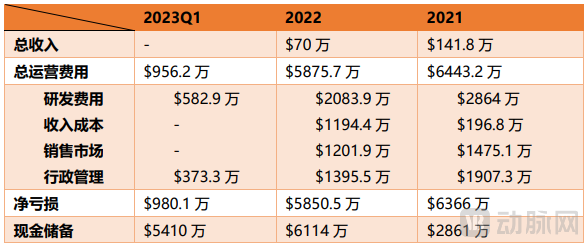
Pulse’s Financial Performance from 2021 to Q1 2023
Source: Pulse Financial Report
Since its inception, the company has incurred annual operating losses, with net losses exceeding $120 million in 2021 and 2022 alone. In the coming years, the company is expected to continue reporting losses due to a shift in strategic direction.
From the perspective of cash reserves,As of March 31, 2023, the company held $54.1 million, a decrease of $7.04 million from the end of the previous quarter.. Based on the Company’s current operational status, this amount is largely sufficient to meet its projected operating needs for the next three quarters. However, as the Company continues to incur net losses and is exploring new therapeutic areas, it will still need to secure ongoing funding through public or private equity offerings, debt financing, and potential new collaborations to support future growth demands.
The atrial fibrillation (AF) ablation market is currently dominated by radiofrequency ablation, with cryoablation playing a secondary role. In contrast, pulsed field ablation (PFA), still in its early stages, offers distinct advantages and is regarded as the promising next-generation AF ablation technology in the field of electrophysiology, holding substantial market potential. Many companies both domestically and internationally have already established their presence in this sector.
In 2021, Boston Scientific’s FARAPULSE system received both the FDA Breakthrough Device designation and the EU CE mark, becoming the first pulsed field ablation (PFA) product approved for market launch globally. Subsequently, PFA products from Medtronic and Johnson & Johnson entered the green channel of China’s National Medical Products Administration (NMPA). In addition, companies such as Canada’s Kardium, the U.S.-based Galvanize Therapeutics, and Galaxy Medical have also actively explored this field.
In China, the number of patients with atrial fibrillation has reached 20 million. As the aging of society accelerates, this figure is expected to rise further in the future. With the expanding patient base and growing market demand, the electrophysiology market size is steadily increasing.
According to Frost & Sullivan data,The market size of cardiac electrophysiology devices in China reached RMB 5.15 billion in 2020 and is projected to reach RMB 21.11 billion by 2024.. However, the penetration rate of electrophysiology procedures in China remains below 1%, and the market share of domestic brands is less than 10%, indicating substantial potential for import substitution. Many Chinese companies are quietly intensifying their efforts and strategically positioning themselves in the pulsed field ablation (PFA) sector to develop domestically produced products. Examples include Deno Electrophysiology, Xuanyu Medical, Jinjiang Electronics, Zhouling Medical, and Ruidi Biotechnology.
As no PFA products have been approved in China to date, domestic companies must continue to strive for breakthroughs in core technologies if they are to overtake competitors and break the import monopoly in the electrophysiology market.