

Bicycle Therapeutics: Powering Next-Gen Radiopharmaceuticals with Bicyclic Peptide Technology

Bicycle Therapeutics
Cancer Treatment Drug Developer
Bayer Accelerates R&D of Radiopharmaceuticals.
Previously, a senior industry insider told VCBeat New Medicine, “I speculate that Bayer may make some major acquisitions in the future, as its internal pipeline is progressing relatively slowly; it may seek to in-license or acquire external assets and companies with faster development progress.”
In May, Bicycle Therapeutics (hereinafter referred to as “Bicycle”) announced a strategic collaboration with Bayer. Under the terms of the agreement, Bicycle will receive an upfront payment of $45 million and up to $1.7 billion in milestone payments.Bicycle will leverage its proprietary phage display platform to discover and develop bicyclic peptides., which contains 9 to 20 amino acids and can bind to specific receptors.
Dr. Kevin Lee, CEO of Bicycle Therapeutics, expressed his enthusiasm for the collaboration. In an interview with the media, he stated, “Bayer is a pioneer in the field of radiopharmaceuticals, providing further validation for our unique technology. We believe that our Bicycle peptide platform, combined with Bayer’s R&D scale and expertise in developing radiopharmaceuticals, has the potential to deliver better clinical outcomes for cancer patients. We look forward to collaborating with Bayer to advance novel, best-in-class radiopharmaceutical therapies based on Bicycle technology.”
Christian Rommel, Head of Global Drug Development at Bayer, stated, “Leveraging Bicycle’s proprietary peptide-based technology, we are continuing to strengthen our oncology development pipeline by adding next-generation targeted radioligand therapies.”
Bayer and Novartis are also intensifying their competition in the field of radiopharmaceuticals.Following the market launches of Bayer’s Xofigo, as well as Novartis’s Lutathera and Pluvicto, these two international pharmaceutical giants continue to ramp up their investments in the radiopharmaceutical sector. This is not the first time Bicycle Therapeutics has secured such a substantial collaboration funding; indeed, just two months ago,3Month, Novartis entered into a $1.75 billion collaboration with Bicycle Therapeutics,Research on radiopharmaceutical conjugates.
Two years ago, Bayer acquired the radiation therapy biotech company Noria Therapeutics and its subsidiary, PSMA Therapeutics. In late April, Novartis made a $40 million upfront payment to acquire FAP-targeted peptide technology from 3B Pharmaceuticals, a company focused on cancer radioligand therapy. This deal includes exclusive global rights for the development and commercialization of FAP-2286 for both therapeutic and imaging applications. These series of acquisitions and strategic moves clearly demonstrate the ambitions of these two pharmaceutical giants, who may soon face off directly.
Setting aside this competition, today we will discuss what makes Bicycle Therapeutics so distinctive that it has attracted the favorable attention of the two leading companies in the radiopharmaceutical sector.
According to incomplete statistics, since its establishment, Bicycle Therapeutics has completed six transactions with various partner companies, with disclosed cooperation amounts exceeding US$6.6 billion,
Time | Transferor | Transferee | Total Transaction Value (USD Million) | Down Payment (USD Million) |
2023-05-10 | Bicycle Therapeutics | Bayer | 1745.00 | 45.00 |
2023-03-28 | Bicycle Therapeutics | Novartis | 1750.00 | 50.00 |
2021-07-13 | Bicycle Therapeutics | Ionis Pharmaceuticals | Not disclosed | 45.00 |
2020-02-25 | Bicycle Therapeutics | Genentech | 1730.00 | 30.00 |
2017-09-06 | Bicycle Therapeutics | Bioverativ | 424.20 | 10.00 |
2016-12-01 | Bicycle Therapeutics | AstraZeneca | 1000.00 | 0.00 |
▲ Collaboration with Bicycle Therapeutics
Bicycle was founded in 2009. The company’s core bicyclic peptide technology is based on the innovative research of Sir Greg Winter, a Nobel Laureate in Chemistry, and Professor Christian Heinis. Sir Greg Winter, a pioneer in the field of monoclonal antibodies and a faculty member at the University of Cambridge, shared the 2018 Nobel Prize in Chemistry with Frances Arnold and George Smith for his work on the directed evolution of antibodies using phage display. Sir Greg Winter is also a co-founder of Bicycle Therapeutics.
Dedicated to the development of bicyclic peptide conjugate drugs,As a leading enterprise in the development of novel cyclic peptide drugs, its technology platform encompasses monovalent bicyclic peptides, bispecific bicyclic peptides, multispecific bicyclic peptides, peptide-drug conjugates, and peptide-oligonucleotide conjugates, demonstrating perfect overlap with the application scope of antibody-based therapeutics.
Bicyclic peptide technology evolved from cyclic peptides. Peptide-based drugs combine the flexibility and specificity of both large and small molecules, but they tend to be relatively unstable. Cyclizing peptide chains into cyclic peptides can partially address this issue. This led to the emergence of bicyclic peptides, which link two small rings together to form a bicyclic structure that enhances stability while maintaining adequate molecular weight. Bicycle Therapeutics introduced innovations to existing bicyclic peptide designs. Conventional bicyclic peptides typically feature a linear scaffold with two cyclic peptide rings attached on either side, resembling a figure “8.” In contrast, Bicycle Therapeutics developed a triangular central scaffold, anchoring each end of the peptide chain to one vertex. This configuration transforms the scaffold into a wheel-like rim, with the peptide chain forming the tire.
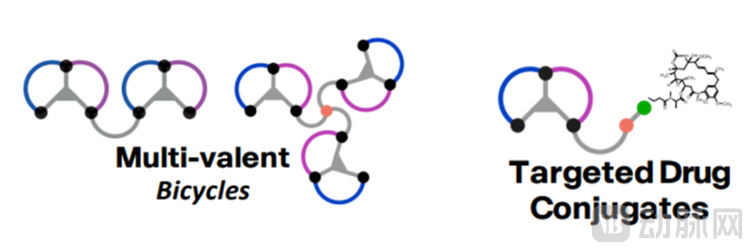
▲ Schematic diagram of Bicycle peptides (Source: Bicycle)
Bicyclic Peptides: Integrating Multiple Advantages
Low molecular weight, target specificity, rapid action, and safety
Bicyclic peptide molecules combine the properties of antibodies, small-molecule drugs, and peptides.It exhibits affinity and precise targeting specificity similar to antibodies; meanwhile, its low molecular weight enables rapid and deep tissue penetration, thereby achieving targeted delivery to lesions from within the tissue. Its peptidic nature avoids the hepatic and gastrointestinal toxicities commonly associated with other drug modalities by modulating pharmacokinetic half-life.
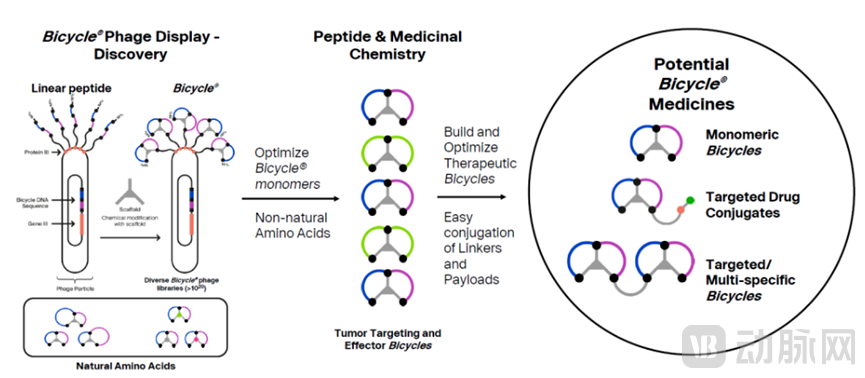
▲ Schematic diagram of bicyclic peptide drug development (Image source: Bicycle)
Bicycles have a molecular weight between 1.5 kDa and 2 kDa, offering advantages over antibody drugs, including superior tissue penetration, renal clearance, high affinity, and selectivity.
Taking PDC-related data as an example: Due to their low molecular weight, PDC drugs can rapidly accumulate at tumor sites and quickly exert their cytotoxic effects on cancer cells. Meanwhile, drug molecules in the bloodstream are rapidly cleared, resulting in a short half-life, which helps reduce off-target toxicity. Furthermore, since PDCs carry a limited number of toxin molecules, higher doses may be required to achieve sufficient therapeutic efficacy. The favorable tumor penetration and short blood half-life of PDCs provide a feasible window for dose escalation.
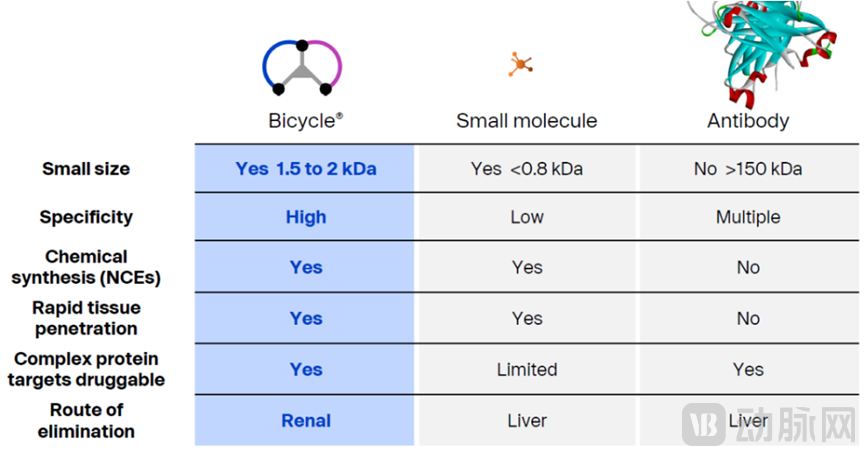 ▲ Comparison Chart of Bicyclic Peptide Drug Advantages
Bicyclic peptides bind to targets with high affinity and selectivity, exhibit enhanced tumor penetration, and are rapidly cleared from healthy organs. These bicyclic peptides can be chemically synthesized, feature tunable pharmacokinetics, and possess a large molecular interaction surface area, enabling them to target protein–protein interactions.
Bicycle and Orano Med presented preclinical results for Pb-BCY20603 (a Bicycle® Radioconjugate [BRC]) at TIDES 2023. The results showed:
In rodent tumor xenograft studies, Pb-BCY20603 demonstratedTumor Targeting,Radioactivity levels at 24 hours post-injection > 45% of the injected dose (ID/g).
Following a single 5 μCi dose, Pb-BCY20603 demonstratedEffective antitumor activity.
After three 10-μCi dosing cycles at two-week intervals, it was observed thatComplete tumor regression.
The median survival time was increased in each dosing group.
At the end of the 100-day study, three 10-μCi treatment cycles were observed.The survival rate is 90%.
Currently, Bicycle'sOur R&D efforts are primarily focused on products based on bicyclic peptide-based BTCs and tumor-targeting immune cell agonists (TICAs).such as BT8009, BT5528, BT7480, and BT7455. Since its establishment, Bicycle Therapeutics has generated a substantial portfolio of intellectual property, including EP2257624B9 relating to complexes involving phage particles and methods for their preparation, EP2474613B1 relating to genetically encoded polypeptide-nucleic acid libraries of complexes, and EP2653543A1 relating to polypeptide-linker compound conjugates.
According to data released by Bicycle Therapeutics, excluding co-developed products, BT5528 and BT8009 are currently the most advanced candidates. Both are antibody-drug conjugates (ADCs) that have entered Phase II clinical trials. Notably, BT8009 has received Fast Track designation from the U.S. Food and Drug Administration (FDA), with further data expected this year. Clinical data for BT5528 remain incomplete; it has demonstrated an objective response rate (ORR) of 22% and a disease control rate (DCR) of 67% in ovarian cancer, while achieving an ORR of 67% in urothelial carcinoma. However, due to the small sample size, the current data are of limited value. More comprehensive data are anticipated later this year.
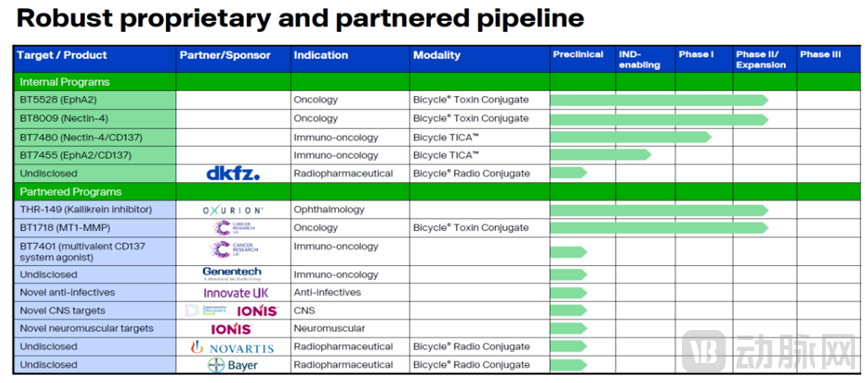
▲ Progress in Drug Development by Bicycle Therapeutics
Advantages and Disadvantages Coexist
How to Find New Pathways for Peptide Drugs
Bayer and Novartis have both entered into collaborations with Bicycle Therapeutics,It is evident that both pharmaceutical companies are optimistic about bicyclic peptides; however, their development is challenging, particularly in screening for bicyclic polypeptides with superior affinity. While cyclization significantly enhances stability, it remains crucial to ensure sufficient specificity while maintaining the highest possible affinity, posing substantial challenges.
This also highlights the disadvantages of peptide drugs—the greatest challenge for in vivo transporters and peptides is their instability. Therefore, during drug development, it is necessary to comprehensively consider factors such as molecular size, molecular charge, intramolecular protein structure, solvent effects, lipid membrane packing and hydration, stability, and receptor affinity.
For example, the main drawbacks of peptide-drug conjugates (PDCs) are suboptimal circulatory stability and rapid renal clearance. An ideal PDC should remain stable in circulation to prevent premature release of the chemotherapeutic agent and systemic exposure. In contrast, antibody-drug conjugates (ADCs) utilize specific monoclonal antibodies (mAbs) targeting antigens expressed on cancer cells to deliver cytotoxic agents, thereby reducing damage to normal cells, achieving better therapeutic efficacy, and enhancing drug metabolism. However, mAbs can also induce immunogenicity.
Peptide drugs constitute a specialized market, with successful validation currently limited to a few targets and indications, yet offering unique applications in certain areas of competitive advantage. The prevalence of similar indications and targets is a common phenomenon during the industry’s explosive growth phase. It is crucial for companies to seize the time window to deploy leading technologies, pursue differentiated development, and rapidly validate the clinical value of their products. Establishing a pathway for “rapid product validation and swift market launch” is vital to the future development of enterprises.