Shijiazhuang Siyao Group Inks Deals for Six Blockbuster Drugs Within Two Days, Expanding into Biologics and Modified New Chemicals

Johnson & Johnson
Medical Device R&D and Manufacturer
The drugs covered in this letter of intent include ustekinumab, dupilumab, aflibercept injection, and evolocumab.
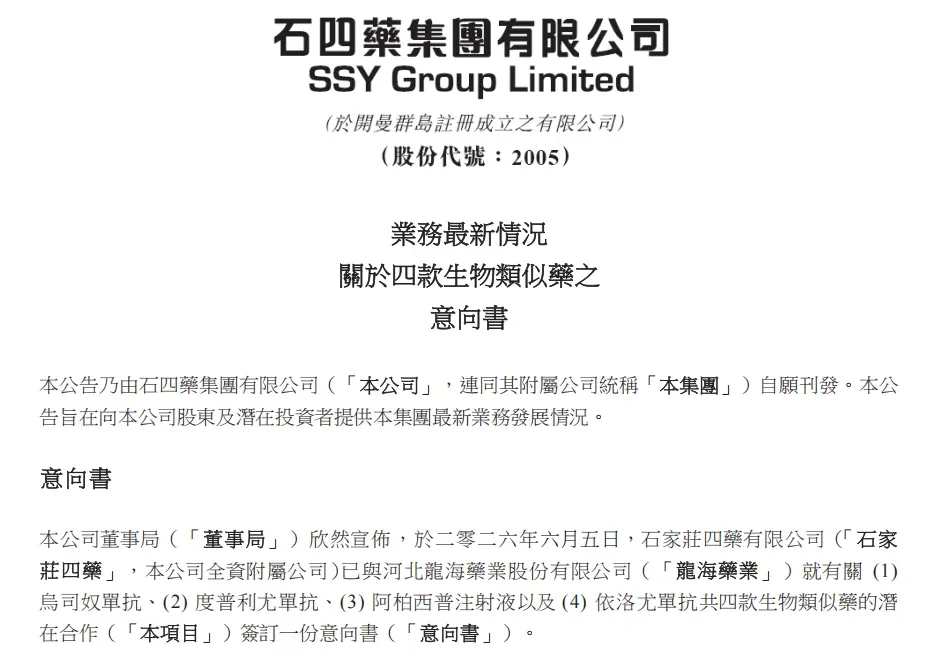
Figure: Shijiazhuang No. 4 Pharmaceutical Co., Ltd. Announcement
And just one day earlier, Shijiazhuang No. 4 Pharmaceutical had also announced its collaboration withAnhui Xinzheng Heying QianSigned letters of intent for collaboration on two Class 2 chemically modified new drugs, including one Class 2.2 drugPediatric Antispasmodics and a Class 2.3 COPD Drug (Class 2.3)。
Shijiazhuang No. 4 Pharmaceutical Group initially built its business on large-volume parenterals (LVPs) and generic conventional drugs, with no biologics in its portfolio. As profits from generics continue to shrink and LVP sales decline year after year, the company appears unable to sustain this pressure and has begun venturing into new areas, starting with improved chemical drugs and biosimilars.
Biosimilars are indeed a favorable entry point. Generally, the originator biologics in this category have been marketed in China for many years and are typically priced at a premium. Domestic manufacturers can leverage their price advantage without needing to reduce prices to the extreme levels seen with small-molecule drugs; moderate price reductions are sufficient to generate profits.
Shijiazhuang No.4 Pharmaceutical Group has selected several biosimilars that are all blockbuster drugs with immense potential.
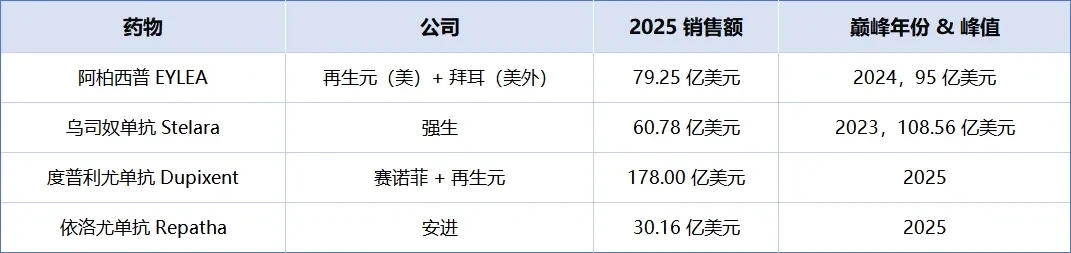
Note: Data source: financial reports of each company. There is overlapping commercial data from multiple enterprises, for reference only.
These Four MedicationsThe patents for aflibercept and ustekinumab have expired, with their peak sales already passed, while the sales of the other two drugs continue to rise.

Ustekinumab, this drug has recently gained exceptional popularity; on May 21 alone, five approval numbers were granted, with three companies receiving approval on the same day.

This medication was developed by Johnson & Johnson.World’s First Fully Human Monoclonal Antibody Dual-Targeting IL‑12/IL‑23,UstekinumabSubcutaneous Injection (Stelara)Approved in the United States in 2009, it was primarily indicated for immune-mediated skin diseases. Subsequently, Johnson & Johnson continued research and developed an intravenous injection formulation for endocrine and immune disorders.In China, in 2017,Stelara (subcutaneous injection) was launched, and intravenous injection was launched in 2020.
Stelara’s sales have been on a steady rise since its market launch, surpassing $10 billion in 2023 and, following Remicade, bolstering Johnson & Johnson’s dominance in the autoimmune disease sector.
In 2023, the patents for ustekinumab successively expired, and biosimilars began to emerge globally.Sales of Stelara began to decline, with the first domestic biosimilar appearing in 2024.Zhongmei Huadong’s Ustekinumab Injection (Subcutaneous) Approved for Psoriasis
By 2025UstekinumabTotal domestic hospital sales reached RMB 1.3 billion, with Zhongmei Huadong capturing over RMB 90 million, making it a highly profitable product.
It is precisely such returns that have prompted major pharmaceutical companies like CSPC, Bio-Thera, and Zhongmei Huadong to compete for entry into this market. Currently, Zhongmei Huadong and Bio-Thera each have both subcutaneous and intravenous injection formulations available, whereas CSPC currently offers only the subcutaneous injection.
Aflibercept, isThe world's leading ophthalmic product,In 2011, the FDA first approved aflibercept (Eylea) for the treatment of neovascular (wet) age-related macular degeneration, marking Regeneron’s first true blockbuster drug in its 23-year history.
Regeneron is responsible for the commercialization of aflibercept within the United States, while Bayer handles it outside the U.S.This flagship ophthalmic product has reached a peak global revenue of nearly $10 billion.Cumulative sales exceeded $70 billion from market launch through 2025.
However, as global patents continue to expire,EyleaSales began to decline, taking China as an example,EyleaApproved for marketing in China in 2018; in December 2023, Qilu’s first biosimilar was approved; in November 2025,Boan Biotech, a subsidiary controlled by Luye Pharma Group'sAflibercept has also been approved for marketing,Among them, Qilu has already captured a market share exceeding RMB 100 million in 2025.
Meanwhile,EyleaThe high-dose formulation (8 mg) is marketed in the United States and extends the duration of action, reducing dosing frequency from once monthly to once every 20 weeks. Leveraging this high-dose formulationEylea temporarily"Held steady against the decline in global sales."
Currently, Mabwell (Shanghai) Bioscience'sAflibercept has also submitted a marketing application, and Qilu is conducting Phase III clinical trials for the high-dose version.
For CSPC Pharmaceutical Group, these two biologics represent a somewhat late entry into the market, yet they hold significant potential. Unlike generic drugs, biosimilars are less prone to mass market entry due to existing technical barriers.

Dupilumab andEvolocumab: Developing biosimilars at this stage constitutes premature market entry, as the patents for these two drugs have not yet expired and the originator products are currently dominating the market.
Dupilumab (Dupixent) was jointly developed by Regeneron and Sanofi,March 2017,Upon its market launch, it secured the major indication of atopic dermatitis (AD), becoming the first biologic approved by the FDA for the treatment of atopic dermatitis.
At that timeJAK inhibitors have not yet become widely used in the treatment of AD.DupixentSparked widespread debate upon its market launch, at that timeDupilumab’s competitor remains the “former blockbuster king,” Humira; laterJAK InhibitorsUpadacitinib has been developed for the indication of atopic dermatitis (AD),Ruxolitinib Topical Cream Emerges.
Dupixent no longer holds a strong advantage in the field of atopic dermatitis (AD) and has begun to expand into various other indications. Currently, approved indications include asthma, chronic rhinosinusitis with nasal polyps, eosinophilic esophagitis, prurigo nodularis, chronic spontaneous urticaria, and chronic obstructive pulmonary disease (COPD), among others.
It is also by virtue of these numerous indications,DupixentAchieved global sales of $17 billion, with over $1 billion generated in China.
Multiple companies are currently vying for a share of the dupilumab market; five have already obtained clinical trial approvals, and several others are advancing their clinical development programs.
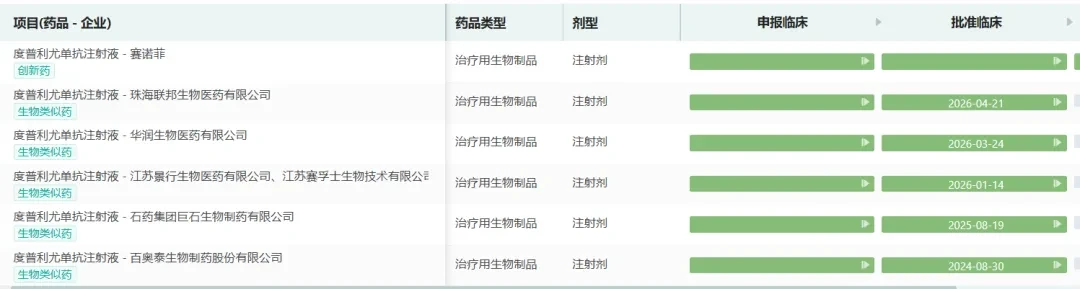
Image source: Mopharm
The final product, evolocumab (Repatha), is the world’s first developed by Amgen.PCSK9 inhibitors, a new generation of lipid-lowering drugs, were first launched globally in 2015 and introduced to the Chinese market in 2018, currently ranking as the best-selling in China.PCSK9 inhibitors, nearly RMB 3 billion.
RepathaGlobal sales reached $3 billion in 2025, maintaining a robust growth rate of 36%.Currently, no companies in China have reported clear progress on biosimilars for evolocumab.
Upon investigationShijiazhuang No. 4 Pharmaceutical and Hebei Longhai Pharmaceutical have not yet announced clear progress on these four biosimilars; developing biosimilars may be a sound strategic choice for established generic drug manufacturers.
Qilu Pharmaceutical, another established pharmaceutical company, already has several biosimilars in its portfolio, with its most profitable product being the biosimilar bevacizumab. The original innovator, Roche, frequently experienced supply instability in the past, and Qilu leveraged appropriateLeveraging cost advantages and a more stable supply chain, it completely outperformed Roche, expanding the market for this product to the million-unit level.