

MindRank Leverages AI Platform DeepDrugDiscovery to Overcome the 'Valley of Death' in Alzheimer’s Drug Development

MindRank
AI Drug Developer
Recently, MindRank, a leading AI drug discovery company in China, formed a joint research team with the University of Macau and Imperial College London.Published a significant research paper titled "DeepDrugDiscovery identifies blood-brain barrier permeable autophagy enhancers for Alzheimer's disease" in the international top-tier academic journal *Nature Biomedical Engineering* (Impact Factor 26.8).
This study established an AI-based platform for discovering active ingredients in traditional Chinese medicine and natural products, which integrates millions of compound information and multiple predictive modules, and applied it to the virtual screening of Alzheimer's disease-related candidate small molecules.
Through computational screening, drug-likeness evaluation, and cross-species experimental validation, the research team ultimately identified small-molecule compounds derived from natural products with potential for further development.
For the AI pharmaceuticals industry, the value of this research lies not only in the discovery of candidate molecules but also in validating an early drug discovery pathway for complex central nervous system diseases.
Research Background: High Barriers in AD Drug Development
As a neurodegenerative disease with complex mechanisms and extremely high clinical translation difficulty,Alzheimer's Disease (AD)Has always been a high-risk area in global drug development.Currently, there are over 50 million Alzheimer's patients globally, but progress in treatment options for this field has been slow for a long time.
Dysfunction of autophagy is one of the important pathological features of AD.
Autophagy can be understood as the "scavenger system" within cells, responsible for clearing abnormal proteins and damaged cellular components. When this system becomes imbalanced, harmful substances such as β-amyloid and hyperphosphorylated tau proteins may accumulate in the brain. Therefore, the development of autophagy enhancers is considered a forward-looking therapeutic approach.
But this direction also faces significant challenges. Most existing autophagy enhancers rely on the mTOR (mechanistic target of rapamycin) pathway, which is a crucial hub for metabolic regulation in the human body. Direct intervention may lead to off-target effects and disrupt normal physiological homeostasis.
At the same time, the blood-brain barrier, the complex pathogenesis of AD, and the insufficient autophagy markers in the brain together constitute the core obstacles in drug development in this field, known as the "valley of death."
DeepDrugDiscovery: Reshaping the Early Screening Paradigm
Faced with this highly challenging scenario, the research team built the DeepDrugDiscoveryAI-driven screening platform, attempting to systematically reconstruct the drug discovery process for brain diseases.
The research team first applied the DeepDrugDiscovery platform to screen 1.16 million compounds in the University of Macau's million-level natural product and traditional Chinese medicine compound library. With the help of GPU-accelerated molecular attention mechanisms, the platform completed large-scale similarity matrix calculations of 50×1,155,606 and initially screened out 6,834 hits.
Subsequently, the team further applied the MindRank ADMET Ranker™ graph neural network/graph Transformer prediction module to jointly evaluate key drug-likeness indicators of the candidate molecules, such as blood-brain barrier penetration, Caco-2, MDCK, LogD, pKa, and solubility, narrowing down the candidate pool to 449 high-potential molecules.
Combined with molecular docking and commercial availability validation targeting FKBP12, mTOR kinase, and the FKBP12-mTOR complex, 15 candidate compounds were ultimately selected for the experimental stage.
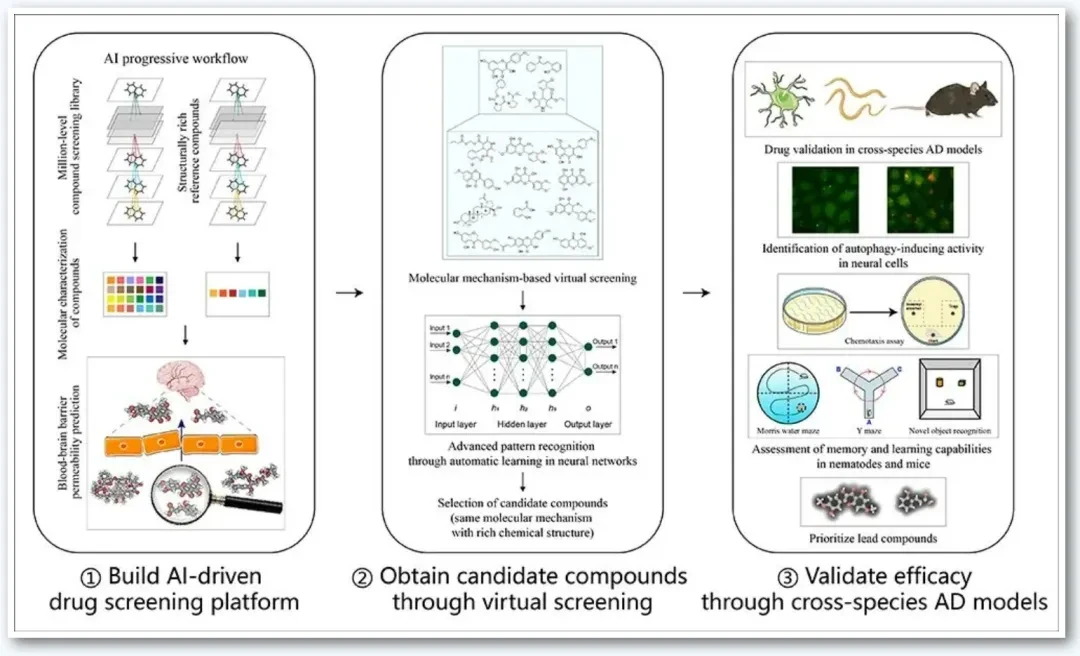
This process demonstrates the commercial value of AI platforms in early drug discovery: they not only provide computational predictions but also integrate mechanism screening, drug-likeness evaluation, and experimental validation upfront, thereby enhancing the efficiency and verifiability of drug discovery for complex diseases.
AI Empowerment: Efficient Screening of Potential Lead Compounds
Experimental validation results showed that all 15 candidate molecules screened exhibited the ability to promote autophagy in cell experiments.
Subsequently, the research team further combined the changes in autophagy markers in N2a cells, as well as the detection of mTOR and its downstream signals, to screen out seven candidate molecules that could enhance autophagy without significantly affecting the mTOR pathway.
This result is highly significant. It indicates that the candidate molecule does not simply function through the traditional mTOR pathway but may offer a more differentiated approach to autophagy regulation.
For chronic central nervous system diseases like AD, potential safety and mechanistic differentiation are important foundations for subsequent development value.
Based on the novelty of the mechanism of action, neuroprotective activity, and chemical structural diversity, the research team further selected four more drug-like candidates from seven molecules for in-depth study.
In Alzheimer's disease-related cell models, all four molecules can promote the clearance of abnormal proteins. Among them, Ombuin and 2-Hydroxycinnamic acid showed the most significant effects and were identified as core lead compounds.
Subsequently, these two lead compounds were further validated in vivo using Caenorhabditis elegans and 3×Tg-AD mouse models, and their blood-brain barrier penetration was assessed, both showing promising neuroprotective potential.
Research Significance and Commercial Prospects
This study not only provides two promising candidate molecules for Alzheimer's disease treatment but, more importantly, validates a replicable and scalable AI-driven drug discovery pathway.
By efficiently integrating mechanism-oriented screening, drug-likeness evaluation, and cross-species experimental validation, AI technology has the potential to shorten the early discovery cycle, reduce trial-and-error costs, and enhance R&D efficiency in challenging disease areas such as the central nervous system.
From an industrial perspective, the significance of this research for MindRank is not limited to a single AD project.
For AI pharmaceutical companies, the real value lies not in the one-time discovery of a candidate molecule, but in whether they can continuously produce early-stage assets that are verifiable, optimizable, and advanceable. DeepDrugDiscovery’s completion of an experimental closed loop in the high-barrier scenario of Alzheimer's disease will help enhance the external credibility of its platform capabilities.
At the same time, this research also provides a new path for the modern development of traditional Chinese medicine and natural product resources.
China has a vast library of natural products and traditional Chinese medicine compounds but has long faced issues such as insufficient mechanistic explanation, low screening efficiency, and unstable clinical translation.
If AI platforms can continuously improve the efficiency of identifying candidate molecules and the ability to validate mechanisms, they will have the opportunity to transform traditional compound resources into innovative drug discovery portals with greater industrial value.
The research team has open-sourced the DeepDrugDiscovery platform in the hope of promoting more mechanistic analyses of traditional Chinese medicine and the development of innovative drugs.
If the platform could continuously generate high-quality candidate molecules in more complex disease scenarios in the future, its commercial value would not only be reflected in the progress of a single pipeline but also potentially in external collaborations, asset licensing, and the systematic amplification of platform-based R&D capabilities.
About MindRank
MindRank is an AI for drug discovery technology innovation company dedicated to empowering new drug research and development through machine learning, reinforcement learning, and first-principles calculations. Relying on its self-developed one-stop AI platform that integrates biology, structural biology, chemistry, and medicine, the company expands the technical boundaries of new drug R&D and promotes innovative drug discovery across more disease areas.