

Generative AI in Healthcare: Microsoft, Google, and NVIDIA Lead the Surge with Breakthrough Applications

Abridge
Developer of Artificial Intelligence Medical Applications

Microsoft
Computer software development, manufacturing, licensing, and service provider
NVIDIA
Artificial Intelligence Computing Service Provider

Babylon
Digital Health Service Provider

DiagnaMed
Digital Health Researcher

Nuance
Healthcare AI Solutions and Services Provider
Doximity
Digital Platform Provider

Epic Systems
Private Healthcare Software Developer
Syntegra
Healthcare Data Provider

Internet-related services and product providers
How large is the market for Generative AI? This figure is being constantly rewritten as emerging opportunities spring up like mushrooms after rain. What is certain, however, is that the fervor surrounding AIGC is poised to give rise to yet another company with a trillion-dollar market capitalization. Following NVIDIA’s further “all-in on AI” move on May 29, its share price briefly surpassed $419 on May 31, pushing its market cap above the $1 trillion mark.
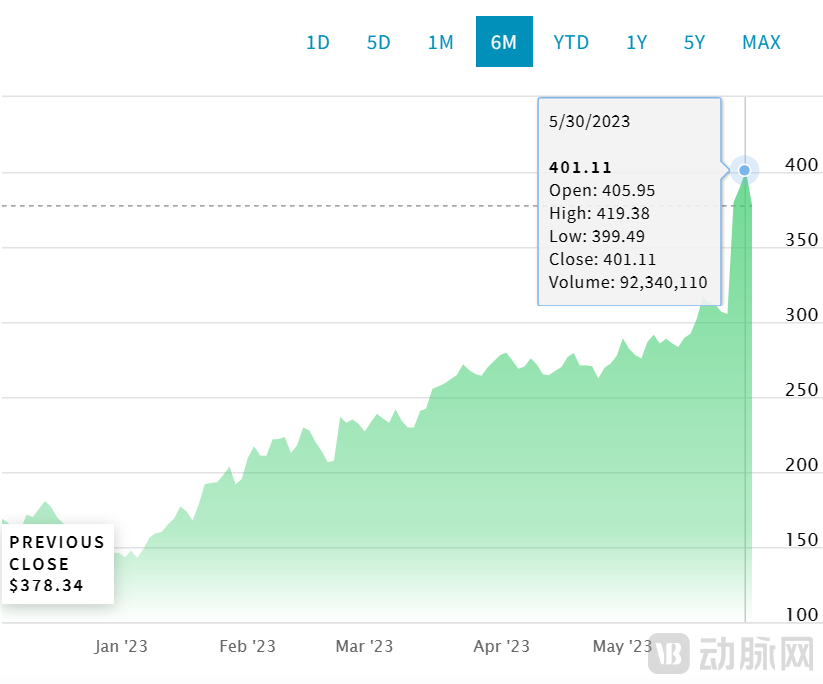
Generative AI Concept Propels NVIDIA’s Market Cap Past $1 Trillion (Screenshot from Nasdaq Official Website)
To date, only eight companies worldwide have ever achieved a market capitalization exceeding $1 trillion. Currently, the only companies with higher market caps than NVIDIA are Apple, Alphabet, Microsoft, and Amazon.
Coincidentally, Microsoft, which has recently witnessed another surge in its stock price, is similarly underpinned by generative AI—its investment in OpenAI has become the key catalyst for igniting the generative AI boom, particularly through ChatGPT.
Recognizing the breakthrough significance of generative AI, the global healthcare industry has rapidly begun integrating this technology into medical practice with unprecedented speed and enthusiasm, yielding initial results. VCBeat has compiled a collection of cutting-edge cases showcasing the current applications of generative AI in healthcare worldwide for reference.
The biggest news in the exploration of generative AI in the healthcare sector is undoubtedly the partnership between Epic Systems and Microsoft.As a global leader in healthcare information technology, Epic Systems firmly holds its position as the market leader in the U.S. electronic medical record (EMR) sector. It is the preferred choice for large healthcare institutions, and the gap between Epic and its competitors continues to widen. According to a KLAS research report, Epic lost only one of the 85 public tenders it participated in during 2022.
At the HIMSS23 conference in April, Epic announced a partnership with Microsoft to integrate AIGC into its EHR system. Healthcare organizations using Epic’s EHR system will be able to leverage generative AI capabilities through Microsoft Azure cloud services in the future. Since the release of the GPT-4 model, Microsoft has rapidly integrated GPT-4-based services into its Azure cloud solutions.
This also marks Epic’s first foray into generative AI. Currently, Epic has launched two generative AI-based solutions. One integrates generative AI into its In Basket messaging system, automatically drafting responses to some of the most common and time-consuming patient messages. Of course, it does not replace clinical judgment; physicians can either accept the suggested drafts or reject them and write their own responses.
Currently, Epic has launched a limited-scale beta test for this feature, with healthcare institutions such as UC San Diego Health, University of Wisconsin Health, and Stanford Health Care already onboarded for testing. Epic stated that the beta testing scope will be further expanded, and if the tests proceed smoothly, the feature is expected to be officially released within a few months.
The second approach involves integrating generative AI with Epic’s Slicer Dicer data visualization tool. Previously, users faced a high barrier to entry when customizing specific data searches in this tool, as it required a deep understanding of the underlying data. Generative AI can now automatically recommend different metrics based on user input. According to reports, this feature is still under development and is expected to be released later this year.
In fact, Microsoft not only provides services to other enterprises but also strongly drives the adoption of OpenAI’s services by integrating generative AI into its own products. In March, less than a week after the release of GPT-4,Nuance, a Microsoft subsidiary, announced that it will integrate GPT-4 capabilities into its Dragon Ambient eXperience Express product.。
Nuance was once a leader in the voice AI sector, not only as the developer of Apple’s Siri speech engine but also by commanding over 60% of the global intelligent voice market share. Facing challenges from tech giants, Nuance shifted its strategic focus to the healthcare industry and, through years of dedicated development, established significant competitive barriers.
In April 2021, Microsoft acquired Nuance for $19.7 billion. This transaction marked the third-largest acquisition in Microsoft’s history, significantly strengthening its influence in the healthcare vertical.
Nuance’s products primarily provide physicians with speech recognition and transcription services. Its voice AI intelligently recognizes doctor-patient conversations, performs contextual analysis, and then inputs the data into electronic health records to automatically generate clinical documentation, thereby improving the efficiency of physician diagnoses.
The integration of GPT models will significantly accelerate the generation of clinical documentation. Typically, DAX without the GPT-4 model takes approximately four hours to generate clinical notes. Leveraging GPT-4’s powerful generative large language model and reasoning capabilities, DAX Express reduces this process to mere seconds.
This significantly enhances physicians' user experience, reduces their administrative burden, enables real-time clinical documentation, and improves efficiency.
Google, which once led the way in deep learning, has yet to launch a viable service in generative AI + healthcare, lagging half a step behind Microsoft. However,Google also announced in mid-April that it would test its medical-specific large language model, Med-PaLM 2, among a limited user group.。
Over the past few years, Google has been conducting research on large language models for medicine and released the first-generation Med-PaLM to address the professionalism and specificity required in the healthcare sector. The Med-PaLM model has achieved remarkable results. It is the first AI to attain a “passing score” (>60%) on U.S. medical licensing examination questions, not only accurately answering multiple-choice and open-ended questions but also providing rationales for its answers and evaluating its own responses.
Med-PaLM 2 demonstrates even more advanced capabilities. In medical licensing examinations, Med-PaLM 2 has achieved performance nearly on par with that of expert physicians, attaining a score of 85%. It is also the first artificial intelligence system to achieve a passing score on the MedMCQA dataset, which includes questions from India’s AIIMS and NEET medical entrance examinations, with a score of 72.3%.
Even so, even the most die-hard Google fans have to admit that Microsoft has indeed gained a half-step lead in generative AI + healthcare. However, in this marathon, it remains to be seen who will emerge victorious in the end.
NVIDIA, as a core provider of AI computing power, has reaped substantial profits from the surge in generative AI. Over the years, NVIDIA has continuously refined its technology and product portfolio in high-performance computing and data centers. It now offers a comprehensive suite of AI acceleration solutions, commanding 95% of the machine learning GPU market and serving as virtually the sole choice for large AI models.
The proportion of revenue from its data center business in its total income has been rising repeatedly. According to its first-quarter financial report, the data center business generated $4.28 billion in revenue, accounting for nearly 60% of the company's total income; it increased by 14% year-on-year and 18% quarter-on-quarter, showing quite rapid growth.
NVIDIA has long been strategically positioned at the intersection of generative AI and healthcare.In 2022, NVIDIA partnered with King’s College London to use the Cambridge-1 supercomputer to create a dataset comprising 100,000 synthetic brain images, thereby training AI applications to accelerate the understanding of dementia, Parkinson’s disease, and other neurological disorders.Its generation logic shares similarities with text processing: real-world data is broken down into constituent elements, which are then recombined by AI algorithms following specific logical rules, thereby addressing the issue of data scarcity.
This is not NVIDIA’s only case involving synthetic data,UF Health, the academic health center of the University of Florida, has also partnered with NVIDIA to develop SynGatorTron, a generative AI model for generating synthetic clinical data.. It is trained on a decade of data from over 20,000 patients and can synthesize patient profiles for researchers to use in training other AI models in the healthcare sector.
Furthermore,NVIDIA has also partnered with companies such as Alchemab Therapeutics, InstaDeep, Peptone, and Relation Therapeutics to provide generative AI support for their new drug development.。
According to research, the global generative AI market is experiencing rapid growth. The market size was approximately $900 million in 2022, is projected to reach $1.8 billion in 2023, and could surge to $12.1 billion by 2027, representing a compound annual growth rate (CAGR) of 60%. In the healthcare sector, its applications will span drug discovery and development, medical imaging and diagnostics, personalized medical interventions, and the automation of hospital and clinical decision support systems.
Financing in the generative AI + healthcare sector has also been quite frequent. In just the latter half of May, Hyro, a company whose core business is conversational bots, secured $20 million in Series B funding, while Hippocratic AI, which develops generative AI models specifically for healthcare, raised $50 million in seed funding.
A large number of healthcare startups related to generative AI have also sprung up like mushrooms after rain, embarking on their own “legendary journeys.”
Abridge, founded in 2018, is one of Nuance’s competitors and has also begun integrating generative AI.. By leveraging generative AI, Abridge’s platform can extract conversation summaries from patient visit recordings and generate reports. According to reports, after adopting generative AI, physicians spend an average of more than two hours less per day on report summarization.
Competing with giants like Nuance is certainly not easy, but Abridge has its own unique advantages—its product has already been deployed at scale within the University of Kansas Health System. Reportedly, more than 2,000 healthcare providers in the Kansas City area are using the product, which is considered one of the largest-scale applications of generative AI in healthcare systems to date.
Currently, Abridge is integrating its products into electronic health record (EHR) systems such as Epic and Cerner. Once the integration is complete, it will provide healthcare organizations with an optional alternative.
The digital platform Doximity has also launched a GPT-based beta feature for physicians, leveraging the capabilities of generative AI to streamline time-consuming administrative tasks, such as drafting and faxing prior authorization and appeal letters to insurance companies.。
Syntegra, founded in 2019, has been dedicated to leveraging generative AI for synthetic data generation since its inception, making it one of the earliest companies to adopt generative AI for this purpose.Generative AI can produce large volumes of synthetic data for data augmentation in model training. This will benefit R&D professionals in addressing scenarios with data scarcity, such as rare diseases or disease areas with uneven data distribution.
Syntegra is collaborating with Janssen Pharmaceuticals, a subsidiary of Johnson & Johnson, to conduct testing. As Syntegra’s synthetic data is not subject to the same GDPR restrictions as real patient data, the Belgium-based company enjoys greater flexibility in leveraging synthetic data.
It is widely believed in the industry that generative AI has been first applied to assisted document generation and synthetic data because these applications have a relatively smaller direct impact on patients and entail lower risks. In contrast, its use for diagnostic purposes would involve significantly higher risks.
This is not difficult to understand: the accuracy of generative AI in diagnosis is closely tied to its training data, which can make it hard to distinguish between true and false outputs. ChatGPT can confidently generate plausible-sounding but incorrect information, and Midjourney can produce images that are indistinguishable from reality. Such ambiguity is absolutely unacceptable in the serious field of healthcare.
OpenAI, a representative of generative AI, has specifically pointed out that the outputs of its large language model-based ChatGPT may be inaccurate, untruthful, and sometimes misleading; furthermore, ChatGPT may occasionally generate harmful instructions or biased content.
In earlier reports, GPT-4 achieved strong results on the U.S. SAT and the bar examination. According to a study published in JAMA, GPT models were also able to provide generally appropriate responses to questions regarding cardiovascular disease prevention. However, this performance is not consistent; a recent study published in The American Journal of Gastroenterology found that both GPT-3 and GPT-4 failed to pass the American College of Gastroenterology’s self-assessment tests in 2021 and 2022.
To pass this test, individuals must achieve a score of 70% or higher. GPT-3 scored 65.1%, while GPT-4 scored 62.4%. Researchers attribute the models’ failing grades to their training data’s exclusion of paywalled medical journals, resulting in knowledge that is relatively outdated and limited.
Nevertheless, it is undeniable that generative AI can assist physicians in answering clinical questions by accessing vast amounts of medical literature and data. Therefore, how to maximize its strengths while mitigating its weaknesses will be a focal point of attention in the future application of generative AI. Targeted optimization of models is undoubtedly the most critical step. Google’s Med-PaLM, designed for healthcare, is an adaptation of the general-purpose large language model PaLM, fine-tuned for the medical domain to provide more accurate and safer responses to medical inquiries.
The renowned digital health company Babylon has built its core competitiveness around its well-known digital-first “pyramid” model. The base of this pyramid is anchored by a mobile app that enables users to self-manage their health. At this level, users can address the majority of their needs, including symptom checking, tracking their health status, managing prescriptions, and accessing clinically relevant guidance, among other services.
This tier is critical for Babylon. Through assessments via digital tools, Babylon helps members understand their current health metrics and trends; most importantly, it enables risk stratification of the served population. Subsequently, Babylon can provide proactive intervention alerts or establish health goals for members to maintain their well-being and prevent deterioration of their health status.
In an interview,Babylon Introduces Deployment of Proprietary Generative AI Models on Its Technology Platform, to support members and healthcare professionals in providing telehealth consultations, thereby gaining a better understanding of the evolving risk profiles of members/patients on our platform, ensuring that clinical teams can prioritize those members with the greatest needs.
On the other hand, Babylon has also developed generative AI models optimized for telemedicine consultations., to automatically summarize patient-clinician consultations in near real-time, thereby reducing clinicians' administrative burden and enabling more targeted patient consultations.
Babylon also revealed that it is developing solutions to provide its clinical teams with predictive insights and care recommendations through generative AI in a conversational format, thereby supporting the delivery of the highest quality care to patients.
What’s even more intriguing is that generative AI is bringing scenes from science fiction movies into real life.
Ten years ago, there was a science fiction film titled *Her*. The movie portrays a sensitive letter writer in the near future who engages in conversations with an AI to cope with the depression following his divorce, only to fall hopelessly in love with the AI, voiced by Scarlett Johansson.
DiagnaMed has just launched PalGPT.ai, which almost perfectly replicates this scenario—this generative AI, powered by GPT models, aims to provide users with a simulated AI companion., designed to facilitate natural, human-like conversations via text messaging, providing meaningful private dialogue, friendly advice, and a space for sharing inner thoughts, thereby improving users' brain health.
PalGPT.ai is built on DiagnaMed’s proprietary CERVAI generative AI platform. DiagnaMed plans to develop multiple generative AI solutions for specialized fields based on this platform, with PalGPT.ai being its second commercialized product. Once users register for the service, PalGPT.ai will deliver personalized information based on their prior interactions, gradually evolving into a private space where users can share their thoughts, emotions, beliefs, experiences, memories, and dreams.
According to Accenture’s report, 98% of healthcare providers and 89% of healthcare payer executives believe that advancements in generative AI are ushering in a new era of enterprise intelligence. Half of healthcare organizations plan to use generative AI for learning purposes, while more than half intend to launch pilot projects this year. Surveys indicate that approximately 40% of working hours in the healthcare sector can be empowered by generative AI on average.
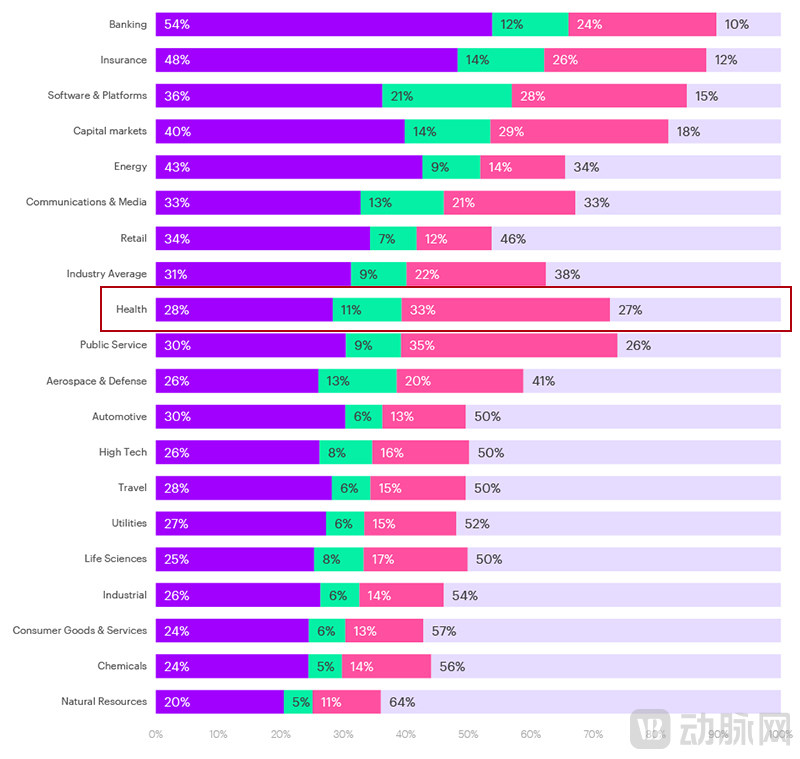
Generative AI will bring about profound transformation across industries (source: Accenture report; the red box indicates the healthcare sector, purple represents high potential for automation, green signifies high potential for augmentation, and magenta denotes moderate potential for both automation and augmentation)
For instance, generative AI can create value by boosting workforce efficiency, quality, and performance—reducing the time clinicians spend on documentation and allowing them to devote more time to patient care. Looking ahead, we will continue to monitor advancements in generative AI within the healthcare sector. How it will further transform healthcare is an exciting prospect for all of us growing alongside this new era.
References:
Belle Lin, the Wall Street Journal: Generative AI Makes Headway in Healthcare
Bill Siwicki, Healthcareitnews.com: A primer on generative AI – and what it could mean for healthcare
Paul Daugherty, Bhaskar Ghosh, Karthik Narain, Lan Guan, Jim Wilson, Accenture: A new era of generative AI for everyone
Jessica Hagen, mobihealthnews.com: Study: ChatGPT fails to pass American College of Gastroenterology tests
Heather Landi, fiercehealthcare.com: startups test out generative AI in healthcare