

RedDress Secures $26M Series D Funding to Advance Autologous Blood Clot Therapy for Chronic Wounds

RedDress
Wound Management Solution Provider
Ulceration and foul odor of the feet, if not intervened in time, will likely lead to amputation. This is the dilemma faced by every patient with diabetic foot.
However, in addition to diabetes, burns, motor vehicle accidents, and prolonged bed rest can also lead to severe skin wound complications. According to data from Annals of Epidemiology, the incidence of chronic wounds in the general population is approximately 2.21 per 1,000; in developed countries, this figure rises to 1–2%. Although not receiving as much attention as heart disease and cancer, chronic wounds silently affect tens of thousands of patients.
High incidence rates lead to significant harm. Chronic wounds that fail to heal over months or even years not only severely impair patients’ quality of life, but their prolonged treatment courses also impose substantial caregiving burdens and financial strain on families. While managing the underlying condition is paramount, in addition to standard debridement procedures, high-quality wound care products are key to the treatment of chronic wounds.
RedDress, headquartered in Tel Aviv, Israel, has also entered the wound care market with a product derived from patients’ autologous blood. On May 24, 2023, RedDress announced the completion of a $26 million Series D financing round led by ATHOS Biopharma GmbH and other life sciences investors. This brings RedDress’s total funding to $43 million. The company stated that the proceeds will be used to support the adoption of its wound care products, establish global partnerships, and expand its proprietary blood-based technology to treat additional indications.
After falling off a bicycle and getting injured, what else would you do besides feeling the pain? For Igal Kushnir, founder of RedDress, it was another new startup idea.
In 2009, Igal accidentally injured himself in a cycling accident. As he got up, Igal began to reflect: while his own wounds could heal naturally through the body’s repair processes, this was not the case for patients with diabetes or elderly individuals with poor circulation. “They suffer greatly; chronic wounds are often difficult to heal and may ultimately lead to amputation,” said Igal.
Following the accident, Igal co-founded RedDress with his son, Alon Kushnir, firmly believing that they could bring about a transformation in chronic wound care. However, Igal, who holds an M.D. from Tel Aviv University and has previously founded two medical device companies, knew that developing a new product from scratch would take considerable time.
Igal stated that, under normal circumstances, when the human body is injured, a blood clot composed of red blood cells, platelets, and fibrinogen forms at the wound surface. This clot signals the body about the injury to prevent further blood loss. Additionally, the body has a reminder mechanism that sends signals to initiate subcutaneous tissue repair upon injury. However, this reminder mechanism is triggered only at the time of injury and does not provide signaling during the wound healing process.
Thus, Igal had a bold idea: If patient blood were drawn and prepared into a blood clot in vitro, and then applied to an open wound, would the blood clot trigger a “reminder mechanism” that ultimately accelerates wound healing? If a blood clot were applied weekly to a chronic wound, would the body perceive it as a new wound each week, thereby re-“awakening” the repair mechanism?
During the first two years after the company’s founding, Alon and Igal drew blood from themselves and their friends, conducting experiments in their kitchen to validate the concept. They prepared hundreds of blood clots in soufflé bowls until they were satisfied with the clotting time, clot strength, shape, and color.
To coagulate blood and form a uniform clot, Igal added calcium gluconate and kaolin to the blood. They even hung the blood clot on a clothesline for a week to check whether it would develop an odor. Alon also tied a blood clot to his leg for three days to observe whether it caused any harm to the human body.
After several years of research and development and testing, RedDress commenced laboratory studies. Upon achieving ideal results in animal experiments, RedDress obtained approval for clinical trials. Following a lengthy journey from initial concept exploration and preliminary investigations to animal studies and clinical trials, RedDress’s first product was finally approved for market launch in the United States. In fact, a full 11 years had passed since Igal’s bicycle trip.
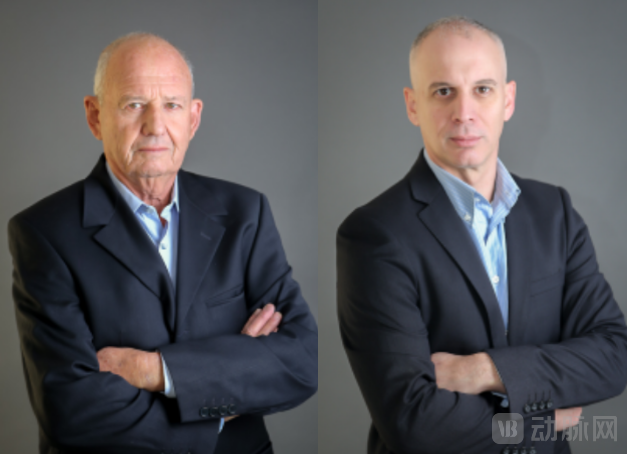
Igal Kushnir and Alon Kushnir | Image source: RedDress official website
“Many companies produce blood-derived products to aid wound healing. Some use fibrin from blood to make wound adhesives; another Israeli company, MacroCure, extracts macrophages from blood and injects them into wounds. But no one uses blood ‘as is.’ Moreover, our treatment can be administered even without water or electricity,” said Alon.
RedDress’s flagship product, the ActiGraft kit, includes a blood collection device, a clotting mold, calcium gluconate solution, an extraction loop, syringes, and gauze. After debridement and dressing change for the patient, healthcare professionals draw two tubes of venous blood from the patient and then mix the patient’s blood with the calcium gluconate solution provided in the care kit within the syringe. Next, they inject the blood mixture from the syringe into the clotting mold. Healthcare professionals apply a circular sterile “bandage” over the needle puncture sites to prevent leakage, and by shaking and rotating the clotting mold, they mix the blood with the medical-grade kaolin powder contained within the mold. After approximately ten minutes, once the blood clot has fully coagulated, the clot gel—with a layer of gauze attached to its back—can be removed.
Once the ActiGraft blood clot has been prepared, healthcare professionals can place it on the patient’s wound and secure it with medical tape. Finally, they apply the primary non-adherent dressing from the care kit over the blood clot, followed by a secondary absorbable foam dressing on top. At this point, the application of Topical Autologous Blood Clot Therapy (TABCT) using the ActiGraft care kit is essentially complete.
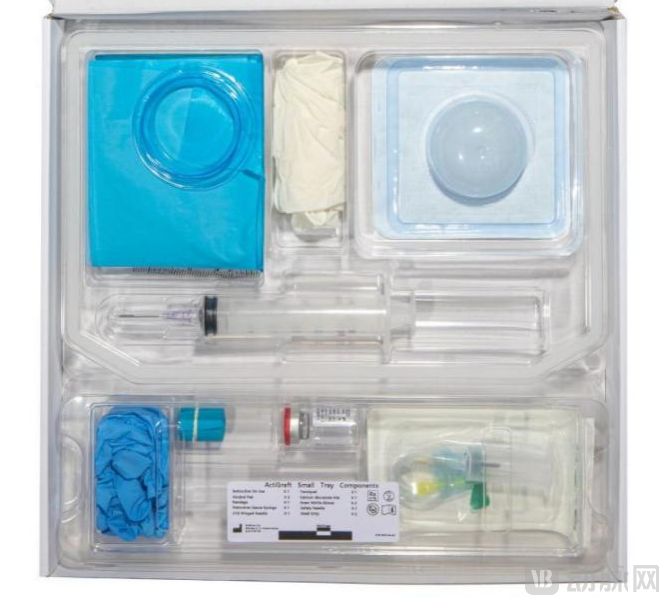
ActiGraft Care Kit Image source: RedDress official website
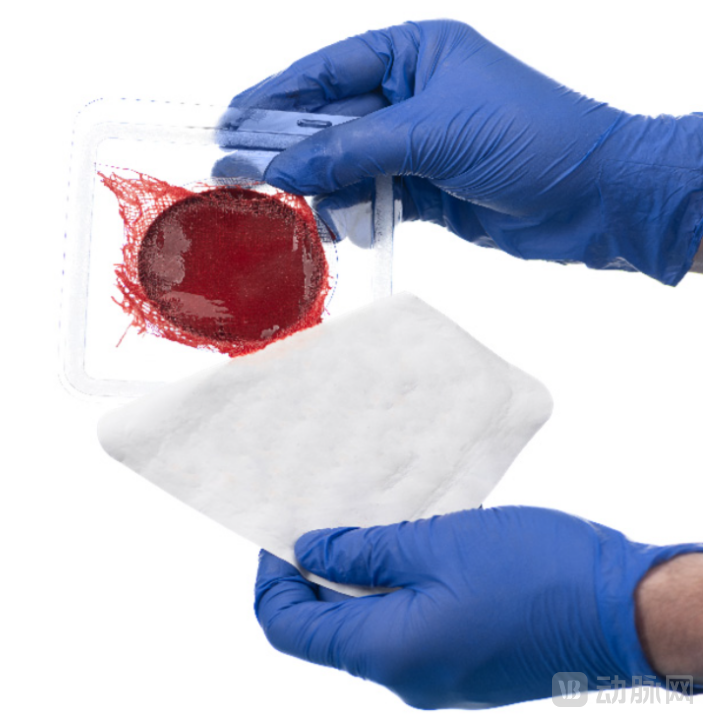
ActiGraft-Prepared Blood Clot Image Source: RedDress Official Website
In terms of efficacy, RedDress stated that ActiGraft can serve as a physical barrier for wounds, preventing bacteria from the surrounding skin and external environment from entering the wound site. Moreover, TABCT is also a treatment option for patients with irregular wound beds. Because the whole blood clot has certain fluidity and can cover the entire wound bed, growth factors associated with wound healing can be delivered more effectively.
In addition, while TABCT is suitable for use on wounds after debridement, it remains a viable treatment option for patients who are not candidates for surgical debridement. This is because TABCT maintains a moist wound environment that facilitates autolytic debridement by the body. For full-thickness wounds with exposed tendons and bone, TABCT not only serves as a barrier and maintains moisture in the microenvironment but also promotes the transition of the wound from a pro-inflammatory to an anti-inflammatory state, thereby preventing desiccation and necrosis of the exposed tissues.
In terms of application scenarios, except for wounds associated with malignant tumors and those clinically diagnosed as having active infections, the ActiGraft Care Kit has a broad range of indications. Indications for ActiGraft include, but are not limited to, refractory chronic wounds such as diabetic foot ulcers, pressure ulcers, venous leg ulcers, surgically debrided wounds, and traumatic wounds.
RedDress stated that ActiGraft is the only wound biologic approved in the United States for bedside use in homes or nursing facilities. This is because other products require “special handling,” such as freezing at -60°C and subsequent thawing. Furthermore, although studies have demonstrated that certain platelet-rich plasma (PRP) products can promote the healing of chronic wounds, PRP products typically require technicians to use centrifuges to separate plasma prior to use, thereby precluding their widespread adoption in home-care settings.
In terms of costRedDress stated that the cost per use of ActiGraft is $300 in the United States and 800 Israeli shekels (approximately $235) in Israel, whereas competing products cost between $700 and $2,500 per use. RedDress also indicated that using ActiGraft for wound care could help patients save approximately 40% on wound care expenses. Additionally, ActiGraft is covered by the U.S. government’s Medicare program.
To validate the safety and efficacy of ActiGraft for chronic wounds, RedDress first initiated a preclinical animal study. The experimental pigs were divided into an experimental group and a control group. For full-thickness skin wounds on their bodies, they received ActiGraft treatment every six days and saline debridement, respectively. The experimental results showed that after 18 days of treatment, the percentage reduction in wound area was significantly higher in the experimental group (66%) than in the control group (41%), and researchers observed more epidermal cell regeneration in the experimental group.
With robust animal experimental data, RedDress proceeded to conduct two prospective clinical studies. Study 1 enrolled seven patients with chronic wounds, and the results showed that 77% of the patients achieved complete wound healing, with no blood-draw-related adverse events observed in any of the participants.
Study 2 was conducted at three wound care clinics in the United States. In addition to receiving standard wound care procedures, 20 patients with diabetic foot ulcers received ActiGraft treatment weekly. Researchers analyzed the experimental data using both Intention-To-Treat (ITT) analysis and Per-Protocol (PP) analysis. The results showed that the wound healing rates were 65% in the ITT population and 72% in the PP population. The percentage reductions in wound area at 4 weeks and 12 weeks were 61.3% and 66.6%, respectively, in the ITT population, and 60.0% and 76.1%, respectively, in the PP population. Additionally, two patients experienced serious adverse events, which were not related to the device or the study wounds.
In the fall of 2020, ActiGraft received FDA approval for market launch in the United States. Two years later, RedDress introduced the next-generation wound care kit, ActiGraft+. ActiGraft+ is an enhancement of the original technology, designed to shorten clotting time and generate higher-quality topical blood clots.
To date,ActiGraft has been approved for market launch in over 40 countries/regions worldwide.. In November 2022, the first ActiGraft wound therapy procedure in China was performed at Ruijin Hainan Hospital. A 60-year-old patient underwent debridement and ActiGraft treatment for a chronic wound on the right lower leg.
With the rising incidence of chronic diseases such as diabetes and the increasing volume of surgical procedures, the wound care market has been expanding year by year. A report by Research Nester predicts that the global chronic wound care market will reach $20 billion by the end of 2033, growing at a compound annual growth rate (CAGR) of 10% from 2023 to 2033.
In terms of product categories, wound care products are broadly classified into wound dressings, wound care devices, and other products. Regarding wound types, pressure ulcers, diabetic foot ulcers, and lower extremity venous ulcers account for the majority. In terms of regional market distribution, Research Nester indicates that North America will become the largest market for chronic wounds by 2033, while the Asia-Pacific market is expected to witness the highest growth rate in the coming years.
As for companies in this field, Smith & Nephew, Mölnlycke Health Care AB, ConvaTec, 3M, Integra LifeSciences, and Acelity L.P. have become international leaders in the chronic wound care industry. In contrast, although the number of patients with chronic wounds in China is on the rise, domestic related nursing products are still in the early stages of development, and the market is currently dominated by foreign brands. In terms of functional dressings, most enterprises engaged in the export of medical dressing products are small in scale, with low industry concentration, and their products still lag behind international companies in terms of innovation and technical level.
Against this backdrop, companies such as Allmed Medical, Zhejiang Yiding, and UTE Medical are also intensifying their investments in this sector. If these enterprises can seize the opportunities presented by consumption upgrades and the accelerated substitution of domestic products for imports, they may well reshape the landscape of the chronic wound care market in the future.