

Lingdang Cloud Files IPO Prospectus, Targeting Digital Child Healthcare Solutions for Grassroots Hospitals
Let us first examine a set of data—
In 2022, the number of live births totaled 9.56 million, a decrease of 1.06 million from 2021; the number of deaths reached 10.41 million, an increase of 270,000 from 2021. By the end of the year, China’s total population stood at 1.41175 billion, representing a decline of 850,000 compared to the end of 2021.
The Director of the Department of Population and Employment Statistics of the National Bureau of Statistics pointed out, “The slight decline in China’s total population in 2022 was mainly due to a decrease in the number of births. First, the number of women of childbearing age continued to decline. In 2022, the number of women of childbearing age (15–49 years) in China decreased by more than 4 million compared with 2021, among which the number of women in the peak childbearing age group (21–35 years) decreased by nearly 5 million. Second, the fertility level continued to decline. Influenced by multiple factors, including changes in fertility concepts and delays in marriage and childbearing, the fertility level of women of childbearing age in China continued to decline in 2022.”
Primary hospitals may have felt the impact of the decline in newborn births earlier than tertiary Grade A hospitals.
As the decline in newborn numbers becomes an inevitable trend, a cohort of primary-care hospitals has begun to implement “self-rescue” measures: for instance, splitting obstetrics and gynecology departments and redirecting physicians from combined obstetrics-gynecology units to gynecology-only practices; and devoting greater resources to health management services, such as aggressively expanding maternal and child healthcare programs.
The shift in services provided by primary healthcare institutions has also given rise to a new market: the medical informatics market related to child health care and maternal and child health care.
Lingdang Cloud, which is optimistic about the market prospects of the “child health care” sector, also chose to enter this field in 2020.
On one hand, there is a massive demand for medical informatization in child healthcare among primary care institutions; on the other, the field of child healthcare informatization is rife with pain points.
Xu Kaibing, founder of Lingdang Cloud, analyzed and pointed out that the pain points in the field of child healthcare are nothing more than the following:
First, medical informatics in the field of child healthcare is characterized by a low level of digitalization and fragmented systems. Even in 2020, when Lingdang Cloud considered entering the “child healthcare” market, some primary care hospitals’ child healthcare departments still relied on manual or semi-manual data entry methods, such as paper-based records, resulting in high statistical error rates and low efficiency. Furthermore, with the growing demand for child healthcare services, fragmented systems have caused numerous problems. For instance, the lack of data sharing and interoperability between clinical diagnosis/treatment information and child healthcare information has led to redundant data entry, consuming significant time and energy of primary healthcare workers.
Second, medical informatization in the field of child healthcare struggles to meet the department’s growing operational demands. On one hand, some child healthcare information systems face operational challenges such as severe congestion during peak periods for school-entry physical examinations and insufficient traffic during off-peak times. On the other hand, mere data collection fails to establish a decision-making closed loop based on data analytics for hospital departments related to child healthcare. Furthermore, certain primary healthcare institutions lack online service components, preventing effective coverage of the broader user population. Numerous pain points remain for hospital child healthcare departments seeking to achieve efficient operations.
The vast market demand and the outdated state of current pediatric healthcare information systems have undoubtedly presented Xu Kaibing with an opportunity.But opportunities do not arise out of thin air; they are often reserved for those who are prepared. Lingdang Cloud’s timely entry into this sector was also underpinned by its readiness: the team itself carries the DNA of “healthcare informatization”—
In 2004, Xu Kaibing entered the internet industry. In 2011, leveraging his accumulated resources, he founded Kunming Chuanhai Technology Co., Ltd., specializing in internet software development services for government and enterprise clients. In 2014, the company officially embarked on a strategic transformation by entering the field of healthcare informatization. Initially, it focused on hospital portal websites and smart hospital office automation (OA) systems; later, it gradually launched hospital HIS (Hospital Information System) integration services. By 2023, the company had cumulatively served more than 300 hospitals.
Before recognizing the development opportunities in the field of medical informatics for child healthcare and conceiving the creation of “Lingdang Cloud,” the team led by Xu Kaibing already had over a decade of experience in custom software development and many years of experience in building medical informatics systems. In addition, the accumulation of resources from maternal and child health hospitals among their previous institutional partners (more than 50) provided Lingdang Cloud with an initial customer base for its pilot efforts.
Benefiting from the company’s long-term dedication to healthcare informatization, after conceiving the “Bell Cloud” in 2020, the first version of “Bell Cloud” was officially launched in 2021.Currently, Lingdang Cloud, invested in by Chuanhai Digital Health Group (Chuanhai Technology Co., Ltd.) and operated by Yunnan Zanlang Technology Co., Ltd., has been deployed in more than 20 hospitals, covering a population of over 100,000 pregnant women and more than 50,000 children...
“Traditional information systems tend to focus more on internal hospital management, with less consideration given to patient-centered service delivery. In developing our digital solution for child healthcare, we have built a closed-loop service model centered on ‘patient-focused care,’” added Xu Kaibing. “Especially in the process of health management, users often lack self-discipline. Guided by the concept that ‘health requires reminders,’ we have also created a corresponding health management platform for users.”
Guided by this same logic, Lingdang Cloud does not merely limit its pediatric healthcare digitalization solutions to providing an in-hospital pediatric health management system; its product portfolio also encompasses a preterm infant management platform, appointment registration systems, maternal and child health service platforms, and new media marketing solutions for the maternal and child sector.
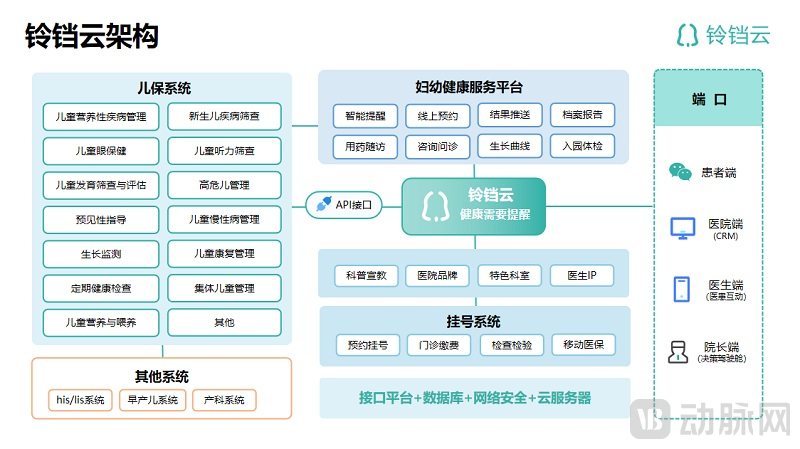
We may understand Lingdang Cloud’s approach to providing solutions from two dimensions: addressing the existing demand for medical services and expanding the incremental demand for medical services.
In addressing the backlog of existing healthcare demands, Lingdang Cloud provides hospitals with services such as an informatization system for child health care, a management platform for premature infants, and appointment registration systems.
The child health care system product is designed to address the lack of management tools for pediatric healthcare departments in primary medical institutions. By adopting this system, primary medical institutions can centralize, standardize, and digitize information on populations (healthy individuals/patients), thereby accumulating more valuable data assets for hospitals. Supported by medical record templates and standardized scales, the system significantly enhances physicians' work efficiency. Furthermore, multi-dimensional population data analysis helps unlock greater value from the data.
The development of the Preterm Infant Management Platform can be regarded as a practical implementation of Lingdang Cloud’s “patient-centered” philosophy. According to WHO statistics, more than 15 million preterm infants are born worldwide each year, while the preterm birth rate in China is approximately 10%. Taking into account the actual needs of primary healthcare institutions, Lingdang Cloud has separated preterm infant management from the child health care system to create an independent Preterm Infant Management Platform. The hospital-side interface enables the creation of personal health records for preterm infants, facilitating follow-up documentation and case-specific management; the user-side interface allows patients or caregivers to access the latest follow-up reminders and consultation records at any time.
In terms of expanding incremental healthcare demand, Lingdang Cloud provides maternal and child new media marketing services to help hospitals reach users, as well as a maternal and child health service platform that undertakes health services and facilitates subsequent healthcare navigation.
When seeking medical consultations, the general public tends to favor well-known public hospitals. Lingdang Cloud empowers primary healthcare institutions by providing new media tools, creating differentiated video content tailored to departmental specialties and physicians’ professional personas to drive incremental reach. Furthermore, it leverages data analytics to enhance the precision of video content delivery. Ultimately, by offering a platform for health education and interactive consultations, Lingdang Cloud helps promote hospital brand value and enables targeted marketing toward maternal and child health populations.
Aggregating the target population on a maternal and child health service platform inherently meets hospitals’ need for business growth. Amidst declining birth rates, health management and disease prevention services hold greater development potential, prompting hospitals to actively explore and expand into these areas. This approach enables hospitals not only to better manage their existing patient base but also to address the health management needs of new users acquired through precision marketing, while facilitating precise referral and admission when these individuals require clinical care.
Amid declining birth rates and widespread pessimism about the development of obstetrics, gynecology, and pediatrics, Xu Kaibing remains more optimistic.
In a recent interview with China Entrepreneur Magazine, Liang Jianzhang stated, “The relationship between women’s status and fertility rates is not a simple linear one. In traditional societies with lower levels of development, women held relatively low status and were compelled to bear many children. As society and the economy developed, women’s status and labor force participation gradually increased, while fertility rates declined. However, this decline is not unidirectional. When society further advances and women attain very high status and economic independence, introducing additional childbirth benefits can lead to an increase, rather than a decrease, in fertility rates. Of course, achieving this requires a significant reallocation of social resources.”
Xu Kaibing holds a similar view.He believes that the current decline in fertility rates is only temporary. Furthermore, he noted that the child healthcare department represents a market distinct from general pediatrics—
On the one hand, the market size of medical informatization in the field of child healthcare continues to expand, with growing demand for standardized and regulated information systems. On the other hand, amid the current trend of declining birth rates, parents are placing greater emphasis on their children’s health, leading to increased health-related investments driven by the rise of meticulous parenting. Furthermore, the implementation of policies such as the “Healthy Children Action Enhancement Plan” and the “Outline for the Development of Chinese Children” is further promoting industry growth. More importantly, perhaps, is the ongoing transformation of China’s healthcare system, where the national focus is shifting from disease-centered treatment to health management-centered care.
“Given these factors, the field of child healthcare has significant room for future growth,” Xu Kaibing added. “Lingdang Cloud is also planning to raise funds, aiming to further accelerate market expansion and product iteration, deepen its presence in the child healthcare sector, and expand into new digital solutions.”