

Why Only a Few Succeed in Replicating Silicon Valley: Global Models of Innovation Hubs
From Silicon Valley in the United States to Tsukuba Science City in Japan, science cities have become a winning strategy for regions and even nations to secure their future by incubating frontier industries and leading mainstream trends in development.
In recent years, cities across China have been intensively laying out plans for science cities. Whether it is Guangming Science City or Zhangjiang Science City, they both resemble self-sufficient research-oriented urban hubs, fromScientific Research, Talent, Industry, Capital, Space, Transportation...and other aspects, providing supporting guarantees for settled enterprises and innovative talents, enabling researchers to “take root” in the city and truly retain talent.
The competition for innovation is, at its core, a competition for talent. Currently, most cities in China are still characterized by low conversion rates of scientific research achievements and low R&D intensity, making it particularly crucial to develop science cities capable of attracting high-end scientific and technological talent.
The Science City Claiming to Be “Number One”
To date, there have been more than600 seatsScience cities, which mostly develop by integrating their own urban conditions and innovation needs, can be broadly categorized into four types: those clustered around research institutions, industry-clustered, government-organized, and organically formed.Silicon Valley Innovation Center (USA), Tsukuba Science City (Japan), Novosibirsk Akademgorodok (Russia)andScotland's High-Tech ZoneThe four major science cities are distinctive representatives.
Silicon Valley Science and Technology Innovation Center (U.S.): Research Institution Cluster
Whenever innovation hubs are mentioned, Silicon Valley is an inevitable topic.
Silicon Valley was not an innovation park planned by the government, but rather Stanford University’s initiative to alleviate its fiscal deficit."An Unintentional Act"In 1951, Stanford University decided to lease its land to establish a science park to increase revenue, coinciding with the most vibrant era of electronic industry development. As a result, among the first batch of companies to settle in Stanford Research Park wereGeneral Electric, HP...and other well-known electronics and technology companies. As tech firms developed in Silicon Valley, they attracted a cluster of innovative talent; inspired by the entrepreneurial spirit, an increasing number of high-tech companies have sprung up in Silicon Valley like mushrooms after rain.
For a time, Silicon Valley became a “promised land” for startups, drawing young entrepreneurs eager to try their luck; over time, it evolved into a science city.
Currently, Silicon Valley has already gatheredOver 1 Million Science and Technology Personnel、Over 1,000 Members of the U.S. National Academy of SciencesTreaty30% of the Global Top 100 Tech Giants’ Headquarters. World-class universities such as Stanford University, the University of San Francisco, and the University of California, Berkeley, are clustered around it, continuously supplying talent to Silicon Valley.
In addition, as Silicon Valley became a hub for startups, corresponding support services also increased. Silicon Valley boasts the nation'sApproximately 35%Venture capital firms provide financial support to innovative and entrepreneurial companies, while also leveraging professional technology intermediary services that span every stage from research and development to commercialization.
In addition to industrial services, Silicon Valley has planned a series of convenient amenities to help innovative talents better “put down roots” in the region. The urban functions of the science city are arranged in concentric circles, with social corridors formed by cafes, restaurants, bars, and other social spaces linking these various layers. Ecological green spaces account for more than 40% of the total area of the technology city. This design not only meets the daily living needs of researchers but also inadvertently fosters greater collaboration.
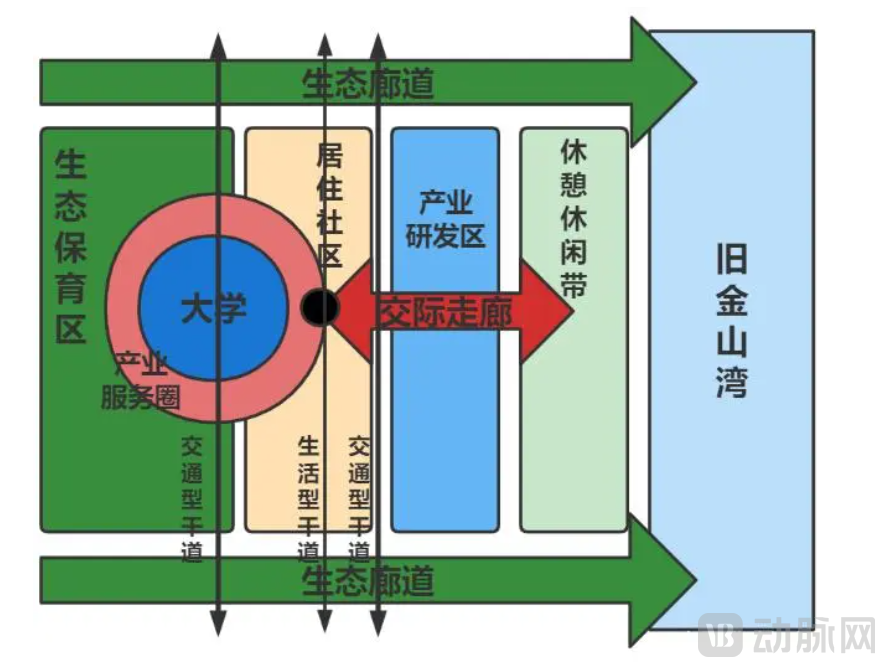
▲ Urban Functional Planning of Silicon Valley (Image source: Internet)
Scotland's High-Tech Zone: Industry Cluster Model
The United Kingdom Was Once the World's Leading Nation in InventionsWhether it was the improved steam engine that ushered in the Steam Age, or the advent of the first fax machine and telephone, these innovative products held epoch-making significance. Their emergence is inextricably linked to the Central Belt of Scotland, UK.
Central Scotland, including Glasgow, Edinburgh, Stirling, Livingston, Dundee, and other areas. It once gatheredResearch Institutions of the Royal Academy of SciencesandOver 400 High-Tech Enterprises, is the hub of the UK’s high-tech industry. Leveraging the strong scientific research foundation in Central Scotland, the Scottish Government designated in 1980 a vast area stretching 100 kilometers from Edinburgh to Glasgow as a high-tech industrial park and electronics industrial zone—now known as Scotland’s High Tech Triangle—to vigorously develop advanced technologies.
Scotland’s High Tech Zone is primarily oriented toward high-tech enterprises. It is home to more than 500 life sciences companies, 150 big data-driven firms, and nearly 100 fintech companies. The concentration of large corporations has also attracted many startups seeking growth opportunities. To support startup development, Scotland’s High Tech Zone has established the largest technology business incubator in the United Kingdom.CodeBaseAt least 90 startups have taken root here, collectively securing over $1 billion in investment to date.
Tsukuba Science City, Japan: Government-Organized Model
In 1963, under the immense pressure of Tokyo’s population and traffic congestion, and in response to the national policy of “rejuvenating the country through science and technology,” the Japanese government was compelled to consider building a science city around Tokyo to alleviate these issues, andTsukuba, located approximately 50 to 60 kilometers from Tokyo, emerged as the preferred choice.
Tsukuba Science City is composed ofDirect State Management,Model Project Directly Overseen by the Prime Minister of Japan. The Japanese government directly intervened in the entire planning and construction process of Tsukuba Science City, including site selection, workforce recruitment, and urban land acquisition.
After the site was determined, the Japanese government mandatorily relocated and concentrated some of Tokyo’s national-level research institutes and universities to Tsukuba. To date, nationwide in JapanNearly 50% of Research Institutions Are Based in Tsukuba, including 150 national-level research and educational institutions such as the University of Tsukuba, JAXA (Japan Aerospace Exploration Agency), the National Institute of Advanced Industrial Science and Technology (AIST), and the National Institutes of Biomedical Innovation, Health and Nutrition. With over 20,000 researchers residing in Tsukuba, it has become Japan’s largest hub for talent, earning Tsukuba Science City the reputation as"Japan's No. 1 Science City"。
In addition, the Japanese government attracts top-tier overseas talent to settle in and promotes innovation by hosting world expos and establishing sister-city relationships. To facilitate the lives of international talent, most urban amenities and consultation hotlines offer support in more than ten languages, including English, Chinese, Korean, Thai, Portuguese, and Spanish.
To retain talent, the Japanese government has also made meticulous efforts in urban development. Tsukuba Science City has been ranked for several consecutive years as one of Japan’s cities offering a “comfortable lifestyle” and “peace of mind in child-rearing.” It features comprehensive supporting facilities, including schools and housing, as well as 48 kilometers of pedestrian-only pathways and 146 urban parks. The government has deliberately zoned the city into research-oriented school districts and surrounding development areas to promote overall urban balance in Tsukuba and extend its positive influence to neighboring regions.
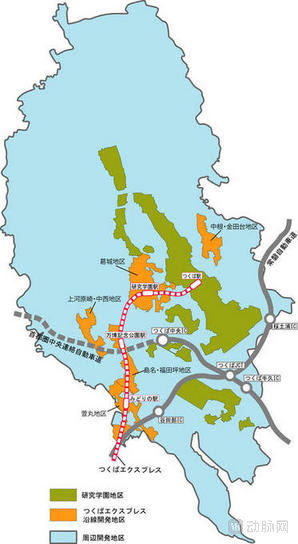
▲ Tsukuba Science City Urban Planning (Image source: Official website of Tsukuba Science City)
Novosibirsk Akademgorodok, Russia: Spontaneously Formed Type
Although Silicon Valley was the first innovation cluster, in terms of its founding nature, Russia’s Novosibirsk Akademgorodok isThe World’s First Officially Named “Science City”, and to this day, it remains the world's largest science city.
In the mid-1950s, to address imbalanced economic development, the Soviet Union decided to establish the Siberian Branch of the USSR Academy of Sciences in Siberia to vigorously promote scientific research. As the Siberian Branch of the USSR Academy of Sciences continued to expand, it established subordinate institutions in various localities.9 Research Centers, Novosibirsk Akademgorodok is among themThe Largest Research Center, bringing together more than half of the branch’s research capacity.
However, Siberia’s emergence as a hub for scientific research was no accident. Following the outbreak of the Great Patriotic War in the Soviet Union, Siberia gradually became a major rear area, and many research institutions evacuated from the central parts of the country provided opportunities for the development of science in Siberia. A large number of scholars mastering cutting-edge technologies congregated there, laying a solid talent foundation for the establishment of the Novosibirsk Akademgorodok (Science City).
In 1957, the Soviet government implemented a unified plan for the Siberian region, aiming to establish a scientific city in Siberia that would both provide research support and be livable.In less than six years, the Novosibirsk Academic Town rose from the primeval forest.
For Akademgorodok, the most critical factor is talent support. In addition to leveraging its existing talent base, Novosibirsk Akademgorodok places significant emphasis on training new talent. Novosibirsk State University has specially developed a series of specialized courses tailored for Akademgorodok’s unique talent needs, such as “Explosion Welding,” “Applied Linguistics,” and “Economic Cybernetics.” Furthermore, affiliated schools have been established, creating a long-term, continuous system for cultivating high-level specialized professionals—from primary school through university—with Novosibirsk at its core.
According to statistics, under its unique talent cultivation system, the Novosibirsk Akademgorodok had already gathered by 2006More than 320 research institutions, over 20 higher education institutions including Novosibirsk State Technical University, and more than 50,000 researchers; this figure continues to rise year by year.
Furthermore, the Novosibirsk Akademgorodok places particular emphasis on incubating startups. The science city hosts four business incubators specializing in information technology, instrument manufacturing, biotechnology and medicine, as well as nanotechnology and new materials. Startups are required to pay an annual rent of only 1,000 rubles (approximately 120 RMB), in exchange for which they receive support from the science city, including funding, office space, and technical equipment.
Supported by generous welfare policies, Novosibirsk Akademgorodok has given rise to a large number of well-known enterprises such as ABBYY, Kaspersky Lab, and Paragon Software, earning it the nickname “Russia’s Silicon Valley.”
Spiral Ascending Triangular Model
Due to differences in their locations, establishment dates, and historical backgrounds, these four science cities have distinct areas of focus and reasons for their creation.
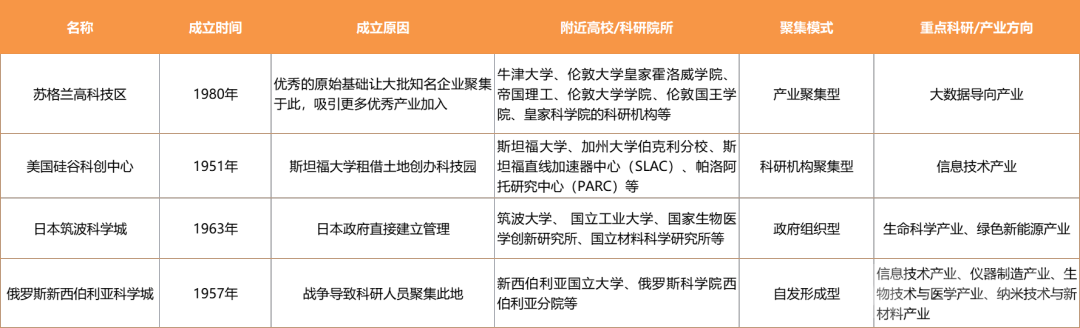
▲ Four Major SciencesCityBasic Information
Yet, coincidentally, they all share three key elements, namelyMajor scientific infrastructure, frontier industries, and leading research institutes.
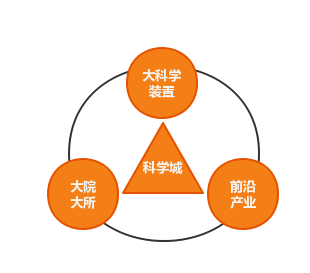
▲ Three Key Elements of a Science City
“Three Major Elements—Large-Scale Scientific Facilities, Frontier Industries, and Leading Research Institutes—are Not Isolated but Mutually Reinforcing.”From the perspective of large-scale scientific facilities,The research demands of major research institutes often determine the establishment of large-scale scientific facilities, which in turn attract high-tech enterprises to settle in, thereby further reinforcing the agglomeration of talent.
Large-scale scientific facilities refer to specific major experimental installations, such as the Center for Genomic Technologies (CGT) in Novosibirsk Akademgorodok and the High Energy Accelerator Research Organization in Tsukuba Science City, Japan. These large-scale instruments are often rare and play a decisive role in the development of high-tech industries. Typically, the site selection for deploying such advanced equipment is closely linked to local talent demands. The research focus and expertise level of prominent local research institutions determine both the sophistication of the equipment and its placement.
Large-scale scientific facilities exert a “magnetic effect” on technology-oriented enterprises. For instance, many Fortune 500 companies and industry leaders have clustered around the European Synchrotron Radiation Facility (ESRF). This is because areas near such facilities boast stronger research attributes, often yielding breakthrough achievements in cutting-edge technological fields and providing robust advanced technological support for the development of specific industries.
Moreover, the clustering of technology-driven industries will spur a new wave of R&D centers and laboratory deployments, thereby reinforcing the foundational momentum for scientific research at the corporate level. Meanwhile, technology-based enterprises also provide employment opportunities for researchers emerging from major research institutes and academies, and their connections with Science Cities help mitigate brain drain.
In general, regardless of the type or rationale behind their establishment, science cities fundamentally rely on the synergy among “industry, academia, and research.” Only by enabling innovation resources such as high-tech enterprises, universities, and research institutions toHigh-density, high-efficiency collaboration,Only then can a symbiotic and integrated innovation ecosystem be formed, further promoting the development of both the innovation industry sector and the scientific research sector.
Glimpsing the Future of Science City through Major Scientific Infrastructure
From the examples of four science cities, we can see that major scientific infrastructure, frontier industries, and leading research institutes work in concert to formSpiral Ascending Triangular Model, where improvements by either party have the potential to drive the overall industry upward.
“Stones from other hills may serve to polish the jade.” In developing local science cities, we can also draw on these experiences.
Still taking the large-scale scientific facility with the most easily changeable location as the starting point of perspective.Large-scale scientific facilities are often accompanied by the "white elephant problem," meaning they require substantial financial, material, and human resources for maintenance and take a long time to yield results. Therefore, when establishing large-scale scientific facilities in science cities, it is essential to find appropriate solutions to address the "white elephant problem."
First, major scientific infrastructure should be developed based on local industrial conditions and the actual state of scientific research.Although large-scale scientific facilities can attract some related industries to settle locally, if the local industrial foundation is weak, even the introduction of high-tech industries cannot drive industrial economic development in the short term. The initial investment is substantial, and subsequent returns fail to meet expectations quickly. Therefore, only by developing large-scale scientific facilities that are compatible with the local industrial base can we achieve mutual promotion between the research and industrial sectors and reduce maintenance costs.
Secondly, while the selection of large-scale scientific facilities must align with the local industrial base, it is also essential to consider the forward-looking nature of industrial development.Innovation is the primary driver of development; an excessive focus on cost adaptation may result in missed opportunities for innovative growth. By leveraging relevant national support policies and building upon existing industrial models, it is possible to establish new strategic positioning combinations.
For instance, Guangming Science City was built upon the industrial foundation of the Shenzhen Synchrotron Radiation Source. However, Guangming Science City has not confined itself to a single field; instead, it has further focused on integrated circuits, biopharmaceuticals, advanced materials, and advanced manufacturing. By leveraging its existing industrial base and empowering it with innovative technologies, the city has attracted more than 800 renowned enterprises, achieving a dual enhancement of both source innovation capabilities and industrial capacities.
In a nutshell, innovation cannot be achieved overnight; only by staying grounded and progressing step by step can one go further. A solid foundation in scientific research is essential to seize the next wave of innovative opportunities.