

Can Pulsed Field Ablation—Already Transforming Electrophysiology—Revolutionize Oncology?
Pulsed Electric Field Ablation (Irreversible Electroporation, IRE) is emerging as a novel option for minimally invasive tumor therapy.
Due to its advantages such as tissue selectivity, non-thermal nature, and safety,Pulsed Field Ablation (PFA) not only achieves superior immediate ablation rates and lower long-term recurrence rates within the traditional indications for tumor ablation, but also breaks through the "ablation no-go zones" that are difficult to access with conventional thermal ablation techniques—such as tumors in the perihilar region, gallbladder and bile ducts, pancreas, and ureters—thereby safeguarding the lives and quality of life of patients with locally advanced cancer.。
Since the global first tumor irreversible electroporation (IRE) system, developed by US-based AngioDynamics, received regulatory approval in China in 2015, pulsed field ablation (PFA), as an innovative technology, has demonstrated significant advantages in clinical oncology and has been gradually adopted by numerous top-tier tertiary hospitals across the country. The Chinese market for tumor IRE systems has evolved from being initially dominated by a single imported brand to a highly competitive landscape featuring multiple domestic innovators. Meanwhile, the indications for IRE systems have expanded beyond malignant tumors to include benign nodules and chronic obstructive pulmonary disease (COPD), continuously broadening the target market.
With the approval of the first domestically produced irreversible electroporation (IRE) therapy device in 2021, there has been a steady stream of innovations from Chinese manufacturers in the tumor pulsed electric field ablation market. Domestic enterprises have cleared the technical hurdles and now stand at the threshold of commercialization. In the post-pandemic era, looking ahead, how will Chinese companies capture market share, and what changes will unfold in the pulsed electric field ablation market?
With the advancement of minimally invasive technologies, ablation has become an important therapeutic modality alongside surgery, chemotherapy, and radiotherapy.
In 2022, approximately 300,000 tumor ablation procedures were performed in China, with radiofrequency ablation and microwave ablation accounting for about 80%, and cryoablation comprising approximately 10%. However, compared to the more than 3 million tumor ablation procedures conducted in Europe and the United States, the domestic market still has significant room for growth given China’s large population of cancer patients. According to statistical analysis by Frost & Sullivan, the size of China’s tumor ablation market was RMB 3.92 billion in 2021 and is projected to grow to RMB 11.22 billion by 2025.
Incomplete tumor ablation and high postoperative recurrence rates have long been major factors limiting the widespread adoption of ablation techniques. According to Chen Xinhua, founder of Ruidi Bio: “Traditional thermal ablation faces three major challenges. First, its non-selective nature may indiscriminately damage healthy tissues; to avoid vascular injury, physicians often hesitate to position the ablation probe in close contact with the target tissue, potentially resulting in incomplete treatment. Second, the heat-sink effect of blood flow in large vessels dissipates heat from the ablation zone, preventing the core area from reaching the intended temperature and leading to inadequate ablation. Third, the ablation boundary is ill-defined, as the eschar formed during ablation hinders uniform energy distribution.。”
Unlike traditional ablation methods such as radiofrequency, cryoablation, and laser, pulsed field ablation offers higherTissue Selectivity, without damaging normal human tissues and organs during the ablation process, and with clear ablation boundaries. Meanwhile, pulsed field ablation belongs toNon-thermal Ablation, the ablation process is non-thermal, offering a high safety profile and enabling treatment of "forbidden zones" inaccessible to other thermal or cryoablation modalities.
Xue Zhixiao, Clinical Lead at Yuanshan Medical, stated: “Radiofrequency ablation induces cell death through direct thermal injury and coagulative necrosis. In contrast, pulsed field ablation triggers pyroptosis by causing irreversible electroporation of the cell membrane. Furthermore, pulsed field ablation can remodel the immune microenvironment, leading to the production of tumor-specific antibodies postoperatively and resulting in improved long-term prognosis.。”
Currently, pulsed field ablation (PFA) is applicable to liver, lung, kidney, pancreatic, prostate, and other solid tumors. It effectively treats lesions while preserving normal tissues and organs, demonstrating good reproducibility. Cancer patients who undergo PFA can still receive subsequent PFA or other therapeutic interventions. Furthermore, PFA holds promise for combination with immunotherapy, addressing issues such as low response rates and suboptimal efficacy in treating solid tumors, thereby achieving a synergistic therapeutic effect where “1+1>2.”
In recent years, clinical evidence for pulsed electric field ablation has been continuously accumulating, and relevant clinical guidelines have been successively released. According to the “Expert Consensus on Image-Guided Irreversible Electroporation Ablation for the Treatment of Malignant Liver Tumors (2022 Edition),”For liver tumors with a diameter ≤3 cm and located near critical structures such as the hepatic hilum, IRE can be considered the preferred treatment option.. For primary liver cancer, in situ ablation can be performed using irreversible electroporation (IRE) or other ablation modalities; for multiple liver metastases, IRE combined with targeted therapy, chemotherapy, or immunotherapy is recommended.
Similarly, in the treatment of pancreatic cancer, known as the “king of cancers,” the disease has an insidious onset and lacks typical early symptoms. However, it progresses rapidly and carries a poor prognosis. More than 80% of pancreatic cancer patients lose the opportunity for curative surgery due to late-stage diagnosis, resulting in a five-year survival rate of less than 10%. Pulsed electric field ablation has demonstrated excellent clinical performance in the treatment of pancreatic cancer. In the PANFIRE I/II clinical trials conducted at the Amsterdam University Medical Centers Cancer Center in the Netherlands, patients with locally advanced pancreatic cancer treated with pulsed electric field ablation achieved a median event-free survival of 8 months, a median time to local progression of 2 months, and a median overall survival of 11 months post-treatment.
The “Guidelines for the Diagnosis and Treatment of Pancreatic Cancer (2022 Edition)” states that, for patients with locally advanced unresectable pancreatic cancer undergoing surgical treatment, local therapies such as radiotherapy and irreversible electroporation (IRE) can be employed to achieve improved local control rates and pain relief.
In addition to tumor treatment, pulsed field ablation technology can also be used for the treatment of atrial fibrillation, but the technical challenges in these two fields are different.In atrial fibrillation ablation, energy is delivered between two pulsed electrodes to achieve pulmonary vein isolation; whereas in tumor ablation, the pulsed energy between the two electrodes must be continuous and complete, as any uncovered gaps may result in residual tumor cells.Therefore, the development of irreversible electroporation therapy devices is highly challenging; in addition to pulse energy design, factors such as operational complexity and delineation of the ablation zone must also be taken into account.
Currently, three irreversible electroporation (IRE) therapy systems have been approved in China, comprising one imported product and two domestically produced ones. AngioDynamics’ NanoKnife IRE system received FDA approval in 2012 and approval from the National Medical Products Administration (NMPA) of China in 2015. In recent years, it has been increasingly adopted in clinical practice both domestically and internationally. Leveraging its first-mover advantage, the NanoKnife holds a leading share in China’s tumor pulsed electric field ablation market.
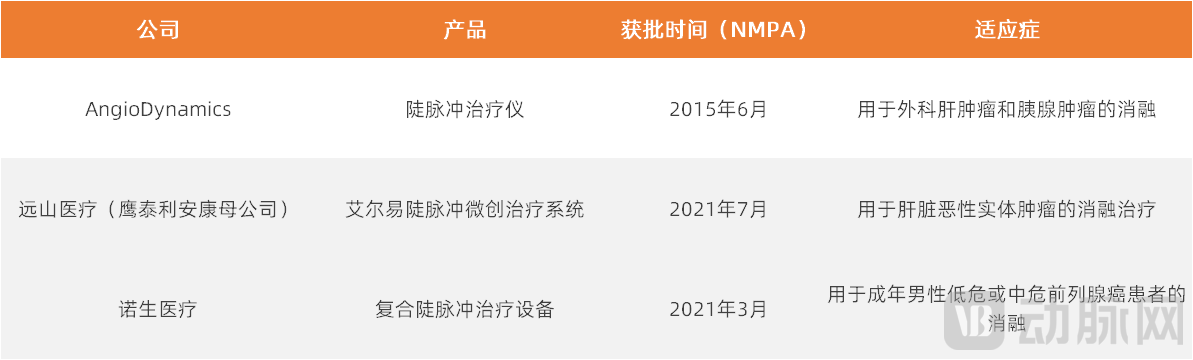
Irreversible Electroporation Ablation Systems Approved in China (Source: National Medical Products Administration)
Pulsed field ablation has been developed in China for nearly eight years, but it currently accounts for less than 1% of tumor ablation procedures. According to industry insiders, out of approximately 300,000 tumor ablation procedures performed nationwide in 2022, only about 2,000 to 3,000 involved pulsed field ablation.
The long-standing dominance of imported brands, coupled with the two-year pandemic period, has to some extent slowed the adoption of this technology. Overall, factors such as product pricing, procedural complexity, and clinical education have hindered its large-scale clinical application.
Puncture and needle placement are technically challenging, and pulsed field ablation procedures still require general anesthesia.
From a clinical perspective, the puncture procedure during pulsed field ablation surgery is technically challenging, requiring precise insertion of multiple pulse electrodes around the tumor.Although pulsed field ablation is a non-thermal ablation technique, excessive application can cause coagulative necrosis in tissues adjacent to the electrode needles. Therefore, ablation parameters should be carefully selected, and repeated ablation of the same area should be avoided to prevent thermal injury.
Meanwhile, as high-voltage electrical pulses are generated during pulsed field ablation, they may cause an increase in the patient’s heart rate and blood pressure; therefore,Pulsed Field Ablation Still Requires General Anesthesia, which requires hybrid operating rooms and a multidisciplinary team, typically involving collaboration between the interventional radiology and anesthesiology departments, along with on-site support from professional engineers, to ensure the successful completion of the procedure. Due to the specific requirements for performing pulsed field ablation, it is currently primarily conducted at large tertiary Grade A hospitals or major specialized oncology hospitals.
High Procurement Costs for Imported Pulsed Field Ablation Devices Lead to Higher Patient Charges
International giants have taken the lead in deploying tumor ablation technologies, supported by robust clinical evidence. For instance, Medtronic and Boston Scientific have achieved leadership in radiofrequency ablation, while Johnson & Johnson leads in cryoablation. Meanwhile, domestic brands are rapidly developing and establishing local supply chains to reduce equipment costs and selling prices. Currently, radiofrequency, microwave, and cryoablation therapies have been progressively included in medical insurance coverage across various provinces and municipalities.
In contrast, as a latecomer to the field, pulsed field ablation (PFA) technology has secured reimbursement codes in certain provinces and municipalities but has not yet been widely included in national medical insurance coverage. Meanwhile, imported products carry high price tags; for instance, AngioDynamics’ NanoKnife generator is still priced at approximately RMB 7–10 million, with consumables remaining expensive. This has hindered market adoption to some extent, limiting its presence to only select Grade IIIA hospitals. Many hospitals in need of innovative technologies are “deterred” by the high costs of equipment and consumables, while most patients requiring treatment are effectively “priced out” due to prohibitive surgical expenses.
Furthermore, as AngioDynamics has focused its development efforts on Europe and the United States and has not established a subsidiary in China, it is unlikely that the prices of its main units and consumables will decrease in the short term.
Insufficient Clinical Education; Professional Training Needs Strengthening
The National Health Commission issued the "National Catalogue of Restricted Technologies (2022 Edition)," in which tumor ablation therapy remains classified as a restricted technology, imposing stringent professional requirements on the service capabilities and staff proficiency of medical institutions. Currently, physicians performing ablation procedures primarily come from non-surgical departments such as interventional radiology, diagnostic imaging, and medical oncology, and thus require specialized surgical training.
Meanwhile, pulsed field ablation procedures are primarily performed in hospital interventional departments, whereas cancer patients typically seek consultation in oncology departments. This situation involves collaboration among clinicians and is also related to the establishment of a hospital-based tumor multidisciplinary team (MDT) model.
The aforementioned issues pertain to the clinical education and market promotion of pulsed field ablation technology, andAngioDynamics, the first to enter the market, sells its products in China through distributors., with deficiencies in clinical education, physician training, and technical services. An industry insider revealed, “As recently as last year, many oncologists at tertiary Grade A hospitals were still unaware of pulsed field ablation technology.”
With the irreversible electroporation (IRE) ablation systems from Yuanshan Medical and Nuosheng Medical receiving approval from the National Medical Products Administration (NMPA), and SinoMicro’s products obtaining CE certification, Chinese manufacturers such as Ruidi Bio, Zhouling Medical, Ganawei Medical, Sanchunhui Medical, Maiwei Medical, and Shuneng Medical have entered the tumor pulsed electric field ablation market. Capital continues to favor the development of this sector, with multiple financing rounds exceeding RMB 100 million occurring in recent years. In response to the aforementioned challenges, domestic manufacturers have also proposed solutions.
To address the need for general anesthesia during pulsed field ablation procedures, some companies (such as Yuanshan Medical) have adoptedImprovement of pulse energy and acceleration of pulse delivery frequency to achieve larger ablation zones with a single needle. However, it cannot currently be guaranteed that all tumor ablation procedures can be performed under local anesthesia; strict limitations on indications are required.
Some companies (such as Ruidi Bio) adopt nanosecond pulse technology. Nanosecond pulsed electric field technology, with pulse widths in the nanosecond range and electric field strengths exceeding 10 kV/cm, can achieve intracellular electroporation. This not only causes irreversible electroporation of the cell membrane but also induces functional changes in the nucleus and mitochondria, thereby triggering apoptosis.Nanosecond pulsed electric field ablation can increase the electric field intensity while shortening the pulse width, thereby reducing the duration of electric field exposure and preventing muscle twitching.。
In April this year, Vena Anchor Medical performed the world’s first “Micro-Nano Knife” ablation surgery for liver cancer under local anesthesia at the Hepatobiliary and Pancreatic Center of Beijing Tsinghua Changgung Hospital. The entire ablation procedure lasted 15 minutes, and no muscle relaxants were administered to the patient during the operation.
To address the inconvenience associated with the preliminary procedures of pulsed field ablation, irreversible electroporation therapy devices have undergone iterative upgrades in their auxiliary methods. For instance, by incorporating a surgical planning system, these devices can automatically adjust ablation parameters through real-time monitoring of the treatment status and prompt physicians to perform the ablation procedure.Pulse energy parameters are directly related to therapeutic efficacy; however, the optimal ablation parameter combination remains unclear, necessitating further clinical exploration by Chinese manufacturers.Some companies have explicitly stated: “Therapeutic parameters must be standardized, rather than being left to physicians’ individual exploration.”
Meanwhile, endoscopic pulsed field tumor ablation represents a novel technological direction that focuses pulsed electric field energy while reducing surgical complexity. For instance, Ruidi Bio has developed an endoscopic nanosecond pulse system and, in collaboration with the ultrasound team led by Director Jiang Tian’an at the First Affiliated Hospital of Zhejiang University School of Medicine, has achieved significant breakthroughs in the research of precision diagnostic and therapeutic instruments for pancreatic cancer.
Currently, manufacturers both domestically and internationally are gradually expanding the indications for pulsed field ablation while enriching clinical evidence. AngioDynamics is conducting the DIRECT study to evaluate the efficacy of IRE technology in treating Stage III pancreatic cancer; and has launched the RESERVE study in collaboration with SUO-CTC to assess the use of the NanoKnife system as a local treatment option for patients with prostate cancer.
In addition to pancreatic cancer, liver cancer, prostate cancer, and breast cancer, domestic companies are also applying pulsed field ablation (PFA) to the treatment of prostatic nodules, chronic obstructive pulmonary disease (COPD), and other indications. As clinical validation and data accumulation progress, the indications for PFA will be further clarified, thereby identifying its areas of competitive advantage.
Industry participants generally believe that,The future of pulsed field ablation is not limited to large tertiary Grade A hospitals or national-level medical centers; tertiary Grade A hospitals at the prefecture and city levels can also perform the procedures as long as they have the appropriate equipment and personnel, and its widespread adoption in primary care hospitals is only a matter of time.Systematic training, coupled with the implementation of surgical planning systems, will undoubtedly promote the widespread adoption of pulsed field ablation technology in hospitals at all levels.
In recent years, the conditions for performing tumor ablation procedures at primary healthcare institutions have gradually matured. The National Health Commission announced the selection results for the first batch of national centers for minimally invasive interventional oncology (liver cancer and lung cancer), with a total of 301 hospitals selected, including county-level hospitals in top-tier cities.
Meanwhile, national-level requirements for physicians performing tumor ablation procedures have also been relaxed. The 2017 edition of the “Technical Management Standards for Tumor Ablation Therapy” stipulated that physicians conducting tumor ablation therapy must have more than five years of clinical experience in oncology diagnosis and treatment and hold a professional title of Associate Chief Physician or higher. In contrast, the 2022 edition of the “Standards” requires only a professional title of Attending Physician or higher, with at least five years of service in such a capacity.
As a relatively new minimally invasive technique in the field of tumor ablation, pulsed field ablation (PFA) must align with the underlying logic of clinical needs and market development to achieve commercialization, particularly given China’s large patient population and the continuously expanding target market. Overall, pulsed field ablation technology offers unique advantages in the following four aspects:
1、Patient Treatment Benefits: Through pulsed field ablation therapy, patients experience significant short-term benefits (such as zero intraoperative bleeding and the feasibility of outpatient procedures) and long-term benefits (such as reduced complications and higher long-term survival rates).
2、Technical Pain Point Resolution: Break through the "forbidden zones" inaccessible to traditional tumor ablation, enabling safer and more precise normothermic minimally invasive ablation therapy.
3、Physician Self-Actualization: In the field of pulsed field ablation, China has carried out the first clinical applications for various indications and technologies. Through innovative pulsed field ablation procedures, clinical experts have enhanced their technical expertise and industry standing; by refining these innovative techniques, mid-career core physicians and regional specialists have achieved a “leapfrog” improvement in their operational proficiency; meanwhile, grassroots physicians can also master interventional therapy skills, thereby elevating the standard of primary healthcare.
4、Medical Expenditure: Policy measures are being strengthened to exclude innovative medical devices from centralized procurement, while providing encouragement and support for devices with robust evidence-based data demonstrating reduced complications and improved diagnostic and therapeutic efficiency. The comprehensive implementation of tiered diagnosis and treatment is creating more opportunities for domestically produced pulsed field ablation devices. The enforcement of the "two-invoice system" will further drive mergers, acquisitions, and transformation within the industry, leading to continuous industrial structure upgrading. Reforms in medical insurance payment policies are also steering systemic solutions for pulsed field technology toward customized device products and higher value-added offerings.
Domestic innovation remains an enduring theme in China’s medical device sector, whilePulsed Field Ablation Technology Is One of the Few Sectors in China Capable of Competing on Par with International Giants. In the future, domestic manufacturers still need to make efforts in multiple aspects—1.Promoting Market Access, accelerate the implementation of clinical pricing and medical insurance reimbursement for pulsed field technology in more provinces and cities; 2.Strengthen Market Education and Physician Training, promote pulsed field ablation technology through expert mentorship, training courses, and forums to train more physicians capable of performing the procedure and enhance clinical awareness; 3.Reduce Surgical Costs, domestic manufacturers reduce the prices of equipment and consumables through independent innovation and localized production, thereby lowering surgical costs and benefiting more patients.
Reference: “Expert Forum | Zhai Bo: Local Treatment of Liver Cancer—Ablation or Resection?” — Journal of Clinical Hepatology
《Expert Consensus on Image-Guided Irreversible Electroporation Ablation for the Treatment of Malignant Liver Tumors (2022 Edition)》
“Research and Application Progress of High-Voltage Electric Pulse Technology in the Field of Tumor Treatment” — “China Medical Devices”