

From Semiconductors to Bio-Intelligent Pharma: YouSi Tech Files IPO Prospectus with AI-Powered Smart Automated Lab Platform
By Liu Jiaying
As drug research and synthetic biology continue to advance, the biopharmaceutical sector is placing higher demands on the precision and speed of experiments. The seamless integration of artificial intelligence, automation technologies, and laboratory operations precisely meets the market’s need for automated, intelligent laboratories, making automated labs an increasingly sought-after solution.
According to the VCBeat Orange Database, a total of over RMB 2.5 billion was invested across 22 financing deals in the automated laboratory sector from 2020 to June 2022, with participation from top-tier venture capital firms such as Northern Light Venture Capital, Sinovation Ventures, Sequoia China, and Matrix Partners China.
The advancement of artificial intelligence technology has sparked a surge in the research and development of automated laboratories. According to estimates by Jiacheng Capital, China’s pharmaceutical industry output reached RMB 4 trillion in 2020, with R&D expenditures accounting for approximately 20%. Of this R&D budget, 10% was allocated to data management, experimental standardization, and intelligent R&D solutions, resulting in a market size for automated laboratories of RMB 100 billion. This market is experiencing rapid growth, with a compound annual growth rate (CAGR) exceeding 8–10%.
Amid the R&D boom in automated laboratories, USTC Intelligent Technology (Tianjin) Co., Ltd. (hereinafter referred to as “USTC”) is equally committed to empowering life science laboratories with automation and AI technologies. The company has established an unmanned, intelligent, fully automated laboratory that is efficient, precise, safe, eco-friendly, and capable of cloud-based sharing. USTC’s automated laboratory products can simultaneously conduct 70 reactions and are currently deployed at top-tier industry enterprises, helping them increase experimental efficiency by 3–5 times.
Even as the biopharmaceutical sector sees fervent development and investment in automated laboratories, USTC remains humble and focused on accumulating technical expertise, continuously iterating and innovating its automation products to help shape a comprehensive blueprint for automated laboratories.
Hou Mingtao, founder of Ustec, graduated from the University of Science and Technology of China. Prior to establishing Ustec, he had already accumulated over 30 years of experience in the automation industry. After graduating from university, Hou worked both in China and abroad, holding semiconductor technology management positions at the Institute of Semiconductors, Chinese Academy of Sciences, and a semiconductor equipment company in Singapore. These two experiences provided him with extensive practical expertise and knowledge, laying a solid foundation for his subsequent entry into the automation sector.
In 1996, Hou Mingtao returned to China from Singapore and founded Hongtian Industrial Automation (Tianjin) Co., Ltd. The company’s clientele consisted primarily of foreign-invested enterprises, to which it provided customized automation solutions and products. His early work in the field of automation brought Hou a profound sense of accomplishment; however, as the company’s business became increasingly confined to customized automation services, he grew dissatisfied with this trajectory. “Customized automation products challenge and hone one’s creativity and problem-solving abilities. Yet, from the perspectives of commercial viability and social contribution, the development prospects and technological impact of customized automation are limited. Only innovative products hold greater market and social value. By comparison, independently developing interdisciplinary automation products offers stronger market competitiveness and sustainability, while better leveraging my own capabilities,” stated Hou Mingtao.
In 2019, the company partnered with the AI Automation Strategy Department of a major domestic pharmaceutical R&D enterprise. As the collaboration deepened and through continuous learning, Hou Mingtao’s understanding of the life sciences sector has grown significantly. He discovered that, for a long time, life science laboratories and experimental research have remained largely stuck in a primitive state reliant on manual labor using test tubes and flasks, with minimal adoption of automated equipment to enhance the efficiency and precision of experimental research. The underlying reasons are the barriers posed by cross-disciplinary knowledge structures and the inherent complexity of experimental research, which make the implementation of smart laboratory automation extremely challenging. This has resulted in a situation where smart laboratory automation technologies and related products are largely unavailable.
After delving into the complexities of experimental research and contemplating the potential prospects of integrating AI and automation, Hou Mingtao believes that given the current maturity and cost reduction of AI and automation tools, coupled with the urgent need for rapid growth in the biopharmaceutical industry, there is a significant opportunity to leverage cross-industry experience and multidisciplinary advantages. This approach can rapidly elevate laboratory intelligence and automation to a leading position both domestically and internationally through innovative technologies. “The current technological heights achieved by those internationally renowned scientific service companies are not insurmountable. Commercializing innovative laboratory automation technologies not only offers broad commercial prospects but also allows us to leave our mark on industry transformation,” stated Hou Mingtao. He decided to put the idea of “independently developing smart automated laboratory products” into practice. In 2021, USTC (Youseitech) was officially established. This company, focused on developing automated laboratories for life sciences and biopharmaceuticals, has developed seven commercialized AI-driven automated laboratory process stations and control systems within less than two years, covering the operations of major laboratory processes.
Currently, Ustec is actively recruiting top talent and has established a seasoned core management team. Dr. Qiu Liang, who boasts over a decade of research experience in organic chemical synthesis and biopharmaceutical R&D, serves as Ustec’s Chief Scientist. Meanwhile, Zhang Ning, former National Sales Director at Novartis Pharmaceuticals and General Manager of China Operations at Takeda Pharmaceutical, has also joined the team. The combination of Dr. Qiu Liang’s profound academic expertise in life sciences from the University of Science and Technology of China and Hou Mingtao’s extensive experience in automation provides the direction and foundation for maximizing the company’s capabilities in developing automated laboratories. Zhang Ning oversees the company’s marketing and promotion efforts. These three core members leverage their respective domain advantages to ensure end-to-end quality control in product design, implementation, and marketing, thereby facilitating the company’s stable operations.
In the experimental research of biopharmaceuticals, it has become an industry consensus that more modern and efficient approaches are needed to address the drawbacks and shortcomings of traditional laboratories, such as safety risks, environmental pollution, issues with data integrity and accuracy, low experimental efficiency, and heavy reliance on human resources. Meanwhile, data shows that over 70% of life science R&D instruments in China are imported products, which has led to increased experimental costs and geopolitical risks. Adhering to the product manufacturing philosophy of “Safety,” “Efficiency,” “Precision,” “Scalability,” and “Shareability,” USTech has developed a range of AI-integrated automated process stations and control systems, including fully automatic solid powder quantitative dispensing systems, fully automatic liquid dispensing systems, fully automatic high-throughput organic synthesis reaction systems, fully automatic flexible detection and sampling systems, fully automatic high-throughput parallel vacuum concentration systems, and fully automatic multi-task extraction process stations.
Fully Automated High-Throughput Parallel Vacuum Concentration System: Traditional rotary evaporators commonly used in laboratories require manual operation and can only perform single tasks. Control mechanisms for bumping prevention, concentration endpoint determination, and data logging are inadequate, preventing true automation. Currently, neither international corporations nor leading domestic laboratory automation companies offer fully automated solutions for this application, necessitating a human-machine interactive approach. Leveraging our extensive and in-depth expertise in automation and biopharmaceuticals, we have developed a patented product from the ground up that resolves these issues. It supports simultaneous or independent multi-task execution, achieving complete automation, intelligence, and high throughput. Moreover, its implementation cost is highly competitive, amounting to less than half the price of comparable semi-automated products from foreign manufacturers.
Fully Automated Solid Powder Dispensing System: Capable of dispensing 12–36 samples per run, with simultaneous dispensing of 3–6 types of solid powders. Liquid dispensing can also be integrated into this workstation if required. This is our proprietary product developed from the ground up. It overcomes the limitations of other advanced automated laboratory solutions, which require synchronized robotic arm operation and have restrictions on minimum dispensing volumes. The price is also highly affordable.
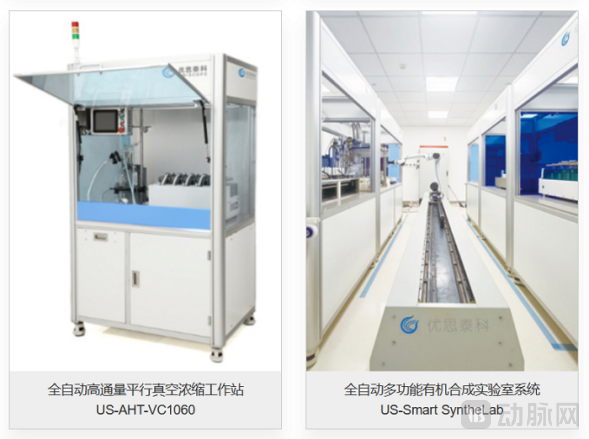 Image source: USTC official website
 Image source: USTC official website
The fully automated high-throughput organic synthesis reaction system is an intelligent platform that precisely controls reaction parameters and executes procedures, automatically records all data, and enables rapid data sharing and reporting. This system has transformed the workflow of researchers by ensuring the generation of more comprehensive data for each experiment and accelerating the achievement of precise experimental results, thereby truly realizing fully automated, unattended operation.
In addition, the automated products developed by USTC are not limited to the biopharmaceutical sector. For instance, the solid quantitative dispensing system has market demand across various industries, including new energy, cosmetics, and food. Meanwhile, the fully automated high-throughput concentration system, in addition to its application value in organic chemistry, also meets market needs in the environmental protection industry.
Since its inception, the company has been dedicated to the iterative development of its laboratory automation technologies and products. Building on this solid foundation, USTech made its debut in March this year at the 12th China International Summit on Chemical Pharmaceuticals – Asia (CIS-Asia 2023), showcasing its series of fully automated laboratories and laboratory automation products. In the short period since then, numerous well-known enterprises have visited USTech for discussions on technology, collaboration, and investment. Furthermore, in May 2023, at the 7th Future Healthcare 100 Conference hosted by VCBeat (VB100), USTech further enhanced its reputation by highlighting its product advantages—efficiency, precision, safety, environmental friendliness, and cloud-based sharing capabilities—thereby securing a firm position in the R&D market for fully automated laboratories.
Hou Mingtao possesses a forward-looking vision for the application of artificial intelligence in the biopharmaceutical sector, which is a key reason why Ustek Therapeutics boasts broad development prospects.
Hou Mingtao expressed deep sentiments: “AIGC technology and large language models, as new application tools, are providing fresh empowerment to fully automated laboratories. This trend is leading to a more refined division of labor in intelligent laboratory R&D; it is not a monopolized domain dominated by a single player, but rather requires broader participation. Many unknown frontiers remain in the intelligent automation of laboratories, awaiting our exploration. Only through persistent innovation can we continue to perfect this crucial piece of the laboratory intelligence puzzle.”
“This is an era of profound technological transformation. We are privileged to have the opportunity to make meaningful contributions that may leave a lasting impact in one of the most critical fields during this remarkable period, which is truly exciting. Following Elon Musk’s example, we embrace an open mindset to share technologies and collaborate with peers who are currently at the forefront. We engage in diverse forms of cooperation and joint development with enterprises, universities, and research institutions that share our vision and commitment. We also look forward to exchanging insights with leading experts involved in the planning and development of both large and small models within the AIGC life sciences laboratory sector, working together to build intelligent automated laboratories,” said Hou Mingtao.