

Top 10 Most Commercially Promising Invasive Brain-Computer Interface Products of 2026 Unveiled

Neuracle
Developer and Manufacturer of Brain-Computer Interface Systems and Related Equipment
Policy Support Injects Strong Momentum into Industry Boom! From the issuance of systematic industry guidance by seven departments to being listed as one of the six key future industries in the "15th Five-Year Plan" recommendations; from local governments actively implementing special action plans to healthcare insurance and drug regulatory authorities establishing "green channels" for product approvals, multiple policies are working in synergy to build a comprehensive, full-chain support system for the brain-computer interface industry.
At the same time, an industrial wave is sweeping in: On the clinical front, invasive, semi-invasive, and non-invasive brain-computer interface (BCI) technologies are continuously making breakthroughs, constantly refreshing industry milestones; on the capital front, full-cycle investments are increasing, empowering the industry’s growth from early-stage technical validation to the marketization of mature products; on the industrial front, leading companies are accelerating their lead, with invasive BCI enterprises entering the mass production preparation phase, and non-invasive BCI enterprises speeding up their industrialization process! Driven by strong national strategies, China's BCI industrial ecosystem is rapidly maturing and now stands at the critical tipping point of transitioning from technological breakthroughs to industrial explosion. Commercial exploration has become the core proposition driving the industry forward!
To accurately analyze industry trends and identify high-quality commercial targets, VCBeat has developed a "technological breakthrough-clinical progress-commercial potential" three-in-one evaluation system for the commercial potential of brain-computer interfaces based on in-depth preliminary research. Among these, technological breakthrough focuses on innovation levels and core barriers, defining the future value boundaries of the industry; clinical progress relies on standardized data and empirical research, solidifying the foundation of product safety and efficacy; commercial potential centers on scenario adaptation and market space, clearly outlining the path from the laboratory to the end market. These three aspects are interconnected and progressively layered, providing an end-to-end reference for scientifically evaluating the commercial feasibility and growth potential of brain-computer interface products.
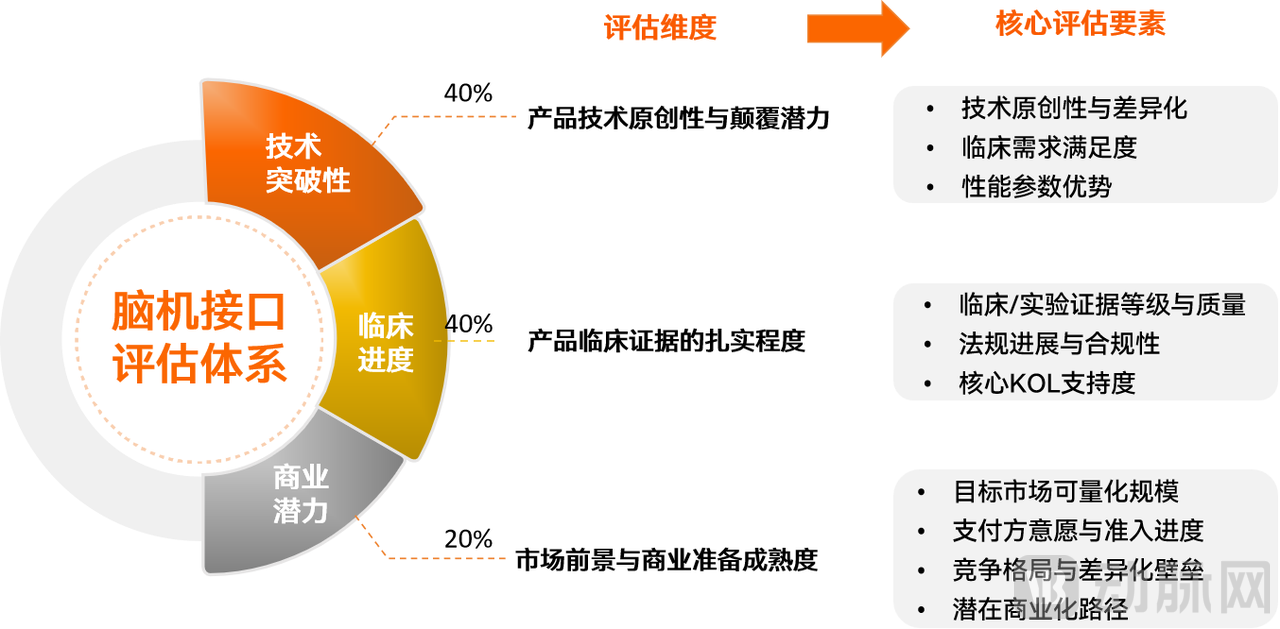
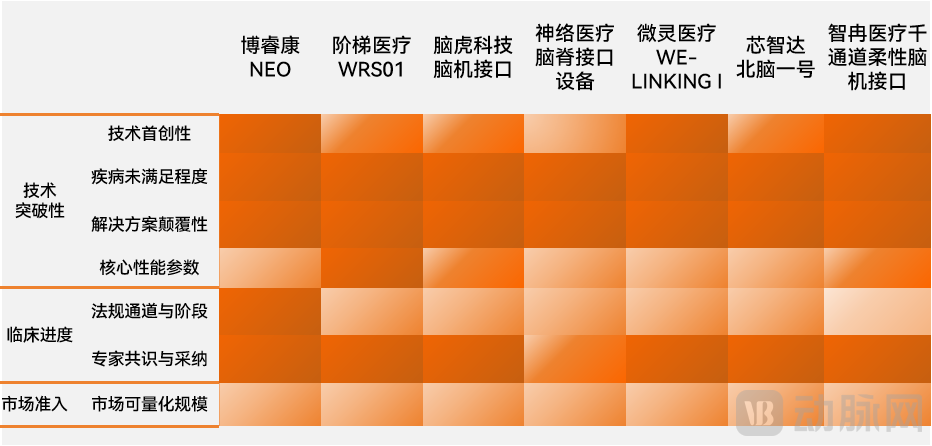
VBInsight conducted a multi-dimensional quantitative evaluation of dozens of brain-computer interface products based on core indicators and set differentiated weights according to the characteristics of different tracks. Taking invasive brain-computer interfaces as an example, given that most products are still in the clinical trial stage, technological breakthroughs and clinical validation outcomes have become key factors in measuring their value. Therefore, VBInsight assigned the highest priority to "technological innovation" and "clinical application" (each accounting for 40%), with "commercial potential" weighted at 20%. The darker the color, the higher the score. Special note:This evaluation focuses on the analysis of the "single product" dimension, aiming to objectively reflect the comprehensive strength of a specific product. The evaluation results do not represent the status of other product lines or the overall comprehensive strength of the enterprise (ranked in alphabetical order by the initial letter of the company).。
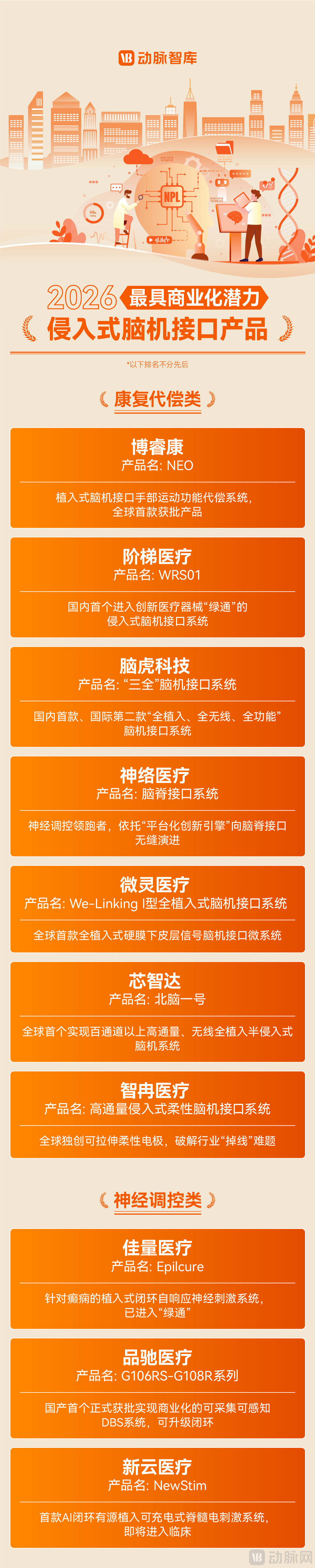
According to the "Guiding Principles for Naming General Names of Medical Devices Using Brain-Computer Interface Technology," VCBeat categorizes invasive brain-computer interface products into rehabilitation compensation and neuromodulation categories. Based on this classification, VCBeat conducted a comprehensive evaluation, scientific scoring, and integrated analysis of nearly 30 invasive brain-computer interface products, ultimately selecting ten products with the most commercial potential (ranked by the initial letter of the company).
Not only that! The list of "the most commercially promising non-invasive brain-computer interface products" will be revealed soon. Stay tuned!
The two major lists are both derived from the "2026 Brain-Computer Interface Early Commercialization Exploration Report." This report was jointly initiated by VBInsight and the Brain-Computer Interface Community. Through in-depth research and interviews with nearly twenty innovative companies in the brain-computer interface field and leading investment institutions, the core of the study revolves around three key issues to seek answers:
Why:Is Now a Good Time to Explore the Commercialization of Brain-Computer Interfaces?
What is:What are the potential commercialization paths for different technical routes and the core variables for path selection?
How to do it:Crack the Bottleneck, Accelerate Commercialization
According to the "Guiding Principles for Naming General Names of Medical Devices Using Brain-Computer Interface Technology," VCBeat categorizes invasive brain-computer interface products into rehabilitation compensation and neuromodulation categories, conducting in-depth analyses of their commercial development respectively.
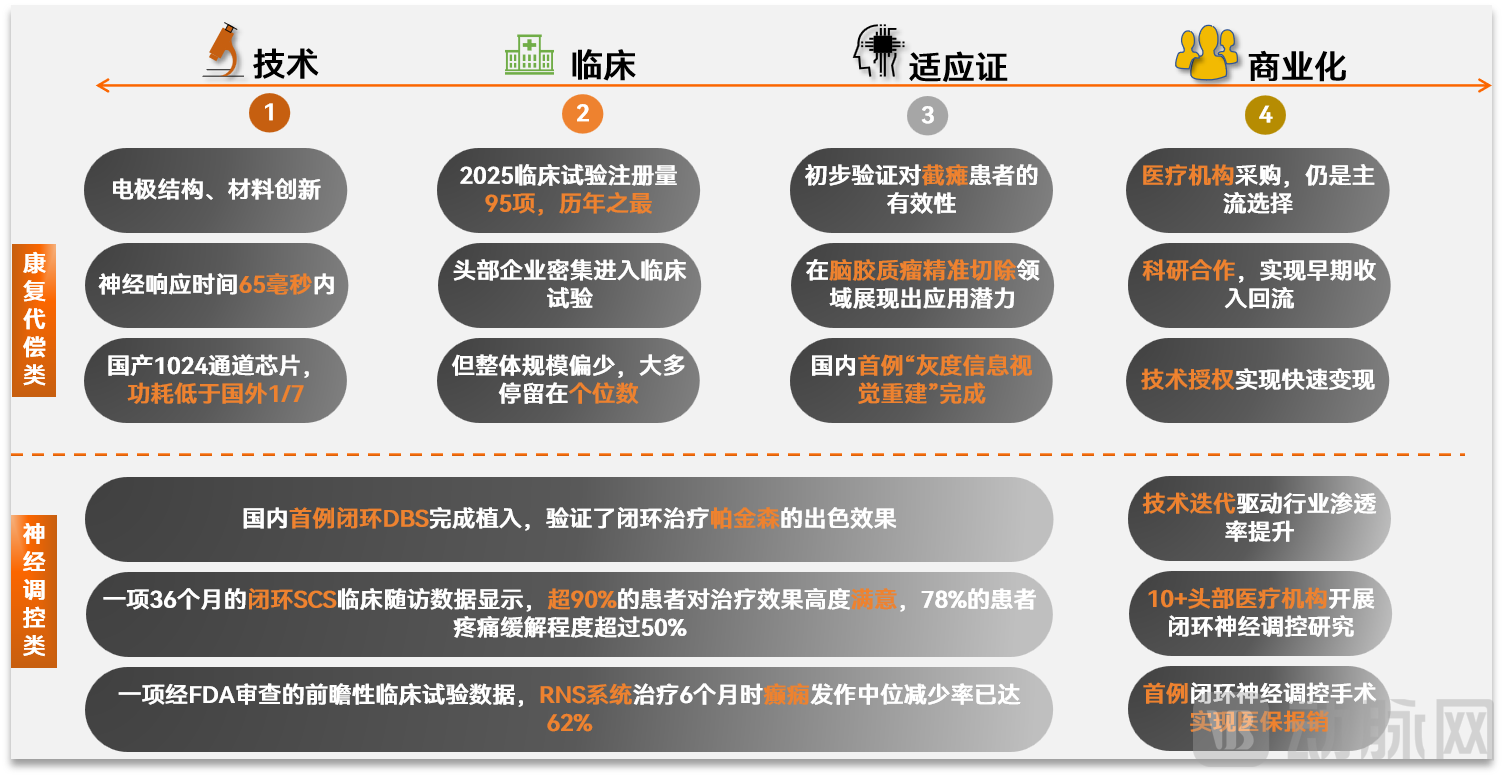
The full report will be重磅 released at the 2026 Future Healthcare 100 Forum, a sub-forum of the Future Medical and Pharmaceutical Industry 100 Conference, titled "Brain-Computer Interface Industry Innovation and Investment Forum," held in Shanghai on the morning of May 20!
The 2026 Future Healthcare 100 Summit, hosted by VCBeat, features four thematic forums on brain-computer interfaces, with nearly a hundred prominent guests sharing insights on-site to explore "how to develop, invest in, and implement brain-computer interfaces." Secure your spot at the summit to unlock the core secrets of brain-computer interface commercialization, seize the opportunity in this burgeoning industry, and join the golden future of the brain-computer interface sector!
Registration link:https://www.vbdata.cn/1519072168