

Brain Science Keeps Boiling: Prodegre Breaks the Curse of Parkinson's Incurability
The brain is the most important and enigmatic organ in the human body. Speculation and research on the brain have persisted for over a century, with countless researchers exploring this “final frontier.”Academician Wang Yutianis also one of them.
Academician Wang Yutian isFellow of the Royal Society of Canada; Dean and Chair Professor, School of Life and Health Sciences, Shenzhen University of Advanced Technology, Chinese Academy of Sciences (in preparation); Chief Scientist, Shenzhen Institutes of Advanced Technology, Chinese Academy of Sciences; Endowed Chair Professor, Djavad Mowafaghian Centre for Brain Health, University of British Columbia, Canada.

Academician Wang Yutian
Over the years, Academician Wang has been deeply engaged in brain science research and achieved remarkable accomplishments. His team has published more than 160 articles in the field of medical neuroscience, with over 40,000 total citations on Google Scholar and an h-index of 77, widely recognized asOne of the world's leading research teams in neuroscience.
However, basic research does not constitute the sole focus of Academician Wang’s scientific endeavors. As a physician by training, he places significant emphasis on translating research achievements into clinical practice. Since 2004, Academician Wang has established three companies dedicated to the development of Class 1 innovative drugs through technology transfer. To date, three products have successfully entered Phase I clinical trials, one product has advanced to Phase II clinical trials, and one product is currently in Phase III clinical trials.
To bring more achievements to market, Academician Wang’s team frequently travels to various roadshow events. During one such roadshow, Academician Wang’s team presented their latest research"Peptide-Guided Protein Knockdown Technology Platform"Taking the stage, Tan Shen, who has spent many years working on technology transfer within Tsinghua University’s incubation system, immediately recognized its market potential.
Following the meeting, two teams with high expectations for brain science came together. After a period of in-depth communication and collaboration, Academician Wang decided to establish a company to facilitate the translation of their work through the “Peptide-Guided Protein Knockdown Technology Platform.” Through the joint efforts of both parties, they focused on researching the mechanisms of major neurological diseases and developing innovative drugsPudruiEstablished.
“Breaking Through” the Final Frontier of Life Sciences
Neurodegenerative diseases are a prolonged and arduous process.Some say its onset is akin to starting a life countdown: as the disease progresses, patients develop various corresponding functional impairments, gradually lose the ability to live normally, and ultimately succumb to death.
Common neurodegenerative diseases include Parkinson’s disease, Alzheimer’s disease, and amyotrophic lateral sclerosis (ALS). In recent years, as population aging has intensified, the number of patients has been steadily increasing. In 2023 alone, the number of Parkinson’s disease patients in China exceeded 3.5 million, and projections indicate that this figure will surpass 5 million by 2030.China's Parkinson's disease patient population will account for half of the global total.
The vast patient population is also compelling the scientific research community to seek solutions, but unfortunately, there is still no therapy available on the market specifically targeting neurodegenerative diseases.Targeted, Highly Efficient, and SafeEtiological treatment measures.
Currently, the most common treatment for neurodegenerative diseases is small-molecule drugs. However, most existing medications can only alleviate symptoms; as the disease progresses, their efficacy becomes increasingly limited and side effects intensify, offering minimal impact on halting disease progression.
Therefore, there is an urgent need to identify novel therapeutic pathways for patients with neurodegenerative diseases.
Academician Wang has dedicated many years to in-depth research in brain science. He believes that only by addressing the root causes of neurodegenerative diseases—namely, the abnormal accumulation, aggregation, and misfolding of specific pathogenic proteins—can we fundamentally treat and improve these conditions. Based on this conviction, he has decided to embark on an uncharted path:Build a peptide-guided protein knockdown technology platform, and leverage it to develop innovative drugs that are causative, effective, and safe for treating degenerative diseases of the central nervous system.
"Three-Stage" Peptide-Guided Protein Knockdown Technology Platform
In simple terms, the core principle of the peptide-guided protein knockdown technology platform is to use a specific peptide to selectively target misfolded or aberrant proteins in the body for degradation, thereby addressing the root cause of neurodegenerative diseases.
While this may sound similar to traditional “PROTAC technology,” PROTACs are unable to regulate proteins when the proteasome is impaired, leaving them ineffective against such diseases. In contrast, Pudrui’s peptide-guided protein knockdown technology platform innovatively adopts a “three-stage” model, enabling direct regulation of the protein system via downstream pathways. Theoretically, this approach can treat all diseases caused by protein aggregation and misfolding.
The innovative three-segment design divides a natural polypeptide intoTransmembrane domain, target protein-binding domain, and degradation tag region.
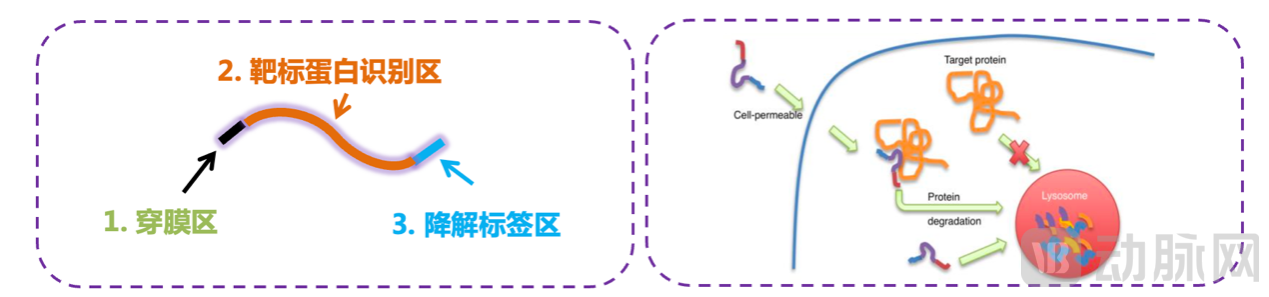 Peptide-Guided Protein Knockdown Technology Platform
Step 1: Non-targeted TAT protein achieves transduction in the membrane-penetrating regionThe entire rotational process does not require specific ligand-receptor binding, enabling the drug to efficiently cross the blood-brain barrier and neuronal cell membranes. This forges a “key” for degrading cytotoxic proteins in brain cells.
Step 2: Screening for amino acid sequences that are evolutionarily conserved, physiologically present, and specifically bind to the toxic protein within the target protein's binding domain.. This approach offers higher specificity and a lower risk of off-target effects compared to traditional PROTAC technology. Meanwhile, by leveraging protein chip technology for high-throughput screening of protein targets of drug action, the peptide-guided protein knockdown platform can theoretically degrade any protein in vivo without affecting normal physiological proteins, thereby reducing the potential for drug side effects.
Finally, after the drug binds to the toxic protein in the degradation tag region, the degradation tag directs the complex to the protein degradation machinery for degradation, which can involve either the proteasome system or the lysosomal system.In cases of lysosomal damage, the protease system can serve as an alternative pathway, thereby overcoming challenges that remain unresolved by “protect technology.”
“Three-Stage” Design-Based Peptide-Guided Protein Knockdown Technology Platform Demonstrates More Significant Advantages in Pharmaceutical Safety and Efficacy Compared to Traditional “Protect Technology”
Since the Protect technology relies on small-molecule drug development, the identification of suitable targets has become the key to successful drug formulation. If the most intuitive and valuable targets are not accurately identified, the therapeutic efficacy will be significantly compromised. However, undruggable targets still constitute the majority, and pinpointing the most accurate targets remains a low-probability event. Therefore, drug development using Protect technology in the field of neurodegenerative diseases stillTreats only the symptoms, not the root cause.。
The peptide-guided protein knockdown technology platform addresses the pathogenic mechanisms of neurodegenerative diseases, eliminating the root causes at their source. This approach not only offers the potential for a complete cure but also holds promise for reversing disease progression in the future. Furthermore, the platform utilizes natural peptides, which, compared to small-molecule chemicals,Higher Safety, and it is reversible.The likelihood of the medication causing side effects is low.
Tan Shen, CEO of Purui, told Chengguo Bureau: “Purui has applied for patents for its peptide-guided protein knockdown technology platform, and numerous international laboratories have repeatedly verified the reproducibility and reliability of the technology. The peptide-guided protein knockdown technology platform has established a technological moat for Purui.”
New Challenge: Research on “Reversing Parkinson’s” Has Begun
Currently, leveraging its peptide-guided protein knockdown technology platform, Purui has initiated drug research programs for Parkinson’s disease, Huntington’s disease, and amyotrophic lateral sclerosis (ALS), with therapeutic candidates for Parkinson’s disease and ALS having advanced intoPharmacodynamic Evaluation Phase.
In the next phase, Purui will conduct research on improving the brain environment of patients with Parkinson’s disease, striving to go beyond disease suppression and achieve reversal of Parkinson’s disease.
Pudrui has attracted widespread attention since its inception. Tan Shen attributes this to Academician Wang’s more than two decades of dedicated research. “As a former clinician, Academician Wang is better positioned to identify critical pain points and channel innovative technologies back into clinical practice—an insight that cannot be derived solely from laboratory work.”
In the future, Pudirui will continue to delve into brain science research, embarking on new explorations in the “uncharted territories” of neuroscience.