

Cutia Therapeutics Debuts on HKEX with Dual Focus on Hair Loss and Localized Fat Reduction

Cutia Therapeutics
Developer of Dermatological Therapeutics
Cutia Therapeutics, an R&D-driven biopharmaceutical company focused on the treatment and care market for a wide range of skin diseases, officially listed on the Hong Kong Stock Exchange today. The shares were priced at HK$21.85 each, near the lower end of the indicative offer price range of HK$20.65 to HK$24.75, raising net proceeds of HK$390 million. The funds raised from this listing will be used for the research and development of the company’s core products and other drug candidates, technological development for pipeline expansion, and business development.
The Hong Kong stock market has been struggling recently, with the once-booming IPO subscription frenzy now a thing of the past. On June 9, Cutia Therapeutics’ grey market performance was also lackluster, yet the emergence of Cutia Group has still attracted considerable attention.This company, established in 2019, boasts a star-studded lineup of shareholders.Including Tonghe Yucheng, Sequoia China, CICC Capital, Taikang Life Insurance, Yunfeng Capital, and Fidelity Investments. According to the prospectus, prior to Cutia Group’s IPO, entities affiliated with Tonghe Yucheng held 53.57% of the shares,Thus, it is regarded as another “WuXi AppTec-affiliated” enterprise.。
The Company’s pipeline primarily focuses on hair diseases and care, skin diseases and care, pharmaceuticals for the management of localized fat accumulation, and topical anesthesia. As of the Latest Practicable Date, there were a total of 11 candidate products in the pipeline, six of which are indicated for hair loss. Among these, the flagship product CU-40102 is the world’s first and only approved topical finasteride product for the treatment of androgenetic alopecia, and it is also the only topical finasteride product in clinical development in China. Another core product, CU-20401, is a recombinant mutant collagenase targeting fat accumulation, serving as a local therapy for metabolic disorders.
Cutia Therapeutics has capitalized on the two most prevalent “anxiety points” among modern individuals, which helps explain why it has garnered favor from multiple top-tier institutions and achieved a rapid IPO just four years after its establishment.
Robust and Comprehensive Pipeline: Spend Money to Make Money
Targeting the continuously growing market for dermatological treatment and care, Cutia Group positions itself as a “one-stop solution provider with a comprehensive product portfolio” to meet consumer needs across key therapeutic areas and throughout the treatment and care continuum. Compared with companies focusing on specific niches, those with diversified product pipelines can benefit from synergies among their product portfolios, thereby continuously building brand awareness and gaining market share.
Over the past four years, Cutia Therapeutics has built a highly diversified product portfolio. However, it is important to note that several of its 11 products are not internally developed, and the company has already incurred substantial costs for these products prior to their generating revenue.
CU40101 and CU40102 in the field of hair disorders and care, CU10201 in the field of skin disorders and care, and CU20401 for the management of localized fat accumulation are licensed from Jiaxing Keteruo Biotechnology Co., Ltd., Polichem S.A., Foamix, and Hangzhou Guansu Biotechnology Co., Ltd., respectively. The licenses include authorized patents, know-how, and trademarks, as well as commercialization rights in the relevant fields. According to the prospectus, a total of approximately RMB 300 million is payable for these four products, along with tiered royalties based on a percentage of net sales. Cutia Therapeutics has paid approximately RMB 140 million to date.
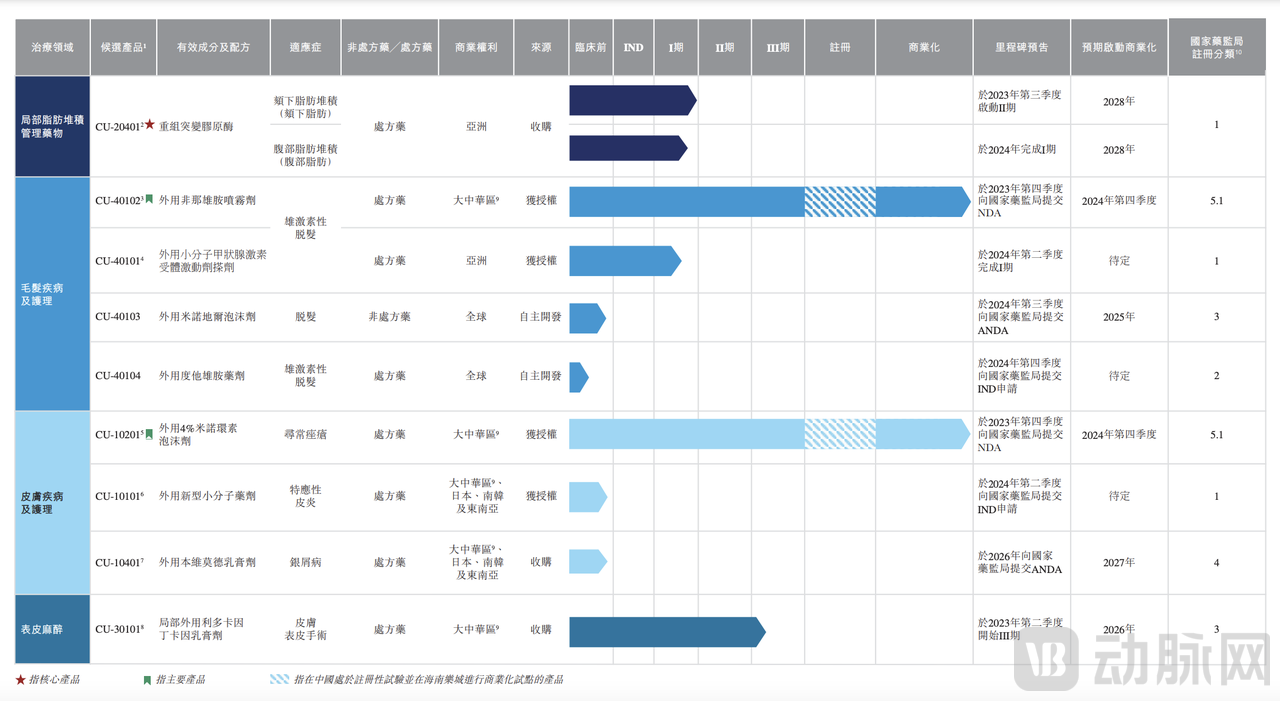
Cutia Group’s Pipeline, Source: Company Prospectus
Products not included in the latest pipeline table also comprise CUP-MNDE and CUP-SFJH, two hair disorder and care products licensed by Laboratoires Bailleul and Van Montfort Laboratories B.V., respectively, granting exclusive distribution and operational rights in mainland China.
CUP-MNDE is an over-the-counter minoxidil spray indicated for hair loss, including male patients with gradual thinning or hair loss at the vertex and female patients with overall fragile and sparse hair. It has been a best-selling product in European countries such as Italy, Portugal, and Belgium. CUP-SFJH is a plant extract used to prevent hair loss and improve hair quality. Both products have been launched and are primarily sold through Tmall and JD Health. However, under the relevant agreements, Cutia Therapeutics committed to minimum annual purchase volumes for the first three years. As of the end of October 2022, Cutia’s book inventory totaled RMB 15 million.
It is evident that prior to selling these products, Cutia Therapeutics had paid substantial licensing fees and procured a certain quantity of the relevant products. These costs constituted a significant factor contributing to the company’s losses. According to its prospectus, Cutia Therapeutics reported revenues of RMB 0, RMB 2.038 million, and RMB 658,000 from 2020 through the first half of 2022, respectively; during the same periods, its net losses amounted to RMB 199.9 million, RMB 319.5 million, and RMB 252 million, respectively, resulting in cumulative losses of approximately RMB 770 million.
Meanwhile,Cutia Group’s R&D investment is rapidly increasing:In 2021 and 2022, R&D expenses amounted to RMB 110 million and RMB 180 million, respectively. As the company continues to advance multiple preclinical and Phase I clinical products, it will incur substantial R&D costs.It is foreseeable that cash burn will be an unavoidable issue for Cutia Therapeutics for a considerable period of time.
Despite the vast market, quality products still speak for themselves.
In 2021, the number of individuals with hair loss in China reached 252 million, and is projected to grow to 258 million by 2030, with more than half of these cases being androgenetic alopecia (AGA). Currently, there are limited treatment options available globally for AGA, consisting only of topical minoxidil and oral finasteride.
Minoxidil may initially cause hair shedding before promoting regrowth and is subject to a plateau phase. Although oral finasteride can affect male sexual function, it remains the most effective FDA-approved medication worldwide for treating androgenetic alopecia.Cutia Therapeutics’ introduced CU-40102 topical finasteride, designed as a spray to avoid side effects, has thus generated considerable anticipation.
However, Merck & Co., the originator of finasteride, initially considered developing it as a topical agent during the early stages of Propecia’s development. Nevertheless, Merck determined that topical administration would make precise dose control difficult, thereby compromising efficacy. Additionally, topical application is not only less convenient but also carries the risk of systemic absorption through the skin, potentially leading to adverse effects. Consequently, the drug was developed as a 1 mg oral finasteride tablet.
The topical finasteride product introduced by Cutia Group was launched in Europe in 2021 under the brand name Caretopic. Data from Phase III clinical trials at that time indicated that the topical spray significantly reduced the impact on serum dihydrotestosterone (DHT) levels, meaning that both the severity and incidence of side effects were substantially lower than those associated with the oral formulation. The data also suggested that “the therapeutic efficacy is similar” between oral and topical finasteride. However, since its market launch, there has been a lack of compelling comparative evidence demonstrating the therapeutic effectiveness of Caretopic.
It is also important to note the pricing: Caretopic (18 mL, 2.275 mg/L) is sold in Europe for €68, which translates to over RMB 500, whereas Propecia (28 tablets, 1 mg) is priced at RMB 178 in China. CU-40102 has commenced its commercialization pilot in Hainan Lecheng, but it has not yet reached the stage of full market realization. The final pricing for Cutia Therapeutics’ topical finasteride remains unknown, though it will clearly be higher than that of the oral formulation.In the face of high-quality products, price is not a decisive factor; however, earning consumer trust and driving widespread product adoption pose a significant test to Cutia Therapeutics’ commercialization capabilities.
The metabolic disease sector, in which Cutia Therapeutics has established a presence, represents an even larger market. In 2022, semaglutide generated $10.9 billion in sales for Novo Nordisk. On June 3, Novo Nordisk submitted a marketing application to the Center for Drug Evaluation (CDE) for the weight-loss indication of its semaglutide injection, signaling that the domestic weight-loss market is on the verge of opening up.
Cutia’s CU20401 is more medical-aesthetic in nature, being a “recombinant mutant collagenase” indicated for the treatment of submental and abdominal fat accumulation.The market size for pharmaceuticals managing localized fat accumulation in China is projected to grow from RMB 135 million in 2023 to RMB 805 million in 2025, reaching RMB 3.927 billion by 2030. Currently, no products for localized fat management have been approved for marketing in China. Globally, the main product approved by the FDA is Kybella, developed by Kythera Biopharmaceuticals, which was acquired by Allergan. However, Kybella has experienced sluggish growth in recent years, with global sales in 2019 totaling only USD 31 million, a year-on-year decrease of 19.4%, which may be related to Allergan’s product strategy for Kybella.
Among the domestic pipelines with rapid progress, Nanjing Nuoruite Pharmaceutical Technology Co., Ltd.’s me-too product, “Deoxycholic Acid Injection,” has entered Phase III clinical trials, with a mechanism of action quite similar to that of Kybella. Cutia Therapeutics’ CU20401 has completed Phase I clinical trials for the indication of submental fat, with Phase II trials expected to commence in the third quarter of this year; Phase I clinical trials for the abdominal fat indication are still ongoing and are expected to be completed next year.
In terms of pipeline progress, Cutia Therapeutics’ products do not hold a first-mover advantage; however, if they can demonstrate superior safety and efficacy in clinical data, the currently untapped domestic market for local fat accumulation management will still open up to them.
Beneath Cutia Group’s “alluring” pipeline portfolio, following this IPO fundraising,Whether its flagship products can deliver commercial results and compelling clinical data to support the narrative of “dual essential needs for hair loss treatment and fat reduction” remains worth watching closely.