

Fresenius and Grand Pharmaceutical Make Billion-Yuan Bets: Is Tissue Engineering the Next Investment Hotspot?
Innovations in foundational technologies often drive disruption across multiple fields, and the wave of change in these core technologies will give rise to numerous emerging opportunities.
Regenerative medicine is creating such a wave of transformation. Even amid the capital winter, the three major domains of regenerative medicine—gene and cell therapy, tissue engineering, and regenerative materials—remain highly active.
In the capital markets, the cell and gene therapy (CGT) sector has emerged as the most prominent investment hotspot within China’s biopharmaceutical industry. Meanwhile, regenerative materials have garnered significant attention in the medical aesthetics sector, with companies such as Huadong Medicine, Imeik, and Changchun Shengboma Bioengineering actively deploying product portfolios in regenerative aesthetic medicine. The field of tissue engineering rose to prominence as a key concept in 2023. According to VCBeat (WeChat ID: vcbeat), multiple domestic tissue engineering companies secured financing in the first half of 2023, with tissue-engineered artificial vascular grafts becoming a focal point of interest.
In fact, the surging interest in the three major fields of regenerative medicine is interconnected. Over the past five years, the boom in cell therapy, driven by substantial capital investment and R&D efforts, has spurred the development and upgrading of upstream cell culture equipment, reagents, consumables, and processes in China’s regenerative medicine sector. These technological advances have, in turn, paved the way for the development of tissue engineering technologies.
Tissue engineering technology may not be new to industry insiders. As early as 2008, the National Development and Reform Commission (NDRC) proposed the development of tissue-engineered products in its “11th Five-Year Plan for the Industrialization of High-Tech Industries.” Humacyte, a pioneering overseas company in tissue engineering, has also been conducting research in this field for more than a decade.
Why Has This Sector Suddenly Garnered Increased Attention This Year? Tissue Engineering Technology Boasts Broad Applications and Plays a Role Across Multiple Clinical Departments; Which Markets Will It Transform in the Future? VCBeat Has Conducted an Analysis and Interviews.
What Is Tissue Engineering?
Tissue engineering refers to the technology of regenerating or repairing organs and tissues by using bioactive substances through in vitro culture or construction methods.
Unlike cell therapy, tissue engineering is an emerging discipline that combines cell biology and materials science to construct tissues or organs in vitro or in vivo.
In layman's terms, tissue engineering can be applied to the replication of various tissues, such as muscle, bone, cartilage, tendons, ligaments, artificial blood vessels, and skin; the development of bioartificial organs, such as artificial pancreas, liver, and kidney; the development of artificial blood; as well as neural prostheses and drug delivery systems.
The three elements of tissue engineering include seed cells, scaffold materials, and growth factors.Cells can secrete various cytokines and extracellular matrix components, ultimately forming corresponding tissues or organs to repair wounds and restore function. Scaffold materials primarily serve the role of the extracellular matrix, providing a framework that supports cells in developing into complete tissues. Culturing specific cell types requires the addition of specific cytokines.
Currently, the fields of cardiovascular, orthopedic, and oral medicine are among the most prominent areas for the application of tissue engineering technologies. VCBeat has compiled relevant financing activities in the field of tissue engineering scaffolds in China.
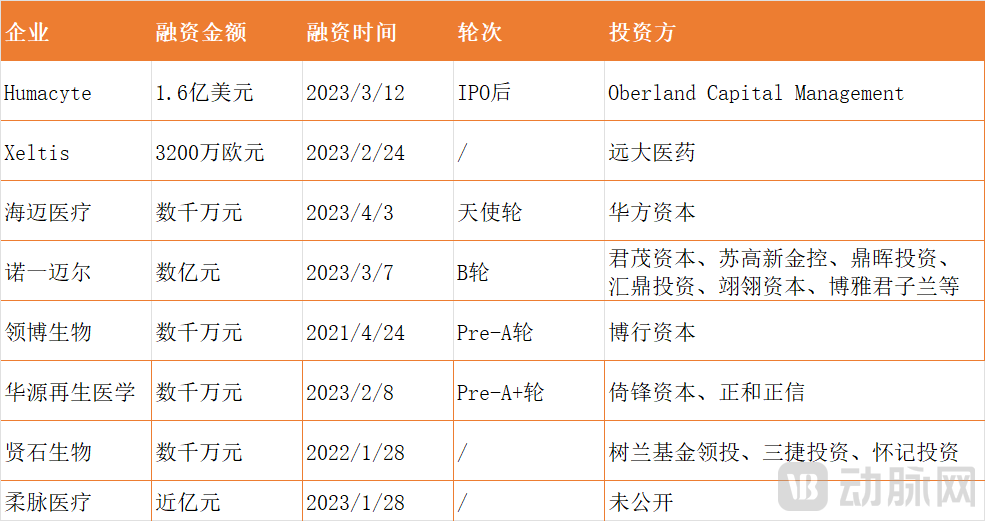
Financing in China’s Tissue Engineering Scaffold Sector (Note: Data compiled from public sources. Companies not included are welcome to contact VCBeat for further discussion.)
Based on the current distribution of companies, artificial blood vessels are the focal product for tissue engineering technology enterprises at this stage. Many tissue engineering companies have artificial blood vessel products in their pipelines.
Global medical device companies are also turning their attention to this sector.
Artificial vascular grafts are essential consumables for creating arteriovenous fistulas in dialysis patients. In 2018, Fresenius, a company in the hemodialysis sector, acquired a stake in Humacyte for $150 million as part of a strategic partnership. In 2021, Fresenius extended the collaboration period and made an additional investment of $25 million in Humacyte.
Humacyte is a pioneer in the field of tissue engineering. Founded by Yale University academician Laura E. Niklason, who has been dedicated to researching the creation of blood vessels and tissues using bioreactors, Humacyte initiated clinical trials for its tissue-engineered vascular grafts in 2013 and recently announced the six-year results from its Phase II study.
Grand Pharmaceutical, which has been actively investing in the cardiovascular and cerebrovascular sectors, also invested approximately RMB 100 million in Xeltis, an overseas company specializing in synthetic blood vessels. Grand Pharmaceutical will hold the rights for the development, manufacturing, and commercialization of Xeltis’ products in the Greater China region.
Currently, in addition to developing synthetic blood vessels, Xeltis is also developing the bioresorbable pulmonary valve, Xeltis PV. Fabricated using electrospinning technology, Xeltis PV features a dense porous microstructure. These porous microstructures enable rapid infiltration by the patient’s own tissue, ultimately leading to the formation of a new, native heart valve.
Not limited to financial investment, the two companies have also secured in advance the commercialization rights for tissue engineering-related products, demonstrating their strong confidence in this technology.
Among domestic enterprises, several companies, including LeadBio, Roumai Medical, Haimai Medical, and Nuoyi Maier, have established a presence in the field of tissue engineering, with multiple firms securing financing in the first half of the year.
Lingbo Bio’s products under development include approximately 10 tissue-engineered products, such as bio-based small-diameter vascular grafts, bio-based large-diameter vascular grafts, artificial esophagus, vascular patches, biological tissue patches, and hydrogel series products.
Roumai Medical has achieved breakthrough progress in the field of small-diameter tissue-engineered artificial blood vessels, adopting a fully biomimetic technical route that replicates the human body’s tissues. This approach mimics the three-layer structural composition of blood vessels—endothelial cells, smooth muscle, and adventitia—within the realm of vascular regeneration. In addition to its second-generation tissue-engineered blood vessels, Roumai Medical is actively advancing its third-generation electronic blood vessel technology. As a platform-based regenerative medicine and brain-computer interface company, Roumai Medical has assembled an interdisciplinary talent pool spanning chemistry, materials science, biomedical engineering, synthetic biology, mechanical engineering, electronics, software, hardware, chip design, and AI algorithms. Looking ahead, the company aims to develop a comprehensive portfolio of regenerative medicine products, including humanized blood vessels, humanized tissue patches, humanized heart valves, and humanized collagen, while also creating more groundbreaking products for in situ human monitoring and functional enhancement.
Haimai Medical initially focused on the development and production of allogeneic small-diameter tissue-engineered blood vessels, which are suitable for establishing vascular access for hemodialysis in chronic renal failure, replacing injured lower extremity arteries, treating lower extremity atherosclerosis, and performing coronary artery bypass grafting.
Nuoyi Mai’er’s product portfolio encompasses key technological pathways in tissue engineering, including electrospinning, 3D printing, and chemical synthesis. It features a diverse range of product forms such as membranes, bone grafts, hydrogels, and agents, extending its applications to multiple clinical specialties including dentistry, ophthalmology, otolaryngology, surgery, reproductive medicine, and sports medicine.
Why Are Tissue Engineering Companies Gaining Increased Attention in the Capital Markets?
Dr. Luo Wangqian, Partner at Huafang Capital, once stated: “Following small-molecule and large-molecule drugs, living cells, as a more complex therapeutic modality, have entered clinical practice in recent years, benefiting patients. We believe that with breakthroughs in multiple key technologies, the ex vivo ‘replication’ of tissues and organs—which are more complex than individual cells—will soon become one of the focal points for biotechnology research and investment in the next stage.”
From a commercialization perspective, which products and fields are expected to be transformed by tissue engineering technology?
First, the product closest to commercialization is tissue-engineered artificial blood vessels. Traditional artificial blood vessels are produced by manual weaving, whereas tissue-engineered artificial blood vessels are grown in vitro.
A representative from Roupai Medical stated, “Existing artificial vascular grafts are made from expanded polytetrafluoroethylene (ePTFE) and polyester materials. These materials are prone to calcification and thrombosis, which compromise long-term patency rates. Material limitations have precluded the development of small-diameter artificial vascular grafts with a diameter of less than 6 mm for use in coronary artery bypass grafting. To date, no such small-diameter artificial vascular graft products have been launched on the market.”
“Tissue-engineered artificial blood vessels are essentially products primarily composed of human collagen and elastin. Compared with polymer materials, they are less prone to rejection reactions and demonstrate superior performance in anti-infection, anti-calcification, anti-proliferation, and long-term patency rates.”
Based on clinical data released by Humacyte, a pioneer in tissue-engineered vascular grafts, these grafts can achieve zero rejection and zero infection. In terms of long-term patency, some Humacyte grafts have remained functional in vivo for up to ten years, demonstrating the anti-calcification advantages of tissue-engineered vascular grafts.
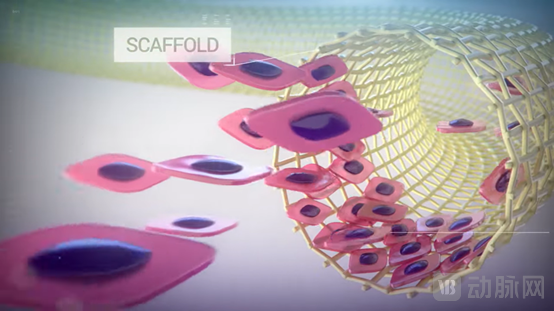
Schematic Diagram of Humacyte Product Manufacturing
In the future, tissue-engineered artificial blood vessels are expected to be used in scenarios such as dialysis arteriovenous fistulas, pediatric cardiac surgery, vascular trauma repair, peripheral artery disease, and coronary artery bypass grafting.
In orthopedics, tissue engineering scaffold technology can be used for the development of articular cartilage.
Repair of damaged articular cartilage has long been a major challenge. Human articular cartilage has poor self-repair capacity, making natural regeneration difficult after injury. Existing clinical treatments generally fail to regenerate hyaline cartilage.
Articular Cartilage Tissue EngineeringArticular cartilage tissue engineering constructs bioactive cartilage tissues using principles and methods from biology and engineering to repair and improve articular cartilage defects, thereby accelerating the recovery of joint function. This approach involves harvesting and extensively expanding chondrocyte seed cells in vitro, seeding them onto widely available, mass-producible, and shapeable biomaterials to create chondrocyte–3D scaffold complexes in vitro, which are then implanted into the body to repair various articular cartilage defects.
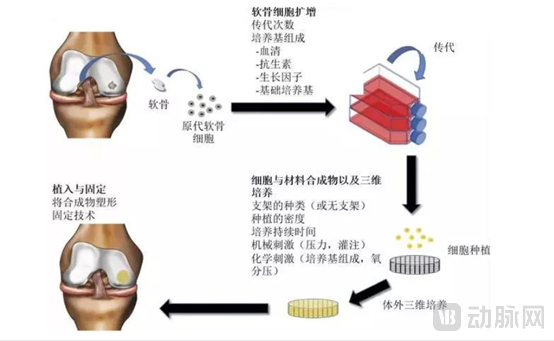
Domestic company Nuoyi Maier is developing articular cartilage regeneration products, dedicated to promoting the regeneration of true hyaline cartilage and its subchondral bone without the use of cells, growth factors, or other drugs.
In addition to the fields of cardiovascular medicine and orthopedics, tissue engineering technology can also be applied in dentistry for the repair of defects in the jawbone, alveolar bone, and dental hard tissues; and in gynecology for endometrial repair.
The potential of tissue engineering scaffold technology is undeniable, and there is no shortage of research worldwide that remains at the laboratory stage. However, for tissue engineering technology to achieve large-scale clinical application, it must first clear the hurdle of commercialization.
Industry leader Humacyte has been exploring commercialization for a decade. On the surface, Humacyte’s product commercialization has been slow. There are several key reasons behind this sluggish pace.
As a pioneer in the industry, Humacyte explored the field from scratch. Compared to later entrants, it has had to address more challenges, and as a technological trailblazer, Humacyte has embarked on a longer journey.
From a regulatory approval perspective, Humacyte’s tissue-engineered vascular grafts are classified as biological products, rather than medical devices, under FDA regulations. Traditional therapeutic modalities, namely drugs and medical devices, primarily focus on diseased tissues, whereas regenerative medicine centers on the creation of new cells, tissues, and organs. From this standpoint, regenerative medicine can be regarded as being on par with pharmaceuticals and medical devices.
Therefore, to address issues related to the approval of regenerative medicine products, the FDA established the Regenerative Medicine Advanced Therapy (RMAT) designation in 2016. Products granted RMAT designation gain access to the FDA’s expedited review pathway, enabling more frequent communication with review officials and accelerating market entry.
Humacyte was the first company to receive Regenerative Medicine Advanced Therapy (RMAT) designation. However, as a novel product, the approval of its tissue-engineered human acellular vessels still required a prolonged period of exploration, even under the Fast Track pathway. In terms of team dynamics, Humacyte’s team has maintained a relatively laid-back approach, resulting in slower overall progress in commercialization.
For commercialization, regulatory approval for market launch is not the endpoint; products often require continuous iteration after being launched.
A representative from Roumai Medical stated: “The market tests true product strength. In the field of tissue engineering, two to three years of refinement is far from sufficient to create dominant, enduring products; the entire industry must exercise ample patience. This is particularly true for domestic companies, which still need to achieve breakthroughs in many foundational technologies, including core raw material technologies and upstream equipment technologies.”
Specifically regarding products, tissue-engineered vascular grafts still need to address the issue of compatibility with different anatomical sites.
Among tissue-engineered products, articular cartilage was predicted by the industry to be one of the first bodily tissues successfully manufactured; however, it still faces significant challenges, with few studies advancing to clinical trials. A key factor contributing to this hurdle is the biomechanical mismatch between engineered neocartilage implants and the surrounding native cartilage tissue. While it is relatively easy to produce neocartilage with consistent biochemical properties in vitro, its immature structure results in biomechanical properties that are inferior to those of native, mature articular cartilage.
In the future, the vast potential of tissue engineering extends far beyond artificial blood vessels or articular cartilage. From the perspective of current disease treatment, tissue engineering holds the promise of replicating tissues and organs, thereby providing entirely new therapeutic approaches for existing medical conditions. From a longer-term perspective, tissue engineering technology could serve as a vehicle for extending human life. While brain-computer interface technology is exploring the continuation of individual consciousness, the replication of the physical body may one day be achieved through tissue engineering.
References:
"Regenerative Medicine Report"
Tissue Engineering—The Ultimate Regenerative Medicine—New Medical Valley
[Review] Research Progress on Layered Scaffolds in Osteochondral Tissue Engineering—Chinese Journal of Orthopaedics