

Nationwide Rollout to Township-Level Units Drives Over 3 Million Unit Demand, Propelling AED Industry into a RMB 100 Billion Market Opportunity

yuwell
Developer and Manufacturer of Basic Medical Devices

Mindray
Medical Device R&D Manufacturer
For a long time, pre-hospital emergency care in China has been neglected. As a critical device within the pre-hospital emergency system, the availability of Automated External Defibrillators (AEDs) reflects the level of emergency medical services in a given region. Data from the report “Analysis of the Current Status of AED Deployment in China and Countermeasures” shows that around 2019, China had only two AEDs per 100,000 people, a stark contrast to the Netherlands, which had 596 AEDs per 100,000 people.
Despite the current lag in AED deployment, this also signifies immense market potential. Driven by increased government investment, supportive policies, heightened public health awareness, wider dissemination of first-aid knowledge, breakthroughs in domestically produced AEDs from scratch, and the rapid development of China’s AED industry, the number of AEDs installed in China has been steadily increasing in recent years. Since the beginning of this year, a wave of AED deployment has swept across various regions. With future demand expected to exceed 3 million units, the AED industry is poised to capture a trillion-yuan market opportunity.
AEDs Are Beginning to Penetrate Village-Level Primary Healthcare Institutions.
On June 5, the Shiyan Municipal Government issued the “Implementation Plan for the Deployment of Automated External Defibrillators (AEDs) in Urban and Rural Public Spaces in Shiyan City,” announcing that AEDs will be installed in urban and rural public areas, village clinics, public middle schools, residential communities with property management, scenic spots, elderly care institutions, and other locations. Shiyan has thus become the first city in China to deploy AEDs at the village-level clinic tier.
According to the plan, Shiyan will equip over 300 urban and rural public venues, 1,856 village clinics, public middle schools, and residential communities with property management services with automated external defibrillators (AEDs) over the next three years. This initiative adheres to the standard of 100–200 AEDs per 100,000 people, as recommended by the World Health Organization and the “Expert Consensus on the Layout and Deployment of AEDs in China.” Based on Shiyan’s population of 3.2 million, this requires the deployment of 3,200–6,400 AEDs. At a unit price of RMB 20,000 per AED, Shiyan is projected to spend RMB 64 million to RMB 128 million on AED procurement over the next three years.
Shiyan Sets a Precedent for AED Coverage in Village-Level Primary Healthcare Institutions.
The introduction of this policy stems not only from the national government’s longstanding appeals but also from Shiyan City’s formulation of measures tailored to local conditions. According to reports, a survey conducted by the Shiyan Emergency Medical Center revealed that cardiovascular and cerebrovascular diseases are the leading cause of death in rural areas. Due to the considerable distance from hospitals, timely emergency care is often difficult to access, making it essential to deploy automated external defibrillators (AEDs) in rural communities.
It is against this backdrop that the Plan incorporates the deployment of automated external defibrillators (AEDs) in public places as a key component of the Healthy Shiyan initiative and as an important measure to improve the pre-hospital emergency care system.
Configuration is only the beginning. Shiyan has also relied on the Municipal Emergency Center and 120 command centers at all levels to establish a citywide information management and public inquiry platform for AED configuration and application, as well as an electronic map, navigation, and remote management system for AEDs, facilitating public access and use. Meanwhile, the Shiyan Municipal Health Commission formulated the "Measures for the Administration of Automated External Defibrillator Configuration in Urban and Rural Public Places in Shiyan City," clarifying technical specifications and operational procedures, and conducted AED emergency response training at 151 emergency centers (stations) across the city to enhance the population’s ability for self-rescue and mutual aid.
Shiyan is the first city in China to deploy automated external defibrillators (AEDs) to village-level health clinics. In the future, more regions will equip village-level units with AEDs, and the momentum toward comprehensive AED deployment has become irreversible.
In recent years, the Chinese government has successively introduced multiple policies to boost the penetration of automated external defibrillators (AEDs).
According to statistical data from the National Center for Cardiovascular Diseases of China, there are up to 550,000 cases of sudden cardiac death in China each year, with an average of 1,500 people dying from cardiac arrest every day. Every minute, one person suddenly collapses due to cardiac arrest, and 87% of these incidents occur outside of hospitals.
Studies have shown that if CPR is immediately administered and an AED is used for emergency rescue within one minute of sudden cardiac arrest, the survival rate can reach 90%; for every minute of delay, the success rate decreases by 7%–10%. If cardiac arrest lasts longer than 4 minutes, permanent brain damage will occur. Therefore, these 4 minutes are referred to as the "Golden 4 Minutes" of emergency rescue.
AED: A medical device capable of diagnosing specific arrhythmias and delivering defibrillation shocks, designed for use by laypersons to rescue patients experiencing cardiac arrest; it is widely recognized as a “lifesaving miracle” for cardiac arrest resuscitation.
However, the AED deployment rate in China has long been too low, with fewer than two units per 100,000 people. According to data from the 2020 “Expert Consensus on AED Layout and Deployment in China,” the United States and Japan have an average of 700 and 276 units per 100,000 people, respectively, indicating a significant gap between China and these countries.
In recent years, driven by national policies, the widespread adoption of public health awareness, and the impetus from high-profile public incidents, the deployment of automated external defibrillators (AEDs) in China has gradually accelerated.
As early as 2010, Hainan Province promulgated the Regulations on the Red Cross Society of Hainan Province, becoming one of the first regions in China to incorporate automated external defibrillators (AEDs) into its legislation. In 2015, the Shanghai Red Cross Society launched an AED pilot program, deploying AEDs in public places such as airports and subway stations. In 2017, the Shenzhen Municipal Government included the “Public Defibrillation Program” as a key livelihood project. In 2019, the General Office of the State Council released the Healthy China Action (2019–2030), mandating the installation of AEDs in densely populated areas, including schools, government agencies, enterprises, public institutions, airports, railway stations, port passenger terminals, and large shopping malls.
By the end of 2021, the National Health Commission had formulated the Guidelines for the Configuration of Automated External Defibrillators in Public Places (Trial), after which various regions across China successively issued documents on AED configuration, leading to an expansion of the domestic market.
In 2022 alone, more than 20 provinces and municipalities announced AED deployment plans, including Shenzhen, Hainan, Fujian, Jiangxi, and Sichuan. If the National Health Commission’s standard of 100–200 units per 100,000 people is applied,China’s AED deployment could reach approximately 3 million units, with a market size nearing RMB 60 billion. If the penetration rate were to match that of developed countries such as the United States and Japan, the market would surpass the RMB 100 billion mark.
Driven by national policies and the progressive implementation of AED deployment initiatives across various regions, market demand for automated external defibrillators (AEDs) will continue to grow, leading to rapid expansion of the market size.
Starting this year, health commissions and Red Cross societies across China have begun procuring AEDs in phases.
Public information from the China Government Procurement Network reveals that procurement activities have taken place in regions including Guangdong, Shanghai, Hubei, Xinjiang, and Zhejiang, with numerous projects exceeding RMB 10 million.
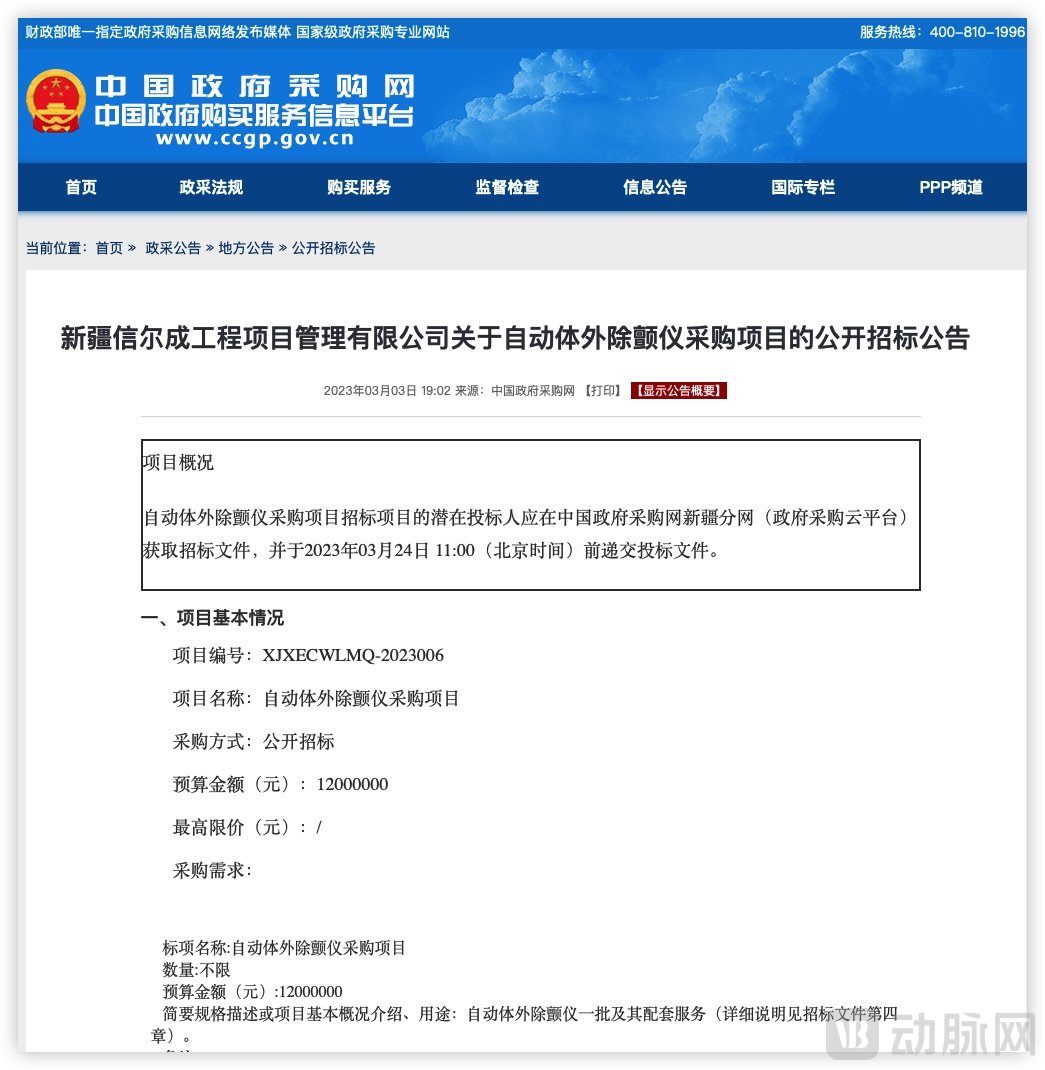
AED Tender Notice, image source: China Government Procurement Network
Such as the Xinjiang Uygur Autonomous Region Health Commission’s AED procurement project with a budget of RMB 12 million; the Shuangliu District Health Bureau of Chengdu issued the “Public Tender Announcement for the 2023 Public Place Automated External Defibrillator (AED) Configuration Procurement Project,” with a budget of RMB 4.9 million to purchase 200 AEDs; the “Procurement Announcement for the Fenyang City Health and Sports Bureau’s Project to Procure Automated External Defibrillators for Public Places,” with a budget of RMB 8.125 million to purchase 325 AEDs; and the Xihu District Health Bureau of Hangzhou allocated an even higher budget of RMB 16 million for AED procurement.
The large-scale deployment of AEDs stems from the implementation of the "Hangzhou Municipal Administration Norms for the Configuration and Maintenance of Automated External Defibrillators in Public Places" last June. The norms mandate AED placement based on factors such as population density, foot traffic, and distribution distance, adhering to the principle that an AED should be accessible and reachable at the scene within 3–5 minutes. The procurement in Xihu District is merely the beginning; demand for AEDs in Hangzhou is expected to remain strong in the future.
In addition to the frequently surging procurement demands, changes in purchasing entities also warrant attention.
Historically, AED procurement has been dominated by provincial-level health commissions and Red Cross societies. This year, however, numerous county-level entities and educational institutions—including vocational colleges, primary schools, and secondary schools—have emerged as significant purchasers. With the introduction of policies across multiple sectors such as education and sports, demand for AEDs in public venues throughout China is poised for sustained explosive growth.
Widely deployed AEDs have repeatedly demonstrated their value in emergency situations. For instance, Hongshan District in Wuhan has installed 270 AEDs across various public spaces within the district. In May this year, a school nurse at the Jianhe Branch of Luxiang Experimental Primary School successfully resuscitated a parent who had collapsed while picking up students after school, using an AED. Similar scenarios have frequently unfolded this year in supermarkets, parks, and ports, with multiple successful rescues providing positive momentum for recognizing the value of AEDs.
Faced with a product that has achieved both market success and strong reputation, Chinese manufacturers are naturally eager to enter the fray.
Continuous breakthroughs by domestic manufacturers in the AED sector have contributed to the healthy development of the Chinese market.
Prior to the emergence of domestically produced AEDs, the Chinese market was dominated by foreign brands such as Philips, ZOLL, and Nihon Kohden. With unit prices ranging from approximately RMB 40,000 to 90,000, the high cost hindered the widespread adoption of AEDs to some extent.
In 2013, Mindray developed China’s first domestically produced automated external defibrillator (AED) and launched it on the market, marking a breakthrough from zero for domestic brands in the AED sector. With the growth of the AED market, domestic companies including Mindray, Yuwell, Jiuxin, Weiweisi, Comen, and Ruixin Kangda have begun to exert greater efforts, increasing investment and R&D intensity in hopes of breaking the import monopoly and achieving domestic substitution.
During this period, Mindray developed China’s first biphasic waveform AED with independent intellectual property rights, breaking through the technical barriers established by over 1,000 patents held by foreign brands. It also secured 18 invention patents, achieving innovation at both the technological and product levels.
In its annual report, Mindray classified its AED products as a seed business, stating that it would continue to increase R&D investment to focus on nurturing this segment. Based on its positive outlook for seed businesses, Mindray has raised its revenue targets for the next three years, expecting these related operations to gradually grow into a core pillar supporting the company’s long-term development.
It is precisely due to its strong product competitiveness that Mindray has repeatedly secured major procurement contracts, such as the exclusive bid for the Wuhan Municipal Health Commission’s project last year, which involved a one-time purchase of 4,000 AED units with a total budget of RMB 64 million.
Another listed company, yuwell, acquired 100% equity of the German company Metrax GmbH for €11.7 million, thereby obtaining its brand PRIMEDICTM, which has been focused on the AED field for many years. It also attracted investment from Tencent. Both parties will leverage their respective advantages and resources to promote the popularization and implementation of emergency first-aid measures.
Following the approval of Primedic products, yuwell leveraged its channel advantages to deploy units across various public spaces throughout China, including train stations, subway stations, airports, schools, tourist attractions, and shopping malls. The company provided life-saving support for hundreds of thousands of participants in marathons at all levels nationwide and conducted nearly 100 training sessions on first aid and AED usage for enterprises, institutions, and communities.
It is not only Mindray and Yuwell; in recent years, products from numerous domestic enterprises, including Jiuxin Medical, Weiweisi, Comen Medical, and Xi’an Ruixin Kangda, have obtained registration certificates.
With the increasing number of domestically produced AED products entering the market, not only has China’s capacity for health emergency and first aid been continuously enhanced, but the price of AED devices has also dropped significantly. According to data from the China Government Procurement Network, the current winning bid price for domestic AEDs is approximately RMB 20,000 per unit, a substantial decrease compared to previous levels, which has greatly accelerated the popularization of AEDs.
As the aging of China’s population intensifies, the incidence rates of myocardial infarction, coronary heart disease, and sudden cardiac death are gradually rising. Consequently, the demand for defibrillation and emergency rescue equipment, such as automated external defibrillators (AEDs), will continue to grow. The domestic AED market in China offers broad prospects, necessitating that manufacturers promptly iterate their products to address an expanding range of application scenarios.
From 0 to 1 is just the beginning; domestically produced AEDs are continuously being upgraded and iterated.
In defibrillation technology, there remains a gap between domestically produced products and imported brands, but Chinese manufacturers are rapidly closing this distance by leveraging the advantages of domestic supply chains. For AEDs, a public health initiative that benefits society as a whole, the true challenge lies in subsequent management, operation, and maintenance.
An analysis of current AED deployment strategies reveals that these devices are distributed across both public areas, such as airports and railway stations, and private premises, including hotels and shopping malls. This mix of public and private settings poses significant challenges for subsequent management. As emergency medical equipment, AEDs require regular maintenance checks to ensure proper functionality after installation. While areas with designated managers can assign responsibility to them, the maintenance of many public spaces still lacks clear accountability. Establishing the necessary regulations and defining the roles of relevant administrative departments will take time.
On the other hand, the maintenance cost of AEDs is also a factor that must be taken into account. Although core components can theoretically be reused multiple times, certain consumable parts, such as electrode pads, need to be replaced after each use. The batteries that power AEDs have a theoretical lifespan of only 4–5 years, with replacement costs amounting to approximately RMB 2,000. When the number of devices is small, this portion of the cost is not particularly noticeable; however, once AED deployment across society reaches a certain scale, the labor expenses for routine maintenance and inspections alone become substantial. In addition, training for relevant personnel represents another significant expenditure.
Fortunately, the widespread adoption of IoT technology in China has enabled manufacturers to find a way to break through the impasse.
Currently, AED products from many domestic manufacturers can connect to the internet to perform self-checks on electrode pad expiration dates and battery levels, then transmit the relevant data to a centralized platform. This allows users to monitor the status of all AED devices through the platform, eliminating the need for traditional manual inspections. This approach significantly improves AED management efficiency and reduces labor costs associated with actual maintenance operations.
For instance, Jiuxin Medical has developed an AED Emergency Response Map mini-program for end-users and the JOUnet AED Management System Platform for administrators. Users can locate AEDs through visual navigation on the mini-program and trigger one-click emergency alerts that mobilize volunteers to ensure rapid emergency response. The JOUnet AED Management System Platform provides one-stop AED device management, refined personnel management, and scenario-based solutions. It establishes a closed-loop linkage across four dimensions—space, time, personnel, and emergency response—and integrates with third-party systems such as the 120 emergency medical services system and urban surveillance systems, thereby delivering customized intelligent emergency care solutions.
Furthermore, some domestic manufacturers have delved into actual needs and expanded AED application scenarios.
Suzhou Weiweisi Medical Technology Co., Ltd. has not only developed traditional fixed-location AED devices but also independently created a mobile AED device. This compact unit, roughly the size of a smartphone and weighing approximately 600 grams, can be installed on buses, taxis, and patrol cars. It receives emergency alerts through a management system, enabling immediate dispatch to the scene. Leveraging this lightweight technology, Weiweisi has partnered with AVIC Jincheng, a subsidiary of the Aviation Industry Corporation of China (AVIC), to develop drone-mounted AEDs. These are designed for use in large scenic areas, mountainous villages, and densely populated regions. By overcoming ground-based limitations, drone-delivered AEDs significantly reduce emergency response times.
As previously mentioned, the future domestic AED market in China represents a vast opportunity, with a market size exceeding RMB 100 billion and a deployment volume surpassing 3 million units. In the gradual progress toward deployment targets, new demands and challenges will inevitably arise. Companies that can provide tailored solutions to address these practical realities will gain a competitive edge in the future.
Not only in the domestic market, but Chinese-made AEDs are also vigorously expanding into overseas markets. Mindray’s AED business in Europe achieved doubled growth in 2022, with large-scale installations in the United Kingdom, France, the Netherlands, Italy, Norway, and other countries. During an investor conference, Mindray stated that medical devices in Europe are currently in a replacement cycle, making the local market a significant source of incremental growth for its AED business. After catching up with international brands in terms of technology, Chinese-made devices have become highly competitive in overseas markets by offering more comprehensive services and features.
Miracles do not come easily, but the widespread adoption of public first-aid skills and emergency equipment can create more possibilities for miracles to occur.