

Nearly 500 Class II Innovative Medical Devices Approved in Two-and-a-Half Years Signal Key Industry Shifts

T-capital
Boutique Investment Bank
As June begins, China’s innovative medical devices appear to have entered a harvest period. In just nine days, from June 1 to June 9, five innovative medical devices were approved for market launch: the “Coronary Intervention Surgical Control System and Its Single-Use Accessories,” the “Electronic Colonoscopy Image-Assisted Detection Software for Colonic Polyps,” the “Carbon Ion Therapy System,” the “Implantable Left Ventricular Assist System,” and the “Multimodal Tumor Therapy System.” This is a relatively rare occurrence, indicating that China’s innovative medical device sector is ushering in a new phase of development.
To date, the term “innovative medical devices” has primarily referred to Class III innovative medical devices listed by the National Medical Products Administration (NMPA). In fact, this does not represent the full picture. Beyond Class III devices, numerous Class II innovative medical devices remain largely unrecognized, akin to hidden gems, yet they still exemplify the direction of innovation in the medical device sector. To provide a comprehensive overview of innovation in China’s medical device industry, VCBeat (WeChat ID: VCBeat) has conducted a review of the current status of Class II innovative medical devices in China in recent years.
As early as 2000, the "Regulations on the Supervision and Administration of Medical Devices" clarified the classified and graded management of medical devices. Class II medical devices are subject to approval by provincial-level drug regulatory authorities, while Class III medical devices, which pose greater risks, are subject to approval by the national drug regulatory authority.
A similar model is followed for innovative medical devices. In February 2014, the former China Food and Drug Administration (CFDA) formulated the “Special Examination and Approval Procedures for Innovative Medical Devices (Trial),” which came into effect in March 2014. Article 11 explicitly states that if an innovative medical device under application is classified as a Class II or Class I medical device, the corresponding provincial or municipal-level regulatory authorities shall carry out subsequent procedures and review and approval in reference to these Procedures.
Various regions also began to formulate their own innovative medical device approval procedures, tailored to local conditions, by referencing the National Medical Products Administration’s (NMPA) framework for innovative medical devices. Among them, Shandong, Hubei, and Guangdong moved swiftly, issuing their respective local innovative medical device approval procedures in April, May, and December 2015. Subsequently, other regions followed suit.
The primary purpose of establishing an approval process for innovative medical devices is to shorten the review time for such products. Consequently, various regions have made corresponding adjustments based on their local circumstances. For example, Shandong and Hubei both required regulatory authorities to issue review opinions within 30 working days, whereas Guangdong required them to do so within 20 working days.
In early 2017, the former China Food and Drug Administration (CFDA) began implementing the "Priority Review Procedures for Medical Devices." Unlike the Innovation Program, which focuses on innovation, the Priority Program is more geared toward facilitating devices intended for emergency response and major scientific research purposes. It specifies three categories of situations eligible for priority review.
First, the priority review procedure may be applied to medical devices for rare diseases, malignant tumors, geriatric diseases, pediatric diseases, and other conditions with urgent clinical needs, which demonstrate significant clinical advantages and have no similar products registered in China. Second, this applies to medical devices included in the National Science and Technology Major Projects or the National Key Research and Development Program. Finally, it covers other medical devices that should be subject to priority review.
At this time, the policies formulated by the National Medical Products Administration (NMPA) included two “green channels”: the Special Examination and Approval Procedure for Innovative Medical Devices, which focuses on innovation, and the Priority Examination and Approval Procedure, which is primarily intended for emergency response and major scientific research purposes. Some regions merged these two policies into one when formulating local regulations; for example, the Hunan Province Measures for Expedited Examination and Approval of Medical Device Registration, implemented in February 2017, made specific provisions to this effect.
Article 8 of the Measures for Expedited Approval of Medical Device Registration in Hunan Province stipulates seven categories of medical devices eligible for expedited approval. The first category specifically refers to innovative medical devices, while the remaining six fall under medical devices qualifying for priority review procedures.
Regions similar to Hunan include Shaanxi, Anhui, Beijing, Tianjin, Hubei, and Guangxi, where local policies have all adopted an expedited approval process that combines innovative medical devices and priority-review medical devices into a single framework.
In November 2018, the National Medical Products Administration (NMPA) revised the original “Special Approval Procedures for Innovative Medical Devices (Trial).” The revised “Special Review Procedures for Innovative Medical Devices” officially came into effect in December 2018, replacing the previous trial procedures.
The revised innovation program has made key supplements to the patent-related requirements for innovative medical devices. It adds a requirement that the time between the examination application and the patent grant announcement date shall not exceed five years; the patent must be accompanied by a search report issued by the Patent Search and Consultation Center of the China National Intellectual Property Administration, which explicitly states that the product’s core technical solution possesses novelty and inventiveness, among other more concrete requirements.
Relatively speaking, the new regulations impose stricter requirements on the “innovation” of innovative medical devices, not only specifying precise patent timelines but also requiring companies to demonstrate the “innovative” nature of their products through evaluation by patent agencies.
Subsequently, various regions have successively revised their original expedited approval procedures for Class II innovative medical devices based on this framework, and these revisions remain in effect to this day.
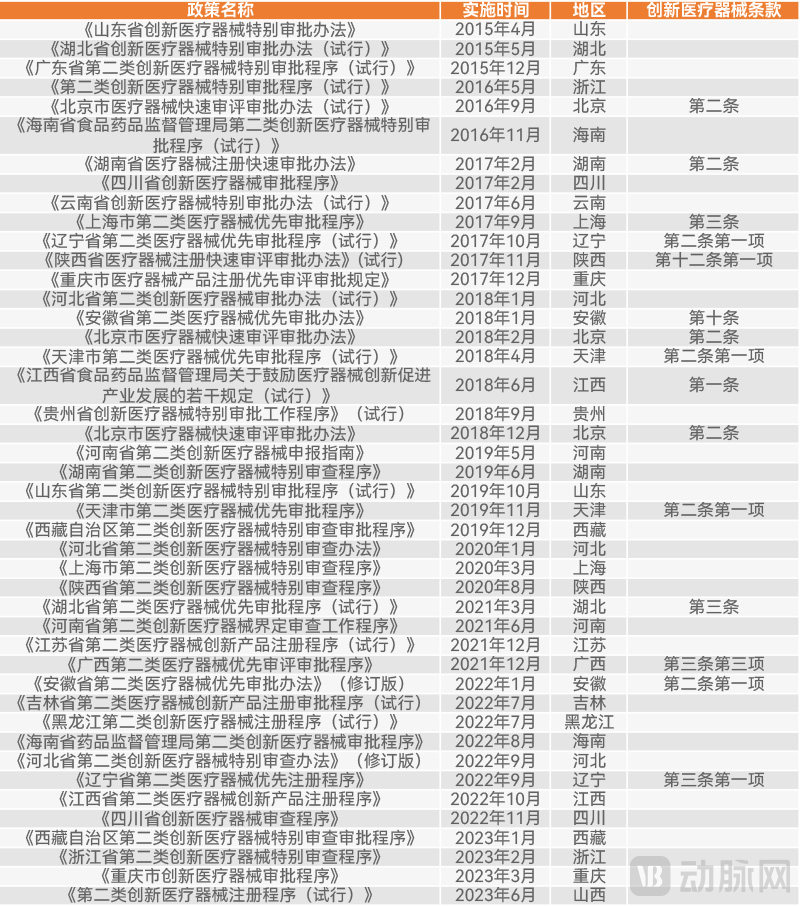
Approval Policies for Class II Innovative Medical Devices Across Regions Over the Years (Chart by VCBeat)
According to VCBeat statistics, as of June 10, a total of 26 provincial medical products administrations have issued 44 special approval procedures for Class II innovative medical devices, which has significantly promoted the development of such devices in China.
Dr. Wang Yueyue, Partner at T-capital, has long tracked the development of domestically produced innovative medical devices. She noted that a series of measures have consistently demonstrated strong national support for innovative medical devices, ranging from policy to action. These include the National Medical Products Administration’s 2018 release of the Special Review Procedure for Innovative Medical Devices, which further streamlined the approval process and shortened review times; the June 2022 refinement of the fifth listing standard on the STAR Market to support the listing of unprofitable innovative medical device companies; and the September 2022 clear response from the National Healthcare Security Administration stating that “volume-based procurement is not yet feasible for innovative medical devices due to their immature clinical application and the current difficulty in estimating usage volumes.”
According to VCBeat’s statistics on the public notices of review results for Class II innovative medical devices issued by provincial drug administrations, three scenarios have been identified in the public notices across provinces.
First, the locality has formulated policies specifically targeting Class II innovative medical devices. Second, the locality’s expedited approval policy covers both Class II innovative medical devices and Class II priority-review medical devices, with the reasons for inclusion clearly specified in the publicly announced list. Third, the locality’s expedited approval policy also covers both Class II innovative medical devices and Class II priority-review medical devices, but the publicly announced list does not explicitly indicate the reasons for inclusion.
Among these, the first two categories can be definitively classified as Class II innovative medical devices. According to statistics, from 2020 to June 10, 2023, a total of 12 provincial drug administrations publicly announced a combined total of 380 identifiable Class II innovative medical devices.
Anhui and Chongqing fall under the third category. Anhui began implementing the "Measures for Priority Review and Approval of Class II Medical Devices in Anhui Province" in January 2018, with a revised version taking effect in January 2022. Although Chongqing recently issued the new "Chongqing Municipality Approval Procedures for Innovative Medical Devices" in March 2023, it has been in effect for only a short period, and no Class II innovative medical devices have been publicly announced under the new regulations to date. Prior to this, expedited approval was conducted in accordance with the "Provisions on Priority Review and Approval for Medical Device Product Registration in Chongqing Municipality," which came into effect in December 2017. Meanwhile, neither region’s public lists provide explanations for the selection rationale.
VCBeat conducted a one-by-one comparison of the publicized lists from both regions against the National Medical Products Administration’s (NMPA) domestic medical device registration database. This assessment was based on criteria such as whether registered devices of the same category already existed, whether the device in question was the earliest registered within its category, and whether its entry into the public notice period preceded the approval date of the earliest registered device in that category. Additionally, publicly available information, including relevant corporate patents, was reviewed to estimate whether these devices qualified as Class II innovative medical devices. Nevertheless, this determination remains an approximate estimation and should be used for reference purposes only.
It is estimated that from 2020 to June 10, 2023, the number of products likely approved as Class II innovative medical devices in Chongqing and Anhui were 39 and 61, respectively.
Including the previously confirmed 412 Class II innovative medical devices, it is estimated that a total of 480 Class II medical devices entered the local green channels for innovative medical devices across China from 2020 to June 10, 2023.
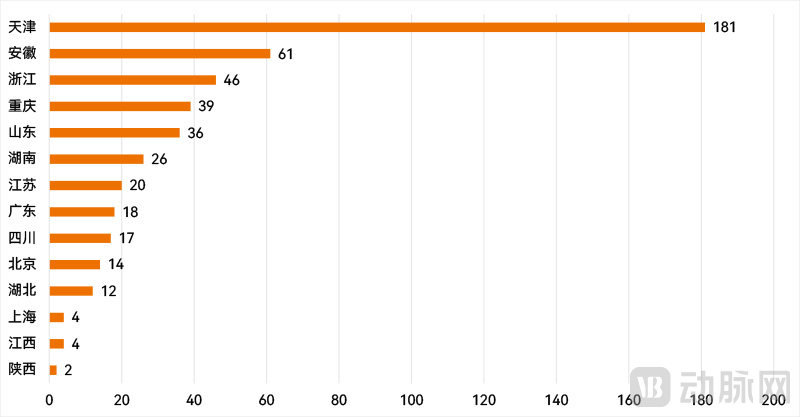
Number of Products Entering the Class II Innovative Medical Device Approval Process in Various Regions (Chart by VCBeat, 2022–June 10, 2023)
In terms of the number of products that have entered the expedited approval pathway for Class II innovative medical devices in various regions in recent years, Tianjin undoubtedly takes the lead, with a total of 181 Class II innovative medical devices publicly listed—far exceeding other regions and accounting for nearly 40% of the national total of 480 such devices.
Excluding Anhui and Chongqing, whose figures are estimates, Zhejiang ranked second in the number of Class II innovative medical devices granted expedited approval, with 46 products during this period. Shandong followed with 36 products. Apart from Zhejiang, the number of Class II medical devices entering the expedited approval pathway from provinces traditionally regarded as major players in the medical device industry was relatively low, indicating rather mediocre performance.
Upon reviewing the National Medical Products Administration’s summary of regulatory approvals for Class III innovative medical devices, it is evident that the highest number of approved products originated from companies registered in Beijing, Shanghai, Guangdong, Jiangsu, and Zhejiang. These regions accounted for approximately 82.5% of the total 189 innovative medical devices approved as of 2022, a distribution pattern that differs significantly from that observed for Class II innovative devices.
VCBeat believes that there may be several reasons for this discrepancy.
First, this is partly related to the prior development level of the medical device industry. A review of the approval procedures for Class II innovative medical devices across various regions reveals a basic requirement: “first-of-its-kind in the province (or municipality) and technologically leading.” In provinces with strong medical device industries, many products have already been marketed, leaving relatively limited room for innovation. In contrast, late-developing regions, due to their previously incomplete local industrial chains, actually have greater scope for advancement. Meanwhile, the definition of “technologically leading” also varies among regions with different levels of medical device industry development.
Secondly, this is partly related to the development level of local medical device enterprises. Regions with a more advanced medical device industry have seen the agglomeration of leading companies. Unless their core business is concentrated in low-to-medium risk products under Class II medical devices, these sizable enterprises are generally more willing and better resourced to challenge Class III innovative medical devices, which better reflect technological prowess. In contrast, Class II innovative medical devices hold greater appeal for small and medium-sized enterprises.
From this perspective, Zhejiang Province, which has demonstrated strong performance in both Class II and Class III innovative medical devices, is certainly worthy of note.
Finally, the level of stringency in regulatory oversight varies across regions. Class III innovative medical devices are subject to unified review and approval by the National Medical Products Administration (NMPA), ensuring consistent standards. In contrast, Class II innovative medical devices are reviewed and approved by provincial medical products administrations in accordance with locally implemented detailed rules. Due to the influence of subjective factors (such as local demands for promoting the development of the medical device industry) and objective factors (including the technical expertise and capabilities of review personnel), the degree of regulatory strictness cannot be entirely uniform across different regions. For instance, regarding the documentation required to demonstrate product innovativeness—a clear requirement for innovative medical devices—some regions impose highly detailed requirements, while others adopt a more flexible approach.
Based on the approval timelines for Class II innovative medical devices in recent years, the number of such devices entering the green channel has shown a declining trend from 2020 to the present. In 2020 and 2021, 169 Class II innovative medical devices entered the green channel each year; this figure dropped to 103 in 2022. Approximately 47 devices entered the green channel in the first half of 2023, suggesting that the full-year total is likely to be roughly comparable to that of 2022.
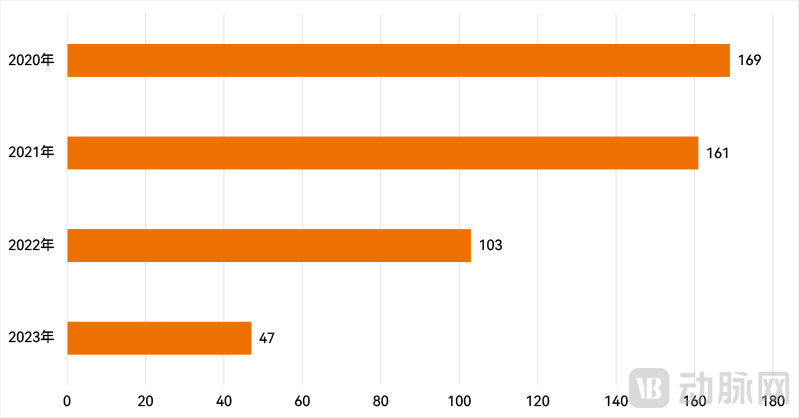
Number of Products Entering the Special Approval Process for Class II Innovative Medical Devices in Various Regions Over the Years (Chart by VCBeat, as of June 10, 2023)
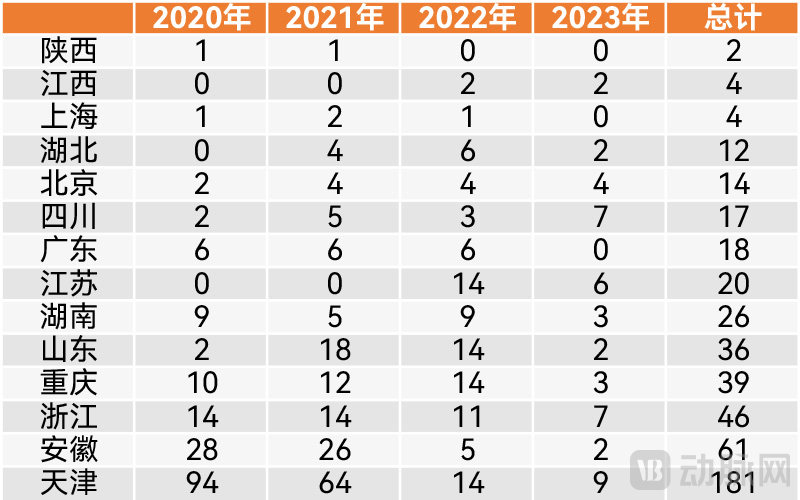
Number of Class II Innovative Medical Devices Entering the Special Approval Procedure by Province and Year (Chart by VCBeat, Data as of June 10, 2023)
Luo Wei, Regulatory Affairs Manager at Wuhan Tacro Technology Co., Ltd., a medical device CRO, stated that the approval process for innovative medical devices has indeed become more stringent in recent years, with tighter scrutiny over claims of innovation. As clinical pain points are addressed one by one, the difficulty of achieving subsequent innovations in medical devices is clearly increasing. This trend also helps promote the overall advancement of China’s medical device industry. Nevertheless, companies can still apply for innovative device designation under the same device name; the key lies in the specific innovative aspects and whether they deliver greater efficiency, better outcomes, faster results, and cost savings in clinical practice.
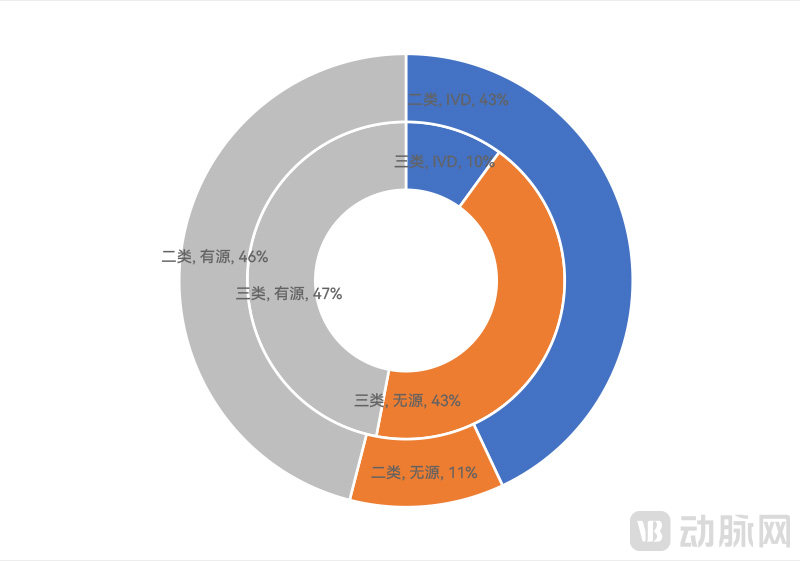
Distribution of Types of Class II and III Innovative Medical Devices Entering the Special Approval Procedure Over the Years (Chart by VCBeat; Class III: 2014–2022; Class II: 2020–June 10, 2023)
In terms of classification, Class II innovative medical devices present a stark contrast to Class III innovative medical devices. According to statistics, among the devices that have entered the National Medical Products Administration’s (NMPA) approval process for Class III innovative medical devices, active devices account for the largest proportion at 47%. Passive devices account for 43%, showing a relatively small gap compared to active devices. In vitro diagnostic (IVD) products constitute only 10%.
Among the Class II innovative medical devices we compiled, active medical devices accounted for 220 products, representing 46%; IVD products totaled 206, accounting for 43%; while passive medical devices comprised only 54 products, making up just 11%.
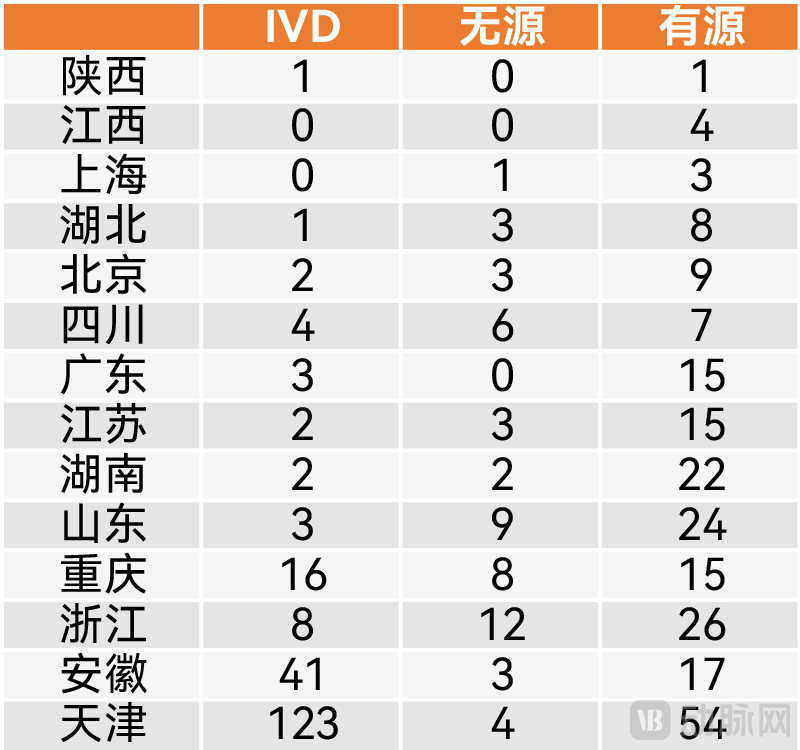
Classification of Class II Innovative Medical Devices by Province (2020–June 10, 2023)
Further analysis reveals that Tianjin accounts for the vast majority of IVD products—123 Class II innovative medical devices in the IVD category originated from Tianjin, representing 60% of the total IVD share. Among Tianjin’s total of 181 Class II innovative medical devices, IVD products accounted for an exceptionally high proportion of 68%. Additionally, it is estimated that Anhui and Chongqing had 41 and 16 Class II innovative medical devices approved, respectively.
The popularity of IVD among Class II innovative medical devices is directly related to the regulatory classification of IVD products. In the "6840 Subcatalogue for Classification of In Vitro Diagnostic Reagents (2013 Edition)," a total of 433 IVD products are classified as Class II medical devices, which is greater than the number managed as Class III medical devices (249).
Meanwhile, as applications and technologies mature, policy adjustments will further reduce risk classifications. In October 2020, the National Medical Products Administration (NMPA) issued an announcement adjusting the “Subcatalogue of Classification for 6840 In Vitro Diagnostic Reagents (2013 Edition),” reclassifying 29 types of IVD products—originally regulated as Class III medical devices—in terms of their management category and intended use to Class II.
IVD is certainly not the only sector affected by policy adjustments. In recent years, the National Medical Products Administration (NMPA) has repeatedly adjusted the regulatory classification of medical devices based on practical considerations. For instance, endoscopes and diagnostic X-ray machines have both been reclassified from Class III to Class II medical devices.
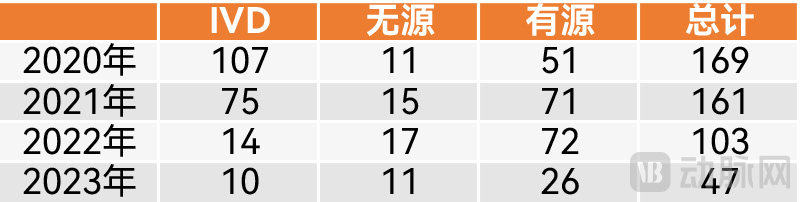
Classification of Class II Innovative Medical Devices Over the Years (Chart by VCBeat, as of June 10, 2023)
Interestingly, as time progressed, the number of IVD products entering the approval process for Class II innovative medical devices decreased significantly. In 2022 alone, there were only 14 IVD products and 17 passive devices, while active devices became the absolute mainstream, with 72 products accounting for as much as 70% of the total 103 products approved that year.
Whether in Class III or Class II innovative medical devices, active devices remain a consistent theme. This also reflects the recent trend in the development of digital health—after all, whether it is artificial intelligence, digital therapeutics, or various digital therapeutic devices, they are essentially active devices. Moreover, among the limited number of passive devices, a significant proportion are based on 3D printing technology, which is another important manifestation of digital health.
Regarding which application scenarios see more innovation, well-informed institutions possess unique sensitivity. “T-capital has engaged with and served innovative medical device projects across various fields. From our observations, ophthalmology, minimally invasive surgery, otolaryngology, and cardiovascular care are among the hotter sectors. On another note, we have also noticed that a growing number of investors—including some who previously focused primarily on biopharmaceuticals—are beginning to enter the medical device space. We believe the next few years will present a rare and favorable window for innovative medical devices,” said Dr. Wang Yueyue in an interview with VCBeat.
As the name suggests, the purpose of the expedited review process is to accelerate approvals—prior to its introduction, medical device approvals often faced severe backlogs. Qin Lu, CEO and founder of Fanju Technology, whose products have been included in Zhejiang’s Class II Innovative Medical Device List, stated that after entering the fast track for innovative medical devices, the relevant specialized departments of regulatory agencies primarily adopt approaches such as early intervention, dedicated personnel assignment, and full-process guidance. This ensures priority review and approval without lowering standards or reducing procedural steps, thereby shortening the approval timeline.
Taking the application for Class III innovative medical devices with the National Medical Products Administration (NMPA) as an example, regulations require provincial drug administrations to complete preliminary reviews within 20 working days; subsequently, the NMPA must issue its review opinion within 40 working days. This means that from submission to final approval by the national authority, it takes a maximum of 60 working days, after which the application enters a public notice period of no less than 10 working days.
Special approval procedures for Class II innovative medical devices in various regions have been further optimized on this basis. Taking the "Special Review Procedures for Class II Innovative Medical Devices in Zhejiang Province" issued in early 2023 as an example, it requires preliminary review within three working days and the transfer of materials to the Provincial Medical Device Evaluation Center within three working days after acceptance; subsequently, the Provincial Medical Device Evaluation Center must issue its review opinion within 15 working days.
Furthermore, Qin Lu stated that companies included in the list of innovative medical devices can also gain greater visibility and reputation, facilitating financing and subsequent commercialization. Once approved, they can also receive rewards from local governments aimed at promoting the development of the local medical device industry.
The "Several Opinions of the General Office of the Hangzhou Municipal People's Government on Accelerating the High-Quality Development of the Biopharmaceutical Industry," formulated by Hangzhou City in 2021, explicitly states that medical devices entering the National Special Examination Procedure for Innovative Medical Devices or the Priority Review Procedure for Medical Devices, which obtain their first medical device registration certificate and are manufactured within the city, shall be eligible for financial support of up to 40% of R&D investment, capped at RMB 6 million (including reductions or exemptions for local clinical trial costs), subject to review. For innovative Class II and Class III medical devices that have obtained medical device registration certificates and are manufactured within the city, financial support of up to 20% of R&D investment shall be provided upon review, with a maximum of RMB 2 million and RMB 4 million per product variant, respectively (including reductions or exemptions for local clinical trial costs).
According to statistics, the expedited review process has indeed effectively shortened the time required for evaluation under ideal conditions. In its early 2022 summary on innovative medical devices, the Beijing Medical Products Administration also noted that since the implementation of the expedited review process in Beijing, the fastest turnaround time for Class II innovative medical devices—from registration acceptance to approval—has been reduced from the statutory limit of 183 working days to approximately 100 working days, a reduction of 83 days. For Class III innovative medical devices, the fastest initial review time has been shortened from 20 working days to just 2 working days.
However, this does not mean that the time to final market approval can be shortened by 100%. According to statistics from VCBeat on some known Class II medical devices that have been approved for market launch, there is a significant variation in this timeframe. Some products took only three months from entering the public notice list to obtaining the final certification, while others took up to two years to reach the market. Additionally, many products that entered the list in 2020 have yet to gain approval for market launch. Even if they eventually do get approved, the process has already taken as long as three years.
In this regard, Luo Wei believes that the establishment of a special approval procedure for innovative medical devices, which allows companies to receive priority review once they enter the process, reflects the efforts made by the drug regulatory system. However, innovative medical devices often lack established guidelines and standards, leading to numerous issues during review that are not easily resolved. These are challenges that companies must address through their own efforts, which require time. Furthermore, as clinical pain points are progressively addressed, subsequent innovative medical devices are increasingly entering uncharted territory, making verification and validation more difficult than before.
Qin Lu also noted that while expedited review procedures can shorten the approval timeline, clinical trials may account for the majority of the overall process. As this phase cannot be accelerated, the ultimate time to market—or even the failure to obtain marketing authorization—will depend on whether the company’s clinical trials proceed smoothly.
The medical device industry is one of the fastest-growing sectors worldwide and a significant driver of economic development. In developed countries, the medical device industry accounts for approximately 10% of GDP, with the figure reaching 15% in the United States. By comparison, China lags considerably behind; its share within the total pharmaceutical market is even below the global average, indicating substantial room for future growth in China’s medical device industry.
During the 13th Five-Year Plan period, China’s medical device industry experienced rapid development in recent years. The market size expanded quickly, with the number of manufacturers exceeding 30,000 and the annual number of product filings/initial registrations approaching 50,000. The industry scale surpassed RMB 1 trillion, achieving a compound annual growth rate (CAGR) of 10.54% over the past five years, which is higher than the overall growth level of China’s manufacturing sector.
Currently, China's medical device industry is demonstrating a favorable development trend characterized by sustained high growth in scale, steady improvements in development quality, new strides in innovative development, enhanced international competitiveness, and a stable rise in the comprehensive industry development index. Compared with the past, China's medical device sector has made significant progress, giving rise to several globally renowned medical device giants.
Innovation is the only way for China’s medical device industry to catch up with advanced international standards. With the gradual improvement of the approval process for innovative medical devices, and their integration with fields such as artificial intelligence, mobile internet, the Internet of Things, and big data, the path of innovation in China’s medical device industry is expected to broaden continuously. VCBeat will continue to closely monitor this sector.