

HealthyWay Inc., a Pioneer in Internet Healthcare, Files for IPO with Three Consecutive Years of Profitability
On June 13, 2023, Health Road Co., Ltd. (“Health Road”), a low-profile early explorer in the field of internet healthcare, submitted its listing application to the Main Board of the Hong Kong Stock Exchange.
Jiankang Zhilu (Health Road) traces its origins to “Yihu Wang” (Medical and Nursing Network), established in 2001. Initially focusing on core services such as online appointment scheduling, it became one of the earliest well-known online hospital registration platforms. Over 22 years of development, Jiankang Zhilu has continuously expanded its service boundaries. According to its prospectus, by the end of 2022, the company had accumulated 171 million individual users and 833,200 registered physicians, while connecting with 11,500 hospitals.
However, during the most prosperous years for internet healthcare in the past few years, Health Road rarely took the initiative to communicate with the public. It was not until the submission of its prospectus that the industry gained insight into Health Road’s recent performance: in 2020, 2021, and 2022, the company’s revenues were RMB 187 million, RMB 431 million, and RMB 569 million, respectively; adjusted profit figures indicate that the company has achieved profitability for three consecutive years.
Early-stage internet healthcare companies have either established their own distinct models and survived to this day, or been eliminated from the market due to unsustainable profitability models. What has Health Road quietly accomplished in recent years? What business model has it formed? Where lies its future growth potential? VCBeat has conducted a multi-faceted analysis of these questions.
A review of the development journey of Health Road reveals that, although the company has maintained a low profile, its key milestones have been closely aligned with industry trends.
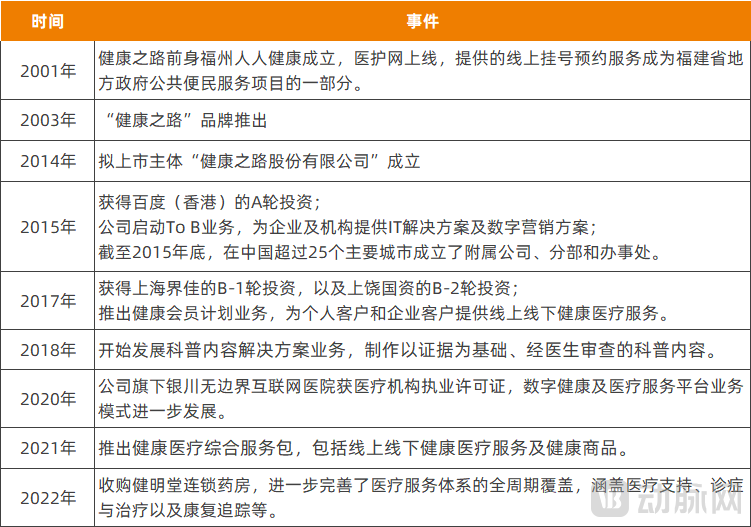
Key Milestones in the Development of Jiankang Zhilu; Source: Prospectus, Chart Compiled by VCBeat
In 2001, the predecessor of Health Road, Fuzhou Renren Health, was established and launched Yihuwang. Its online appointment registration service became part of the public convenience services provided by the local government in Fujian Province.
At that time, the internet began to gradually penetrate the healthcare industry, choosing the appointment registration process—characterized by numerous pain points and high demand—as its entry point. Over the following decade, various national or regional online appointment platforms were launched in succession. Leveraging the advantages of its early market presence, Jiankang Zhilu accumulated an early user base and built brand influence.
2014–2015 marked the first peak of the internet healthcare boom: a surge in company formations, an influx of capital, and vigorous investment and financing activities. The BAT giants also joined the rush to establish their presence in internet healthcare, each investing in or acquiring leading platforms.
In 2015, Jiankang Zhilu secured Series A funding from Baidu (Hong Kong), becoming a key vehicle for Baidu’s strategic expansion in the internet healthcare sector and laying the foundation for subsequent collaborations between the two parties in areas such as traffic acquisition and popular science content solutions.
During the early trial-and-error phase of internet healthcare, it became evident that a pure consumer-facing (C-end) model struggled to generate scalable revenue, making a business-to-business (B-end) approach an inevitable choice. In 2015, Jiankang Zhilu launched its B2B operations, providing IT solutions and digital marketing services to enterprises and institutions.
In 2020, the value of internet hospitals became prominent during the pandemic. Online medical consultations provided great convenience to patients under containment measures, gaining widespread recognition from health and medical insurance authorities, physical hospitals, doctors, and other stakeholders. That year, Yinchuan Borderless Internet Hospital, affiliated with Jiankang Zhilu, obtained its Medical Institution Practice License, expanding its services from online consultations to online diagnosis and treatment.
Meanwhile, in the course of industry development, Jiankang Zhilu promptly capitalized on the trend toward “productization” of online medical services, successively launching business offerings such as its health membership program and comprehensive healthcare service packages.
In 2022, Jiankang Zhilu acquired the Jianmingtang chain of pharmacies; thus, its services now encompass medical support, diagnosis and treatment, rehabilitation tracking, and pharmaceutical retail, further enhancing the full-cycle coverage of its healthcare service system.
To date, Jiankang Zhilu has formed two major business segments: Digital Health Medical Services, and Enterprise Solutions & Digital Marketing Solutions.
Digital Health Medical Services, Jiankang Zhilu provides healthcare services to individuals and enterprises through its health membership program, including appointment scheduling, medical advocacy, clinical accompaniment, health examinations, medical consultations, and surgical appointment coordination.
Non-member users can also seek advice from doctors on the platform regarding diseases and health issues. In addition, Jiankang Zhilu assists medical institutions in handling routine operational tasks beyond clinical diagnosis and treatment, such as patient navigation and triage guidance, as well as patient satisfaction surveys.
After accumulating resources in online and offline services, pharmaceuticals, and non-pharmaceutical products, Health Road began launching comprehensive healthcare service packages. These packages provide users with holistic, continuous care tailored to specific diseases or health issues. The offerings include health membership plans, along with related medications and health products. Currently, comprehensive healthcare service packages addressing joint pain, sleep disorders, and nutritional issues have become significant revenue generators.
Furthermore, in the digital health medical services segment, Health Road also sells pharmaceuticals and medical devices to individual customers through its proprietary pharmacy.
Enterprise Solutions and Digital Marketing Solutions, Health Road collaborates with external physicians and experts to provide science popularization content solutions in formats such as articles and videos; it partners with external physicians to help pharmaceutical companies create medical content related to the specific diseases treated by their drugs and medical products, and promotes this medical content to target audiences; it collects and analyzes clinical data, conducts observation and analysis of clinical evidence-based cases, and supports pharmaceutical companies in conducting real-world studies.
Leveraging years of technological expertise, Jiankang Zhilu provides IT solutions to pharmaceutical and healthcare companies, as well as medical institutions, to meet their needs for technical infrastructure, marketing consulting services, and more.
Leveraging its proprietary platform and third-party online media, Jiankang Zhilu also provides digital marketing services to enterprises, assisting them in promoting healthcare and medical products.
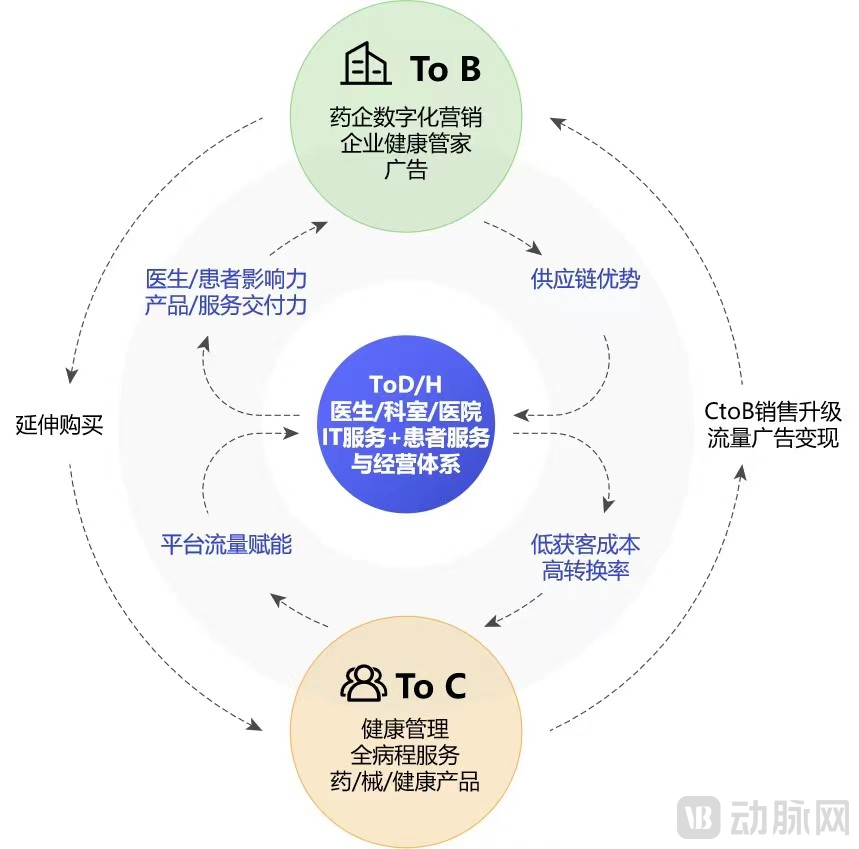
Jiankang Zhilu’s Business Synergy Model
It is evident from the business structure that Jiankang Zhilu has established a value network system targeting key stakeholders, including C-end users, pharmaceutical and related enterprises, medical institutions, and physicians, all of whom derive benefits from this ecosystem.
For C-end users, access is provided to end-to-end, personalized medical consultation assistance and health management services.
Leveraging its extensive coverage of hospitals and doctors across China, Jiankang Zhilu enables users to more conveniently locate nearby, high-quality medical resources and thereby obtain appropriate treatment plans.
For diseases or health conditions requiring long-term intervention, such as pediatric growth and development, weight management, rheumatoid arthritis, skin care, allergies, and other chronic diseases, Health Road integrates resources from doctors, hospitals, and pharmaceuticals to enable users to conduct comprehensive and continuous disease management. The platform also establishes personal health records for users and provides health monitoring tools and knowledge to facilitate more effective self-management.
Across every stage of health and disease management—from pre-consultation inquiries to post-visit claims processing, and from treatment plans to cost information—Jiankang Zhilu provides guidance and support to users. By offering end-to-end medical care support, it enhances patient adherence, optimizes treatment plans, and ultimately achieves better therapeutic outcomes.
For B-side clients, pharmaceutical companies can access more efficient and cost-effective digital marketing services, while insurance companies can leverage Jiankang Zhilu’s offerings to provide customers with more competitive, differentiated products.
In recent years, with the implementation of a series of pharmaceutical policies, pharmaceutical companies have urgently sought more cost-effective and efficient marketing approaches. Jiankang Zhilu has established extensive and in-depth connections between doctors and patients, meeting the new demands of pharmaceutical companies for marketing channels. It helps enterprises promote healthcare products and enhance brand awareness. Meanwhile, its capabilities in big data analytics and academic promotion enable pharmaceutical companies to precisely reach their target audiences.
In addition to selling to individual users, Jiankang Zhilu’s membership health plans are also marketed to insurance companies and other enterprises. By integrating these services into their insurance products, insurers can strengthen product innovation and enhance competitiveness.
Other companies offer employee health plan products as part of their benefits package to enhance employee loyalty and satisfaction.
It is worth emphasizing that hospitals and physicians are the most critical components of the value network system.
The Health Road platform adheres to the tiered diagnosis and treatment policy, encouraging patients with minor ailments to seek medical resources at appropriate hospitals, diverting unnecessary patient flow away from Grade A tertiary hospitals, and promoting efficiency improvements in the healthcare service system.
By leveraging digital technologies, Jiankang Zhilu helps medical institutions and healthcare professionals establish digital tools and workflows, thereby improving work efficiency and reducing errors.
By covering a vast patient population, Health Road can attract more precise patients to hospitals, better aligning with their specialized disease treatment capabilities; the platform can also conduct brand promotion activities to enhance public awareness of certain hospitals.
For physicians, Jiankang Zhilu integrates B-side and internal resources to provide assistance in areas such as pharmaceuticals, testing, rehabilitation, medical administrative services, health consultations, and other non-clinical daily tasks. This enables doctors to focus more effectively on diagnosis and treatment, thereby enhancing work efficiency and fostering better doctor-patient relationships. Furthermore, by leveraging internet platforms, physicians can expand their service scope and patient base, while also gaining opportunities to achieve more substantial compliant income.
It is evident that the establishment of the aforementioned value network system has fostered positive synergy among Jiankang Zhilu’s core business segments, thereby generating a “flywheel effect” that serves as the foundation for sustained performance growth.
Thanks to its value propositions for C-end users, pharmaceutical and related enterprises, medical institutions, and doctors, Health Road has formed diversified revenue sources. In recent years, Health Road has shown a trend of continuous growth.
In 2020, 2021, and 2022, the company’s revenues were RMB 187 million, RMB 431 million, and RMB 569 million, respectively. Adjusted profit figures show that the company has achieved profitability for three consecutive years, with a total net profit of RMB 64.959 million over this period.
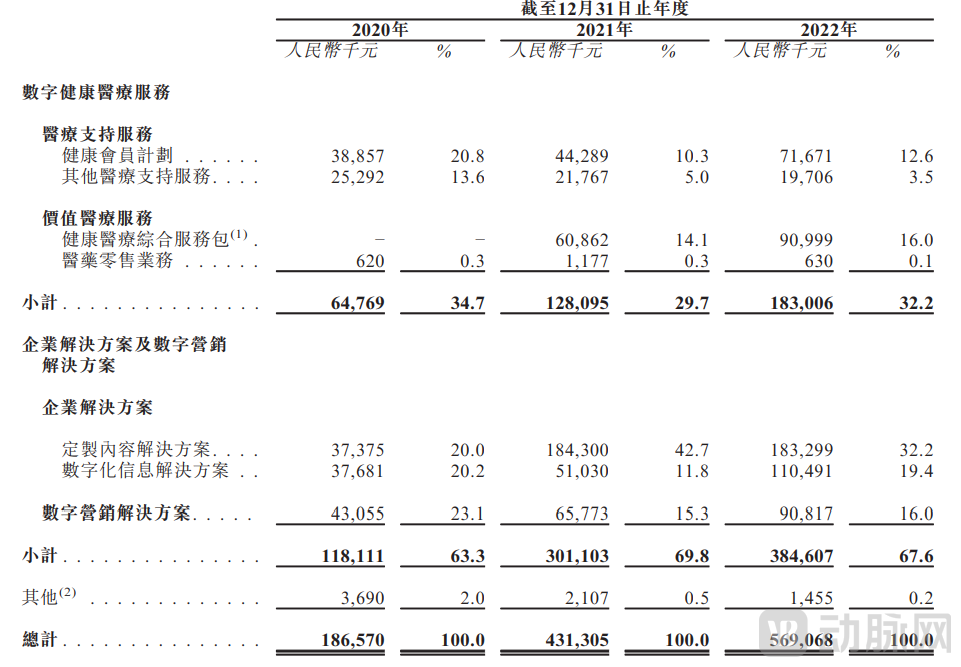 Revenue Structure of Health Road, Source: Prospectus
As shown in the chart above, customized solutions accounted for the largest share of Jiankang Zhilu’s revenue among its segmented business lines, reaching 32.2% in 2022. The health membership program, comprehensive healthcare service packages, digital information solutions, and digital marketing solutions contributed relatively balanced revenue proportions, each accounting for 10%–20%.
Historically, many industry players have relied primarily on the sales of pharmaceuticals and medical devices as their main source of revenue. In contrast, such revenue accounts for a smaller proportion of Health Road’s income, which represents one of the distinctive features of its business model.
In such a revenue structure, each business segment has room for growth and shares risks in a relatively balanced manner: if the revenue of one segment is affected during a certain period, the overall company revenue will be minimally impacted.
Notably, Baidu is a significant shareholder of Health Road, and the two parties have engaged in deep cooperation in recent years. Providing popular science content solutions to Baidu has become one of Health Road’s key revenue streams.
The prospectus shows that in 2020, 2021, and 2022, Jiankang Zhilu derived a certain portion of its revenue from Baidu, but the proportion of total revenue decreased year by year, at 19.4%, 11.7%, and 4.4% respectively.
From the shareholder perspective, Baidu has provided Health Road with traffic access, brand endorsement, and ecosystem synergy, facilitating its rapid growth in recent years. From the customer perspective, however, Baidu’s contribution to Health Road’s revenue has gradually diminished, demonstrating Health Road’s capacity to develop and expand more independently within a vast market space.
If examined in isolation, no single business segment of Jiankang Zhilu is particularly impressive. Services such as appointment registration and medical consultation accompaniment are classic cases of “critically acclaimed but commercially underperforming”: they address essential needs and enjoy high patient satisfaction, yet struggle to establish a sustainable business model.
In the early stages of the internet’s penetration into the healthcare industry, “Internet+ medical escort services” emerged as one of the popular niche sectors. Over the three years starting in 2020, influenced by objective environmental factors and stricter hospital management, medical escort services once again garnered significant attention. However, constrained by challenges in their business models, some companies that had made early entries into this space have since “retreated” from offline medical escort services—either by shutting down their existing escort operations or by outsourcing these services to third-party providers.
In 2023, a well-known regional online appointment platform ceased operations, prompting widespread lament among local users on social media; this outcome stemmed from the platform’s lack of a sustainable profitability model.
In contrast, Jiankang Zhilu has persisted in offering basic services such as appointment registration and medical accompaniment since its inception, and these remain core components of its service portfolio. On the homepage of the Jiankang Zhilu app, these services are prominently featured above the fold.
It must be acknowledged that the unique business model of Jiankang Zhilu has created a “flywheel effect,” enabling commercially undervalued standalone modules such as appointment registration and medical consultation accompaniment to realize their commercial value.
Building on these services, Jiankang Zhilu will further strengthen other components of its “flywheel effect,” including: attracting more physicians and hospitals to join its platform through more professional services; establishing more specialty-oriented disease treatment centers; exploring smoother cross-institutional healthcare services for individual users; providing enterprises with more precise content and digital marketing solutions; and expanding its pharmacy network. At that time, previously “understated” service modules such as appointment registration and medical accompaniment will unleash greater value.