

Inno Healthcare Charts a Path for Deep Integration of Medical and Elderly Care Through Internet Hospital and Early Cognitive Impairment Screening
“By around 2035, the population aged 60 and above is projected to exceed 400 million, accounting for more than 30% of the total population, as China enters a stage of severe aging.”
Last September, the Department of Elderly Care under the National Health Commission disclosed this data at a press conference. Equally “dated” is the domestic discourse on how to better address the challenges of population aging.
Among these issues, “how to better provide for the elderly” has become one of the focal points. In response, the state has introduced a series of policies to vigorously promote the development of the elderly care industry, while numerous enterprises have stepped forward to explore elderly care models suited to China’s national conditions.
After years of development, China appears to have formed a “9073” elderly care pattern, whereby approximately 90% of older adults choose home-based care, about 7% opt for community-based care, and roughly 3% reside in institutional care facilities. However, recent viewpoints suggest that, due to China’s traditional concept of “family, state, and the world” as well as constraints on consumption levels, the actual elderly care structure may not be “9073,” but rather “991,” meaning 99% of older adults receive care at home while only 1% live in institutional care facilities.
However, whether referring to the “9073” or “991” model, it is evident that home-based care will remain the primary setting for elderly care in China. This does not imply that community-based and institutional care lack future development opportunities; rather, it signifies that the focus of China’s elderly care system will shift toward home-based settings, while community-based and institutional care can adjust accordingly to align with this trend.
So, how should companies formulate and timely adjust their development strategies to align with industry changes? The elderly care needs in home settings are already “diverse and varied.” If a company’s business also involves institutional and community-based elderly care, how can it balance these even more complex demands? When VCBeat first came into contact with Yinuo Medical, it had questions. However, after communicating with Huang Chao, the founder of Yinuo Medical, VCBeat gained an appreciation for the efforts made by this innovative enterprise to adapt to industry changes, as well as some of the reflections that emerged during this process.
At first glance at Yinuo Medical’s business materials, one cannot help but recall the phrase: “This company is involved in so many businesses that, at first sight, seem to have little connection with each other.”
Perhaps due to the prevalence of this question, or because founder Huang Chao sensed VCBeat’s confusion, he proactively provided VCBeat with a detailed overview of Inno Medical’s business structure, development trajectory, and logical framework after the initial pleasantries.
Yinno Medical is a “digital medical, health, and elderly care” brand positioned in the home- and community-based elderly care services market. Even judging simply and directly by the sequential order of its positioning keywords, “digital” business undoubtedly occupies a significant position across all of its business segments.
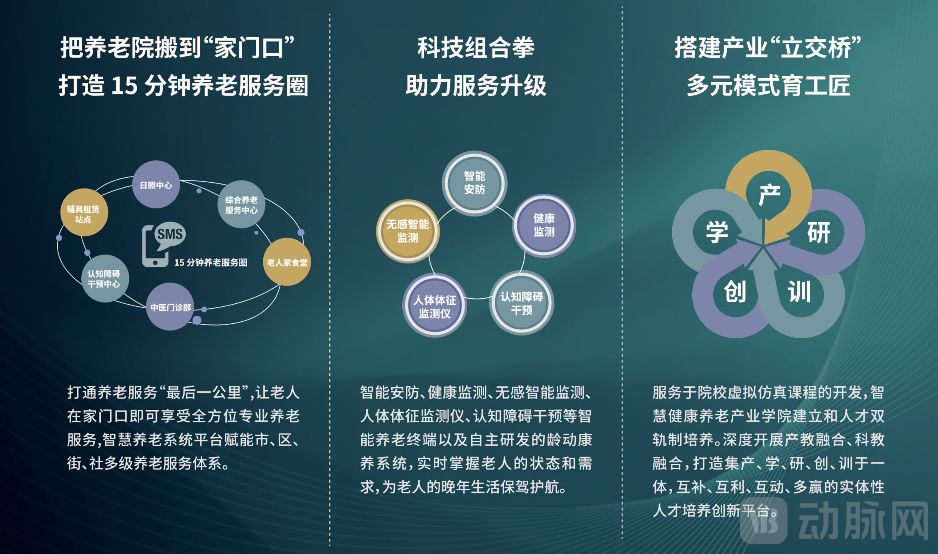
This is indeed the case. Yinno Medical’s three-tier smart elderly care system—spanning districts, sub-districts, and communities—along with its 24/7 elderly care call center, comprehensively covers the three major service scenarios: institutional, community-based, and home-based care. It enables functionalities such as real-time anomaly alerts, tiered account management at the sub-district level, subsidy and fund management, smart security, vital signs monitoring, health record creation, work order dispatching, and service supervision, thereby driving the digitalization and intelligent transformation of the elderly care industry.
However, in terms of Yinuo Medical’s own development, the significance of the district-street-community smart elderly care system and the elderly care call center also lies in their ability to help the company enter the home- and community-based elderly care market, achieving initial market coverage through government procurement channels.
Similarly, Yinuo Medical’s community-based and home-based elderly care services fulfill development functions akin to those of its Smart Elderly Care System and Elderly Care Call Center.
Overall, Yinuo Medical will initially operate service facilities under a “publicly built, privately operated” model by undertaking government-purchased services, thereby providing basic community- and home-based elderly care services to seniors in its service area. On this foundation, it will then explore market-oriented home-based elderly care services, achieving a transition from a B2B to a B2C business model.
Building on this foundation, Innovo Medical is also actively exploring the development of community-embedded elderly care institutions. So-called community-embedded elderly care facilities are characterized primarily by four principles: “not leaving home, not leaving family, not leaving familiar surroundings, and not leaving familiar friends.” Compared with traditional large-scale elderly care institutions, these community-embedded facilities are smaller in scale and have lower operational costs.
According to Huang Chao, Yinnuo Medical’s community-embedded elderly care facilities primarily address three types of eldercare needs: first, for seniors whose family members are unable to provide care due to illness or other reasons; second, for postoperative rehabilitation; and third, for hospice care.
Basic care services in community, home, and institutional settings constitute Inno Medical's first growth curve.
Furthermore, it is worth noting that to meet the postoperative rehabilitation needs of elderly patients, as well as their nutritional requirements during recovery and in daily life, Yinuo Medical has established dedicated teams of rehabilitation therapists and dietitians.
“In fact, the entire elderly care industry is facing a problem: a shortage of talent,” said Huang Chao. Therefore, Yinuo Medical has established a talent development division, collaborating with relevant educational institutions to jointly cultivate professionals for the elderly care sector. This initiative not only builds a talent reserve for Yinuo Medical’s own team but also provides talent empowerment to external parties. “This constitutes the second phase of Yinuo Medical’s revenue streams.”
More importantly, by establishing a comprehensive service system encompassing home-based, community-based, and institutional elderly care, Yinuo Medical has created the “Three-Bed Integration” model—comprising home care beds, long-term nursing beds, and residential care beds. This framework achieves full-spectrum coverage of elderly care services, spanning from home to community settings, and extending from daily care and home medical nursing to postoperative rehabilitation and community-based residential care.
Furthermore, whether it involves home-based elderly care beds, long-term nursing beds, or institutional custodial care beds, Yinuo Medical’s “Three-Bed Integration” system enables shared human resources—where a single care team serves all three types of beds—thereby maximizing the utilization of human resources.
Overall, by undertaking government-funded home- and community-based elderly care projects as well as long-term care insurance initiatives, Yinuo Medical has entered the home and community elderly care market, establishing direct connections and building trust with end consumers. This has provided Yinuo Medical with the opportunity to directly develop the consumer market.
As market expansion deepens, Yinuo Medical has not only accumulated extensive operational management experience and built a comprehensive care team but also established a “three-bed linkage” system. This enables the company to provide C-end users with more comprehensive and diverse “end-to-end” elderly care services while operating the entire system at lower labor costs.
However, professional and comprehensive care services are only one component of elderly care services. In recent years, the elderly care industry has also emphasized the integration of medical and elderly care.
For example, the “Several Opinions on Accelerating the Development of the Elderly Care Service Industry” issued by the State Council in 2013 pointed out the need to promote the integrated development of medical care and elderly care, and to explore new models of cooperation between medical institutions and elderly care facilities; the “Notice on Issuing the Development Plan for Traditional Chinese Medicine Health Services (2015–2020)” released in 2015 proposed promoting the integration of traditional Chinese medicine with elderly care services, and supporting elderly care institutions in providing health management services featuring characteristics of traditional Chinese medicine.
In this context, the integration of medical and elderly care has also become the third business growth curve explored by Yinuo Medical.
In response, Yinuo Medical has chosen to build an internet hospital featuring Traditional Chinese Medicine (TCM) to meet the chronic disease management and daily healthcare needs of the elderly population. According to Huang Chao, Yinuo Medical’s internet hospital is currently under construction and is expected to go live in September.
Furthermore, drawing on years of accumulated experience in elderly care services, Yinuo Medical has identified significant market potential for cognitive impairment screening and intervention among the elderly population. In response, Yinuo Medical partnered with a tertiary Grade A hospital in Tianjin to launch the city’s first center for early screening and early intervention of cognitive impairments, establishing a two-way referral mechanism.

Specifically, by conducting multiple early screening programs for cognitive impairment, such as hearing assessments, hand-brain coordination VR assessments, and core muscle assessments, Yinuo Medical can preliminarily determine whether the screened individuals suffer from cognitive impairment. If a preliminary judgment indicates that the screened individual has cognitive impairment, Yinuo Medical will refer the patient to partner hospitals for diagnosis and treatment.
Meanwhile, the Yinnuo Medical Early Intervention Center for Cognitive Impairment will also provide non-pharmacological interventions and phased assessments for patients. Specifically, it leverages digital therapeutics to intervene in patients with early-stage cognitive impairment, and draws on the expertise of rehabilitation therapists and nutritionists to deliver non-pharmacological therapies encompassing exercise, nutrition, and social engagement.
Currently, the first phase of Yinno Medical’s Early Screening and Intervention Center for Cognitive Impairment has been piloted in Tianjin, but its elderly care service model has gradually expanded beyond Tianjin to Beijing, Hebei Province, and other regions.