

Moon Surgical Secures $55.4M Series B Funding Led by NVIDIA and Sofinnova Partners for CE-Certified Maestro Laparoscopic Robot

MastOR
Surgical Robot Developer
Due to the increasing difficulty in overcoming the physiological limitations of surgeons’ hands and eyes, coupled with the rising complexity of surgical procedures, surgical approaches that rely solely on manual dexterity and visual observation can no longer meet the developmental demands of modern surgery. Patient demand, driven by clinical advantages, is one of the fundamental logics underpinning the advancement of medical devices.
Consequently, laparoscopy has gradually evolved from a purely diagnostic procedure into an independent surgical modality. Furthermore, with continued technological advancements, laparoscopic surgical robots capable of replacing the surgeon’s hands have emerged. The advent of these robotic systems has overcome human physiological limitations, offering significant potential for performing complex procedures within the confined and crowded abdominal cavity.
Maestro is an innovative laparoscopic surgical robot developed by the French medical device company Moon Surgical.As a dual-arm robotic surgical assistant capable of grasping and manipulating standard laparoscopic instruments, Maestro can replace the surgeon’s hands, providing greater flexibility and control to enhance operating room efficiency.
Since its establishment in 2019, Moon Surgical has garnered significant attention from numerous investment firms, prominent enterprises, and scientists.
In May this year, Moon Surgical secured $55.4 million in Series B funding.This funding round was co-led by Sofinnova Partners and NVIDIA’s venture capital arm, NVentures. Other investors included Fred Moll, known as the “father of surgical robotics,” as well as GT Healthcare Capital and Johnson & Johnson Development Corporation (J&J Innovation). The proceeds from this round will be used to support the continued development and commercialization of the company’s Maestro surgical robotic system.
As recently as June 2022, Moon Surgical had just completed a $31.3 million Series A financing round.
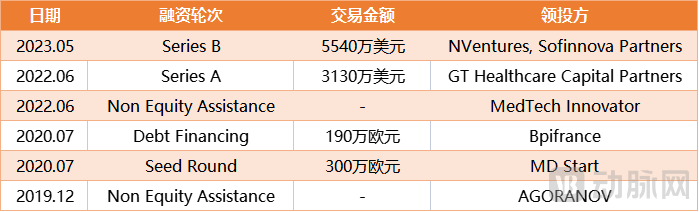
Moon Surgical Funding History
Data source: Crunchbase, compiled by VCBeat
In the surgical robotics arena, the established giant da Vinci leads the field, while numerous medical device companies with successfully commercialized products follow closely behind.What are the standout innovative capabilities of Moon Surgical’s Maestro laparoscopic surgical robot that have enabled it to secure two rounds of financing totaling nearly $100 million within less than a year, attracting continued investment from both investors and the industry market?
Compared with the da Vinci system and other laparoscopic surgical robots on the market, Moon Surgical emphasized that Maestro is a modular surgical robot during its development.
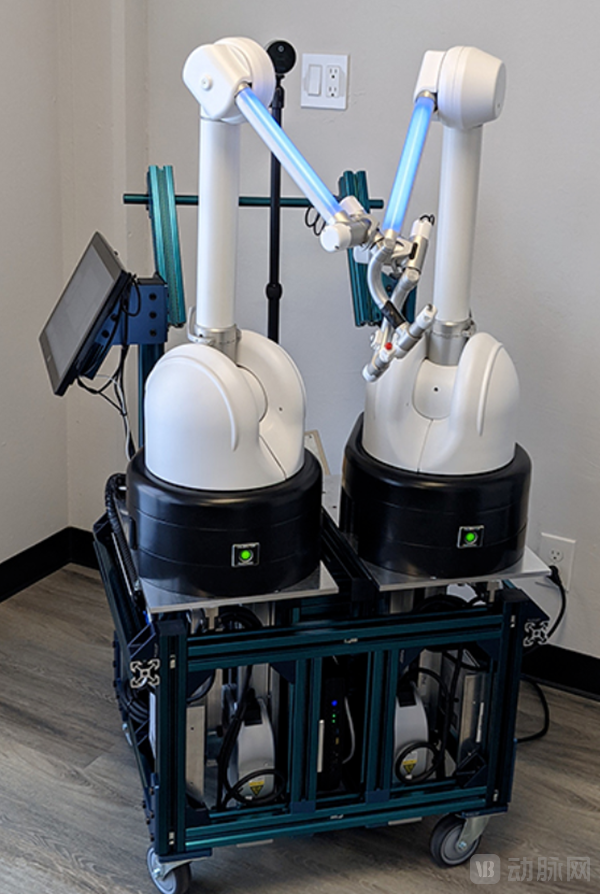
Maestro Laparoscopic Surgical Robot
Image source: Moon Surgical official website
Typical laparoscopic surgical robots generally integrate an all-in-one imaging system, but Maestro is not equipped with an imaging system and consists of only two components: the surgeon’s console and the patient-side surgical cart. This is not a defect but rather one of Maestro’s innovations.
Moon Surgical’s patented magnetic coupling technology enables Maestro to be used with any laparoscopic instrument currently available in the operating room. This not only reduces procurement costs for healthcare institutions but also allows for the flexible integration of various imaging devices with distinct technical advantages into the Maestro system, according to clinical needs.
Moreover, due to Maestro’s compact size, hospitals do not need to specially retrofit operating rooms for this surgical robot. Physicians can operate it beside the surgical table, independently controlling both the endoscope and Maestro without the assistance of a camera-holding surgeon.
Maestro can also be used in conjunction with conventional instruments, such as trocars, staplers, and ultrasonic scalpels. According to the company’s official website, the cost of laparoscopic surgery using Maestro is consistent with that of traditional laparoscopic surgery, offering significant advantages for widespread adoption.
As the robotic surgical assistant for surgeons, the robotic arm can be said to be the most critical component of a surgical robot.The two robotic arms of Maestro are mounted on an independent robotic platform, providing two degrees of freedom along the z-axis and y-axis, centered at the installation origin.
Moon Surgical has also partnered with NVIDIA’s AI platform to equip Maestro with intraoperative camera tracking software.With this intelligent system, Maestro’s two robotic arms can learn to autonomously record the lead surgeon’s habits, automatically follow the instruments manipulated by the surgeon, and track the surgeon’s movements as well as the operating room environment, thereby enabling the automatic adjustment of both robotic arms to their optimal configuration before the surgery begins.
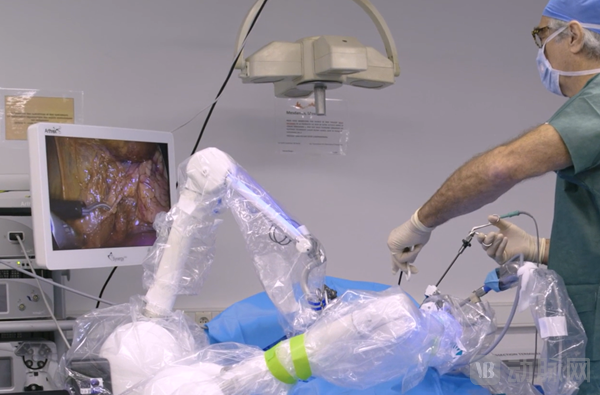
Laparoscopic Surgical Robot Maestro
Image source: Moon Surgical official website
Moon Surgical plans to upgrade its dual-arm robotic system, Maestro, into a next-generation multi-arm robot and enhance the automation level of its robotic arms to further improve surgical efficiency.
Moon Surgical’s predecessor was MastOR, co-founded by Brice Gayet and Pierre Campredon.
Brice Gayet is a Professor of Surgery at the Institut Mutualiste Montsouris (IMM) in Paris and a pioneer in the field of minimally invasive hepatobiliary and pancreatic surgery.Brice Gayet possesses multidisciplinary and cross-field research and clinical experience. He not only holds a degree in computer science from the University of Paris but also served as a professor of anatomy before becoming a professor of digestive surgery.
Brice Gayet also participated in the founding of the European College of Surgeons (EEC) and has served as Dean of the Paris Hospital Medical School, Secretary-General of the French Society of Digestive Surgery (SFCD), President of the French Society of Endoscopic Surgery (SFCE), and Chairman of the IMM Medical Committee.
Pierre Campredon graduated from HEC Paris. He previously served as a senior auditor at Ernst & Young and as a senior consultant at Deloitte, and he held the position of CEO at Moon Surgical until 2020.
The year after Brice Gayet founded Moon Surgical, Sofinnova Partners, a leading European life sciences venture capital firm, and MD Start, a medical technology incubator, decided to invest in the company.Furthermore, Anne Osdoit, the current CEO of Moon Surgical, is also a partner at Sofinnova Partners and MD Start.
“Father of Surgical Robotics” Fred Moll currently serves as the Independent Chairman of the Board of Directors at Moon Surgical.Dr. Fred Moll stated that a surgeon’s two hands are insufficient to meet the demands of surgery, whereas Maestro can serve as an extension of the surgeon’s capabilities, providing greater strength, flexibility, and precision in control.
Leveraging the professional backgrounds and extensive experience of its founders and core team, Moon Surgical plans to expand the use cases and indications for Maestro, applying it to any type of operating room and laparoscopic procedure.
From December 2022 to April 2023, Maestro obtained two key regulatory approvals: U.S. FDA clearance and EU CE marking.
As a startup medical device company, these phased “victories” are inseparable from the company’s accumulated advantages in technological innovation and its rapid response to market and clinical needs.
Moon Surgical’s core technology originates from the ISIR Robotics Laboratory at Sorbonne University.Since its inception, the company has rapidly leveraged its expertise in medical surgical robotics to collaborate with over 30 leading surgeons from Europe and the United States, conducting research, development, and validation across multiple clinical indications.
Notably, within ten days of receiving FDA clearance, Moon Surgical rapidly and successfully performed 30 human laparoscopic procedures using Maestro at the University Hospital Centre Saint-Pierre (Centre Hospitalier Universitaire, CHU) in Belgium. These 30 procedures covered seven different clinical indications, including 14 laparoscopic cholecystectomies, as well as bariatric surgery, hernia repair, colorectal surgery, and anti-reflux surgery.
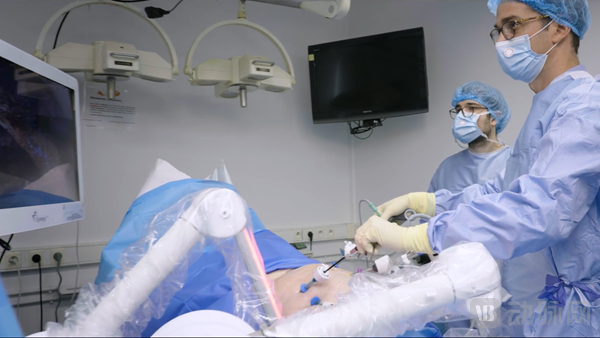
Maestro Laparoscopic Surgical Robot in Surgery
Image source: Moon Surgical official website
The success of the first-in-human clinical trial has validated that Maestro not only provides patients with minimally invasive and more diverse treatment options, but also demonstrates its clinical value in real-world surgical procedures.As of CE certification, Moon Surgical has successfully performed 50 Maestro-assisted laparoscopic surgeries in Europe.
According to the report “Global Laparoscopy Devices Market Opportunity and Forecast, 2020–2027” published by Allied Market Research, the global laparoscopy devices market is projected to grow at a compound annual growth rate (CAGR) of 5.8%, with its size increasing from USD 12 billion in 2019 to USD 18.9 billion by 2027.
Facing a nearly RMB 20 billion market for laparoscopic instruments, Maestro’s commercialization is accelerating.According to Anne Osdoit, CEO of Moon Surgical, the company has established a commercial marketing presence in the United States and plans to open a manufacturing facility in France. The company expects to officially launch Maestro in the U.S. market in 2024.
In the field of laparoscopic surgical robots, Intuitive Surgical’s da Vinci multi-port robotic system has long held a dominant market position, once facing no rivals, thanks to its first-mover advantages such as an early technological start, comprehensive patent coverage, prolonged market presence, and widespread global adoption.Today, surgical robotics giants are facing fierce competition from innovative startups, with Chinese firms emerging as a key force in this wave.
2021 was hailed as the inaugural year for laparoscopic surgical robots in China. Multiple domestically produced laparoscopic surgical robots received regulatory approval in late 2021, marking China’s entry into a new era of homegrown surgical robotics and giving rise to numerous innovative enterprises dedicated to the research and development of laparoscopic surgical robots.
Beijing Shurui Robotics completed a C3 round of financing amounting to hundreds of millions of RMB in April this year. Its single-port laparoscopic surgical robot is the first single-port surgical robot in China to pass the Special Examination Procedure for Innovative Medical Devices. Ruilong Nuofu completed a Pre-B round of financing worth tens of millions of US dollars at the end of 2022, and its laparoscopic surgical robot, Shanhai-1, successfully conducted multi-procedure live animal trials in specialized fields in early 2023.
In addition, many innovative Chinese companies are jointly advancing the development of domestically produced laparoscopic surgical robots, such as Shandong Weigao, Suzhou Kangduo, MicroPort MedBot, Shenzhen Jingfeng, Agile Medical, Konosoton, and Renguan Medical.
According to Frost & Sullivan research data, the market size of surgical robots in China increased from USD 93 million in 2015 to USD 755 million (approximately RMB 4.78 billion) in 2021, and is estimated to reach USD 3.84 billion (approximately RMB 25 billion) by 2026, with a compound annual growth rate (CAGR) of 44.3%. Its share of the global surgical robot market is projected to rise from 6.4% in 2021 to 11.4%.
In terms of policy, in April this year, the Center for Medical Device Evaluation of China’s National Medical Products Administration issued the “Notice on Publicly Soliciting Comments on Two Technical Review Points, Including the ‘Technical Review Points for Laparoscopic Endoscopic Surgical Systems’.” This notice further standardizes the requirements for laparoscopic endoscopic surgical systems regarding standards, technical parameters, animal studies, and clinical trials, thereby leveling the playing field and establishing a regulated pathway for domestically produced laparoscopic robots.
In the surgical robotics sector, domestically produced laparoscopic surgical robots will pursue a path of innovation-driven import substitution, leveraging their advantages in cost-effectiveness, rapid high-quality iterations, and operational workflows better suited to the Chinese market. Furthermore, these innovative enterprises and their products will expand globally, entering the international market in line with globalization trends.