

Zhide Pharmaceuticals Positions Itself as a Leader in Novel Drug Delivery Systems with 'Biological Missile' Liposomes
In the field of drug development, new molecular entities (NMEs) and novel dosage forms play a crucial role in revolutionary new drugs. However, the success rate for developing new molecules is relatively low. According to a joint report released by BIO (Biotechnology Innovation Organization), Informa Pharma Intelligence, and QLS, the probability of a new molecular entity advancing from Phase I clinical trials to approval is only 5.7% (n=6,803). In 2022, only 23 new molecular entities received FDA approval.
The high R&D costs and low output efficiency of new molecular entities have prompted many pharmaceutical companies to shift their focus toward the development of novel drug delivery systems (NDDS). Many drugs suffer from drawbacks such as poor solubility, inadequate stability, and weak targeting capabilities, failing to achieve optimal therapeutic efficacy in clinical practice. Consequently, numerous novel drug formulations and delivery systems have been developed to enhance clinical efficacy, reduce toxicity, improve patient compliance, and extend the lifecycle of pharmaceutical products.
Over the past few decades, novel drug delivery systems have emerged in rapid succession, including liposomes, nanoparticles, and exosomes. Since 1971, liposomes have been widely recognized by the industry as “biological missiles” and have become a prominent new class of drug delivery systems. With the rapid advancement of liposome technology, more than ten liposomal products have been launched successively, such as doxorubicin, vincristine, daunorubicin, paclitaxel, irinotecan, mifamurtide, cytarabine/daunorubicin, amphotericin B, bupivacaine, and amikacin.
In this field, VCBeat has recently turned its attention to Zhejiang Zhida Pharmaceutical (“Zhida Pharmaceutical”), a leading domestic innovative formulation pharmaceutical company specializing in novel drug delivery systems (NDDS). Leveraging its liposomal drug-loading technology platform,Zhida Pharmaceutical’s first product, Doxorubicin Hydrochloride Liposome Injection (Zhisai), has been approved as the first generic drug in China under the new registration classification for this variety, and is deemed to have passed the Generic Drug Consistency Evaluation.
Liposomes, first discovered by Bangham and colleagues in 1965, are primarily composed of phospholipids (glycerophospholipids and sphingomyelins) that form their basic structural framework. Glycerophospholipids and sphingomyelins share similar structures and largely identical properties; as amphiphilic molecules, they both possess hydrophilic head groups and hydrophobic tail regions. In aqueous environments, phospholipid molecules can spontaneously assemble into liposomes, driven by hydrophobic interactions and other intermolecular forces.
Due to the amphiphilic nature of liposomes, both hydrophilic and hydrophobic drugs can be efficiently encapsulated within them. Furthermore, since the fundamental structure of biological membranes is also a phospholipid bilayer, liposomes exhibit excellent biocompatibility and biodegradability. In addition, liposomes can provide improved pharmacokinetic properties, prolonging drug circulation time in vivo and enhancing therapeutic efficacy.
Upon entering the human body, liposomes are recognized as “invaders,” activating the immune system and leading to their phagocytosis by mononuclear phagocytes. This results in targeted accumulation in tissues such as the liver, spleen, lungs, and bone marrow, a phenomenon known as the passive targeting potential of liposomes. Due to their high efficiency, low toxicity, and targeting capabilities, liposomes have become a focal point of research in novel drug formulations both domestically and internationally.
As research advances, liposome technology continues to improve. Special modifications are typically made to the liposome surface to enhance its functionality, with PEGylation being the most common approach. Polyethylene glycol (PEG) is a hydrophilic and flexible polymer that prevents opsonins from adsorbing onto the liposome surface, thereby reducing opsonization and minimizing phagocytosis by the mononuclear phagocyte system (MPS), ultimately achieving prolonged circulation.
In 2015, the government began to introduce policies promoting the research and development of innovative drugs and improving the quality of generic drugs, stipulating that consistency evaluations for 289 commonly used generic drugs must be completed by the end of 2018. In 2018, the State Council issued the Opinions on Reforming and Improving Policies for the Supply, Assurance, and Use of Generic Drugs, explicitly calling for the promotion of generic drug substitution and including generic drugs with consistent quality and efficacy to their originator counterparts in the list of mutually substitutable drugs. Since then, the development of China’s generic drug industry has entered a fast track.
“In 2018, relevant industry standards had been refined, and Zhida Pharmaceutical was established in response to this development. We aim to start with generic drugs, accumulate experience through their successful R&D, and gradually advance into the research and development of innovative drugs,” said Geng Min, CEO of Zhida Pharmaceutical.
The liposome sector was the first strategic focus targeted by Zhida Pharmaceutical, a company specializing in novel drug delivery systems (NDDS). Currently, Zhida Pharmaceutical has established a comprehensive liposome technology platform encompassing PEGylated long-circulating liposomes, flexible liposomes, multilamellar liposomes, and multivesicular liposomes. This achievement is underpinned by its strong backing from numerous senior industry experts.
Zhida Pharmaceutical’s core team comprises multiple technical professionals with over 20 years of industry experience, possessing distinct advantages in pharmacological analysis, nanomedicine, R&D management for both innovative and generic drugs, and production line construction. The team has accumulated the expertise to overcome technical bottlenecks and drive innovative development, laying a solid foundation for Zhida Pharmaceutical’s achievement of notable results within a short period.
Doxorubicin Hydrochloride Liposome Injection (Zhisai) was approved in February 2023, marking the first product approved for Zhida Pharmaceutical.
Liposomal Doxorubicin Hydrochloride Injection, as one of the liposomal drugs, was first launched in November 1995 and received import approval in China in 2002. In the current domestic market, manufacturers with approved liposomal doxorubicin hydrochloride formulations include CSPC Pharmaceutical Group, Changzhou Jinyuan, and Fudan-Zhangjiang Bio-Pharmaceutical. Among them, two companies’ products have passed the generic drug consistency evaluation. Zhida Pharmaceutical is the first company in China to obtain approval for a generic drug under the new registration classification, which is deemed equivalent to passing the generic drug consistency evaluation.
Doxorubicin is an anthracycline antineoplastic agent that holds a crucial position in cancer therapy due to its broad spectrum of antitumor activity and efficacy against hypoxic cells. It is commonly used in the chemotherapy of multiple myeloma, lymphoma, ovarian cancer, and breast cancer. Doxorubicin Hydrochloride Liposome Injection exhibits enhanced solubility, potential sustained-release properties, and targeting capabilities. By leveraging a unique drug release mechanism, it achieves synergistic efficacy with reduced toxicity, enabling targeted accumulation and precision therapy.
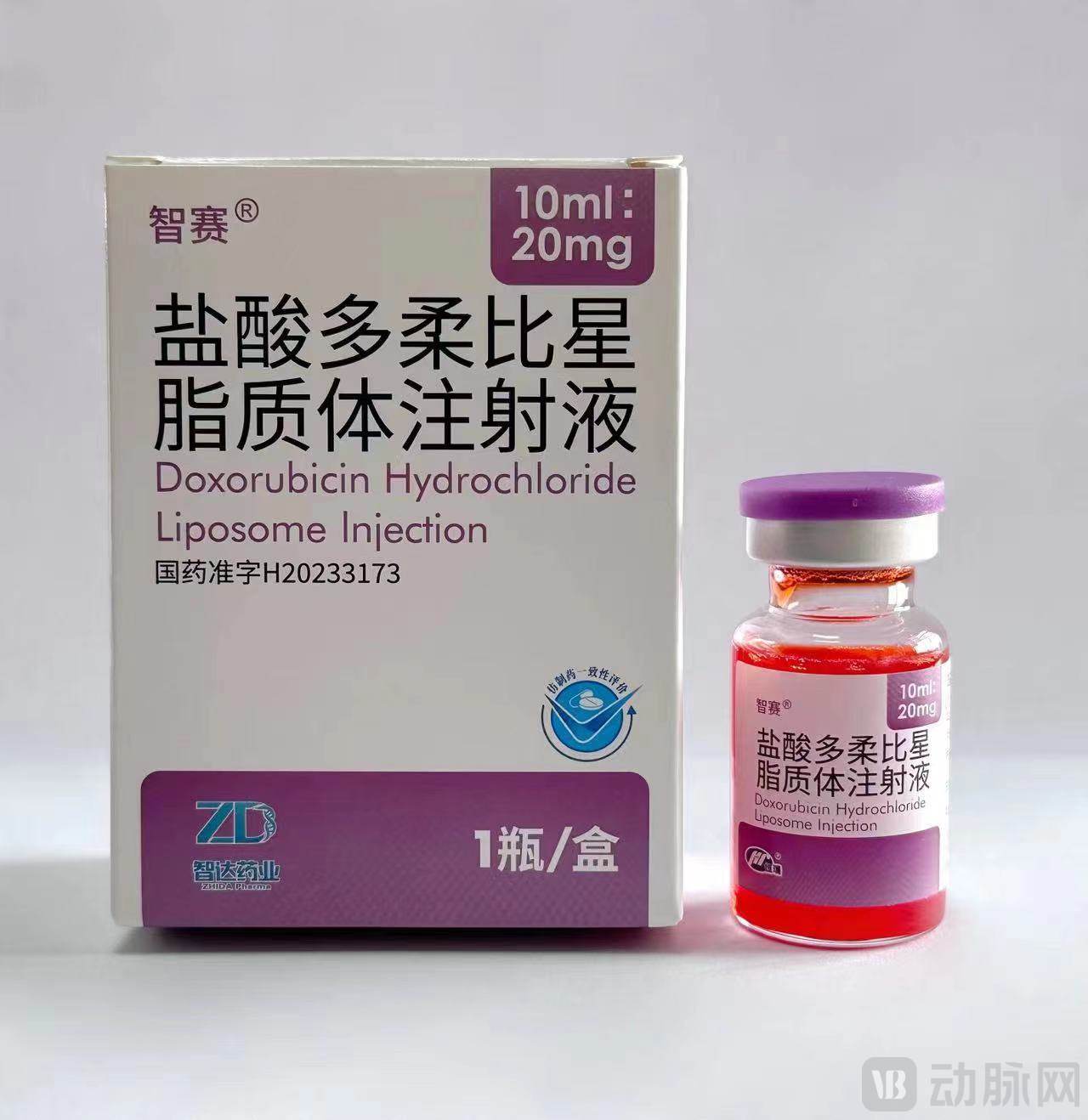
Zhisai Doxorubicin Hydrochloride Injection. Photo provided by the interviewee
In the liposome sector, in addition to the already marketed Liposomal Doxorubicin Hydrochloride Injection, Zhida Pharmaceutical is advancing the R&D of additional liposomal drugs, such as Irinotecan Hydrochloride and Amphotericin B, with notable progress achieved in each.
In addition to liposomal drugs, Zhida Pharmaceutical is also actively developing other advanced formulation technologies. Meanwhile, the company is strategically establishing a macromolecular drug delivery platform centered on liposome technology, positioning itself as a potential global pioneer in resolving the challenges of oral administration of macromolecules, thereby improving patient medication adherence.
“The successful market launch of the first liposomal drug, Doxorubicin Hydrochloride Liposome Injection, has given us the confidence and potential to continue developing other liposomal pharmaceuticals. Mitoxantrone Liposome and Amphotericin B Liposome share similar development processes with Doxorubicin Liposome, enabling rapid advancement in their R&D and manufacturing,” said Geng Min, CEO of Zhida Pharmaceutical.
“As an innovative pharmaceutical company focused on novel drug delivery systems (NDDS), Zhida Pharma aims to advance along a path ‘from liposomes to diverse nanomedicine technologies, and from generic drugs to innovative therapeutics.’ ‘Just as when we first started out, few were optimistic about our prospects, yet we ultimately achieved certain successes. This is inextricably linked to our mastery of core NDDS development technologies,’ said Geng Min, CEO of Zhida Pharma.”