

From Property Developers to Tech Giants: A Major Reshuffle in Cross-Industry Healthcare Investment

SANXING MEDICAL ELECTRIC
Provider of Integrated Smart Power Distribution and Consumption Solutions
On June 9, 2023, Yihua Health issued an announcement regarding the termination of its stock listing and delisting. According to public information, since announcing its entry into the medical and big health industry in 2014, Yihua Health had successively ventured into niche sectors such as hospital logistics, hospital investment and operations, collaborative oncology diagnosis and treatment, medical devices, and elderly care and wellness. Ultimately, this real estate company failed in its transition toward the medical and big health industry.
Meanwhile, according to a report by Wuxi Daily, the Wuxi Xinwu District Center for Diagnosis and Treatment of Immune Diseases will be established at SK Wuxi Hospital. Invested and constructed by South Korea’s SK Group and jointly managed with Renji Hospital affiliated to Shanghai Jiao Tong University School of Medicine, the hospital has a total investment of RMB 3.8 billion and is planned to have 1,500 beds. Leveraging Renji Hospital’s disciplinary strengths in basic immunology research and clinical immunology, the center will address the needs for prevention and treatment of immune diseases in Wuxi and southern Jiangsu Province.
In the recent wave of cross-industry entry into healthcare, the voice of real estate enterprises has grown increasingly quiet, while technology companies have gradually come to the fore. This shift in investor identity signals a significant transformation in the landscape of privately run healthcare.
Real estate developers often view hospitals as financial instruments and treat hospital establishment as a speculative endeavor.
With societal development, the middle-class and affluent populations are gradually expanding, driving higher and more diverse demands for medical services closely linked to their personal health.
Meeting the needs of this demographic has become one of the development goals for many enterprises. Over the past two decades, real estate developers have predominantly played this role. After experiencing rapid growth, these developers have embarked on diversified expansion, with healthcare and wellness emerging as a particularly significant strategic direction.
According to incomplete statistics, more than 100 real estate enterprises in China have ventured into the medical and health industry. Well-known listed companies such as Wanda, Evergrande, Vanke, Greentown, Sunac, Country Garden, and Longfor are all involved. Notably, many real estate developers that once made high-profile entries into the healthcare sector have now retreated from the spotlight. Annual reports of several listed companies no longer mention their medical and health-related businesses, marking a stark contrast to previous years when such topics were referenced dozens of times.
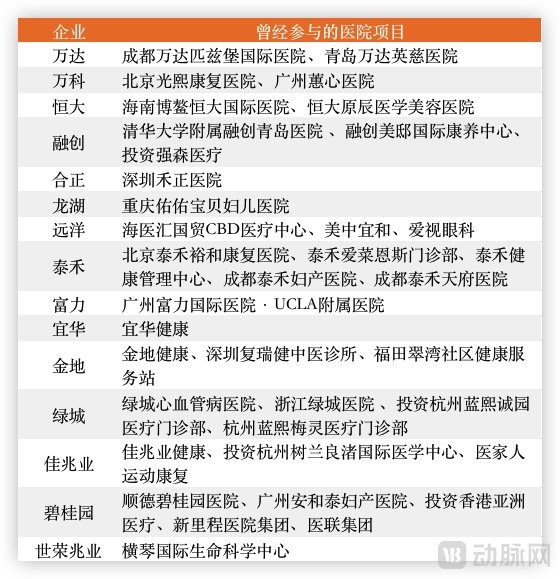
Healthcare Projects Previously Undertaken by Select Real Estate Developers, Compiled from Public Sources
Taking the hospital ventures favored by real estate developers as an example, most adopt a model of collaborating with renowned domestic and international hospitals, whereby the real estate developer provides land and funding, while the hospital supplies personnel, with joint construction and co-management. The advantage of this model is full control throughout the process, but its drawback is also evident: the cycle is excessively long.
However, from the perspective of real estate developers, the rationale for building their own hospitals is primarily centered on land acquisition, with listed companies also considering market capitalization management. The timeline from announcing entry into the healthcare industry, acquiring land, construction, and opening to achieving stable operations typically spans 5–7 years. Even if the venture ultimately underperforms, this outcome would not materialize until nearly a decade later, by which time the initial positive market sentiment generated by the cross-sector move into healthcare has already been fully priced in.
“In actual operations, real estate developers have different priorities from ordinary hospital investors,” an industry insider told VCBeat. “From the perspective of some real estate firms, securing the land means the project is already in hand; they anticipate that the project will naturally appreciate in value as the surrounding area develops over the next few years, at which point it can simply be sold off. Consequently, they do not place particular emphasis on operational management.”
Real estate developers investing in healthcare rely on capital; however, the healthcare service sector is not short of capital but rather lacks professionals capable of executing numerous details effectively.
In hospital operations management, real estate developers typically collaborate with hospital management companies. However, the separation of property rights from operational rights has sown hidden risks for subsequent actual operations, particularly when the property owner is a cross-industry entrant prone to applying the commercial logic of its original industry.
Hospitals are, by nature, a capital-intensive, long-cycle, low-return yet stable business model. They do not fluctuate with economic cycles and even exhibit a certain degree of counter-cyclicality. For real estate developers accustomed to rapid expansion fueled by financial leverage, the returns on hospital investments are notably low. When their core business was thriving, these developers did not mind merely “maintaining” their medical operations. However, in recent years, as the real estate sector has entered a broad downturn and developers have depleted their cash reserves, exiting the market or partnering with third parties for managed operations has become a common choice for many real estate firms.
As real estate developers fade out, technology companies are taking the baton to become the new generation of hospital investors.
Unlike real estate companies that cross over into healthcare with the primary goal of “land grabbing,” technology companies focus more on how their existing businesses can empower the healthcare sector, thereby expanding into new business lines.
BOE’s Smart Healthcare Strategy
As a global leader in the semiconductor display industry, BOE has accumulated profound expertise over the years in display technology, sensor technology, system device technology, the Internet of Things (IoT), and intelligent manufacturing. Meanwhile, recognizing the trends toward digitalization and intelligence in the healthcare sector, BOE has leveraged its core capabilities developed in the industrial field to empower the healthcare industry, thereby forging a development path characterized by the integration of medicine and engineering.
Taking BOE’s “1+4+N+Ecosystem” business development architecture as an example, the “1” refers to its semiconductor display business, which constitutes BOE’s core competitive advantage and serves as the foundation for its diversified growth. The “4” represents four strategic focus areas selected based on BOE’s internal capabilities and resources, with smart healthcare engineering being one of these four main fronts.
Since 2013, BOE has been involved in the medical and health industry. After ten years of development, it has built and operated multiple hospitals in Beijing, Hefei, Chengdu, Suzhou, and other cities, and its first smart elderly care community is about to be launched.
Digital empowerment is the core strategy of BOE’s hospital operations.
Through the integrated innovation of technology and medicine, the Smart Medical Engineering business has established an IoT-supported smart tiered health management system, forming a smart health management ecosystem. It constructs a full-cycle closed-loop health service model centered on health management, utilizing medical-engineering terminals as tools, and supported by internet hospitals and digital hospitals.
After years of development, BOE has gradually established three core capability platforms: the “Health IoT (HIoT) Platform,” the “Integrated Medical, Educational, Research, and Industrial Platform,” and the “3D Visualized Health Management Platform,” comprehensively empowering full-chain, full-course services spanning prevention, treatment, and rehabilitation.
Leveraging its digital capabilities, BOE’s Smart Healthcare and Medical Engineering business achieved revenues exceeding RMB 2.2 billion in 2022, representing a year-on-year increase of nearly 20%. Total outpatient visits rose by more than 80% year on year, while total hospital discharges surged by over 100% year on year. The business also established collaborations with medical institutions and research academies, including Chengdu Medical College and the Institute of Medical Engineering, Chinese Academy of Sciences.
Beyond digitalization, at the recently concluded China Medical Equipment Fair (CMEF), BOE showcased multiple products and solutions that deeply integrate healthcare with technology, spanning three key scenarios: hospitals, communities, and homes.
In hospital settings, BOE showcased its early screening solution for critical illnesses, AI-assisted medical imaging diagnosis system platform, and smart ward solutions. Among these, the early screening solution for critical illnesses targets high-incidence conditions such as lung cancer, gastrointestinal cancer, liver cancer, bladder cancer, and cardiovascular and cerebrovascular diseases. It not only enables precise detection but also significantly advances the timing of disease identification, facilitating early intervention and disease prevention. The smart ward solution leverages an interactive smart ward system to integrate multi-scenario smart IoT display and monitoring terminals, helping hospitals improve management efficiency and nursing quality while enhancing patient satisfaction.
Furthermore, BOE’s sensing business, one of its four core strategic pillars, has introduced a range of cutting-edge medical sensor products, including passive digital microfluidic systems, glass microfluidic chips, and backplanes for medical imaging. The development of these products relies heavily on feedback from frontline hospitals to address critical pain points in clinical practice. For instance, the passive digital microfluidic system transfers biological experimental procedures—which typically require extensive manual operation and consume large volumes of reagents—onto chips, thereby achieving full-process automation and significantly improving turnaround time.
As a technology enterprise, BOE Technology Group Co., Ltd. has deeply integrated its technological expertise with medical services, using the establishment of hospitals as an entry point to expand extensively along the medical industry chain, thereby forging a distinctive path of “Health + Technology.”
Haier: The Home Appliance Giant’s Big Health Dream
Haier has prioritized smart home solutions, industrial internet, and comprehensive health as its core strategic directions, building a user-centric ecosystem. Its subsidiary, INKON Life Technology Co., Ltd., focuses on medical platforms and medical devices, with hospitals serving as a critical component of Haier’s broader health strategy.
INKON Life operates and manages six hospitals, including Sichuan Friendship Hospital, Suzhou Guangci Hospital, Chongqing Youfang Hospital, Shanghai Yongci Rehabilitation Hospital, Yuncheng Hospital, and Changchun INKON Hospital. As of 2022, the six hospitals had a total bed capacity of 3,258, served 1.56 million patients in total (a year-on-year increase of 155%), and recorded a combined outpatient volume of 1.486 million visits.
In 2022, INKON Life completed the construction of its comprehensive online healthcare platform, “Experience Cloud,” establishing ecosystem service capabilities for a digital healthcare platform. Currently, the major hospitals under INKON Life have each developed localized internet healthcare online service platforms with distinct features, all built upon the “Experience Cloud” infrastructure.
For hospital operations, INKON Life Technology Co., Ltd. has adopted a “Hospital + Ecosystem + Platform” model. By strengthening and expanding regional medical centers, it provides high-quality diagnostic and therapeutic services to patients within the hospital setting, while also extending premium medical resources down to the community level to establish an effective network for sharing medical resources. Meanwhile, to address patients’ pre- and post-hospitalization needs for preventive care, rehabilitation, and other health services, the hospital enhances its digital platform capabilities and leverages technologies such as digital operations, “Experience Cloud,” and digital therapeutics to realize a closed-loop H2H (Hospital to Home) service network.
By extending medical resources to community and home settings, and in conjunction with Haier Home Healthcare, we leverage the empowerment of the COSMOPlat industrial internet platform and advanced intelligent manufacturing capabilities to deliver intelligent, personalized, and customized health solutions for home scenarios. Products such as smart oxygen concentrators and blood pressure monitors help build a smart health ecosystem for users, thereby supporting the group’s broader big health strategy while enriching Haier Smart Home with additional scenarios and solutions.
In addition to digital empowerment, INKON Life Technology Co., Ltd. has built a specialized medical service portfolio centered on comprehensive, full-course and full-cycle cancer care, while driving R&D and innovation in related medical device products targeting key scenarios across cancer prevention, diagnosis, treatment, and rehabilitation.
Haier’s North China R&D Center is currently the INKON Life Medical Technology Research Institute, which has established an R&D team for medical device equipment and another for medical device consumables. In addition, its subsidiary, Shengnuo Medical, has set up three engineering laboratories for the R&D and testing validation of infusion products, high-pressure injector products, and mammography X-ray equipment, as well as one engineering center laboratory for mammography X-ray products. All main products are independently developed.
Currently, INKON Life’s medical device products primarily cover four major application scenarios: radiation therapy, life support, image enhancement, and chronic disease management. Some of these products have been deployed in over 600 Grade A tertiary hospitals across China—including Peking Union Medical College Hospital, West China Hospital of Sichuan University, the Chinese PLA General Hospital, and the First Affiliated Hospital of Sun Yat-sen University—as well as in more than 3,000 hospitals at various levels across over 20 provinces and municipalities. Additionally, the products are exported to more than 80 countries and regions worldwide.
Establishing hospitals is merely one component of Haier’s grand health strategy. Currently, Haier has incubated businesses such as INKON Life Technology Co., Ltd., Haier Biomedical, Haier Medical, and Haier International Cell Bank. In the future, catering to diverse needs across users’ full life cycles, Haier will build a complementary ecosystem of services centered around seven key scenarios: pregnancy, childbirth, infancy, growth, wellness, nursing, and elderly care.
AUX’s 20-Year Commitment
AUX Group’s Samsung Medical Electric is a leading provider of integrated smart power distribution and consumption solutions in China. In 2002, Samsung entered the healthcare industry, with construction commencing on its first hospital, Ningbo Mingzhou Hospital (Zhejiang University Mingzhou Hospital).
This bold cross-industry move stemmed from the excessive time wasted by AUX founder Zheng Jianjiang while seeking medical care for his parents. For Zheng, who had propelled the then-named Sanxing Instrument Factory to a 500-fold performance growth within three years, catapulting it to an industry-leading position, such inefficiency was unacceptable. Consequently, Zheng set aside his ongoing work to conduct overseas investigations into advanced healthcare systems and hospital operational models, with the aim of learning from and introducing these best practices.
Ningbo Mingzhou Hospital has been in operation for 17 years since 2006 and was officially accredited as a Grade III Class B general hospital in March 2023. Through 17 years of exploration, Mingzhou Hospital has established its mission of “patient-centered care and building a humanistic hospital,” accumulating extensive experience in operational management and talent development, which can provide managerial expertise for future expansion in the healthcare industry.
Samsung has prioritized rehabilitation medicine as its core strategic direction, exploring the deep integration of intensive care unit (ICU) services, rehabilitation, and hyperbaric oxygen therapy. By fully leveraging the “golden window” for early intervention, it has pioneered ventilator support techniques within hyperbaric chambers and rehabilitation training for patients on ventilators. Committed to innovating rehabilitation care models and fostering effective collaboration with general hospitals, Samsung is pursuing a differentiated, chain-based, and branded development pathway.
As a medical business incubated by an intelligent manufacturing enterprise, Samsung-affiliated hospitals adhere to the parent company’s requirements for standardization, process optimization, and informatization. Centered on the strategic goal of becoming a “service-oriented hospital,” Mingzhou Hospital has implemented tangible patient services—such as reducing wait times for consultations, minimizing trips for examinations, simplifying inpatient stays, facilitating payment processes, and streamlining medication dispensing—while simultaneously enhancing overall operational efficiency.
In recent years, Sanxing Medical has continuously acquired rehabilitation hospitals. Most of these acquired hospitals achieved positive revenue growth shortly after being consolidated into the listed company’s financial statements, which to some extent reflects its operational capabilities.
In May, Samsung Medical acquired 100% equity stakes in five hospitals: Huzhou Zhebei Mingzhou Hospital Co., Ltd., Quanzhou Mingzhou Rehabilitation Hospital Co., Ltd., Yuyao Mingzhou Rehabilitation Hospital Co., Ltd., Quzhou Mingzhou Hospital Co., Ltd., and Jiaxing Mingzhou Nursing Home Co., Ltd., with a total transaction value of RMB 586 million.
What supports Samsung Medical in replicating its rehabilitation medical business across multiple locations is its refined management model based on digital technology and ample talent reserves.
Unlike tech-driven enterprises such as BOE and Haier, Oscar Healthcare focuses more on management excellence. The essence of a rehabilitation hospital lies in its bed capacity plus rehabilitation services, which offer far lower profit margins than surgical treatments. Without robust management, rapid replication and expansion of the hospital network would be unattainable.
Zheng Jianjiang once publicly stated, “Management is the most advanced high-tech, while IT serves as the soul and lever of management, forming the foundation and core of digital transformation. If process-oriented IT is poorly implemented, the enterprise cannot become strong, nor can it retain talent.” At AUX, it has become a behavioral norm for every employee to recognize that everything follows a process, everyone contributes to process creation, and each individual must identify their role within these processes.
Samsung Medical adheres to the core essence of AUX’s digital transformation, which is centered on enhancing corporate competitiveness. By leveraging data to support business operations and building a comprehensive management system that covers all processes and links without blind spots, it has achieved refined decision-making and management. This has enabled Samsung Medical to accelerate rapidly in its expansion of rehabilitation hospitals.
It is difficult to build a good hospital by throwing fast money at it.
In the past, when real estate developers sought to establish hospitals, their announcements were as loud and dramatic as a storm; yet, when it came to actual project implementation, they often proceeded with conspicuous silence. Healthcare is an industry characterized by long-term investment and extended payback periods, whereas real estate development prioritizes speed above all else, relying on high leverage and high returns. Applying the commercial logic of real estate to healthcare investment, an injection of RMB 100 million would be expected to yield a tenfold return. However, the reality is that a hospital typically requires three to five years of operation just to reach cash-flow breakeven, with profitability emerging even later.
“Transformation for the sake of transformation” has become a true reflection of many real estate developers’ cross-sector forays into healthcare. As the real estate industry enters a downturn and developers’ financial resources dwindle, withdrawal from the sector has become the norm.
At the heart of hospitals lies medical service, whose essence is neither capital nor real estate, but rather operation and development—ultimately centered on people, including physicians and administrators. While real estate developers are willing to seek partnerships with physicians, they rarely invest comparable effort in engaging administrators. Instead, during long-term operations, unfamiliarity with the healthcare industry often leads to conflicts between real estate developers and management teams, thereby reducing hospital operational efficiency.
The real estate industry itself offers limited opportunities to empower healthcare entities, which objectively increases the difficulty of their integration.
In contrast, when technology companies cross over into healthcare provision, their inherent capabilities are more readily integrated with the medical industry.
Due to their inherent characteristics, technology companies have a natural reverence for highly specialized sectors. Having established and launched various business lines during their development, they are more experienced in integrating new ventures. Furthermore, aligning their long-term strategic goals with the healthcare industry prevents short-sightedness in hospital management. Instead, these companies leverage their superior organizational and management expertise to enhance hospital operations, which aligns perfectly with the objective of reducing costs and improving efficiency. This synergy is essential for scaling up hospitals and strengthening their market position.
Furthermore, by deeply integrating their core competencies with the healthcare industry and expanding across the upstream and downstream segments of the value chain, technology companies have gained a deeper understanding of the healthcare sector. They have developed new solutions for various scenarios, both within and outside hospitals, while pursuing additional mergers and acquisitions for expansion. At this stage, these technology firms are no longer “cross-industry entrants,” but rather resemble “insider capital” dedicated to the healthcare industry.
"Those who truly succeed in cross-industry healthcare must be driven by compassion, approach their work with reverence, and commit to a long and arduous journey."