

Carmot Therapeutics Files for IPO Following Strategic Pivot to GLP-1-Based Metabolic Therapies and $310M in Annual Funding

Carmot Therapeutics
Developer of New Drugs for Metabolic Diseases and Cancer
Recently, there has been a steady stream of positive developments regarding GLP-1-based weight-loss drugs. Eli Lilly, Novo Nordisk, Boehringer Ingelheim, Pfizer, and Innovent Biologics have successively announced their latest research progress. According to Novo Nordisk’s financial report, global sales of semaglutide reached $10.9 billion in 2022. However, first-mover advantage is not the decisive factor in the metabolic disease sector. As drug development advances, products that balance patient adherence and efficacy—such as dual-target, multi-target, long-acting, and oral formulations—will occupy the strategic high ground. The vast prospects of this hundred-billion-dollar market belong not only to these multinational corporations (MNCs) but also to numerous biotech companies still in their rapid growth phase.
Carmot Therapeutics (“Carmot”), which just announced in May the completion of a $150 million oversubscribed and larger-scale Series E financing round, is one such example. Carmot is a clinical-stage biotechnology company dedicated to the development of novel GLP-1-based therapeutics for patients with metabolic diseases, including obesity and diabetes.
Leveraging the GLP-1 momentum, Carmot’s development has significantly accelerated since 2020, earning strong favor from capital markets. Amid the funding winter, Carmot completed two rounds of financing within less than a year, with each round raising at least $150 million.
Financing History | Financing Amount (USD 10,000) | Financing Date |
Series A | 155 | 2010-04 |
Series B | 1500 | 2018-01 |
Series C | 4700 | 2020-09 |
Series D | 16000 | 2022-07 |
Series E | 15000 | 2023-05 |
▲ Carmot’s Financing History (Source: Crunchbase)
The successful development of drugs relies on proprietary technology platforms with high barriers to entry. Carmot has established a powerful discovery approach based on chemotype evolution—Chemotype Evolution, a pioneering drug discovery platform.
This originates from co-founder Dr. Stig K. Hansen, who previously served as Director of Biology at Sunesis Pharmaceuticals. The CE technology platform he invented enables the association of a set of small molecules with a proprietary collection of fragments during chemotype evolution, thereby generating a library of drug candidates. The library is screened against human targets, and selected candidates are subjected to further rounds of linking and selection until they evolve into high-affinity binding molecules.
Compared with other drug discovery platforms, this process can rapidly and effectively unlock novel and diverse chemical spaces that are difficult to access using traditional small-molecule discovery technologies. The company is leveraging its CE platform to identify new incretin receptor signaling targets, extensively developing therapies that improve glycemic control and induce significant weight loss in patients.
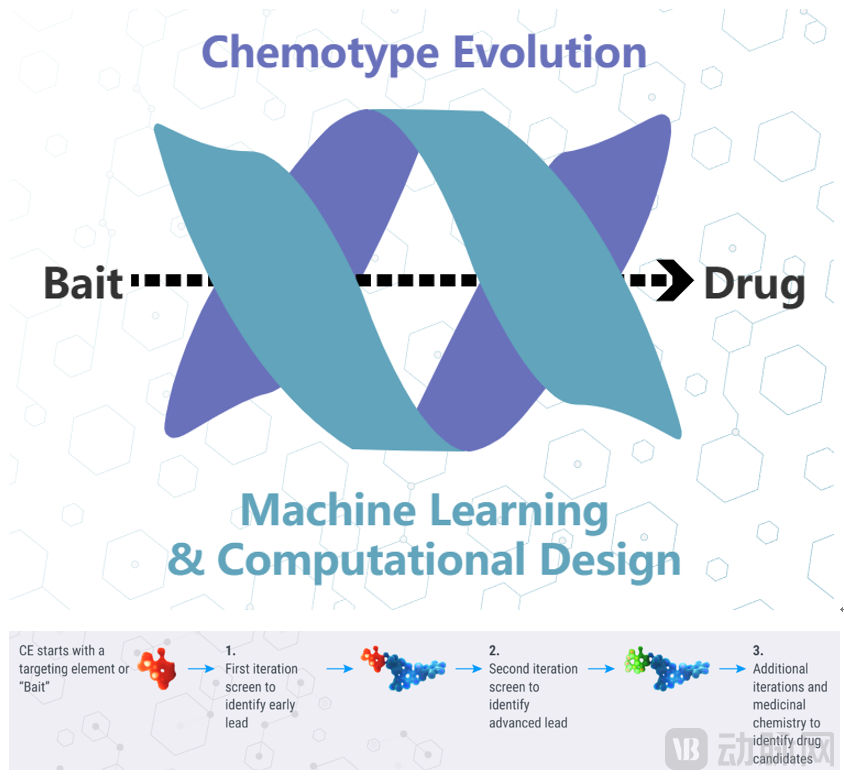
▲ Carmot’s CE Platform (Image source: Carmot)
However, Carmot did not identify its strategic focus from the outset; it underwent a prolonged period of exploration. Founded in 2008, the company initially ventured into the central nervous system (CNS) therapeutic area. It was not until after completing its Series B financing round in 2018 that Carmot transitioned out of its startup phase and established itself as a preclinical innovative therapeutics company.
Following its Series C financing round after 2020, Carmot accelerated its progress; at that time, it was a company advancing concurrently in the fields of metabolism, oncology, and autoimmune diseases.
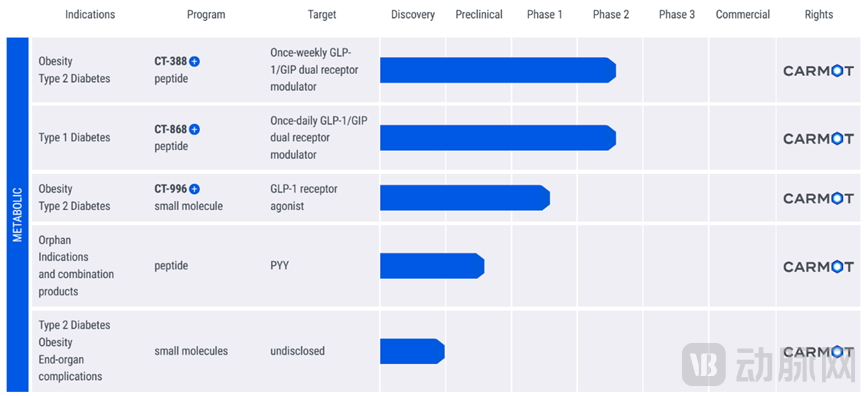
▲ Carmot’s 2023 R&D Pipeline (Image source: Carmot)
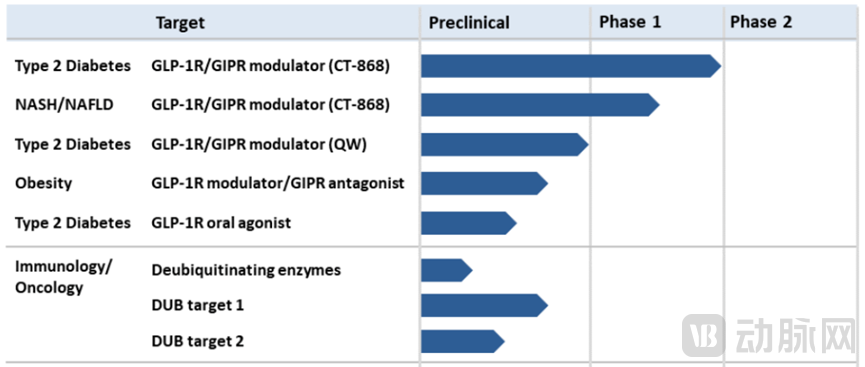
▲ Carmot’s 2020 R&D Pipeline (Image source: Carmot)
In the metabolic disease sector, Carmot had only CT-868 (a dual GLP-1/GIP receptor modulator) in Phase I clinical trials for type 2 diabetes and NASH/NAFLD indications, with all other candidates remaining in preclinical stages.
In 2019, Novo Nordisk launched the oral formulation of semaglutide, which not only generated substantial profits for the company but also sparked a global wave of research into GLP-1 receptor agonists. Carmot Therapeutics clearly recognized the potential of this billion-dollar market. Facing sluggish progress in its own pipeline and unfavorable financing conditions, Carmot made a decisive shift in 2020 to focus its R&D efforts on GLP-1 drugs for diabetes and obesity. This was undoubtedly a risky decision, but fortunately, Carmot bet on the right horse.
Since the pipeline restructuring, CT-868 has completed Phase I clinical trials in healthy adult volunteers with overweight and obesity, and Phase II trials in obese patients with type 2 diabetes (T2D). Mechanism of action (MOA) studies have also been completed in obese adults with and without T2D to evaluate its effects on glucose homeostasis. Recently, Carmot Therapeutics initiated another Phase I MOA study in patients with type 1 diabetes (T1D) who have overweight or obesity, and expects to launch a Phase II proof-of-concept clinical trial in this patient population in the second half of this year.
Meanwhile, Carmot has expanded its R&D pipeline to include the dual GLP-1/GIP receptor modulator CT-388, the oral small-molecule GLP-1 receptor agonist CT-996, a long-acting peptide tyrosine tyrosine (PYY) analog, and a novel small-molecule drug. CT-388 is currently undergoing Phase I/IIa clinical trials in overweight and obese adults with and without type 2 diabetes (T2D), with additional Phase II trials planned to commence in 2023 in obese adults. CT-996 has recently initiated a Phase I clinical trial in healthy overweight and obese adults. The PYY analog is in the late stages of preclinical development.
Other adjustments included the removal of the once-weekly (QW) GLP-1 receptor modulator and deubiquitinase (DUB) inhibitor candidates from the pipeline, as well as the discontinuation of CT-868 development for NASH/NAFLD indications.
All of this unfolded in just three short years; once the right direction was identified, both its financing and clinical development progressed at a remarkable pace.
To better capitalize on the GLP-1 momentum, Carmot formally spun off its CE discovery platform in oncology, immunology, and inflammation into a new independent company, Kimia Therapeutics (“Kimia”), in January this year. Carmot will now focus on metabolic diseases by advancing its proprietary clinical and preclinical therapeutic portfolio that modulates gut hormones and related energy homeostasis mechanisms, while maintaining exclusive access to the CE discovery platform for metabolic diseases through its collaboration with Kimia.
The spin-off enables Carmot to focus on its clinical-stage candidates CT-388 and CT-868, as well as other IND-stage projects (CT-996 and PYY). Given that both CT-388 and CT-868 have recently demonstrated clinically meaningful data, Carmot plans to expand upon these findings. Meanwhile, Kimia will concentrate on leveraging machine learning to enhance the capabilities of CE, thereby accelerating the development of novel oncology, immunology, and inflammation therapeutics.
Dr. Stig K. Hansen, co-founder of Carmot, will become the CEO of Kimia. Dr. Tim Kutzkey stated, “Carmot has discovered novel biological properties, identified incretin modulators, and successfully advanced Phase I/II clinical trials for adult obesity (with and without diabetes). Strategically and operationally, Carmot and Kimia will each be uniquely positioned to optimize their drug development opportunities; the decision to separate them into two distinct, independent companies is the best course of action. Furthermore, Ms. Turner brings extensive leadership experience from biotechnology companies, and Dr. Hansen possesses a strong background in research and early-stage leadership, making them well-suited to lead these companies.”

▲ Ms. Heather Turner, CEO of Carmot, and Dr. Stig K. Hansen, Co-founder of Carmot
With a market valuation in the hundreds of billions of dollars and formidable technical barriers, how should domestic companies prepare before the next industry surge? Carmot’s transformation appears to point them toward a new direction. Shifting from a diversified conglomerate model to specialized expertise, and accelerating from slow growth to completing two rounds of financing within a year, the secret to success seems to lie in its core technological moat and a clear pipeline strategy. To address upcoming challenges—such as insufficient R&D capabilities, constrained production capacity, and a singular technology platform—Chinese enterprises still require clearer strategic planning and more in-depth exploration.
Regarding the follow-up progress of Carmot’s clinical trials, the company announced that it will deliver multiple presentations at the American Diabetes Association Annual Scientific Sessions, held in San Diego, California, from June 23 to 26, 2023, to showcase additional clinical data from its therapeutic pipeline.