

Riding the Wave: Advancing Frontier Research and Commercial Translation in Brain-Computer Interfaces
On May 26, 2023, Neuralink, Elon Musk’s brain-computer interface company, announced that it had received FDA approval and was poised to launch its first clinical trial, signifying thatHuman Brain Implants to Enter Clinical Research for the First Time。
As soon as the news broke, Elon Musk swiftly reposted the good tidings on Twitter, remarking, “Congratulations!”
Once again, brain-computer interfaces (BCIs) have been propelled to the forefront of the technological wave. An investor in the biomedical sector stated that BCIs hold immense promise, with applications extending beyond medical devices into the metaverse.
Meanwhile, on June 8, 2023, at the MATLAB EXPO event hosted by MathWorks,Professor Dan Zhang, Tsinghua Universitypublished a paper titled"Brain-Computer Interfaces: Decoding the Power of Thought"keynote address.How Do Brain-Computer Interfaces Decode Thoughts? How Can They Shine in the Medical Field? And How Far Are They from Commercial Implementation?During the event, Professor Zhang Dan gave an in-depth interview to VCBeat’s Orange Bureau on this topic.
Three Major Types, Brain-Computer Interface Research Moves Forward
Artery Orange Bureau: How Do Brain-Computer Interfaces Decode Thoughts?
Professor Zhang Dan:Based on the neuroscience knowledge, task design, and application scenarios associated with brain-computer interface (BCI) systems, BCI research encompasses multiple distinct types. Among non-invasive BCIs, the most representative include:Motor Imagery Brain-Computer Interfaces, Visual Brain-Computer Interfaces, and Emotional Brain-Computer Interfaces.
First is the motor imagery brain-computer interface (BCI), which represents the BCI approach closest to achieving “thought-to-action” capability among all BCI research domains. Users can perform various limb movements through mental imagery. Notably, motor imagery activates distinct regions within the motor cortex of the human brain. Consequently, when imagining different movement states, specific rhythmic neural activity changes occur in corresponding cortical areas. To translate such mental imagery into control commands for devices, researchers must acquire brain signals and employ algorithms for effective recognition, thereby deciphering the user’s intended actions.
Next is the visual brain-computer interface (BCI), also known as the BCI with the fastest information interaction rate. Three key technologies underpin this type of BCI: First, precise timing of visual stimulus presentation, achieving millisecond-level accuracy; second, BCI decoding algorithms, which serve as the most mainstream toolkit for BCI data analysis and enable deeply integrated signal processing; and third, real-time data processing and decoding.
The above two types of brain-computer interface research,This primarily involves users actively issuing commands to achieve brain-computer interaction, and is therefore also referred to as active brain-computer interface research.
In addition to research on active brain-computer interfaces, an increasing number of teams are now focusing on key human cognitive states, and this category of brain-computer interface research is also known asPassive Brain-Computer Interface Research。
Emotional Brain-Computer InterfaceThis is one such example and has been one of my primary research directions in recent years. Affective computing, which enables machines to understand human emotions, is becoming a research hotspot in fields such as human-computer interaction, mental health, and artificial intelligence. Compared with behavioral and peripheral physiological signals such as speech, facial expressions, and heart rate, electroencephalography (EEG) can more directly reflect an individual’s emotional experience. Consequently, EEG-based affective computing and emotion-based brain-computer interfaces have garnered widespread attention from the academic community in recent years.
Currently, we are leveraging brain-computer interface (BCI) technology to individually quantify human emotions, thereby enabling objective assessment of mental health issues related to emotional disorders. This year, in collaboration with MathWorks, we co-organized the "Emotional BCI (Youth Category)" event at the 2023 World Robot Conference—BCI Brain-Controlled Robot Competition. The competition has officially entered the leaderboard ranking phase, with the on-site finals scheduled for August. For this event, we provided participants with electroencephalogram (EEG) data from 123 subjects whose emotional states were known. Participants were tasked with developing EEG computational models capable of cross-subject emotion recognition, applying these models to perform real-time emotion recognition on EEG data from a separate group of subjects. Competition results were determined based on the accuracy of emotion recognition. We encourage contestants to use MATLAB for programming and implementation, working together to accelerate the exploration of the potential of emotional brain-computer interfaces!
Great Potential in Rare Diseases, Neurological Disorders, and Mental Health Conditions
VCBeat: In the field of life and health, in which application scenarios can brain-computer interfaces create their own "highlight moments"?
Professor Zhang Dan:Let us first examine the applications of active brain-computer interfaces (BCIs). The application scenarios for this type of BCI include rare diseases and neurological disorders: first,Amyotrophic Lateral Sclerosis (ALS), restoring the communication abilities of patients with amyotrophic lateral sclerosis (ALS); secondly,Neurological Disorders Such as Epilepsy, using brain-computer interface technology to control seizures in patients with epilepsy and other conditions.
Next, let us examine the applications of passive brain-computer interfaces (BCIs). The application scenarios for this type of BCI arePsychological Assessment. Traditional psychological assessments rely on questionnaires, self-reports, or counselor interviews, which place high demands on respondents’ education level, background, and compliance, thereby significantly limiting their applicability. In contrast, brain-computer interfaces (BCIs) can establish more objective psychological assessment protocols by capturing human emotional states.
Increased investment is still required in both research and application sectors.
VCBeat Orange Bureau: From Lab to Factory, What Challenges Might Arise in Translating Brain-Computer Interface Research Achievements? How Far Is the Commercialization of This Field, or What Else Is Needed?
Professor Zhang Dan:On the one hand, in terms of research and development, for brain-computer interface (BCI) technology itself, how to quickly and effectively acquire brain signals still needs further optimization. This can be divided into two branches: one is non-invasive brain-computer interfaces, where researchers may stillIt is necessary to address the sensor materials and their corresponding electrical issues.; second, invasive brain-computer interfaces, which mayIssues related to clinical technical protocols, etc.。
On the other hand, there is the application side, we stillIt is necessary to determine which technologies can be integrated with brain-computer interfaces., thereby extending the scope of brain-computer interface applications.
Therefore, from these two perspectives, I believe that greater investment is needed to drive the industrialization of brain-computer interfaces.
VCBeat Orange Bureau: What emerging technologies can help break through bottlenecks in brain-computer interface research and applications? How can MathWorks support the R&D and translational work of brain-computer interfaces?
Professor Dan Zhang:In fact, during the development of brain-computer interfaces (BCIs), many challenges similar to those encountered in the development of other medical devices arise. In our actual research and development work, we utilized the MATLAB platform and a wide range of related toolboxes,From basic statistical analysis tools, to signal processing tools, and then to machine learning/deep learning tools,Help researchers advance the development and engineering implementation of advanced medical devices.
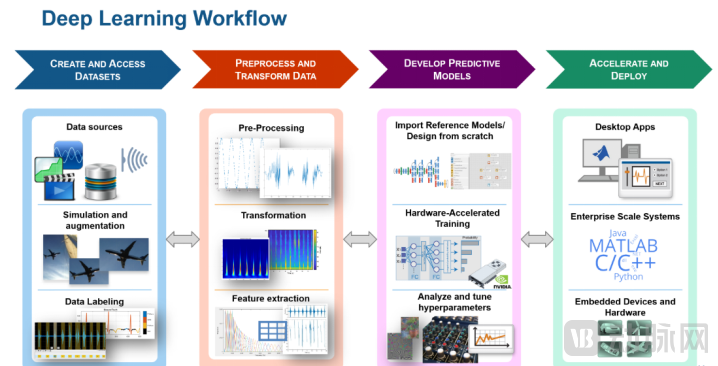 MATLAB Deep Learning Workflow Diagram
Automate high-precision annotation of large datasets by acquiring EEG signals from hardware in real time; leverage a graphical app to automatically generate corresponding code for MEG/EEG preprocessing and feature extraction; utilize common AI models for transfer learning training and provide a graphical user interface; and achieve comprehensive algorithm deployment through a suite of code generation tools.
Medical care cannot remain confined to academic research. To translate medical research achievements from the laboratory to industrial production, new tools such as MATLAB are indispensable. They provide researchers with a comprehensive framework for high-quality engineering implementation, thereby enabling the rapid development of high-quality brain-computer interface systems and other intelligent medical devices.