

Da Vinci Surgical System Goes Local: Intuitive Fosun Secures 'National Medical Device Approval' as Competition Heats Up in China's Robotic Surgery Market

MedBot
Surgical Robot Developer

SHURUI
Surgical Robot R&D and Manufacturer

Intuitive Fosun
Medical Device Developer
Edge Medical
Developer of Robot-Assisted Minimally Invasive Surgical Systems
Just as domestically produced surgical robots are successively receiving approval for market launch, collectively entering the commercialization phase, and preparing to compete with the industry leader, da Vinci, at this critical juncture, da Vinci has transformed itself into a domestic product.
On June 14, 2023, the National Medical Products Administration (NMPA) website published a notice regarding the delivery of medical device approval documents, which included information on Intuitive Surgical-Fosun Medical Technology (Shanghai) Co., Ltd. (hereinafter referred to as “Intuitive Fosun”) and its “Thoracic and Abdominal Endoscopic Surgical Control System,” with registration certificate number “Guo Xie Zhu Zhun 20233010800.” This marks the official approval for market launch of the locally manufactured da Vinci surgical robot.
Intuitive Fosun is a joint venture established in 2017 by Fosun Pharma and US-based Intuitive Surgical, responsible for the sales of the da Vinci Surgical System in China. According to data from its official website, the installed base of da Vinci systems in the Chinese market has currently exceeded 330 units. With the recent entry of domestically produced surgical robots into the market, Intuitive Fosun has also begun to strengthen its localization strategy.
The localization of the Da Vinci system will undoubtedly deliver a new round of shocks to domestic brands that are still in the early stages of commercialization.
Since receiving FDA approval for market launch in 2000, the da Vinci Surgical System has undergone more than two decades of development, becoming the recognized leader in the surgical robotics industry.
With the approval of the da Vinci system in China in 2008, surgical robots, as a novel innovation, began to enter the Chinese market. As the only product available at the time, da Vinci shouldered nearly the entire burden of market education for this category in China. “The road is long and arduous, yet we press on without halt” aptly describes da Vinci’s market journey during this period.
After nearly a decade of effort, the installed base of da Vinci surgical robots in China saw a significant increase after 2018. From 2019 to 2021, the year-on-year growth exceeded 40 units each year, with net growth surpassing 90 units in 2021 alone. Currently, the installed base of da Vinci surgical robots in China has exceeded 330 units, benefiting more than 400,000 patients.
Not limited to abdominal surgical robots, Intuitive Surgical’s Ion endoluminal system (commonly referred to as a bronchoscopic surgical robot and classified as a natural orifice surgical robot) has passed the review by the National Medical Products Administration (NMPA) and been approved for entry into the Special Review Procedure for Innovative Medical Devices. This signifies official national recognition of the technological innovation behind Ion and is expected to accelerate its market launch in China.
According to Frost & Sullivan data, the market size of laparoscopic surgical robots in China grew from RMB 700 million in 2017 to RMB 3.24 billion in 2021, with a compound annual growth rate (CAGR) of 46.7% during this period, wherein the majority of the market share was occupied by the da Vinci system.
With the expansion of the market, numerous domestically produced surgical robots have entered the fray. The Chinese surgical robot market, once dominated solely by the da Vinci system, is gradually evolving into a landscape characterized by intense competition among multiple players.
As the market size expands, policy support strengthens, and capital investment increases, domestically produced surgical robots are accelerating their catch-up efforts.
Taking the da Vinci surgical robot for abdominal procedures as an example, multiple domestically produced models have successively received approval and been launched on the market. During their commercialization process, promotional and educational efforts targeting a broader base of physicians have further expanded the domestic market. For instance, Weigao’s “Miaoshou S” laparoscopic surgical robot system officially received NMPA approval in October 2021, becoming the first laparoscopic surgical robot system approved for marketing in China.
Subsequently, in 2022, the Toumai laparoscopic surgical robot independently developed by MedBot, the Kangduo laparoscopic surgical robot, and the Jingfeng multi-port laparoscopic surgical robot MP1000 were successively approved for market launch. Among them, Toumai is the first domestically developed four-arm laparoscopic surgical robot to be approved for market launch in China; Kangduo is the first laparoscopic surgical robot in China to enter the Special Review Procedure for Innovative Medical Devices in the field of urology.
Domestic laparoscopic surgical robots are rapidly catching up with the da Vinci system.
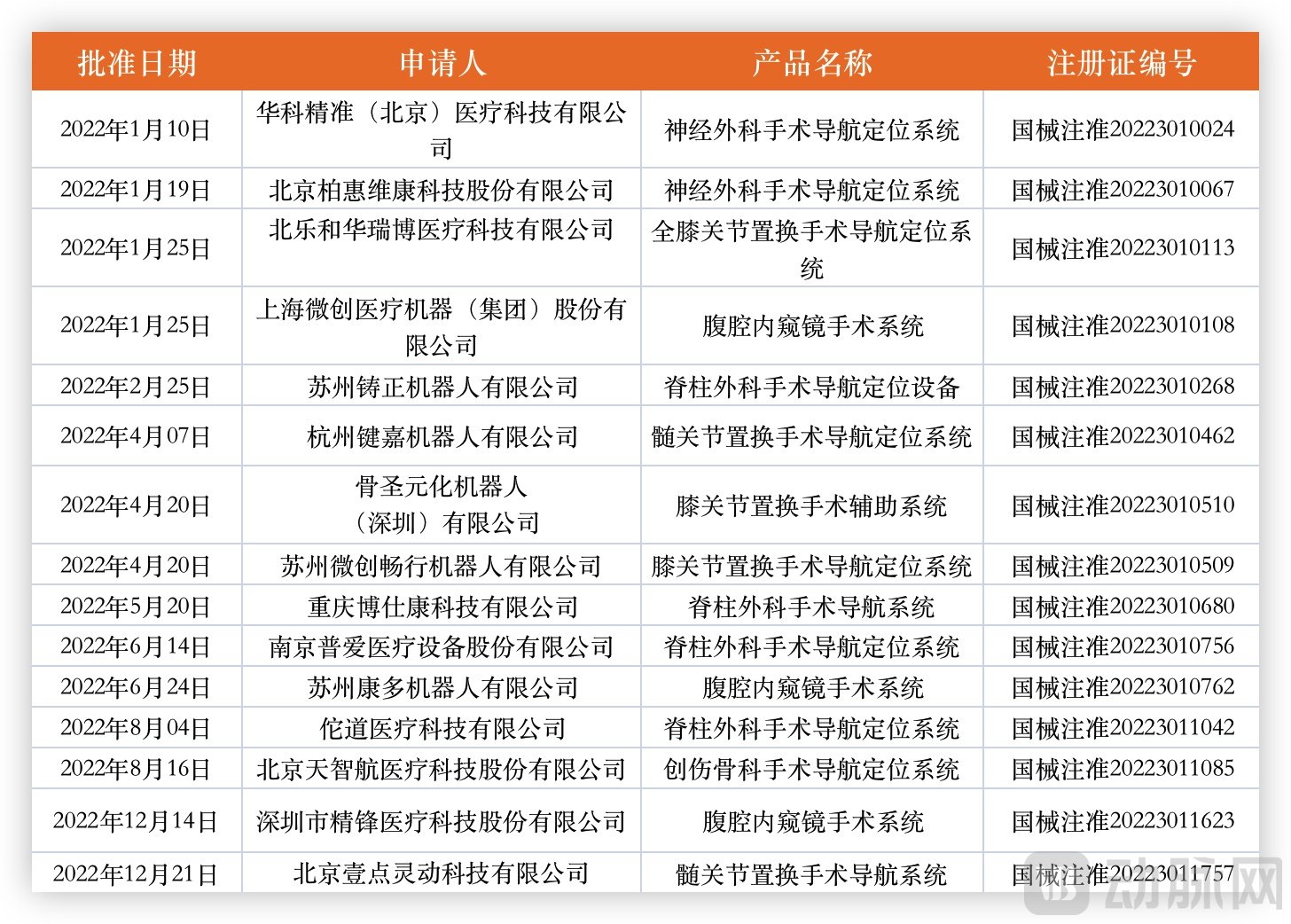
Surgical Robots Approved for Market Launch in China in 2022, Data Source: Artery Orange
According to data from VCBeat, the domestic surgical robotics sector saw 10 financing rounds exceeding RMB 100 million in 2021 alone, with four of these surpassing RMB 500 million each; total financing for the sector exceeded RMB 3 billion. In the secondary market, MedBot went public in 2021, with its market capitalization once surpassing RMB 60 billion. The influx of capital has fueled the prosperity of this sector. Looking at the broader field of surgical robotics, 15 surgical robot models were approved in China in 2022 alone.
Following regulatory approval, commercialization was supposed to be the primary focus for domestic manufacturers at this stage, with some even declaring this year as the inaugural year of industrialization for Chinese-made surgical robots. At this critical juncture, da Vinci has chosen localization as its strategic response.
Beyond product awareness, the high cost is the other major barrier to the widespread adoption of surgical robots.
Public information indicates that the current price of a da Vinci surgical robot in China is approximately RMB 23 million, with annual expenditures on consumables and maintenance constituting a significant financial burden. Consequently, domestically produced surgical robots have generally adopted a lower-price strategy; for instance, laparoscopic surgical robots from Edge Medical and MedBot are priced at around RMB 15 million. Sizhe Rui has further reduced prices to below RMB 10 million. According to Sizhe Rui’s previously disclosed prospectus, the ex-factory price of its SR1000 laparoscopic surgical robot ranges from RMB 3.5 million to RMB 9 million, with an average price approximately one-quarter that of the da Vinci system. The emergence of domestic products has further expanded the market.
Policy support is also driving the adoption of surgical robots.
In the first quarter of this year, the National Health Commission released the “Catalogue for the Administration of Licensing for the Allocation of Large Medical Equipment (2023).” Although laparoscopic surgical robots remain classified under Category B, the baseline price range has been adjusted from the previous RMB 10–30 million to RMB 30–50 million, which now far exceeds the prices of most products available on the market.
Meanwhile, on April 13, the National Health Commission released a draft for public consultation on the new standards for the allocation of large-scale medical equipment. The requirements for hospitals to be equipped with laparoscopic surgical robots have been relaxed from needing to be provincial-level leading institutions to merely having strong comprehensive surgical capabilities. This means that in the future, laparoscopic surgical robots will no longer be exclusive to top-tier Grade A tertiary hospitals; medical institutions at the prefecture-level city and county levels will also have the opportunity to acquire such equipment during this expansion.
Various signs indicate that restrictions on laparoscopic surgical robots may be further relaxed in the future.
Furthermore, medical insurance coverage is gradually being extended to surgical robots.
As early as April 2021, Shanghai’s medical insurance program included the “Da Vinci” surgical system within its reimbursement scope. Subsequently, multiple provinces and municipalities, including Beijing, Hunan, Guangdong, and Jiangxi, followed suit, incorporating surgical robots and related consumables into their medical insurance coverage. This year, Shanghai further expanded its medical insurance coverage to include 76 newly added medical service items and new medical device (consumable) entries, such as the “Da Vinci” system. These measures will undoubtedly continue to enhance the clinical penetration rate of surgical robots.
Driven by supportive policies, a rapid increase in surgical volume, and continuous market expansion, Intuitive Fosun has begun to accelerate its deployment in China.
As the number of installed units has risen steadily in recent years, Intuitive Fosun has also accelerated the localization process of the da Vinci system.
In December 2020, construction officially commenced on the Intuitive-Fosun da Vinci Innovation Center, with a total investment exceeding RMB 100 million. The center is designed to accelerate the research and development as well as the regulatory registration of localized products. In October 2021, the Intuitive-Fosun da Vinci Innovation Center, covering a total area of 1,700 square meters, officially began operations in Zhangjiang. This milestone represents a critical component of Intuitive-Fosun’s localization strategy in China and its commitment to supporting the professional growth and development of Chinese healthcare practitioners.
In July 2022, construction officially commenced on the Medical Robot Manufacturing and R&D Center for the Intuitive Fosun headquarters and industrialization base project. This marks another major strategic initiative following the da Vinci Innovation Center, and represents Intuitive Surgical’s second globally strategic manufacturing and R&D base after Silicon Valley in the United States.
The total investment in the project exceeds RMB 700 million. It is expected to be completed in 2025 and reach full production capacity in 2026. Initially, it is projected to achieve an annual output of 300 da Vinci Xi surgical systems based on the fourth-generation da Vinci Surgical Robot technology platform. Upon reaching full production capacity, the annual output value is estimated at approximately RMB 5.29 billion.
The approval of the domestically produced Da Vinci system is also the culmination of Intuitive Fosun’s deep local engagement and years of strategic layout.
In recent years, the Chinese government has introduced multiple policies to encourage independent innovation and R&D. Procurement documents across various regions have successively imposed restrictions on imported brands while encouraging the purchase of domestically produced equipment. In response, foreign brands have adopted localized production strategies to remain competitive in this market.
According to the "Administrative Measures for Government Procurement of Imported Products," imported products refer to those produced outside the customs territory and entering China through customs declaration and clearance. Medical equipment manufactured domestically by foreign medical device brands is also considered domestically produced and enjoys the same treatment as domestic products.
Furthermore, the nature of the product can also be determined from its registration certificate number. Previously, the da Vinci system’s registration certificate number was “Guo Xie Zhu Jin 20183010498,” whereas the current registration certificate number is “Guo Xie Zhu Zhun 20233010800.” The prefixes clearly indicate that the former was a registration certificate for imported medical devices, while the latter is a registration certificate for domestically produced medical devices.
According to information from the China Government Procurement Network, in multiple procurement processes in 2022 that barred “imported” products from bidding, the “GPS” companies with localized production layouts won bids repeatedly. This means that the da Vinci surgical robot, which has subsequently achieved localized production, will not be regarded as an imported product in future hospital procurements and will compete on a level playing field with domestically produced products.
The localization of the Da Vinci system has circumvented procurement barriers. Combined with nearly a decade of exclusive market education by Da Vinci, its strong clinical feedback has resulted in high recognition among hospitals, establishing a solid hospital base and robust training capabilities—advantages that other domestic products currently lack. With supply chain integration now in place, coupled with China’s strong manufacturing capabilities and cost advantages, further price adjustments would undoubtedly exert significant pressure on competitors.
Da Vinci Breaks Down the Barrier Previously Relied Upon by Domestic Products Through Localized Production: How Will Chinese Brands Respond?
In addition to catching up on the technical front, domestically produced surgical robots also need to provide superior scenario-based solutions tailored to local conditions in China.
Minimally invasive surgeries performed by laparoscopic surgical robots can be categorized into multi-port and single-port procedures based on the number of incisions. Currently, most robots on the market adopt the multi-port approach; however, this method essentially involves one large incision plus multiple small ones, which is not patient-friendly. In contrast, the single-port approach offers more prominent advantages, albeit with a relatively higher technical threshold.
Currently, only the da Vinci SP single-port surgical robot has been approved for market launch, with applications in urology, gynecology and obstetrics, stomatology, and other departments. However, due to its industrial and technological advancements, exports to China are currently restricted. This has created a time window for domestic brands to overtake competitors on the bend, with companies such as MedBot, SHURUI, and Edge Medical having already made strategic moves in this area.
However, the relevant products of these three companies are currently still in the clinical trial phase. In contrast, the da Vinci SP system has received multiple approvals and expanded into several indications. To achieve overtaking on a bend, Chinese enterprises still need to make double efforts.
Furthermore, the integration of haptic feedback represents another key direction for the future development of surgical robots.
For surgeons, performing open surgery allows for direct palpation of target tissues, providing an intuitive sense of their surface texture, elasticity, and shape, which facilitates subsequent surgical procedures. However, currently used surgical robots do not provide haptic feedback.
Haptic feedback encompasses temperature, texture, shape, torque, elasticity, and other parameters. For current technology, scanning target tissues and presenting them to physicians from multiple dimensions presents significant technical barriers. Consequently, research and development efforts currently focus on force feedback, which is relatively easier to implement, as the entry point.
Certainly, China’s advantages in mobile internet can also be integrated into surgical robots.
Not long ago, the world’s first 5G ultra-remote liver resection surgery using a domestically produced robot was successfully performed, connecting the Robotic Tele-surgery Center at Sir Run Run Shaw Hospital, Zhejiang University School of Medicine in Hangzhou, and the operating room at Alar Hospital of the Xinjiang Production and Construction Corps.
Collaboration across a distance of 5,000 kilometers relies not only on the advanced expertise of the medical teams in both regions but also on the assistance provided by domestically produced robots. It is reported that this marks the third 5G ultra-remote robotic surgery jointly conducted by Zhejiang and Xinjiang.
Remote robotic surgery addresses the imbalance in medical resources, a core issue that surgical robots were originally designed to tackle—specifically, how economically developed coastal regions in eastern China with abundant medical resources can support underdeveloped western regions with scarce medical resources. Today, technical barriers have been largely removed, leaving only medical ethical issues to be resolved, such as how bedside teams should intervene in emergencies, the allocation of medical liability, and regulatory challenges.
Domestically produced surgical robots can only gain greater competitive advantages by enhancing their product capabilities in areas overlooked by competitors, thereby creating differentiated experiences.
The localization process of multinational medical device companies will not cease. Following the precedent set by “GPS” (GE, Philips, and Siemens), Medtronic, Johnson & Johnson, and Intuitive Surgical have successively established production bases to achieve localized manufacturing. In the future, more multinational medical device companies are likely to establish a local presence. The localization strategies and marketing capabilities of these multinational corporations will pose greater challenges to the commercialization pathways of domestic brands.
In the specific field of surgical robots, Intuitive Surgical-Fosun’s years of deep cultivation have led the industry leader to allocate high-quality resources, such as manufacturing and R&D innovation, locally, which will inevitably drive the development of the upstream and downstream segments of the industrial chain. Under these circumstances, if domestic enterprises merely rely on the policy dividends of import substitution, they are bound to fail in future market-oriented competition. Only by striving to enhance their capabilities in innovation, product development, and commercialization, and by increasing their brand value and influence, can they seize opportunities for growth.