

Midea Redefines Smart Hospital Construction with 'Big Platform, Small Scenarios' Approach in Latest IPO Filing
When discussing the construction of smart hospitals, attention is typically drawn to the “three pillars”: smart medical care, smart services, and smart management. However, in actual implementation, many hospitals focus on innovations at the system and application levels while neglecting top-level design and corresponding infrastructure development. As a result, numerous smart hospitals are functional but inefficient, with high costs that fail to deliver commensurate value.
For hospitals, identifying a comprehensive solution that integrates both smart software and hardware infrastructure is no easy task. On one hand, the rising complexity of systems leads to an exponential increase in various data flows, significantly complicating data governance. On the other hand, while traditional health IT companies excel in building smart hospital systems, they may not necessarily achieve seamless integration between these systems and the underlying infrastructure.
To address the various challenges facing smart hospitals, Midea Building Technologies released its Midea Smart Hospital LIFE Solution at the 2021 China Hospital Construction Conference & International Exhibition on Hospital Construction, Equipment and Management (CHCC). This solution adopts a holistic perspective on smart hospital development, emphasizing the integration of Logistics, Information, Feeling, and Energy flows to reshape the top-level design of smart hospitals.
At CHCC2023, the LIFE solution has undergone a comprehensive evolution. In the 2.0 era, centered on the new concept of “large platform, small scenarios,” Midea Building Technologies is shifting smart hospital development from a holistic approach to a localized one. By empowering individual medical spaces, it aims to drive the transformation from “system integration” to “scenario-based applications,” ultimately equipping smart hospitals with “future-ready” capabilities.
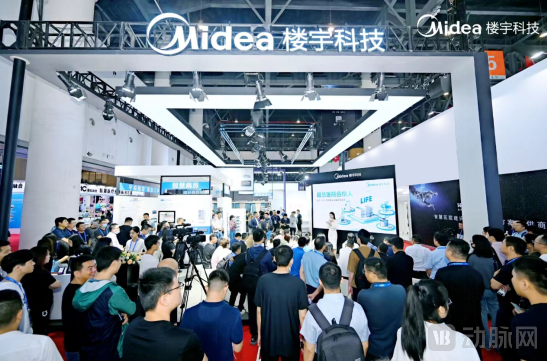
The 24th CHCC Midea Building Technologies Booth
The most significant difference between LIFE 2.0 and 1.0 lies in the newly added iterations of scenarios and users. In simple terms, the new-generation solution is built around the concept of “large platform, small scenarios,” with a focus on scenarios and medical business processes. Here, “chang” (space) refers to subdivided medical spaces such as outpatient and emergency departments, inpatient wards, and operating rooms, while “jing” (context) denotes the specific needs within these spaces. Midea Building Technologies aims to integrate “smart” capabilities into the specific business processes of each scenario.
At the CHCC, Dr. Sun Jing, General Manager of Midea Building Technologies’ M-Control Smart Building Division, elaborated on a new concept: “Traditional healthcare systems are technology-centric and adopt a hierarchical technical architecture, which often leads to difficulties in usage and fragmented user experiences. This is because the underlying systems—including intelligent building systems, specialized medical systems, and healthcare information systems—are each designed by respective specialists and then integrated via a technical platform. The resulting integrated platform typically serves these specialized professionals, making it difficult for end users, such as patients and medical staff, to understand or effectively engage with it. Under this traditional model, hospitals cannot leverage top-level systems to influence subordinate subsystems. Moreover, due to the strong coupling among various subsystems, the overall iteration pace remains exceedingly slow.”
“Under the Life 2.0 architecture, all technologies and resources are integrated in a flattened manner around scenarios and medical workflows. When scenarios change—such as the need for combined routine and epidemic prevention measures during pandemic control periods—the digital platform can rapidly decouple various subsystems and then quickly recombine them to form new applications, thereby flexibly serving end users, namely human lives.”
It is important to note that building smart hospitals on a scenario-by-scenario basis requires abandoning the traditional IT mindset in information system development and truly engaging with the physician community.
Zhou Shuhao, Director of the Public Utilities Industry at Midea Building Technologies, stated in an interview: “In developing our solutions, we did not design around national standards; instead, we placed physicians at the center, taking into account the actual needs of users at every level and in every role.”
“When applied to specific scenarios, we often spend several days alongside physicians, collaborating with users across various roles to co-develop the overall architecture. Only through this process can the resulting solution ensure that end users feel confident and satisfied during actual use.”
In Midea Building Technologies’ vision, the definition of “small scenarios” is flexible; it can encompass patient wards, ICUs, and operating rooms, as well as outpatient and emergency departments and quarantine centers. At CHCC 2023, Midea Building Technologies used the “patient ward” scenario as an example to further elaborate on the concept of “large platform, small scenarios.”
For a hospital, the ward area is one of the most critical core zones. In traditional medical ward settings, healthcare professionals often rush between rooms to administer injections, accompany patients for examinations, and guide rehabilitation therapy. How can we save their time and energy so they can focus more on the quality of medical care? Patients often struggle to remember their diagnosis and treatment progress; how can we provide them with a more comfortable experience and accelerate their recovery? Logistics and property management teams face a large volume of tedious support tasks daily; how can these be managed in a more scientific and systematic manner? Hospital administrators lack visual oversight of ward operations; how can they better trace and optimize operational performance?
At the press conference, Yang Yaochen, a senior engineer at Midea Building Technologies’ Meikong Smart Building division, presented the Meikong “Wukong” 2.0 ward solution, which was specifically developed to address these challenges. Compared with version 1.0, “Wukong” 2.0 builds upon the original solution by incorporating a new-generation intelligent nurse call system featuring integrated screen-based control. This comprehensive approach seamlessly combines medical and nursing services with environmental control, integrating solutions such as the nursing screen, environmental controls, and the Internet of Things (IoT) to achieve “integrated nursing and control.” As a result, it provides healthcare professionals and patients with a more secure, convenient environment and enhanced interaction capabilities.
The upgraded “Wukong” 2.0 ward solution delivers three core values to smart hospitals: convenient deployment, a cost revolution, and efficient configuration. First, “Wukong” 2.0 is compatible with various communication devices as well as wired and wireless equipment, enabling hospitals to achieve comprehensive, barrier-free connectivity. This makes device deployment in ward areas effortless, facilitating the rapid establishment of an intelligent healthcare environment. Second, through the integrated design of the nurse call system and environmental controls, the solution not only reduces the number of devices required but also minimizes complex construction interfaces and maintenance costs, thereby lowering overall hospital expenses while enhancing operational efficiency. Third, medical staff can configure and modify ward settings via smartphones or tablets, eliminating cumbersome equipment adjustments and the need for technical personnel intervention. This returns valuable time to healthcare providers, allowing them to focus more on patient care and infusing medical workflows with flexibility and autonomy.
Currently, the ⎡Wukong⎦ Ward Solution has been successively implemented at medical institutions such as Shanghai Tongji Hospital, Heyou International Hospital, and Shanghai Tenth People’s Hospital. In these smart wards, integrated systems and devices—including intelligent IV infusion displays, smart IV infusion systems, nurse call systems, bedside terminals, and vital signs monitoring equipment—efficiently meet operational needs such as call response, documentation, nighttime care, infusion management, ward rounds, and shift handovers. This solution provides patients with a reassuring and comfortable medical experience, helps healthcare professionals save time and effort, and assists logistical departments in optimizing the management of personnel and equipment.
As a complex building type that combines the attributes of both public and industrial structures, hospitals exhibit remarkably high energy consumption. Data indicates that the energy usage per square meter in hospitals may exceed that of conventional buildings by 30%–50%. Therefore, to maintain the healthy and efficient operation of smart hospitals, there is an urgent need to address the issues of high energy consumption and significant carbon emissions in the healthcare sector.
Based on this requirement, the LIFE 2.0 solution has specifically upgraded the hospital HVAC system proposal, introducing an E framework that encompasses Energy management, Environment management, Health management, and Safety management.2HS management approach helps hospitals achieve higher-quality operations at lower costs.
According to Zhou Shuhao, the newly upgraded solution provides tailored responses to address air conditioning needs across different dimensions and scenarios in hospitals. For instance, public areas such as outpatient lobbies and emergency departments are characterized by large spaces, high personnel density, significant cooling loads, and substantial fresh air requirements, thus demanding high energy efficiency.
For such large spaces, Midea adopts air handling solutions with high air volume and high cooling capacity. The HVAC equipment adjusts the fresh air volume based on indoor CO2 concentrations, thereby reducing operational energy consumption. For smaller spaces such as consultation rooms and wards, which require independent control and have specific needs for sterilization and dust removal, Midea implements zoned control to flexibly meet diverse requirements. Meanwhile, the equipment is equipped with purification and filtration functions to help prevent cross-infection among medical staff and patients.
For functional areas equipped with high-precision devices, such as imaging centers and data server rooms, Midea provides HVAC solutions featuring year-round cooling, high energy efficiency ratio, high precision, and high reliability. These solutions maintain a stable, constant temperature and humidity indoors over the long term, thereby preventing any adverse impact on equipment accuracy and testing performance.
Clean areas such as operating rooms, ICUs, and laboratories require not only constant temperature and humidity but also extremely stringent cleanliness standards. Midea Building Technologies provides professional solutions for clean spaces like operating rooms, ICUs, and hematology wards through various combinations of HVAC and building automation products, including air-cooled heat pumps with electric auxiliary heating, four-pipe air-cooled heat pump units, and direct expansion (DX) air conditioning units. These solutions precisely control temperature and humidity while achieving precise airflow organization management, ensuring healthy and safe working conditions in clean areas.
Central Energy Station, as the management hub for energy equipment, is also a space with extremely high energy consumption. The high-efficiency plant room solution, centered on Midea’s magnetic levitation centrifugal chiller units, leverages technologies such as industrial magnetic bearings, self-powering mode, and long-life emergency landing systems to create an efficient, stable, green, and low-carbon energy management center.
In the 2.0 LIFE framework, specialized solutions tailored to diverse scenarios and products are ultimately interconnected through digital technologies and platforms. At this press conference, Cheng Chiyu, Head of the Digital Ecosystem and Delivery Center at Midea Building Technologies Research Institute, discussed the exploration and practical application of digital technologies within the Smart Hospital LIFE 2.0 solution. Focusing on the application of digital twin technology in the healthcare sector, he cited the construction of smart wards at Shanghai Tongji Hospital as a case study.
Specifically, Shanghai Tongji Hospital has established a new benchmark for the smart upgrade and transformation of existing tertiary Grade A general hospitals in the central urban areas of megacities. This was achieved through three integrated management platforms—the Smart Logistics Management Platform for Wards, the Medical Equipment Operation Monitoring Platform, and the Comprehensive Nursing Management Platform—combined with innovative elements such as digital twins, artificial intelligence applications, system integration, organizational collaborative innovation, situational awareness, and iterative promotion.
In addition to unveiling its solutions, Midea Building Technologies signed a strategic cooperation agreement with Meinian Onehealth at the launch event. The two parties will engage in deep strategic collaboration across multiple areas, ranging from products to the development of digital management systems, embarking on a new journey to jointly contribute to the advancement of smart healthcare.
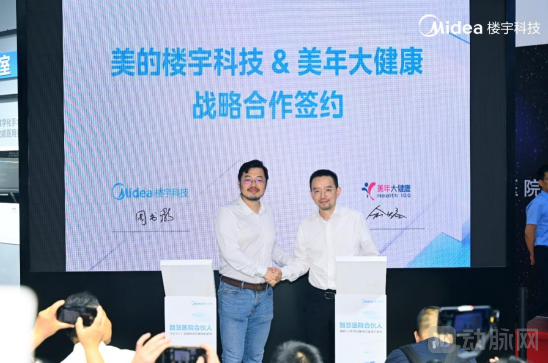
Midea Building Technologies & Meinian Onehealth Strategic Cooperation Signing
Currently, Midea Building Technologies serves 2,071 hospitals across 316 cities in China. With the advancement of smart healthcare, there is a growing demand for scenario-based medical solutions in China. Leveraging its LIFE 2.0 Smart Hospital Solution, which features a “large platform, small scenarios” approach, Midea Building Technologies empowers smart hospitals to build “future-ready” capabilities, enabling the widespread implementation of safe, efficient, and human-centric healthcare scenarios in more medical institutions.