

BCI-Sonics Secures Hundreds of Millions in RMB in Angel Funding to Advance AI-Powered Ultrasound-Based Non-Invasive Brain-Computer Interface
BCI-Sonics
Developer of AI Ultrasound Brain-Computer Interface and Non-Invasive Neuromodulation Therapeutic Devices

As Merge Labs, co-founded by OpenAI founder Sam Altman, emerged from stealth mode with a $252 million angel round and an $850 million valuation, and as Nudge, backed by Coinbase co-founder Fred Ehrsam, secured a $100 million Series A financing, the focal point of the global brain-computer interface (BCI) race is quietly shifting from "craniotomy-based implants" to the new frontier of "non-invasive ultrasound."
In China, this sector is also experiencing a surge in popularity. In March 2026, Gestala refreshed the domestic angel-round funding record in the brain-computer interface (BCI) field with a RMB 150 million angel round; recently, another emerging company focusing on AI-powered ultrasound BCI—BCI-Sonics——Announced the completion of a series angel round financing amounting to hundreds of millions of RMB, with the angel round led byMatrix Partners ChinaLead investor, Angel+ round byDelian CapitalwithDaoyuan CapitalCo-lead investment,Xunguang CapitalContinue to serve as the exclusive financial advisor.
“Consensus First, Venture Second”: A Team of Industry Veterans Well-Versed in Commercialization
BCI-Sonics was founded in 2025, founderLi XinHe holds a joint Ph.D. in Biomedical Engineering from the Chinese Academy of Sciences and the Fraunhofer IGD Institute in Germany, previously served as Head of GE Healthcare’s Global Research Center in China, and has consecutively founded innovative technology and healthcare companies, accumulating extensive expertise in medical imaging, artificial intelligence, brain-computer interfaces, and industrial translation.
Unlike many startups that pursue a “technology-in-search-of-a-use-case” approach, the core team of BCI-Sonics had already reached a strong consensus on the industrial viability of ultrasound-based brain–computer interfaces (BCIs) prior to founding the company. This multidisciplinary team, spanning neuroscience, acoustics, medical imaging, and artificial intelligence, includes members from prestigious institutions such as Tsinghua University, Shanghai Jiao Tong University, and Imperial College London, among others in China and abroad. They are well-versed in the full pathway for medical devices—from proof-of-concept prototypes and engineering prototypes to clinical validation and regulatory approval—exemplifying the model of “building the team, defining objectives, accumulating technological expertise, and establishing clinical insights first, before embarking on entrepreneurship and fundraising.”
From "Open-Loop Stimulation" to "AI Closed-Loop Neural Dialogue"
In traditional brain-computer interface (BCI) solutions, invasive and semi-invasive approaches require craniotomy, entailing high risks and limiting widespread adoption; non-invasive methods such as transcranial magnetic stimulation (TMS), while safer, offer limited spatial resolution and can only modulate superficial cortical layers at a depth of approximately 2 cm, making it difficult to reach deep brain nuclei.
BCI-Sonics has selected transcranial focused ultrasound (tFUS/LIFU) as its core modality, leveraging its physical attributes of being non-invasive, capable of deep brain penetration, and offering high spatiotemporal resolution. Ultrasound waves can penetrate the skull to reach several centimeters into the brain, precisely targeting key deep nuclei that govern movement, emotion, pain, and addiction.
However, transcranial ultrasound propagation faces significant challenges: substantial inter-individual variations in skull thickness, density, and curvature lead to phase distortion, energy attenuation, and focal shift during acoustic wave penetration. Without effective phase correction, discrepancies arise between the theoretical target and the actual acoustic field focus, directly compromising stimulation efficacy and clinical reproducibility.
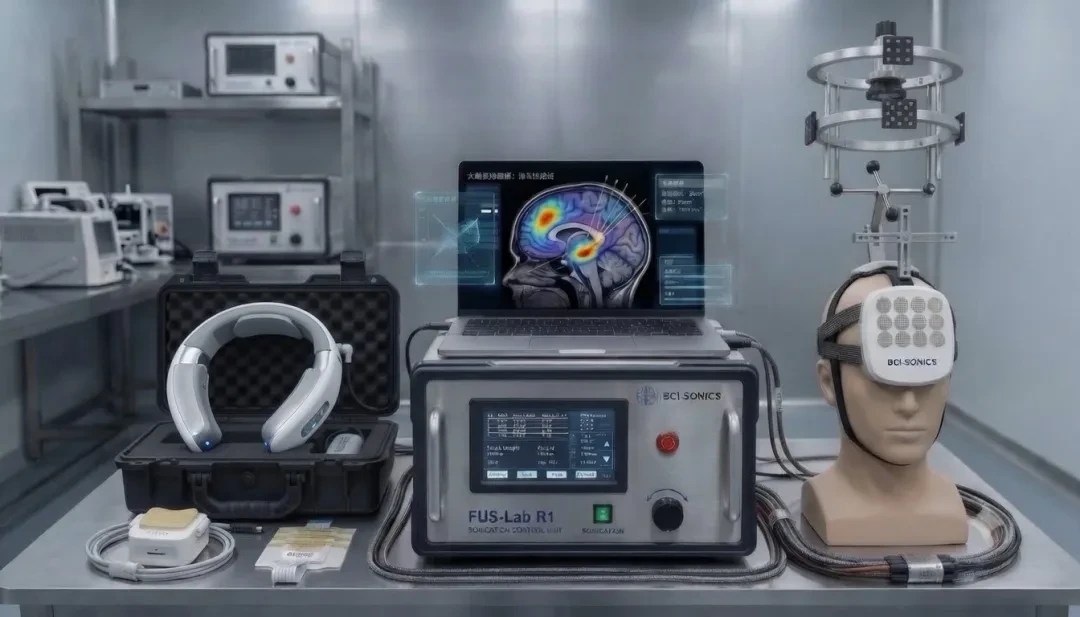
To address this bottleneck, BCI-Sonics has independently developedTranscranial Phase Correction Algorithm, enables rapid, personalized compensation for skull-induced acoustic field distortions, converging transcranial focusing accuracy toMinimum 1.5mm—Achieving millimeter-level precise modulation several centimeters deep within the brain. According to Li Xin, this algorithm can complete personalized calibration in an extremely short time, making it one of the few ultrasound brain-computer interface devices in China with such capability and on the verge of commercialization.
But that is not all. BCI-Sonics has even greater ambitions in buildingAI Closed-Loop Neuromodulation Platform: Real-time dose feedback is achieved through multimodal neural signal acquisition combined with high-precision acoustic feedback AI algorithms. Furthermore, AI is employed to identify brain states and generate personalized stimulation protocols, thereby dynamically adjusting the modulation strategy. This establishes bidirectional capabilities for both "decoding" and "modulation"—utilizing AI to read and interpret neural activity in real time, delivering precise interventions via low-intensity focused ultrasound, and relying on bimodal monitoring to dynamically calibrate targets and dosage at the millisecond scale. This creates a complete closed loop of "read–understand–modulate–feedback–re-optimize."
Clinical Value: Bringing Deep Brain Stimulation from the Operating Room to the Outpatient Clinic
For patients, the direct benefits of this sophisticated technology are evident.
Previously, patients with Parkinson’s disease (PD) and other conditions often required invasive, implanted deep brain stimulation (DBS) to alleviate symptoms under specific circumstances. Leveraging BCI-Sonics’ non-invasive ultrasound brain-computer interface technology, which delivers precise stimulation to targeted nuclear regions, it is possible to achieve comparable clinical outcomes without craniotomy. This transforms deep brain modulation from a surgical procedure into a reversible, non-invasive, and precise intervention that can be performed in an outpatient setting.
Currently, BCI-Sonics has established in-depth collaborations with multiple universities, Grade-A tertiary hospitals, and clinical expert teams. Together, they are designing research pathways focused on pain management, addiction, and neural remodeling, advancing foundational acoustic technologies, neuromodulation mechanisms, multimodal data acquisition, and real-world validation, thereby propelling ultrasonic brain-computer interfaces from research prototypes toward pre-clinical applications.
In Li Xin’s view, the true industrialization of brain-computer interfaces (BCIs) must simultaneously meet three conditions: the underlying technology must have verifiable physical and physiological mechanisms; the devices must possess engineering feasibility, standardization, and scalability; and there must be a sufficiently clear product roadmap that enables continuous validation in real-world application scenarios.
Industry Observation: The "Global Race" and "China's Opportunity" in Ultrasound Brain-Computer Interfaces
Brain-Computer Interfaces Enter a Critical Phase of Diversified Technological CompetitionFrom 2025 to 2026, total financing in China’s brain-computer interface (BCI) sector has exceeded RMB 5 billion, with funding raised in the first four months of 2026 alone surpassing the entire previous year. At the policy level, BCI technology has been included in the 2026 Government Work Report, listed alongside quantum technologies, embodied AI, and 6G as key future industries prioritized for national development. Cities such as Shanghai, Beijing, and Hangzhou have sequentially introduced specialized support policies and established medical service pricing items, paving the way for commercialization.
In this context, the ultrasound brain-computer interface (BCI) is regarded as a niche sector where domestic players are "on the same starting line" as their overseas counterparts, with the technological gap reportedly being less than 1.5 years. The entry of BCI-Sonics coincides with a critical juncture in China's BCI industry, marking its transition from "theme-driven expectations" to "industrialization validation."
Investor Perspectives
Matrix Partners ChinaIt is stated that, compared to traditional implantable solutions, Low-Intensity Focused Ultrasound (LIFU) technology offers advantages in both stimulation depth and spatial resolution while enabling non-invasive stimulation, thereby significantly expanding the boundaries from clinical treatment to consumer health. The core team at BCI-Sonics has established strong technical barriers in underlying algorithms and transducer manufacturing processes. Its products not only hold a first-mover advantage in the academic sector but also demonstrate robust engineering implementation capabilities in the fields of general medical AI and neurological rehabilitation.
Delian CapitalIt is believed that, as an emerging non-invasive neuromodulation technique, transcranial focused ultrasound offers advantages such as greater penetration depth, higher precision, and reliable targeting, thereby addressing the limitations of traditional transcranial electrical and magnetic stimulation to the greatest extent. BCI-Sonics is a rare platform-based enterprise in China capable of independent research and development across the entire industry chain. It possesses core competencies and full-cycle practical experience in acoustic hardware, algorithm development, high-integration medical device development, and regulatory registration. In the future, it is poised to achieve comprehensive product deployment—from research to clinical applications, and from hospital settings to consumer markets—leveraging its integrated AI-plus-ultrasound solutions.
Daoyuan CapitalIt stated that brain science is one of the core areas in which Daoyuan Capital has been continuously investing. Ultrasound-based brain-computer interfaces and neuromodulation have become hot topics in research both internationally and domestically, offering advantages such as deep accessibility, safety, and precision, and are transitioning from the laboratory to clinical applications. The BCI-Sonics team has been deeply engaged in this field for many years, accumulating substantial expertise and demonstrating strong execution capabilities. We look forward to delivering superior ultrasound-based solutions to benefit more patients and the broader population.
Xunguang CapitalIt was stated that ultrasound-based brain-computer interfaces (BCIs) represent one of the most clinically accessible and platform-scalable technical pathways in the field of non-invasive neuromodulation, with only a handful of teams worldwide capable of successfully navigating this route. The core advantages of BCI-Sonics lie not only in its accurate strategic judgment and technological accumulation in the direction of “ultrasound + closed-loop + AI,” but also in its rare industrial cohesion—building consensus before embarking on entrepreneurship. Xunguang Capital will continue to stand side by side with BCI-Sonics, looking forward to the company unleashing its true explosive potential in the vast blue ocean of neuroscience.

The Brain-Computer Interface Community is in ChinaThe First Brain-Computer Interface (BCI) Industry Service Platform, Pioneer and Leader in Domestic Brain-Computer Interface New Media。We provide the following services to enterprises, research teams, investment institutions, and practitioners:
Publicity Report:Report on corporate updates, technical insights, and product introductions through articles with images, short videos, and live streaming to enhance visibility and industry influence.。
Resource Alignment:Match resources such as capital, supply chain, clinical institutions, and channel partners according to needs, facilitate genuine connections, and promote cooperation.
Translation of Achievements:Assist the technical team in identifying industry partners, investors, and implementation scenarios to facilitate the translation of technology into products.
Event Planning and Execution:Undertake the planning and execution of online and offline roadshows, salons, forums, and other events.
Other Customization Requirements:Including personalized services such as report customization, market research, and recruitment support.
Cooperation Negotiation,Please contact WeChat: ZuoLeiLeiya
(Note: Name - Institution - Collaboration)
Submission | Become a Creator,Please contact WeChat: RoseBCI
?Star and Pin to Top?
Don’t Miss Any Frontier Advances in Brain-Computer Interfaces

One-click Triple Action: “Share,” “Like,” and “Watch”
Feel free to chat in the comments section