

ROBO Medical Launches World’s First Digestive Endoscopy Surgical Robot to Enable Widespread Adoption of ESD for Early-Stage GI Cancer

ROBO Medical
Medical Robot Developer
Loss of appetite, difficulty eating, abdominal bloating, constipation… The fast-paced, high-pressure lifestyle has led to frequent digestive issues. However, these seemingly common symptoms are actually early warning signs of gastrointestinal tumors.
According to data released by the International Agency for Research on Cancer (IARC) of the World Health Organization (WHO), five of the top ten most prevalent cancers worldwide are gastrointestinal tumors. In recent years, the incidence of gastrointestinal tumors in China has shown a year-on-year increase. There are approximately 1.5 million new cases and 1 million deaths annually from gastric cancer, esophageal cancer, and colorectal cancer. Nearly 85% of patients are diagnosed at an intermediate or advanced stage, resulting in substantial treatment costs and a heavy societal burden.
According to information from the 21st Century Business Herald in March 2023, the incidence of gastrointestinal tumors in China accounts for 40% of all malignant tumor cases, and the number of deaths caused by gastrointestinal tumors each year accounts for nearly half of all cancer-related deaths. Gastrointestinal tumors have become a major disease that seriously threatens people's lives, health, and social development.
Endoscopic Submucosal Dissection (ESD) is a proven minimally invasive surgical technique for the early treatment of gastrointestinal cancers. It is applicable for the endoscopic resection of early-stage gastrointestinal tumors and has become the preferred treatment option for early gastrointestinal cancer due to its high rate of complete resection and favorable safety profile.
However, traditional ESD procedures are technically challenging and have a steep learning curve. Constrained by the structure of digestive endoscopes, physicians cannot effectively apply traction to tissues while dissecting lesion tissues. This makes ESD heavily reliant on the operator’s individual skills, significantly hindering its widespread adoption and dissemination.
For less experienced physicians, performing endoscopic submucosal dissection (ESD) requires substantial time and maneuvering to maintain a clear visual field of the mucosal layer. This not only reduces procedural efficiency and prolongs operative time but may also increase the risk of complications such as perforation and bleeding.
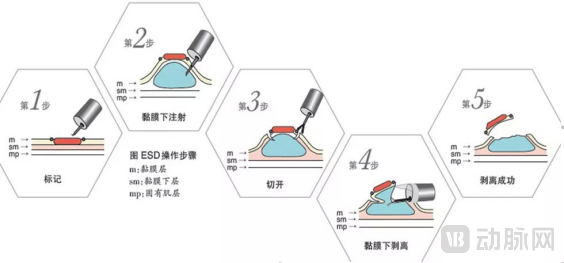
ESD Operational Steps
There is an urgent clinical need for new technologies and devices with high safety profiles and ease of use to optimize the ESD procedure. Addressing these pain points, ROBO Medical has dedicated years of focused R&D to launch the ROBO Medical Digestive Endoscopic Surgery Assistance System.
ROBO Medical is a pioneer in the field of surgical robots for gastrointestinal procedures. Adhering to the philosophy of aligning products more closely with clinicians’ needs, ROBO Medical has developed the world’s first robotic assistance system for endoscopic submucosal dissection (ESD), addressing key clinical challenges associated with ESD through years of technological breakthroughs and accumulation. This system is also China’s first flexible surgical robot system for transgastrointestinal procedures to enter the registration-based clinical trial phase.
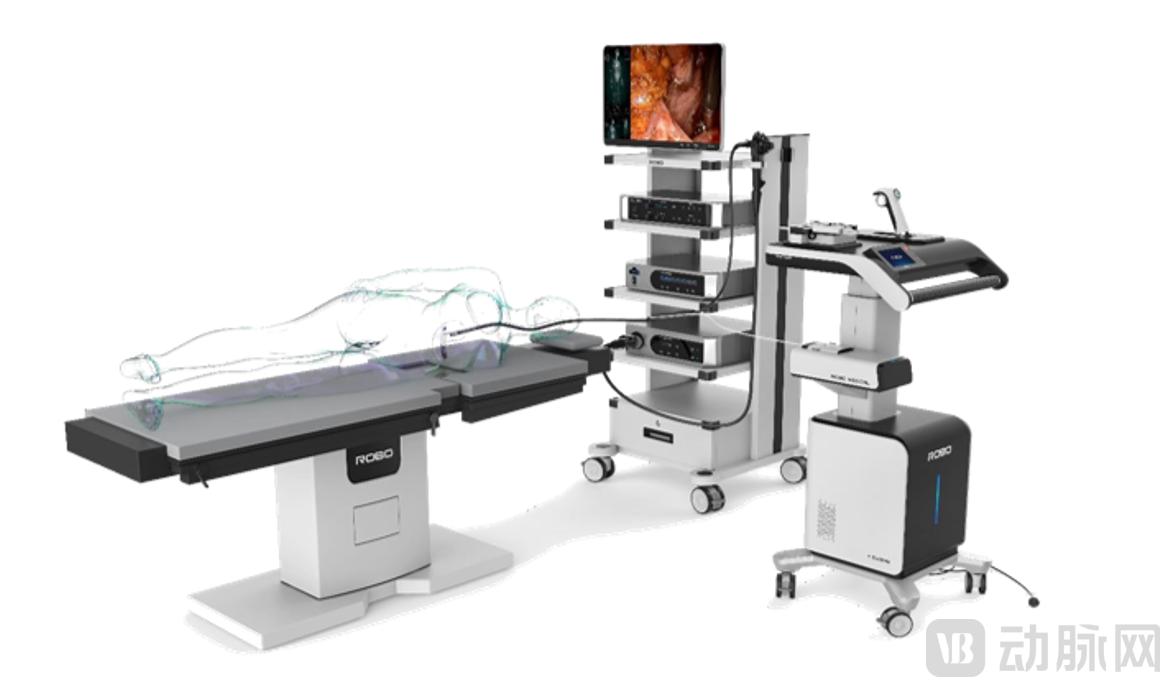
ROBO Medical Digestive Endoscopic Surgical Assistance Operating System
ROBO Medical leverages world-leading flexible-arm technology by adding a flexible robotic arm with a diameter of less than 3 mm, providing gastroenterologists with a clinical “second hand.” This innovation simplifies complex procedures, enabling lifting, traction, and elevation of lesion tissues that are unachievable in traditional surgeries. By better exposing the surgical field, it minimizes tissue trauma, reduces surgical risks, significantly shortens operative time, and expands the scope of procedures. This facilitates more physicians in performing ESD surgeries efficiently and effectively, thereby benefiting a larger patient population.
Unlike traditional surgical robots, the ESD-assisting surgical robot system developed by ROBO Medical offers the following four major advantages:
1. Without altering the traditional endoscope structure, it is attached to conventional endoscopes and provides additional degrees of freedom;
2. Without altering the physician’s operational habits, an independently controlled robotic arm can perform maneuvers such as tissue traction to assist with ESD;
3. Universally compatible with traditional endoscopes; compatibility with conventional endoscopes allows for customized designs across different brands;
4. Products with a price advantage are easier to bring to market, as hospitals do not need to purchase additional customized endoscopic equipment, thereby reducing procurement costs for hospitals.
Meanwhile, the system features a more intelligent user interface and more intuitive operational feedback, enabling doctors and nurses to achieve proficient operation of the device after short-term training. The assistance provided by this system can significantly enhance the safety and stability of gastrointestinal endoscopic surgeries, while also markedly improving surgical efficiency and shortening the learning curve for novice physicians, thereby facilitating the upgrade and iteration from traditional ESD (Endoscopic Submucosal Dissection) to RA-ESD (Robot-Assisted ESD).
Currently, ROBO Medical has established in-depth collaborations with renowned domestic and international institutions, including Qilu Hospital of Shandong University and Shanghai Changhai Hospital. These partnerships will further accelerate the translation of scientific research achievements into clinical practice, promoting the research and development, clinical application, and industrial implementation of surgical robots and medical robots at large, thereby truly realizing the grand vision of borderless healthcare.
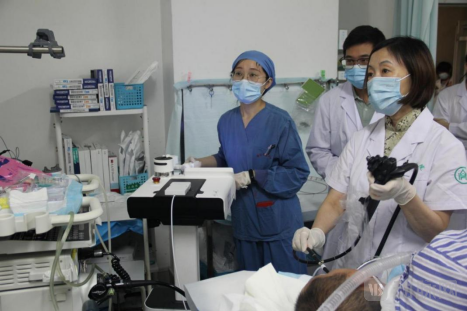
As the annual incidence of gastric, esophageal, and colorectal cancers continues to rise in China, the country launched the “Gastrointestinal Cancer Screening and Early Diagnosis and Treatment Project” in 2018. The project aims to screen 10 to 20 million people annually, with the goal of increasing the early diagnosis rate of gastrointestinal cancers to 20% by 2030.
As the “gold standard” for treating early-stage gastrointestinal cancers, endoscopic submucosal dissection (ESD) is seeing continuous market expansion. Public data indicate that approximately 400,000 ESD procedures are performed annually in China, with a 20% year-on-year growth rate, and the volume is projected to reach 600,000 cases by 2028.
Surgical medical robots possess unparalleled advantages over humans in terms of precision, stability, force, and endurance, offering excellent application prospects in the highly specialized medical field. In recent years, the Chinese government has issued a series of regulations and policies, including the “Notice on the Implementation Plan for ‘Robot+’ Applications” and the “Catalogue for Configuration Licensing Management of Large Medical Equipment (2023),” to encourage the innovative development of high-end medical equipment. These measures have also accelerated and streamlined the review and approval processes for innovative medical devices, thereby positively promoting industry growth.
In early May this year, ROBO Medical also secured tens of millions of yuan in Series A financing, led by Taikun Fund.
Policy support, market expansion, capital empowerment, and strong in-house R&D capabilities... Amidst the resonance of these multiple favorable factors, ROBO Medical is poised to take off, enabling more patients to access high-quality healthcare.