

Jiumingzhu's Strategic Shift to Fully Cloud-Based Digital-Intelligent Healthcare: Empowering Small and Medium-Sized Medical Institutions
Profound changes are brewing in the field of healthcare informatization; the industry is at an inflection point for transformation and reshuffling, as the storm approaches.
Historically, small and medium-sized standalone hospitals in urban areas have often faced challenges such as insufficient investment and a shortage of technical talent for operations and maintenance during the development of smart hospitals, thereby preventing these institutions from fully realizing the benefits of smart hospital initiatives.
And now, the construction of city-level smart hospital cloud platforms is changing the previous landscape.
In 2022, the Wuhu Municipal Health Commission’s Regional Smart Hospital Cloud Platform project, undertaken by Shenzhen Jiumingzhu Information Technology Co., Ltd., was spearheaded by the Health Commission. It adopted a novel cloud model to uniformly provide smart hospital cloud SaaS services to all secondary hospitals (including private ones) within the region. Through a single cloud infrastructure, the project ultimately achieved the two major development goals of “Hospital Cloud” and “Cloud Hospital.”
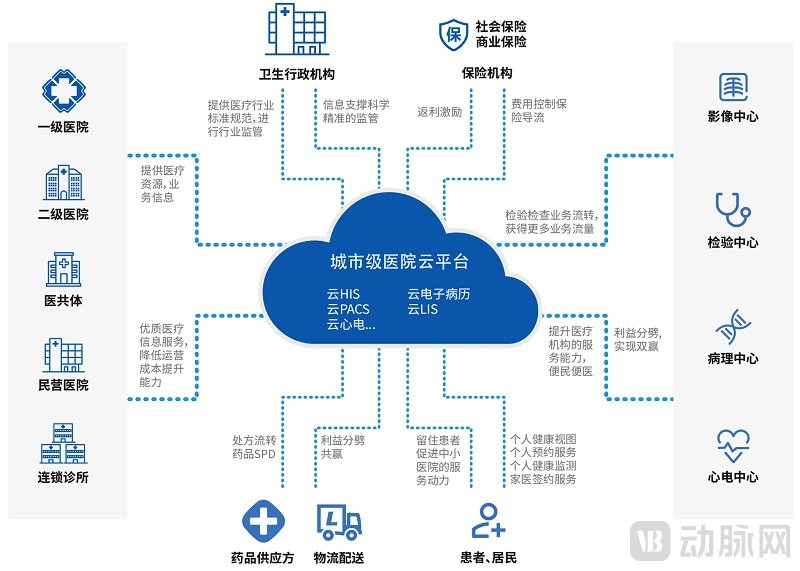
“Hospital Cloud” will enable the comprehensive cloud migration of smart hospital systems for all secondary hospitals within the city. Hospitals can leverage various in-house business systems via the cloud platform, significantly reducing the costs associated with the construction and operation and maintenance of smart hospitals. Meanwhile, through unified data standards, standardized business processes, and interoperability, the Health Commission can achieve centralized regulatory oversight.
The “Cloud Hospital” cloud platform can integrate and share the medical resources of hospitals hosted on the platform, including beds, laboratory tests, and diagnostic examinations. Furthermore, Shenzhen Jiumingzhu Information Technology Co., Ltd. points out that the cloud platform supports access by third-party resource service providers, such as third-party clinical laboratories, imaging centers, ECG diagnosis centers, and teleconsultation centers. Relying on the “Cloud Hospital,” hospitals can further enhance their service capabilities, while patients can receive higher-quality medical services.
Ultimately, the construction of the Smart Hospital Cloud Platform project has yielded significant benefits. On one hand, the adoption of fully cloud-based applications on a unified cloud resource pool effectively avoids redundant infrastructure development by individual medical institutions. The SaaS-based model for daily upgrades and maintenance has also rapidly improved operational efficiency. On the other hand, this foundation supports the creation of a comprehensive service ecosystem platform, where the provision of standardized and homogeneous services facilitates mutual benefits for all stakeholders. Furthermore, the platform implements a unified regional standard system. By leveraging the cloud platform’s data center to store massive volumes of data in the cloud, it ensures both application and data security. This approach also enables more comprehensive data utilization, effectively supporting intelligent decision-making.
Clearly,It will promote the intelligent transformation and overall improvement of medical quality in secondary hospitals within the region, offering significant reference value for the development of smart hospitals in other cities.
Yet, it is merely a small glimpse into the fully cloud-based business strategy of Jiumingzhu, a company with two decades of history.
Witnessing Industry Development, Jiumingzhu Launches Full Cloud Strategic Transformation
Before growing into the giant it is today, Jiumingzhu also went through a long period of development. To trace the origins of Jiumingzhu’s growth, we must go back to 1999. Perhaps by examining Jiumingzhu’s developmental journey, we can better understand the evolution of its business layout and strategic thinking, while also gaining indirect insights into the industry’s historical trajectory—
Company Founding and Steady Market Expansion Phase (1999–2009)
From a certain perspective, Jiumingzhu was “born with a silver spoon in its mouth.” Established by China Resources Sanjiu Group, Jiumingzhu is the pioneer and leading enterprise in Sanjiu Group’s medical informatics sector. It participated in the research and development of the former Ministry of Health’s national project on “Hospital Information Systems” and launched its flagship product, the “HIS999 Hospital Integrated Information System.” It was among the first companies in China to obtain industry access certification from the former Ministry of Health.
Building on this foundation, its nationally pioneering standardized software suite for small and medium-sized hospitals, “B-HIS999,” along with more than ten other hospital-series software products and primary care/regional health informatics solutions, have been widely adopted by 3,000 hospitals and healthcare institutions across China. Shenzhen Jiumingzhu Information Technology Co., Ltd. has maintained continuous innovation and focus in the Health Information Technology (HIT) industry, specializing in digital hospital solutions. Having witnessed the evolution of the medical informatics sector, the company has accumulated extensive expertise and emerged as a leading supplier during that period for digital hospital construction in large domestic hospitals and standardized software suites for small and medium-sized hospitals. During the same period, Jiumingzhu obtained ISO 9001 international quality management system certification and was recognized as a National High-Tech Enterprise.
In 2009, the inaugural year of China’s new healthcare reform, the industry ushered in unprecedented development opportunities. Upholding its social responsibility and commitment, Jiumingzhu leveraged informatization and intelligent technologies to support the new healthcare reform, actively participating in the construction of smart hospitals, regional health information systems, big data platforms for general health, and “Internet+” initiatives. The company’s professionalism, dedication, and innovative spirit have been highly recognized by the market, clients, and investors. In 2016, Jiumingzhu successfully completed its Series A financing. During the same period, the company obtained CMMI Level 5 international certification and Internet Service Certification.
During this phase, Jiumingzhu comprehensively laid out and planned its market presence in two major sectors: HIT (Health Information Technology) and the Medical & Health Innovation Cloud Service Platform. Its subsidiary, Wuhu Jiumingzhu Technology Co., Ltd., was established to professionally oversee the HIT sector and HIT operationalization. Meanwhile, Yunxing Health Technology Co., Ltd. was also founded to specialize in managing innovative internet healthcare operation projects. It was also during this stage that Jiumingzhu initially entered its cloud strategy era. The organizational structures for its cloud and internet segments were successively established, cloud products and cloud SaaS solutions were developed and implemented, and a preliminary big data platform for general health was constructed.
In 2017, Jiumingzhu completed its Series A+ financing round, securing strategic investment from an industrial fund under China Electronics Corporation (CEC), a central state-owned enterprise. Concurrently, the company comprehensively upgraded its cloud and information technology application innovation (Xinchuang) strategies. Starting in 2018, Jiumingzhu invested a cumulative total of RMB 100 million in research and development over four years, gradually forming four major product families built on a unified architecture featuring cloud-native capabilities, middle-platform design, and microservices. By leveraging a novel combination of cloud-based informatization, localization, data-driven operations, intelligence, and internet integration, Jiumingzhu has established its own technical barriers. It is reported that by 2022, Jiumingzhu’s fully cloud-based, integrated series of digital and intelligent healthcare products had been successfully validated by more than 100 hospitals and healthcare groups. During the same period, Jiumingzhu obtained compatibility certifications for localization/Xinchuang and cybersecurity certification, thereby acquiring all major qualifications required across the industry.

Li Haitao, Chairman and General Manager of Jiumingzhu
2017/2018 was a year of great significance for Jiumingzhu as it entered its “adulthood.” Li Haitao, Chairman and General Manager of Jiumingzhu (a co-founder of the medical informatics business segment of the former Sanjiu Group), stated, “On one hand, in 2017/2018, Jiumingzhu underwent a qualitative transformation in its corporate governance structure. With the completion of strategic investment, it evolved into a private health technology innovation enterprise endorsed by state-owned capital participation. On the other hand, driven by the new healthcare reform, Jiumingzhu began its strategic transition from a traditional medical informatics company to an all-cloud, integrated smart healthcare service provider, rapidly positioning itself for future development.”
Perhaps, from a certain perspective, the development history of Jiumingzhu serves as a professional witness to the evolution of healthcare informatization in China.
Industry’s Digital-Intelligent “Great Reshuffle”: Fully Cloud-Based Architecture + High-Quality Data Become the Key to Breaking Through
Choosing to embark on a cloud-based strategic transformation and comprehensively deploying an all-cloud, integrated digital-intelligent infrastructure is the result of Jiumingzhu’s in-depth reflection on industry development: the current pain points facing the industry, rigid policy requirements, and technological advancements have jointly driven the emergence of Jiumingzhu’s all-cloud strategic layout.
On the one hand, from the perspective of industry pain points, the core issue lies in the phased imbalance, asynchrony, and mismatch between the national strategy for high-quality hospital development and the “levers” for building smart hospitals.
Li Haitao, Chairman and General Manager of Jiumingzhu, mentioned that the current pain points in the field of medical informatization are as follows:
First, there is the issue of architecture. The traditional closed architecture has become a key constraint in the industry, failing to meet the open and multidimensional demands of healthcare users for smart medical products under new circumstances. It has reached a critical juncture where a complete overhaul is imperative.
Secondly, there is the issue of efficiency. The traditional healthcare IT industry faces bottlenecks characterized by low R&D and delivery efficiency, which necessitates disruptive innovation through new architectures and models to resolve;
Once again, the issue lies with data. Historically, the industry prioritized business operations over data; today, however, it places significant emphasis on data and its value. The advancement of the industry is inseparable from data assets, yet traditional technical approaches fail to meet users’ demands for high-quality data governance.
Furthermore, there is the issue of resource allocation, including how to meet the demand for providing hospitals with innovative internet healthcare services under the new healthcare reform to expand the boundaries of diagnosis and treatment, as well as how to empower the healthcare industry through intelligent tools such as AI.
Finally, there is the issue of domestic substitution and IT application innovation (Xinchuang). This is an unavoidable policy-driven mandatory requirement at present, serving as a “catalyst” and powerful driver for the industry’s transformation and restructuring.
On the other hand, policy-driven initiatives and technological advancements are driving the industry to address current pain points with superior solutions.
Chen Pei, Marketing Director at Jiumingzhu, added that the national government is driving healthcare institutions to shift from extensive management characterized by traditional scale-based expansion to refined management, thereby further enhancing the quality of medical services.
To facilitate the achievement of this goal, a series of policies and regulations have been frequently issued, including promoting tiered diagnosis and treatment and regional medical collaboration, advancing health insurance payment reforms to control costs, implementing hospital accreditation and smart hospital ratings, and conducting performance assessments—all of which are driving innovation in healthcare institutions. The pandemic, along with the release of policies promoting “Internet + Healthcare,” has also accelerated the development of hospitals’ online healthcare services and their digital and intelligent transformation integrating online and offline operations.
The development of smart hospitals is underpinned by major trends such as emerging IT technologies, Internet+, AI+, 5G, the Medical Internet of Things (MIoT), and domestically produced software, which collectively lay the foundation for the digital and intelligent transformation of hospitals.
However, it should be noted that the varying levels of resources available to hospitals at different tiers also determine the differing degrees of difficulty in building smart hospitals.
Large hospitals can better achieve digital and intelligent transformation by leveraging their technological resource advantages and comprehensive business processes; in contrast, small and medium-sized hospitals struggle to build smart hospitals due to constraints such as limited funding and talent reserves.
Jiumingzhu has undoubtedly recognized the pain points associated with the digital and intelligent transformation of small and medium-sized hospitals. More critically, it has acknowledged the increasingly vital role that future technological applications will play in this process.
“First, the entire IT industry is undergoing a comprehensive shift toward cloud adoption. The strategic initiatives of domestic and international giants such as Microsoft and BAT (Baidu, Alibaba, Tencent) have made large-scale technological application feasible. Second, ‘cloud adoption’ has become indispensable for the healthcare industry to better address longstanding challenges. Furthermore, investments from CEC-affiliated industrial funds have strengthened our understanding of ‘cloud adoption’ and ‘information technology innovation,’ prompting us to embark on comprehensive planning, full-stack top-level design and transformation, and enter a phase of full-scale cloud migration.”
Based on an understanding of industry pain points and technology,Shenzhen Jiumingzhu Information Technology Co., Ltd. has proposed the concept of “Five Dimensions of Digital-Intelligent Transformation” to break through the industry’s traditional single-dimensional focus on informatization. By introducing a new strategic framework and a comprehensive product portfolio encompassing “cloud-based informatization, domestication, datafication, intelligentization, and internet integration,” the company helps small and medium-sized hospitals plan and build smart hospitals, thereby facilitating their digital and intelligent transformation.
Five Major Solutions, Four Product Lines: Comprehensively Meeting Hospitals’ Needs for Upgrading and Modernization
To understand the business layout of Jiumingzhu, it is necessary to comprehend its self-positioning.
“Positioning ourselves as builders of comprehensive cloud-based IT infrastructure, stewards of medical data, and supporters of collaborative innovation in internet healthcare, our core identity is that of China’s leading provider of integrated, all-cloud smart healthcare solutions, with a focus on driving the digital and intelligent cloud transformation of healthcare institutions,” stated Chen Pei, Marketing Director at Jiumingzhu.
It is also this positioning that determines the target clientele of Shenzhen Jiumingzhu Information Technology Co., Ltd. (Jiumingzhu) and its unique technological advantages.
From the perspective of service recipients, Jiumingzhu's clients include district- and county-level secondary hospitals, tertiary specialized hospitals, primary care facilities, medical consortia, and chain healthcare groups.Overall, the focus is primarily on small and medium-sized medical institutions. Behind this lies an important policy context: the equalization and downward distribution of healthcare resources from high-end facilities to primary care levels under the new healthcare reform. Meanwhile, on one hand, the construction of smart hospitals in large tertiary Grade A hospitals is characterized by intense “red ocean” competition; on the other hand, small and medium-sized hospitals are numerous, have relatively standardized operations that are easy to replicate and scale, and are still in the early stages of digital and intelligent transformation, offering substantial market potential.
From the perspective of technical application, Jiumingzhu adopts a “middle-platform-based microservices cloud-native full-cloud architecture + integrated dual-mode business/data platform + full-stack domestic underlying infrastructure/Xinchuang compatibility.”Chen Pei noted, “Jiumingzhu’s technology demonstrates significant uniqueness and industry leadership, establishing a technological barrier that places competitors 2–3 years behind. Jiumingzhu’s core technologies and products have simultaneously obtained certifications for full-stack domestic compatibility and IT Application Innovation (Xinchuang) compatibility.” He added, “In 2022, Document No. 79 issued by the State-owned Assets Supervision and Administration Commission (SASAC) outlined specific requirements and implementation timelines for the localization of IT applications in state-owned enterprises (SOEs). The policy mandates that central and local SOEs achieve 100% Xinchuang substitution by 2027,” which presents substantial opportunities for Jiumingzhu.
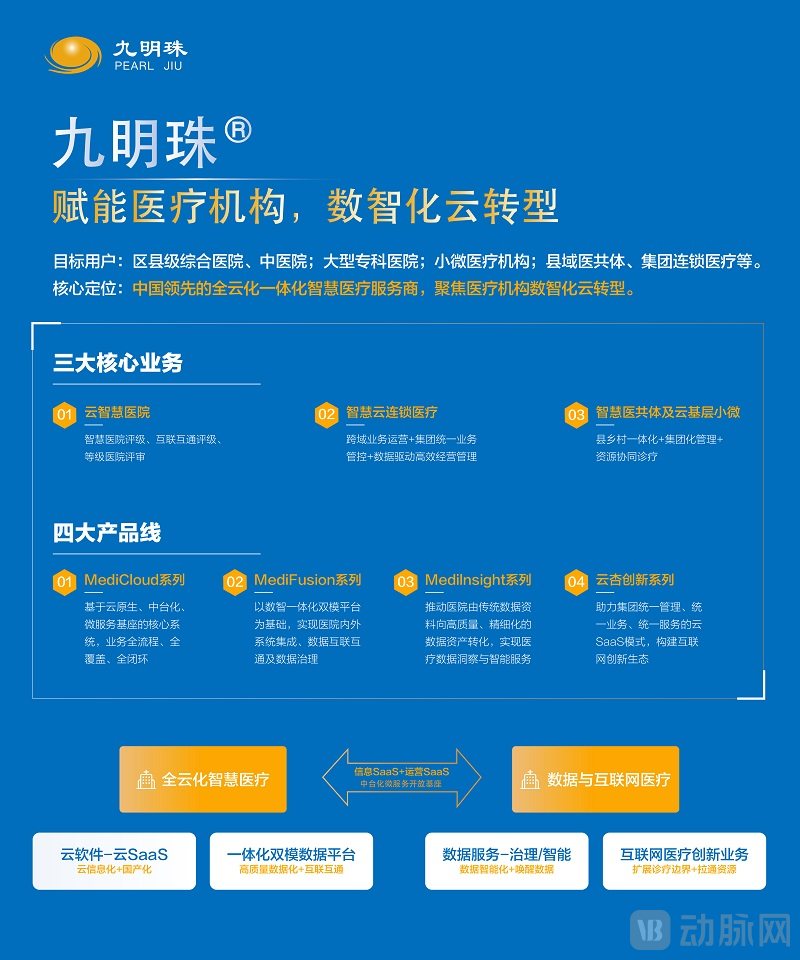
Ultimately, Jiumingzhu adopted a “3+X” core business layout, where “3” refers to Smart Hospitals, the Smart Cloud Group’s Chain Medical Services, and Smart Medical Consortia & Cloud-based Grassroots Micro-Entities; “X” refers to Medical Data Services and Internet-based Healthcare Innovation.Based on its core business layout, Jiumingzhu providesFive Core Solutions, including Cloud Smart Hospital Solutions, Smart Medical Consortium Solutions, Smart Cloud Primary Care Solutions, Smart Cloud Chain Medical Solutions, and Internet Healthcare Innovation Business Solutions. To support these five major product solutions, Jiumingzhu has establishedFour Major Product Lines, respectively including the MediCloud Cloud Smart Healthcare Core Products, the MediFusion Integrated Data Platform and Data Governance Products, the MediInsight Data Insights and Intelligent Products, and the Yunxing Cloud Innovative Businesses and Products.
1)MediCloud Series, is a cloud-native, middle-platform-based, microservices-driven core hospital business system that achieves full-process, comprehensive, and closed-loop management of hospital operations. It includes an integrated business-finance operation system, an integrated clinical diagnosis and treatment system, an integrated clinical nursing system, a mobile healthcare system, a clinical medical technology system, a clinical rehabilitation therapy system, and specialized clinical medical systems.
2)MediFusion Series, it is based on the Digital-Intelligence Integrated Dual-Mode Platform to achieve integration of internal and external hospital systems, data interconnectivity, and data governance. This includes the Digital-Intelligence Integrated Dual-Mode Platform, Clinical Data Repository (CDR), Operational Data Repository (ODR), and Research Data Repository (RDR).
3)MediInsight Series, is designed to drive the transformation of hospitals’ traditional data records into high-quality, refined data assets, thereby enabling medical data insights and intelligent services. It includes the Medical Data Intelligent BI Platform, the Clinical Decision Support System (CDSS), and the Digital Twin Information System for Healthcare (DTIS).
4)Yunxing Series, it is a cloud SaaS model designed to help chain medical groups achieve group-based services, standardized medical care, and chain-style management, thereby building an innovative internet ecosystem. It includes the Cloud Chain Medical Group System, Cloud Primary Public Health System, Cloud Family Doctor System, Cloud Telemedicine System, Internet Hospital System, and Cloud Referral System. Additional offerings encompass cloud aggregated payment, direct connection with commercial insurance, cloud referral services, internet medical services, prescription circulation, bank partnerships/medical finance, shared pharmacies, centralized procurement of pharmaceuticals and medical devices, B2B cooperation, B2C cooperation, and more.
The aforementioned business layout, establishment of product lines, and provision of comprehensive solutions have also enabled Shenzhen Jiumingzhu Information Technology Co., Ltd. to achieve continuous leapfrog development over the past 20 years.
Cloud-Native Architecture, High-Quality Data Governance, and Full-Stack Domestication: Accelerating the Digital and Intelligent Transformation of Hospitals
Currently, all product series of Jiumingzhu are built upon a unified, company-wide new open architecture featuring cloud-native, middle-platform, and microservices capabilities. Furthermore, all products achieve full-stack compatibility with domestic underlying technologies and adhere to XinChuang (Information Technology Application Innovation) standards.The advantages of building the core systems of smart hospitals based on cloud-native, middle-platform, and microservices open architecture are also evident: this architecture can enhance system resilience, high availability, flexibility, openness, and security.
On the one hand,, cloud-native architecture serves as an “open foundation,” acting as a unified open operating system and platform for hospitals. This “open foundation” provides standardized openness and “plug-in” capabilities to support the hospital’s multi-dimensional needs (including the “five modernizations” requirements such as data needs, application needs, and business innovation), as well as diverse informational business functional requirements. Meanwhile, cloud-native architecture can automatically adjust resources based on workload, ensuring that the system always maintains sufficient performance and high availability. Smart hospitals can flexibly allocate resources according to actual needs; at the same time, multi-layered security strategies safeguard the security of system data and business operations.
On the other hand,, microservices architecture can decouple the system by breaking it down into multiple small services, thereby enhancing system availability and stability. Services operate independently, so that an issue with a single service does not affect overall service delivery; meanwhile, it enables hospitals to better integrate with other systems, facilitating seamless information sharing and interoperability.
In addition, the middle-platform architecture can separate business logic from underlying technologies, making the system more flexible and easier to scale and upgrade. This architecture enables smart hospitals to rapidly respond to new business requirements without disrupting existing operations.
“‘Architecture + Data’ is the key to resolving pain points,” added Li Haitao. While building a new open architecture, Jiumingzhu is also expanding into high-quality data governance.
Historically, poor quality and low utility have been significant shortcomings of traditional hospital data, preventing hospitals from developing valuable data assets and constraining their high-quality development and refined operational management.How to activate data—including clinical data, operational data, and IoT sensor data—and integrate them into high-quality, refined data assets for hospitals is a critical issue that must be addressed during the digital and intelligent transformation process.Meanwhile, Jiumingzhu is also centering its business operations on awakening and activating data elements and assets, deploying the MediFusion and MediInsight product series to help hospitals achieve genuine digital and intelligent transformation.
For Li Haitao, Chairman of Jiumingzhu, “the company-wide adoption of a unified, next-generation cloud architecture and the extensive reuse of highly common R&D outcomes have directly laid the foundation for an open-architecture platform supporting Jiumingzhu’s new product and innovative business portfolios over the next decade. This has established significant technological innovation thresholds and barriers that clearly differentiate us from our competitors, and will also substantially reduce the R&D costs for future new products and businesses built on the middle-platform architecture.”Compared with the traditional models of its peers, Jiumingzhu will enjoy increasingly pronounced advantages in R&D costs and R&D efficiency.”
Moreover, its comprehensive planning, design, and integrated delivery capabilities, along with the practical implementation and validation by hundreds of hospitals and healthcare groups across China through its previous fully cloud-based digital intelligence new products and technological pathways, have instilled Jiumingzhu with full confidence in its future development.
Currently, Jiumingzhu plans to achieve rapid development in the fields of cloud-based smart hospitals and cloud-based group chains, deepen data-driven internet innovative businesses, realize year-on-year multiplicative growth in performance, and become a leader in the niche market of cloud-based smart healthcare, securing its position in hospitals and laying the foundation. It is reported that Jiumingzhu is also planning to launch Series B financing to accelerate its business layout. The company plans to speed up core technology research and development and product innovation, particularly increasing investment in the areas of data governance services, AIGC + healthcare, and psychiatric specialty systems; build a nationwide sales network and channels; and further achieve talent acquisition, market promotion, and hardware equipment upgrades.
“‘One Platform, Five Modernizations’ is the fundamental approach and underlying logic adopted by Jiumingzhu, with ‘data’ serving as the core key element or asset in its strategy,” mentioned Li Haitao. He added that Jiumingzhu will continuously innovate its products and services to meet customer needs. “By becoming a ‘leader in fully cloud-based digital intelligence healthcare,’Jiumingzhu will secure its strategic position with data and a strengthened foundation, deepen its vertical expertise, create greater value for users, achieve comprehensive replication and implementation of digital-intelligence business innovations, and ultimately accelerate the smart transformation of hospitals, thereby benefiting patients and society.”
About Jiumingzhu
Jiumingzhu was founded and invested in by China Resources Sanjiu Group, and has received strategic investment from the industrial fund of the central state-owned enterprise CEC system, as well as endorsement and support from CEC’s “three national teams” qualifications in “medical big data/IT application innovation/cybersecurity.” It is a leading domestic all-cloud integrated smart healthcare service provider.
Jiumingzhu focuses on empowering smart healthcare through cloud, data, and AI technologies, with three major business segments: “Smart Hospitals + Smart Group Chain Healthcare + Internet Medical and Health Innovation Businesses.” It offers four product lines: MediCloud (core cloud-based smart healthcare products), MediFusion (integrated data platform and data governance products), MediInsight (data insights and intelligent products), and Yunxing Cloud (innovative cloud-based businesses and products). Its solutions and products have been successfully deployed in over 18,000 medical institutions.