

YaoshiBang IPOs on HKEX with Over HK$13.6 Billion Market Cap, Paving the Way for Pure B2B Digital Pharma Services

YSB Inc.
Off-Hospital Pharmaceutical Industry Digital Comprehensive Service Platform
Today, YSB Inc., a digital pharmaceutical industry service platform for the out-of-hospital market, listed on the Hong Kong Stock Exchange. The IPO price was HK$20 per share. As of 9:58 a.m., the share price stood at HK$21.45, up 7.25%, with a total market capitalization exceeding HK$13.6 billion.

Over the past few years, the internet has deeply penetrated the healthcare service system, during which YSB Inc. has achieved rapid development: the company recorded revenues of RMB 6.06 billion, RMB 10.09 billion, and RMB 14.27 billion in 2020, 2021, and 2022, respectively, representing a compound annual growth rate (CAGR) of 53.4%. However, YSB Inc. has not yet achieved profitability.
As a B2B platform, YSB Inc. does not directly provide medical and health services to individual users; however, as the company has facilitated the internet-based transformation of various segments within medical services and driven digital change across the industry chain, it is also regarded by the industry as part of the internet healthcare sector.
With this, another internet healthcare company has gone public. VCBeat has previously analyzed the “polarized differentiation” and differentiated business models of several listed companies. So, what are YSB Inc.’s industry positioning and model characteristics? Where lies its future growth potential? VCBeat conducted an analysis based on the public information of several listed companies.
YSB Inc. is positioned as a provider of digital pharmaceutical industry services outside hospitals, namely pharmaceutical B2B, with three major business segments: platform operations, self-operated businesses, and other businesses.
In 2015, YSB Inc. launched its platform business, establishing a digital channel for transactions between sellers and buyers, and charging commissions based on a percentage of the sellers’ sales volume.
As of the end of 2022, YSB Inc. had approximately 6,000 sellers and 527,000 buyers. In 2022, third-party merchants on the platform generated a GMV of approximately RMB 22.6 billion, accounting for about 59.8% of the total GMV.
As the platform expanded in scale, the number of SKUs continued to grow. In 2022, YSB Inc. offered an average of approximately 3.3 million SKUs per month.
After the number of registered sellers on the platform and their growth reached a certain scale, YSB Inc. launched its self-operated business in 2019.
In its conventional self-operated business, YSB Inc. procures pharmaceuticals and sells them to downstream pharmacies and primary healthcare institutions. The company has independently developed a comprehensive smart supply chain system covering procurement, warehousing, and distribution, implementing digital transformation across all transaction stages.
As of the end of 2022, YSB Inc. had established 20 smart warehouses across 19 cities, with an average order processing and dispatch time of 2.85 hours. In 2022, YSB Inc. also significantly reduced delivery times, particularly for cross-province shipments, achieving delivery to cities within 41 hours and to townships within 51 hours. According to its prospectus, this speed was approximately 20% faster than the industry average.
In 2022, YSB Inc.'s self-operated business contributed RMB 15.2 billion in GMV, accounting for approximately 40.2% of the total GMV.
In its self-operated segment, YSB Inc. launched the “Factory Brand Priority Recommendation” initiative in 2020 to enhance its competitiveness.
The brand’s flagship business involves YSB Inc. procuring pharmaceuticals from drug manufacturers and their designated primary distributors, then selling them to downstream buyers. Leveraging historical sales data for market analysis, YSB Inc. helps manufacturers better capture downstream demand and tailor products to meet buyer needs. Additionally, YSB Inc. collaborates with manufacturers to promote products through digital marketing.
The combination of self-operated and platform-based businesses can more comprehensively meet the procurement needs of downstream pharmacies and primary healthcare institutions.
Upon further exploration of customers' other needs, YSB Inc. discovered that pharmacies and primary healthcare institutions also have a need to enhance patient service capabilities at lower costs.
In response, YSB Inc. has launched other business lines, including Spectrum Cloud Inspection and Micro Warehouses.
In the Spectral Cloud Testing business, YSB Inc. provides testing equipment to primary healthcare institutions, conducts tests, generates results, and charges service fees for testing and diagnostic services.
Micro-warehouses are 24-hour unattended smart medicine cabinets provided by YSB Inc. to pharmacies. A single micro-warehouse can stock more than 2,000 SKUs of pharmaceutical products, compensating for the lack of nighttime operating hours in traditional pharmacies and addressing issues of low sales per square meter and low labor efficiency. YSB Inc. generates revenue from micro-warehouses as well as associated service fees, maintenance, and upkeep charges.
In addition, YSB Inc. also provides SaaS solutions and online training services for pharmacies and pharmacists, respectively.
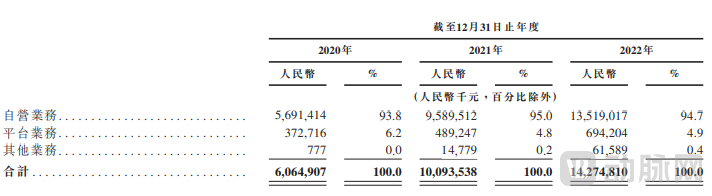
YSB Inc. Revenue Structure, Source: Prospectus
Benefiting from the synergistic interplay among its three core business segments, YSB Inc. has achieved rapid performance growth, with revenues of RMB 6.06 billion, RMB 10.09 billion, and RMB 14.27 billion in 2020, 2021, and 2022, respectively.
Among the various segments, the platform business primarily serves as a connector, earning commissions. In 2020, 2021, and 2022, the average commission rates were 2.8%, 2.9%, and 3.1%, respectively. Consequently, although the platform business contributed more than half of the GMV, its revenue scale remained limited.
Since its launch in 2019, YSB Inc.’s self-operated business has accounted for the majority of the company’s revenue. In 2020, 2021, and 2022, revenue from this segment reached RMB 5.69 billion, RMB 9.59 billion, and RMB 13.52 billion, respectively, each representing over 90% of total revenue and providing strong momentum for overall business growth.
In the internet healthcare sector, listed companies almost universally serve both B-end and C-end clients, with payers also comprising both B-end and C-end entities; in contrast, YSB Inc. has chosen a purely B-end path.
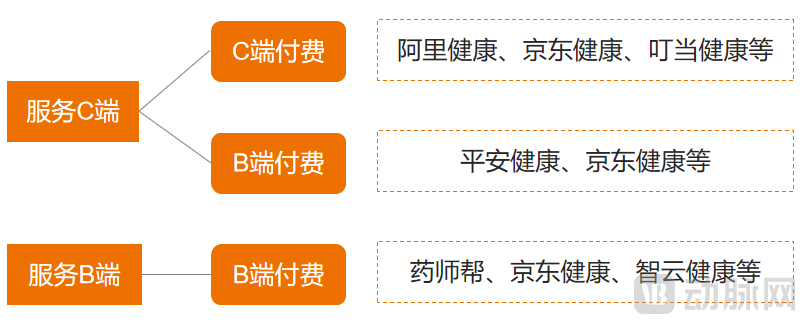
Primary Target Customers and Payers of Publicly Listed Internet Healthcare Companies
Serving the consumer market, with consumers as the primary payers.
This is the most fundamental and common model, in which internet healthcare provides C-end users with services such as online consultations, e-prescriptions, online medication purchases, and chronic disease management. The platform’s competitiveness lies in its C-end traffic sources, user scale, and user engagement.
However, the habit of paying for services among C-end users has not yet been fully cultivated; in contrast, their willingness to pay for online medication purchases is stronger. Consequently, platforms with e-commerce attributes have developed rapidly under this model.
Alibaba Health's latest annual report shows that its revenue from self-operated pharmaceutical business reached RMB 23.59 billion, a year-on-year increase of 31.7%. In 2022, JD Health's revenue from self-operated business amounted to RMB 40.4 billion, representing a year-on-year growth of 54.2%.
O2O platform Dingdang Health achieved differentiated positioning through its self-operated pharmacy network and delivery speed. In 2022, its online direct-sales business generated RMB 3.09 billion in revenue, a year-on-year increase of 19.6%.
Among these platforms, consumer-side payments account for the vast majority of revenue.
Serving C-end users, but primarily monetized through B-end clients
Precisely because the willingness and frequency of C-end consumers to pay for services are limited, enterprises have turned their attention to the B-end.
Currently, the majority of Ping An Health’s revenue is derived from Ping An Group’s integrated financial channels and corporate clients. Among these, Ping An Group’s integrated financial channels serve as one of the core avenues for customer acquisition and high-value user conversion, representing a unique competitive asset.
In the corporate client segment, Ping An Health focuses on medium-to-large enterprises with well-defined employee health management plans, sufficient budgets, and strong willingness to pay, providing them with employee health management services. In 2022, Ping An Health established the “Yi Qi Jian Kang” product suite to meet the diverse needs of enterprises.
Over the past two years, JD Health has also been exploring growth drivers in B-side paid services. In 2022, JD Health continued to expand its health service solutions for corporate clients, leveraging its integrated “products + services” supply chain capabilities, and launched offerings including smart health checkups and corporate Employee Assistance Programs (EAP).
To date, similar B-side payment models have been the more ideal approach for service projects to achieve scalable revenue.
Serving B2B clients and primarily paid for by B2B clients
In this model, the B-side is both the direct service recipient and the primary payer.
Zhiyun Health initially focused on the consumer (C-end) market. Upon recognizing the challenges of sustaining a purely consumer-centric model, it pivoted to a “hospital-first” business-to-business (B-end) strategy. Leveraging SaaS deployment, the company generates revenue by providing chronic disease medical supplies to healthcare institutions, offering online consultations, e-prescriptions, and pharmaceuticals to pharmacies, and delivering digital marketing services to pharmaceutical manufacturers.
However, Zhiyun Health’s business model is built on chronic disease management, with the consumer-facing (C-end) segment being an indispensable component that provides patients with services such as chronic disease products, premium memberships, and insurance brokerage. Nevertheless, this segment contributes a relatively small share of revenue; in 2022, personal chronic disease management solutions accounted for only 6.3% of Zhiyun Health’s total revenue.
Furthermore, although 111.com derives the majority of its revenue from its B2B business, which accounts for over 90% of total revenue, it also offers B2C services.
In contrast, YSB Inc. has opted for a more pure B2B strategy.
Among YSB Inc.’s major business segments, commissions for the platform business are paid by sellers, making distributors the primary payers; order fees for the self-operated business are paid by buyers, with pharmacies and primary healthcare institutions serving as the main payers; in other business lines, services such as Guangpu Cloud Testing, micro-warehousing, and SaaS solutions are also paid for by their respective B-end users, while pharmacist training is mostly offered free of charge.
It should be noted that while micro-warehouses aim to sell pharmaceuticals directly to end consumers (C-end users) as part of terminal services, YSB Inc. only provides software and hardware products along with maintenance services to pharmacies. YSB Inc. does not employ physicians or pharmacists; services such as prescription issuance and pharmacist review required for medication purchases must be configured by the pharmacies themselves.
Focusing exclusively on the B2B sector means that YSB Inc. does not need to incur costs related to patient-facing services, such as user acquisition and operations. Since it does not serve patients directly, there is no need to attract physician registrations or invest in physician outreach and operational expenses. These are the key features that distinguish YSB Inc. from other business models.
Since their inception, internet healthcare companies have aimed to address pain points across various segments of the industry chain. Based on their core businesses, each company’s strategic focus within the chain has become increasingly clear; overall, these efforts center on three key areas: medical services, pharmaceuticals, and insurance.
In the healthcare sector, the focus is on enhancing efficiency and quality for medical institutions and physicians.
For example, Zhiyun Health has deployed its Zhiyun Yihui SaaS solution in hospitals to help enhance the digitalization and standardization of chronic disease treatment and management processes. As of December 31, 2022, approximately 2,567 hospitals had installed Zhiyun Yihui.
JD Health has launched its “Digital Intelligence Healthcare” solution system. By the end of 2022, it had supported more than 20 hospitals in establishing internet hospitals; its intelligent cloud imaging platform, “Jingying Cloud,” has also been deployed in multiple offline hospitals.
Large healthcare institutions have always been key targets for internet medical platforms, as their head effect, large patient base, and other advantages are important factors attracting platforms to collaborate with them.
YSB Inc. focuses on grassroots medical institutions that are geographically dispersed and have a small patient base (referring to the number of patients served by each individual institution). These institutions are numerous in quantity, predominantly located in lower-tier cities and remote areas, and lag behind large-scale medical institutions in terms of medical expertise, service capacity, and drug variety.
However, primary healthcare institutions account for half of the total medical services provided nationwide in China, representing a vast market opportunity. To address this, YSB Inc. leverages its B2B platform and Spectrum Cloud Testing services to bridge the gaps in drug supply capabilities and diagnostic proficiency at these grassroots medical facilities.
In the pharmaceutical sector, the primary focus is on innovating marketing models and distribution channels.
Most internet healthcare platforms are expanding digital marketing as a new business line.
Alibaba Health, leveraging its drug traceability business, had partnered with more than 300 leading pharmaceutical companies as of March 2023, providing them with services such as patient and physician education and digital marketing.
In 2022, JD Health entered into strategic partnerships or upgraded existing collaborations with dozens of pharmaceutical and healthcare brands, supporting pharmaceutical companies in digital marketing through initiatives such as the online launch of new specialty drugs, C2M (Consumer-to-Manufacturer) reverse customization, and health management services.
Zhiyun Health’s in-hospital solutions enable digital marketing for chronic disease-related medications; as of the end of 2022, Zhiyun Health had 26 paying clients.
These platforms deeply connect doctors and patients, enabling more efficient outreach to physicians and academic promotion through digital marketing, thereby encouraging doctors to prescribe medications to appropriate patients; they also provide patients with convenient access to medicines, particularly prescription drugs.
Meanwhile, out-of-hospital management directly impacts whether patients take their medications on time and at the correct dosage, thereby influencing disease control and ultimate treatment outcomes. By extending patient services beyond the hospital setting, the aforementioned platforms can better enhance medication adherence, a key aspect that pharmaceutical companies value in digital marketing.
In pharmaceutical distribution, B2B platforms reduce transaction steps inherent in traditional multi-tier distribution models, lower communication costs between buyers and suppliers, and enable greater price transparency and more efficient transactions.
YSB Inc.’s digital platform enables buyers to quickly locate desired products using search and filter functions, while leveraging algorithms to generate seller feedback and identify popular items.
It is worth noting that large pharmacy chains possess strong bargaining power in drug procurement, whereas small and medium-sized pharmacies do not. These buyers typically place low-value orders with high frequency and have fragmented demands. YSB Inc. aggregates a large number of such buyers, forming a “virtual alliance” through digital means to help them secure more favorable procurement prices.
The prospectus shows that from 2020 to 2022, the GMV per order for YSB Inc. was approximately RMB 400 to RMB 800, and the platform provided a convenient procurement channel for these small-value orders.
Currently,An increasing number of internet healthcare platforms are integrating with insurance, embedding services into health insurance products to establish differentiated advantages for insurance offerings.
In its collaborations with commercial insurance companies, Ping An Health integrates “Health Guardian 360” and similar services into insurance policies, providing policyholders with online consultations, medication delivery, domestic and international second medical opinions, and offline medical arrangement services.
Companies such as JD Health and Dingdang Health are also strengthening their partnerships with commercial insurance providers to create a closed-loop ecosystem integrating pharmaceuticals, healthcare, and insurance services.
As can be seen, with the Internet penetrating every segment of the healthcare service system—medical care, pharmaceuticals, and insurance—YSB Inc. is positioned to address the pain points faced by primary healthcare institutions and small- to medium-sized pharmacies in the medical care and pharmaceutical segments under traditional models.
Within the industry, YSB Inc., similar to its peers, has established specialized business segments and stable, growing revenue streams. While there is some degree of business overlap with other companies, the overall relationship remains complementary.
Furthermore, it is important to note that YSB Inc. is also in a loss-making position, similar to the current situation faced by many platforms. In 2020, 2021, and 2022, its adjusted net losses amounted to RMB 280 million, RMB 340 million, and RMB 120 million, respectively.
Data from the prospectus shows that while YSB Inc.’s self-operated business generated the vast majority of its revenue, it also accounted for approximately 90% of the cost of sales. In 2020, 2021, and 2022, the gross profit margins of the self-operated business were 5.1%, 5.2%, and 6.2%, respectively; in contrast, the platform business, which contributed a smaller share of revenue, achieved gross profit margins exceeding 80%. As a result, YSB Inc.’s overall gross profit margin remained at around 10%, indicating room for further improvement.
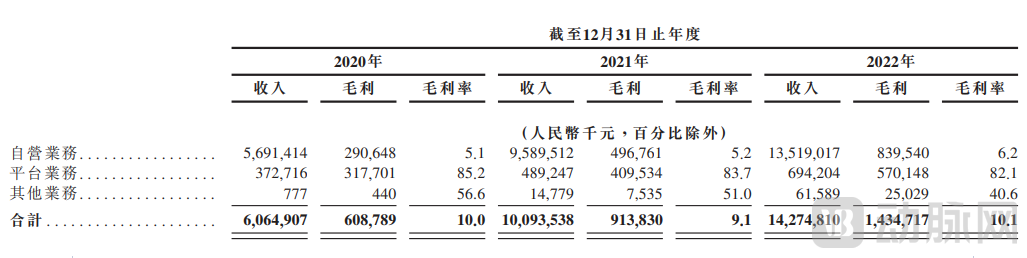 Gross Profit Margins of YSB Inc.’s Business Segments, Source: Prospectus
In response to losses, companies are actively expanding their service scale and seeking new high-margin growth drivers. So, where does YSB Inc.’s future growth potential lie? How can its profitability be improved and enhanced?
As outlined in its prospectus, YSB Inc. plans to expand its buyer base, enhance buyer engagement, broaden its self-operated warehouse network, and improve fulfillment services for self-operated orders.
Digitalization enhances the efficiency of pharmaceutical distribution and enables rapid growth in business volume. While such growth can reduce costs through economies of scale, the value of digitalization extends far beyond this.
In YSB Inc.’s self-operated business, the “Priority Brand” initiative has already demonstrated the profound value of digitalization.
The brand’s flagship business adheres to specific criteria in category selection, such as: focusing on new products or existing products with certain characteristics; targeting drugs with high demand but limited brand awareness; prioritizing drugs that sell well in hospitals but are underpromoted in retail pharmacies; and emphasizing drugs that have gained strong traction in one region but remain less known in others.
In 2020, YSB Inc. partnered with Company A to promote Orlistat Capsules. On the first day of the campaign, gross merchandise value (GMV) exceeded RMB 400,000. Within one month, the product’s market share on the platform rose from 4% to 46%, and the average monthly GMV after the promotion was more than 20 times higher than that before the promotion. In 2021, YSB Inc. collaborated with Company B to promote Celecoxib Capsules, increasing the product’s monthly GMV from less than RMB 200,000 to over RMB 800,000.
As of the end of 2022, YSB Inc. had partnered with more than 500 pharmaceutical manufacturers to promote approximately 1,100 SKUs. In 2022, the gross merchandise value (GMV) of its manufacturer-branded priority promotion business reached RMB 1.01 billion, accounting for 6.6% of the GMV of its self-operated business. From 2020 to 2022, the compound annual growth rate (CAGR) of the GMV for this manufacturer-branded priority promotion business was 72.8%.
The brand’s flagship service enables pharmaceutical companies to better identify market opportunities and promote their products digitally; it allows buyers to purchase medications that meet their actual needs at lower prices, while YSB Inc. can also procure products at reduced costs, thereby achieving higher gross profit margins.
YSB Inc. disclosed that it will expand and deepen its cooperation in the “Brand First-Choice” business, assisting pharmaceutical companies in launching more customized products. Considering factors such as revenue growth rate and gross margin advantages, the “Brand First-Choice” business will become one of the key drivers for YSB Inc. to enhance its profitability and an important means to strengthen its competitive moat.
It is not just YSB Inc.; looking at the industry as a whole, in the process of reversing losses, all players should delve deeper into the value of digitalization. They must not only leverage it as a tool to enhance efficiency but also consider the restructuring of processes and business landscapes amidst digital transformation.