

Renchen Bio Advances Non-Invasive Prenatal Screening to Week 6 with “One Tube of Blood + One Tube of Cells” Platform Validated in Science Advances
From ancient times to the present, the greatness of maternal love has been celebrated worldwide. However, the journey to motherhood is fraught with peril at every turn; from the ten months of gestation to childbirth, each stage carries the risk of lasting sequelae and even the threat of death.
Wei YanxingHe is an obstetrician-gynecologist at a key specialized clinical hospital in a southern country. He once witnessed on the operating table a mother succumb to sudden eclampsia, leaving behind her newborn child as she passed away—This scene has remained a source of lingering regret for Wei Yanxing to this day.InProfessor Stephen James Lye, Fellow of the Canadian Academy of Maternal-Fetal MedicineDuring his postdoctoral work with the research group, he discussed with the professor the issues he had observed in clinical practice:“I have worked in obstetrics and gynecology for seven to eight years. In my view, some of the pain points in this specialty cannot be resolved by clinicians alone and require support from the research community.”This view is also supported by Professor Stephen Lye.
The two hit it off immediately and decided to establish a research translation platform in the fertility sector, focusing on prevention, detection, treatment, and healthcare based on clinical needs. After multiple rounds of evaluation, in 2021,Renchen BiomedicalIt was born within the Tsinghua Pearl River Delta Research Institute, located in the National High-Tech Enterprise Accelerator in Huangpu District, Guangzhou.
Stem Cell Extraction Technology Featured in a Science Subsidiary Journal
Renchen Biomedical’s most important product is Preg-FeGS, which also constitutes the company’s technological barrier.
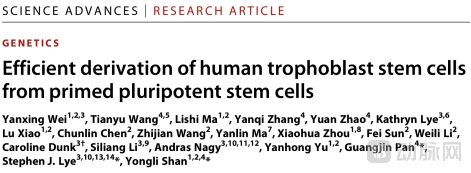
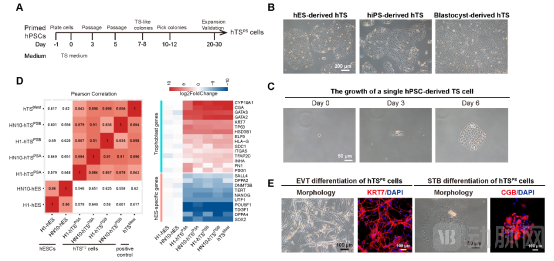
In 2021, Dr. Wei’s team atScience Advances, a sub-journal of ScienceA research paper titled “Efficient derivation of human trophoblast stem cells from primed pluripotent stem cells” has been published online. This study innovatively established, for the first time both domestically and internationally, a highly efficient system for generating human trophoblast stem cells using conventionally cultured primed human pluripotent stem cells (primed PSCs), without the need to convert them into naive or extended pluripotent stem cells. Building on this research, the Preg-FeGS product pipeline was developed.
In the medical community, research on fetal-derived stem cells has consistently garnered significant attention. Whether in the rapidly advancing field of anti-aging research or in maternal and infant studies that are closest to clinical application, the utilization of fetal stem cells represents a critical step. Unfortunately,Isolating and purifying fetal stem cells from pregnant women has long been a persistent challenge that the academic community has struggled to overcome.
This is because the fetus and placenta are enclosed within the amniotic membrane, resulting in a limited number of fetal cells circulating in the maternal system, which are also unstable in state; therefore, isolating and enriching fetal cells is extremely challenging. Furthermore, to achieve non-invasive prenatal testing, it is necessary to obtain a sufficient quantity of fetal cells from maternal peripheral blood or secretions, a feat that has rarely been accomplished to date.
However, Renchen Biomedical leveragesTalentandIn terms of resourcessupport, thereby achieving a breakthrough in this challenging area.
Dr. Yanxing Wei was primarily engaged inStem Cell Research, with considerable expertise in stem cell extraction techniques. During his doctoral and postdoctoral studies, he further specialized in maternal-fetal research. This diverse research background naturally led Dr. Wei to integrate stem cell technologies into his maternal-fetal studies. He told VCBeat:“Currently, we have achieved the extraction of fetal stem cells from pregnant women as early as 6 weeks of gestation and realized their in vitro expansion to ensure that the fetal stem cells reach detectable levels.”
Relying onChina Placenta Project, Renchen Biomedical possesses an extensive repository of clinical collaboration resources. Leveraging this advantage, Dr. Wei began exploring the use of stem cell technology to construct in vitro models of early human placental development and its associated diseases as early as 2017.
In Canada,Academician Stephen Lye, Co-founder of Renchen BiomedicalHe is the Executive Chair of the Ontario Birth Study (OBS) Cohort.The Ontario Birth Study (OBS) Cohort is Canada’s largest maternal clinical research cohort, encompassing a clinical database and a biobank.With the support of Academician Stephen Lye, Renchen Biomedical has achieved a richer and more diversified source of stem cell samples.
Adequate sample volume is the foundation of product development and validation. Renchen Biomedical’s unique advantage in clinical resource repositories sets it apart from its peers: “While other companies are still struggling to collect samples, Renchen has already commenced R&D and commercialization.”
Extraction of the Complete Fetal Genome, with a Screening Accuracy Rate as High as 91%
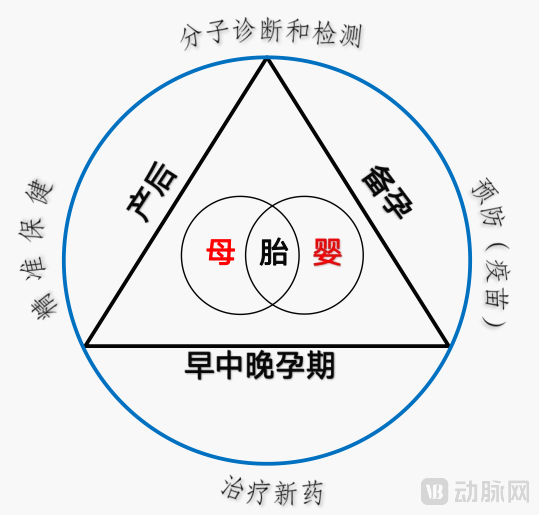
When categorized by the different stages of the reproductive process, the fertility sector comprises a complex array of niche markets. Whether during preconception, the early, middle, or late stages of pregnancy, or childbirth, each phase has its distinct focal points; however, fetal health always remains the top priority. Based on this principle, Renchen Biomedical has decided to initially selectFetal Screening Sectoras an entry point into the fertility market.
Effective screening can detect fetal defects as early as possible, which not only affects the future quality of life for the child and the entire family but is also closely related to the safety and well-being of both the fetus and the mother.
According to data from the 6th Conference on Birth Defect Prevention and Control, as reported by leaders of the Department of Maternal and Child Health under the National Health and Family Planning Commission in “Progress in the Prevention and Control of Birth Defects in China,”Approximately 1 in every 5 infant deaths is due to birth defects, with 3 infants dying from birth defects every hour., birth defects have become the leading cause of infant mortality in China.
These alarming figures compel us to prioritize early screening for fetal defects.But how “early” is considered “early”?
Current screening protocols for fetal genetic disorders primarily begin with an assessment of the parents’ basic clinical history, followed by genetic analysis to evaluate the likelihood of fetal abnormalities. If risks are identified, further invasive diagnostic procedures, such as chorionic villus sampling (CVS) or amniocentesis, are employed for confirmation. However, this process is time-consuming and typically requires until17–20 weeksAt this stage, the fetus is already fully formed; in the event of unforeseen complications, pregnancy can only be terminated through labor induction, which would cause irreversible harm to the mother.
Renchen Biomedical’s pioneering fetal stem cell screening method can, during pregnancy,6 weeksPrecise screening can be conducted to alleviate various anxieties among expectant mothers, such as concerns about “having a cold in early pregnancy,” “whether medication taken has any adverse effects on the fetus,” and “whether home renovation may cause fetal malformations.” Moreover, if life-threatening fetal anomalies are detected, termination of pregnancy can be performed as early as six weeks of gestation through medical or surgical abortion, thereby minimizing harm to the mother and reducing the impact on future pregnancies.
Furthermore, the fetal stem cell screening method not only allows for earlier detection but also employs non-invasive sampling techniques. Compared with amniocentesis and chorionic villus sampling (CVS), it causes less harm to the mother, ensures greater comfort and safety during the sampling process, and is therefore more readily accepted by expectant mothers. More importantly, the fetal stem cell screening method pioneered by Renchen Biomedical can directly obtain complete genomic information from the fetus, resulting in higher accuracy and shorter turnaround times. According to clinical data from nearly 100 cases studied by Renchen Biomedical, the current screening results show a high degree of concordance with diagnostic-level CVS or amniocentesis. Dr. Wei told Chengguo Bureau: “Currently, mainstream screening methods on the market rely on incomplete DNA fragments for analysis, yielding a positive predictive value of only 37% for low-risk populations. This is because the results obtained from such methods are akin to assembling a jigsaw puzzle, where all indicators must be placed in the correct ‘positions’ before the full picture can be seen. In contrast, our screening method is based on a complete genome,”“Naturally more accurate, intuitive, and convenient.”
Delivering End-to-End Services from Preconception to the First, Second, and Third Trimesters of Pregnancy, Through to Childbirth
Preg-FeGSIt is a platform-based technology, upon which Renchen Biomedical can develop further possibilities.
On the day of the interview, Dr. Wei Yanxing rushed over right after finishing his clinical consultations. When asked by VCBeat why he still insists on maintaining clinical practice, he said: “How can one truly understand the most pressing pain points in clinical practice without being on the front lines?“In my view, only research directions guided by clinical pain points are valuable. Translating valuable research into clinical practice to directly benefit patients, while aligning with the national population strategy, has always been my aspiration and the original intention behind the founding of Renchen Biomedical.”
Currently, Renchen Biomedical has established a presence in sectors such as non-invasive early screening for preterm birth, molecular early screening for preeclampsia, and artificial placentas, filling the domestic market gap for early, non-invasive preterm birth screening and providing precise navigation for early clinical intervention. According to Dr. Wei, Renchen Biomedical will further delve into these niche segments in the future to achieve“Preconception – First, Second, and Third Trimesters – Childbirth” Full-Service OfferingLay the foundation.
The Preg-FeGS prototype is expected to be unveiled in the second half of 2023., Renchen Biomedical is fully advancing the registration and certification of its related products. Meanwhile, Renchen Biomedical also plans toSeptemberInitiate the next round of financing to support the production and sales of molecular early screening products for preeclampsia, the research, development, and registration of fetal stem cell screening products, as well as the R&D and market expansion in sectors such as artificial placentas.