

China's Trillion-Scale Medical Device Industry Accelerates Domestic Substitution and Aims for Global Innovation Leadership
“By 2025, the medical equipment industry will see significant advancement in its foundational capabilities and modernization of its industrial chain. Mainstream medical equipment will basically achieve effective supply, and the performance and quality of high-end medical equipment products will be markedly improved.”
This is the “14th Five-Year Plan” for the Development of the Medical Equipment Industry, released at the end of 2021, marking the beginning of a new phase of systematic development for China’s medical device industry. With only half the time elapsed until 2025, China’s medical device industry has already achieved breakthrough phased results.
According to “Current Status and Trends of China’s Medical Device Industry Development” (hereinafter referred to as “Status and Trends”) released by the international management consulting firm Roland Berger, the market size of China’s medical device industry has surged from RMB 843.8 billion in 2021 to RMB 958.2 billion in 2022, with a compound annual growth rate of approximately 17.5% over the past seven years. In contrast, the global market during the same period experienced a sharp slowdown in growth due to the pandemic.
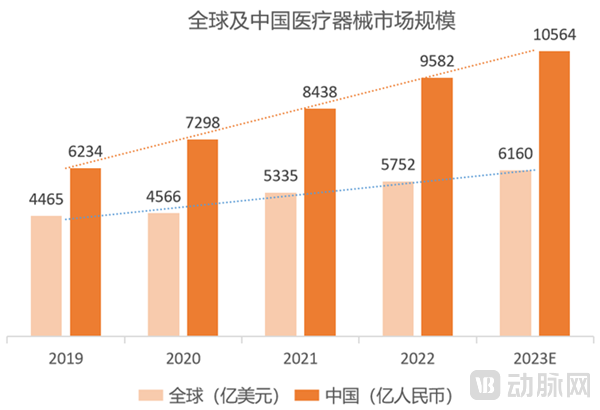
Global and China Medical Device Market Size Trends
Data source: Frost & Sullivan; chart by VCBeat
Riding the warm, moist air currents from the Pacific Ocean, Shenzhen, a coastal city in southern China, is rapidly heating up alongside the sustained growth of China’s medical device industry. An international conference on frontier innovations and industrial development in high-end medical devices is currently being held in Shenzhen.
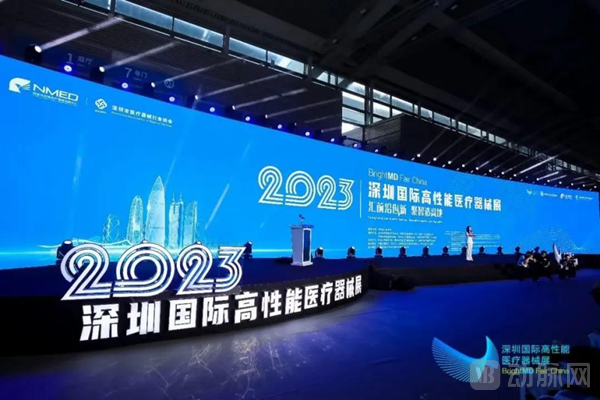
2023 Shenzhen International High-Performance Medical Devices Exhibition
Image source: National Innovation Center for High-Performance Medical Devices
From June 8 to 10, the 2023 Shenzhen International High-Performance Medical Devices Exhibition was successfully held at the Shenzhen Convention and Exhibition Center (Futian). Themed “Converging Frontier Innovations, Gathering Smart Manufacturing Highlands,” the event was guided by the Shenzhen Municipal People’s Government and jointly organized by the China Association of Medical Equipment, the National Innovation Center for High-Performance Medical Devices, and the Shenzhen Medical Device Industry Association.
Currently, China has largely achieved domestic production in the field of low-cost basic medical devices, and the import substitution of high-end devices is about to enter the final decisive stage. How can breakthrough innovations be achieved, “chokehold” challenges be resolved, and global development of the medical device industry be led?
Drawing on years of industry observation and key remarks from conference speakers, VCBeat has distilled the primary questions and their answers into the following three points.
Integrating the Full Ecosystem Chain of Industry, Academia, Research, Healthcare, Policy, and Management to Build an Innovative Industrial Service Platform
China’s medical device industry is currently grappling with the challenges of unbalanced and inadequate development. This is primarily manifested in two aspects: first, there is severe homogenization among low-end products; second, key materials and core components for certain high-end medical devices still rely on imports.
Secondly, in the promotion and application of key technologies and innovative products, there are contradictions such as research institutions striving for breakthroughs in advanced fields failing to meet investors’ requirements for economic returns, and startups possessing innovative technologies being at a loss regarding product commercialization and industrialization.
At its root, this is because China's high-end medical device industry started relatively late, resulting in insufficient accumulation of technical expertise compared to developed countries such as those in Europe and the United States.
The high-end medical device industry belongs to the high-tech sector and particularly relies on the integration of multiple disciplines and industries. Therefore, the development of China’s high-end medical device industry requires systematic strategic deployment, leveraging multi-party resources to collaboratively promote the research, development, and translation of frontier technologies and common key technologies in the field.
To address the aforementioned issues, it is essential to first establish a high-end industrial platform to drive innovation. By systematically integrating resources across the industrial ecosystem, innovation chain, and supply chain, this approach aims to resolve critical challenges such as the disconnect between basic research and translational applications.
In recent years, China has successively established multiple high-end industrial platforms, such as the National Center for Innovation in High-Performance Medical Devices launched in Shenzhen in 2020, and innovative support systems like the Beijing Drug and Medical Device Innovation Service Station established in April 2023.
Achieving independent and controllable source technologies, with innovation as the primary driver for high-quality industry development
Roland Berger also pointed out in "Current Status and Trends" that 80%–90% of high-end medical devices in China currently rely on imports, such as radiotherapy equipment and MRI scanners. Although some products have achieved domestic production, their core components, raw materials, manufacturing equipment, and testing equipment still depend on imports.
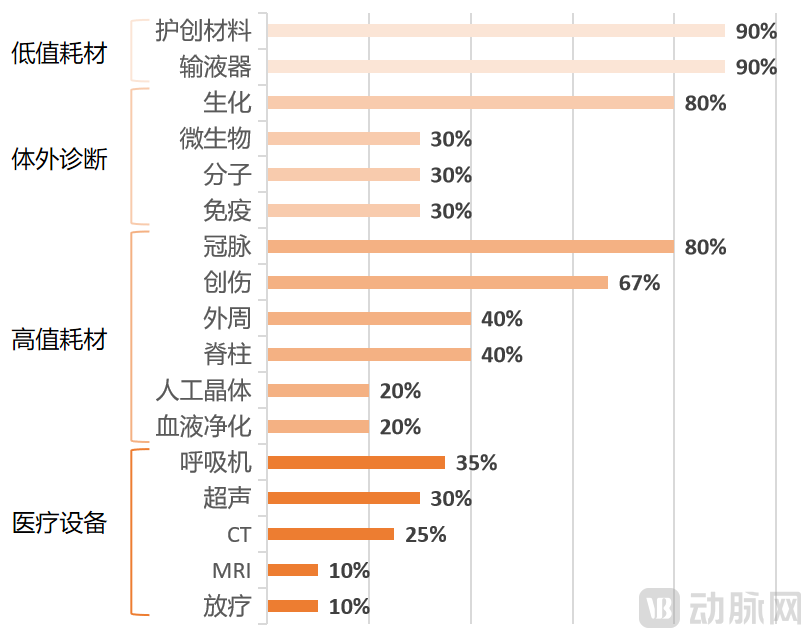
Market Share of Domestic Brands in China's Medical Device Sub-Segments
Data source: “Status and Trends,” Roland Berger Management Consulting; graphic by VCBeat
Academician Hu Shoushou of the Chinese Academy of Engineering commented, “Although China’s medical device market boasts broad prospects and immense potential, it remains predominantly driven by imitative innovation at this stage.” For instance, while domestically produced coronary stents have largely achieved import substitution in China, their core material—cobalt-chromium alloy—remains almost entirely dependent on imports.
The establishment of innovation platforms and the integration of resources serve as external boosts to the high-end medical device industry. However, scientific research achievements from universities and cutting-edge technologies from innovative enterprises are the key to overcoming the challenges of domestic substitution and resolving the “chokehold” issues in core technologies.
Therefore, original innovation driven by clinical needs is the core impetus for advancing China’s high-end medical device industry.
Emphasizing multidisciplinary, forward-looking basic research and pioneering original achievements is, in essence, a cyclical pattern inherent to the development of the medical industry. “Investing early, investing in small ventures, and investing in innovation” is not only an unspoken consensus among investors but also reflects market trends. Therefore, only by focusing on foundational theories and fundamental science across multiple disciplines and industries can we hope to achieve genuine “zero-to-one” breakthroughs in core technologies, materials, or key components.
Centralized Procurement Accelerates Domestic Substitution, Breaking the “First Set” Barrier for Chinese-Made Medical Devices
Although China’s medical device industry started relatively late, more than a decade of concerted catch-up efforts—particularly since the 12th Five-Year Plan period—has enabled a large cohort of innovative medical device companies to rise strongly in response to favorable policies. These enterprises have begun to enter mid-to-high-end markets both domestically and internationally, driving the entire industry to gradually move upstream along the value chain toward higher-value segments.
Although some domestically produced high-end medical devices have achieved significant technological breakthroughs, possess fully independent intellectual property rights, and overcome critical technical barriers, hospitals often limit their procurement to equipment with established market performance. Furthermore, physicians tend to favor mature imported products that have been applied for a longer duration and across a broader range of clinical settings.
If market access is blocked, the revenues and R&D incentives of innovative medical device companies will be adversely affected, making it difficult to keep pace with subsequent product updates. Therefore, breaking down the brand barriers that imported high-end medical devices have established over the years is crucial for the rapid development of China’s medical device industry.
As early as 2015, the “Made in China 2025” plan issued by the State Council stated that the localization rate of large medical equipment must be increased. Centralized procurement serves as one such opportunity.
Li Wenmei, Board Secretary of Mindray Medical, stated, “Volume-based procurement itself provides an opportunity for domestic enterprises with core competitiveness to accelerate import substitution.”
Beyond squeezing out industry inefficiencies and providing domestic equipment manufacturers with an opportunity for market reshuffling, centralized procurement also carves out certain market development spaces for innovative medical devices outside the scope of policy mandates, as the National Healthcare Security Administration has explicitly stipulated that “innovative medical devices are temporarily excluded from centralized procurement.”
Amid the fierce competition characterizing the development of China’s high-end medical device industry, one player stands out prominently: Shenzhen, China’s first Special Economic Zone. This city has given rise to a host of outstanding and influential medical device companies, including Mindray Medical, Winner Medical, BGI Genomics, and Sonoscape Medical.
After more than four decades of dedicated development, Shenzhen has transformed from an obscure border town into a major industrial cluster for China’s medical device industry, with its influence extending worldwide.
In terms of the output value scale of Shenzhen's high-end medical device industry, the added value of this sector in Shenzhen reached RMB 33.2 billion in 2022, representing a year-on-year increase of 12.4%. Compared with 2021, the growth rate of the added value of Shenzhen's high-end medical device industry doubled.
Achieving such a strong competitive edge in the high-end medical device industry, which is characterized by advanced technology and high barriers to entry, is attributable to Shenzhen’s persistent and in-depth efforts over the years to tackle this “hard nut to crack,” as well as to supportive national policies. Consequently, the advantages of Shenzhen’s high-end medical device industry are primarily reflected in the following three aspects.
First, from the perspective of the current development status of Shenzhen's high-end medical device industry, a profound innovation DNA is one of Shenzhen's key advantages.
Academician Gu Xiaosong of the Chinese Academy of Engineering pointed out, “Innovation in China’s high-end medical device industry must be oriented toward major national strategies, critical societal needs, the cause of human health, and the forefront of global scientific advancement.”
Since the establishment of the Shenzhen Special Economic Zone in 1980, its medical device industry has seen the emergence of a large number of innovative enterprises and listed companies striving to reach “global peaks.” For instance, Shenzhen Anke, founded in 1986, is hailed as the “Whampoa Military Academy” of the medical device industry; many founders and core teams of domestic listed medical device companies have previously worked at Shenzhen Anke.
These successive industry innovators have not only significantly driven the development of Shenzhen’s local medical device industry, but also played a vital role in advancing China’s medical device sector and, indeed, the broader cause of human health.
For example, in January this year, China’s first domestically produced extracorporeal membrane oxygenation (ECMO) system received emergency approval for market launch. This project, undertaken over three years through a joint effort by the National Center for Innovation of High-Performance Medical Devices and Shenzhen Hanuo Medical, among others, achieved significant breakthroughs in domestic substitution across ECMO design, research and development, manufacturing, and core components.
Second, Academician Hu Shoushou pointed out at the conference that “the release of policies is key to the development of medical innovation,” and Shenzhen’s high-end medical device industry enjoys unique advantages both in terms of policy support and geographically strategic location guided by such policies.
As early as 2019, the Outline Development Plan for the Guangdong-Hong Kong-Macao Greater Bay Area, issued by the Central Committee of the Communist Party of China and the State Council, proposed integrating the Hong Kong Special Administrative Region, the Macao Special Administrative Region, Shenzhen, and eight other cities in Guangdong Province to deepen innovation cooperation among Guangdong, Hong Kong, and Macao, and to build an open, integrated, and regionally collaborative innovation community.
The “Greater Bay Area Medical Device and Drug Pass-Through” policy not only supports the entry of pharmaceuticals and medical devices from Hong Kong and Macao into hospitals in the Greater Bay Area for clinical use, but also facilitates the regulatory development of drugs and medical devices in the region, fostering a more innovative and dynamic pharmaceutical and medical device industry.
Within the following year, the Greater Bay Area Branch of the Center for Drug Evaluation under the National Medical Products Administration (NMPA) and the Greater Bay Area Branch of the Center for Medical Device Technical Evaluation and Inspection under the NMPA were officially inaugurated in Shenzhen. The establishment of these two branches in Shenzhen has not only facilitated the pilot implementation of new medical devices, technologies, and pharmaceuticals in the Greater Bay Area but also provided a high-quality, integrated platform for regional development.
The integrated policies of the Greater Bay Area have not only facilitated smoother communication and interaction between Hong Kong, Macao, and mainland China, fostering a clustered spatial layout, but also attracted enterprises and research institutions from across China and even globally to establish themselves in Shenzhen, thereby driving the agglomerated development of the high-end medical device industry.
Finally, the development of the high-end medical device industry relies on the latest research achievements in fundamental disciplines such as acoustics, optics, and electronics. Its industrial chain also encompasses multiple foundational industries, including materials science, precision machining, intelligent manufacturing, and electronic information technology. These cutting-edge technologies and leading industries constitute one of the key advantages that distinguish Shenzhen’s high-end medical device sector from those in other cities and regions.
Driven by integration with frontier advantage industries such as biomaterials, sensing technologies, and artificial intelligence, Shenzhen has achieved international leadership in multiple niche segments of the high-end medical device industry in recent years, including high-end color Doppler ultrasound systems and surgical robots. For instance, Mindray Medical and Sonoscape’s high-end color Doppler ultrasound product lines and AED products have broken the long-standing foreign monopoly; Yuanhua Intelligence has successfully developed the first domestically produced integrated hip-and-knee orthopedic surgical robot system, among other achievements.
However, compared with first-tier cities such as Beijing, Shanghai, and Guangzhou, Shenzhen, while young and brimming with innovative vitality, also faces certain shortcomings due to its “less extensive” experience.
According to WHO statistics, by the end of 2022, Shenzhen had a total of 30 public tertiary Grade A hospitals, while Beijing, Shanghai, and Guangzhou had 81, 69, and 67, respectively. This indicates that Shenzhen, with just over forty years of development, still lags behind first-tier cities with deep historical foundations like Beijing, Shanghai, and Guangzhou in terms of the number of top-tier hospitals.
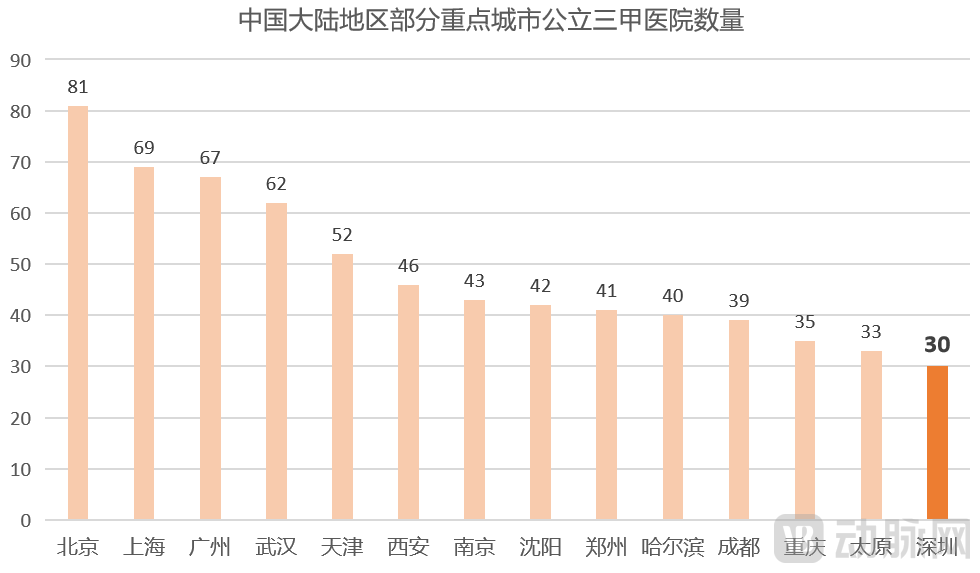
Data source: WHO; compiled by VCBeat
Opportunities always come hand in hand with challenges. From a macro perspective, although the pandemic gradually receded in 2023, the market’s spring has not truly arrived, and both primary and secondary markets remain relatively tight. This tense investment climate has also permeated Shenzhen; whether on the STAR Market or the Hong Kong stock exchange, the performance of some listed high-end medical device companies has been lackluster.
However, the transition from overheating to cooling and then back to rationality has always been the underlying logic of the medical industry’s counter-cyclical nature, with “inelastic medical demand” remaining the focal point for capital and markets. Therefore, although the medical device industry is currently in a new upcycle characterized by both pressures and opportunities, the robust growth of Shenzhen is underpinned by the resilient growth logic of local medical device enterprises—namely, sustained innovation.
Despite the cooling macroeconomic environment, some start-up medical device companies in Shenzhen have continued to deliver impressive performance. For instance, in June 2023, Shenzhen Aibo Medical Robotics secured RMB 100 million in Series A financing; in May 2023, Mingzhun Medical completed an angel round of over RMB 10 million; and in 2022, Anjieming Medical closed an angel round of nearly RMB 10 million.
With the support of capital markets, these innovative medical device companies continuously inject fresh “blood” of innovation into Shenzhen’s—and indeed the global—high-end medical device industry through technological and product innovations.
As previously mentioned, the development of the high-end medical device industry requires the participation of multiple stakeholders, including industry, academia, research institutions, healthcare providers, investors, government bodies, and regulatory agencies. The coordination and communication among these parties are frequent, close, and real-time, necessitating a coordinating role and an implementing entity to accelerate this process.
Since 2016, China has approved and recognized 26 national-level manufacturing innovation centers across the country, focusing on 36 key development areas. Among them, the National Center for High-Performance Medical Devices Innovation (hereinafter referred to as the “National Innovation Center”) is Shenzhen’s first national-level manufacturing innovation center and the only innovation center established by the state in the field of medical devices.
As the “national team” driving the innovative development of high-end medical devices in Shenzhen, the National Innovation Center is jointly led by the Shenzhen Institute of Advanced Technology, Chinese Academy of Sciences, Mindray Medical, United Imaging Healthcare, LifeTech Scientific, and Harbin Institute of Technology.
The establishment and development of the National Innovation Center have not only accelerated the filling of technological gaps in China’s medical device sector for “high-precision, advanced, and cutting-edge” technologies, achieved self-reliance and controllability in high-end medical equipment, and increased the domestic production rate of high-end medical devices in China, but also successfully incubated multiple innovative enterprises in the medical device field, such as Anjieming Medical and Mingzhun Medical, which secured tens of millions in investment within less than two years of their establishment.
The successful incubation of Anjieming Medical and Mingzhun Medical is merely a microcosm of the National Innovation Center’s success in building a full-chain innovation ecosystem. Since its inception, the National Innovation Center has deeply inherited Shenzhen’s innovative DNA.These successes will be continuously replicated in the years to come.
As the first innovative enterprise to emerge from the National Innovation Center’s laboratory, Anjieming Medical has successfully completed the entire process for its early glaucoma diagnostic device—from R&D and engineering translation to technological implementation and clinical application—in just two years. In March this year, the company settled into the National Innovation Center’s industrial incubation base located in Jinxiu Science Park, Longhua District, Shenzhen.
Within two years, it helped startups transform a cutting-edge product “from 0 to 1.” This replicable, mature productization capability stems from the National Innovation Center’s key positioning—namely, its focus on innovation capacity when incubating enterprises.
Most technological innovations in the medical device sector originate from innovative enterprises. However, the National Innovation Center employs assessment criteria for corporate innovation capabilities that differ from those of traditional research institutes. Rather than prioritizing academic publications and patents, it focuses on practical innovation and its value contribution to China’s medical device industry.
The medical device industry is one of the hallmarks of a nation’s manufacturing prowess and high-tech development, and it is a strategic emerging industry receiving key state support. As a national strategic scientific and technological force, the National Innovation Center has firmly established the high-end medical device industry as a defining feature of Shenzhen’s urban identity by focusing on critical technological bottlenecks and aggregating the industrial ecosystem.
On the global stage, the frontier medical device industry has only been emerging for just over a decade, yet high-end medical devices have become the next strategic focus for nations worldwide.
Jiang Baoguo, an academician of the Chinese Academy of Engineering, remarked with emotion while discussing the development of China’s medical device industry, “Over the past four decades since the reform and opening-up, advanced foreign medical device companies have taken away Chinese people’s money by selling plates, screws, stents, and joints. Today, however, China’s medical industry is facing a wave of innovation driven by the large-scale substitution of imported products with domestically produced ones, which will constitute China’s core competitiveness in the global market over the next fifty years.”
Driven by successive rounds of support from national policies and local initiatives in cities such as Shenzhen, and propelled by leading innovation platforms like the National Medical Device Innovation Center, the trend toward domestic substitution of high-end medical devices has become irreversible. China is poised to accelerate its ascent to the global industry’s forefront as a sector leader.
China’s medical device industry is currently in the “golden decade” of development. It is reasonable to believe that, as predicted by Roland Berger Management Consulting in Status and Trends, the size of China’s medical device market will surpass that of the United States by 2030, making it the world’s largest medical device market!
References:
1. “Three Years Since the Establishment of the National Innovation Center: Striving to Be a Leader in the World-Class Innovation Ecosystem for High-End Medical Devices”
2. “Setting the Trend, Innovating the Ecosystem—The 2023 Shenzhen International High-Performance Medical Devices Exhibition Officially Opens”