

Amador Bioscience CSO Dr. Lorin K. Roskos: Translational Science Is the Key to Clinical Trial Success
In the first half of 2023, Amador Bioscience, a next-generation CRO focused on translational science and clinical development, announced the appointment of Dr. Lorin K. Roskos, a distinguished leader in the innovative pharmaceutical R&D industry, as a member of its Board of Directors, Chief Scientific Officer (CSO), and President of Quantitative Clinical Pharmacology (QCP). Dr. Roskos will actively participate in Amador’s strategic planning, lead and implement the company’s clinical pharmacology strategy, and support Amador’s global business expansion and the realization of its next-generation CRO vision.
VCBeat recently had the privilege of conducting an exclusive interview with Dr. Lorin K. Roskos, gaining in-depth insights into his expertise in clinical pharmacology and translational science.
Dr. Roskos is a highly respected scientific leader and pharmaceutical industry executive, and one of the earliest scientists worldwide to research and promote “translational science” and quantitative pharmacology, with over 30 years of R&D and management experience at leading multinational pharmaceutical companies.

Dr. Lorin K. Roskos
After earning his Ph.D. in Pharmaceutical Sciences from the University of Washington, Dr. Roskos has published 200 original research articles, reviews, and book chapters throughout his career, and holds nine therapeutic patents. His expertise spans clinical pharmacology, pharmacometrics, systems pharmacology, translational medicine, and GXP-compliant bioanalysis, covering disease areas including oncology, respiratory, autoimmune, inflammatory, cardiovascular, renal, metabolic, and infectious diseases.
Dr. Roskos has over 30 years of R&D and management experience at major multinational pharmaceutical companies and innovative biotechnology firms, including AstraZeneca, Eli Lilly, Amgen, and Exelixis. He has contributed to the development of more than 50 IND pipelines and nearly 20 NDA drugs. In the 1990s,During his tenure at Amgen, Dr. Roskos pioneered mechanistic pharmacokinetic-pharmacodynamic (PK-PD) models, including the Hematopoiesis Transit model, monoclonal antibody-antigen interaction models incorporating target-mediated drug disposition, models for lymphatic absorption of subcutaneously administered macromolecules, and tumor growth inhibition models.These mechanistic models have become classic examples of using quantitative pharmacology modeling and simulation to guide the rational development of biologics, earning high praise from the U.S. FDA and widespread recognition within the industry.
During his tenure as Vice President of Research and Development at AstraZeneca, Dr. Roskos was responsible for leading the global departments of Clinical Pharmacology, Bioanalysis, Biomarkers, and Translational Science. He also served as Senior Vice President at Exelixis, where he led efforts in Clinical Pharmacology, Bioanalysis and Biomarkers, Translational Science, as well as Toxicology, Pathology, Pharmacogenomics, Bioinformatics, and Translational Medicine. Prior to joining AstraZeneca, Dr. Roskos worked at Eli Lilly, Amgen, and Abgenix, serving as a Senior Director and overseeing the management of Clinical Pharmacology and Toxicology departments.
It is understood that during his tenure at Amgen, he was often likened to “Skywalker” from Star Wars, embodying a rare combination of talent, capability, and leadership. He was regarded as an outstanding achiever who was highly favored by senior executives and deeply respected by colleagues.
In fact, the connection between AMADOR BIOSCIENCE and Dr. Roskos dates back more than 20 years.
“Prior to joining Amador Bioscience, I had already worked closely with Dr. Wang Bing, CEO of Amador Bioscience, for an extended period. Our first collaboration was at Amgen, where he was one of the earliest colleagues I worked with in the industry. We have enjoyed a very productive partnership,” shared Dr. Roskos in an interview.
Throughout the remainder of Dr. Roskos’s career, he also had the opportunity to interact with colleagues across various roles at AMADOR BIOSCIENCE. Many senior executives had previously worked alongside him at leading global pharmaceutical companies, including Amgen and AstraZeneca, leaving him with a highly favorable impression.
However, the fundamental reason for Dr. Roskos to join Amador Bioscience is that it is a truly science-driven company. As a top-tier CRO capable of providing comprehensive services for innovative drug R&D with its leading technology, Amador Bioscience stands at a level that most companies in the industry cannot reach.
An Overview of Amador Bioscience’s Comprehensive Solution Services: Clinical Pharmacology, Bioanalysis and Biomarkers, Clinical Research, Regulatory Affairs, and More. These services are underpinned by robust capabilities in clinical pharmacology and translational science, a focus that Dr. Roskos has consistently emphasized throughout his decades of drug research.
“Clinical pharmacology is a critical discipline in frontier development. If you must focus on one key area, clinical pharmacology is paramount for optimizing dose and dosing intervals,” emphasized Dr. Roskos.
As can be seen, in the field of oncology research that has been ongoing for many years, there is not much consideration given to therapeutic dosing. Commonly, when the dose is continuously increased until the patient can no longer tolerate it, that dose is defaulted as the patient's usage dose, but this completely ignores drug toxicity and the benefit-risk ratio.
In FDA-approved and regulated Phase II clinical trials, there is an increasing emphasis on dose control, specifically evaluating the benefit-risk profile in the context of balancing efficacy and toxicity. In actual clinical development scenarios, this does not primarily represent a scientific or technical challenge; rather, it places greater demands on statistical capabilities, particularly in data analysis.
This is where translational science comes into play.According to Dr. Roskos, there is a close relationship between translational science and clinical pharmacology; only by integrating the two can the target patient populations for drug benefits be precisely identified, which is the key and foundation for the success of innovative drugs.
The translation from preclinical to clinical stages involves substantial specialized expertise, operational procedures, and technical talent. Consequently, a large number of clinical trials fail during Phase I, which is why Phase I clinical studies are often referred to as the “Valley of Death” in innovative drug development. Translational science serves as the bridge between “laboratory research” and “clinical research.” It is patient- and disease-centered, investigating the scientific principles and operational foundations at each stage from problem discovery to therapeutic intervention.
With the advancement of basic sciences and the limitations of traditional drug discovery pathways, innovative drug development increasingly demands broader and deeper foundational scientific knowledge. However, scientists engaged in early-stage basic research often lack extensive clinical experience. In this context, translational science can serve as the guiding discipline for drug development.
Is the disease mechanism clearly understood? Are the in vitro and in vivo models relevant to the disease, and can they help validate targets? Are there suitable biomarkers to serve as indicators of disease onset and progression, as well as drug efficacy? How should proof-of-concept clinical trials be designed? AstraZeneca has subdivided translational science into the “5R” framework.
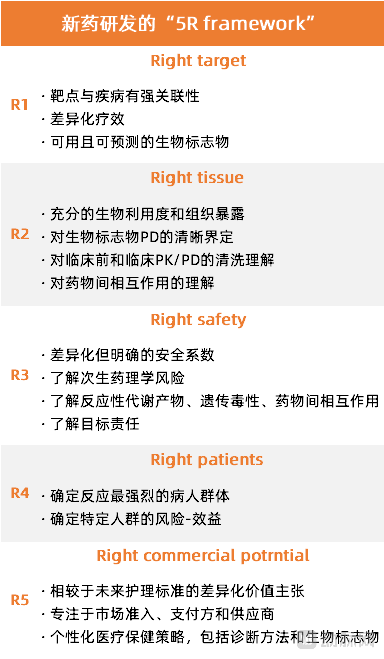
AstraZeneca Summarizes Specific Applications of Translational Science
It can be seen that,Translational science emphasizes approaching drug development from five perspectives: targets, tissues, safety, patients, and commercial value.。
The most critical factor in bridging the preclinical and clinical stages is to have a carefully planned translational pharmacology strategy.This involves a deep understanding of the exposure–response relationship for efficacy in pharmacological animal models, the exposure–safety relationship in toxicology studies, and appropriate bioanalytical methods for transitioning from animal studies to clinical trials. Such information can be leveraged to meticulously design Phase I trials, including establishing a well-justified starting dose, defining dose-escalation steps, predicting effective clinical doses, and characterizing the anticipated safety margin and risks.
Dr. Roskos also separately emphasized the precise efficacy of pharmacotherapy and the exploration of risk-benefit profiles in the interview.To improve the success rate of clinical trials, two critical factors must be carefully considered: first, whether the drug can treat the disease precisely and effectively; second, whether safety concerns may hinder the exploration of therapeutic dosing.
Based on this, developers must first calculate the feasibility, dosage requirements, and safety margin for human trials from in vitro testing systems and animal study data before entering clinical trials. For different drug types such as small molecules, antibodies, and cell therapies, rational tools like AI algorithms and statistical modeling should be employed to rigorously compute and extrapolate relevant data from preclinical experiments—including dose gradients, dosing frequency, therapeutic benefits, and safety margins—to assess the probability of success for the pipeline in human trials.
Following the successful preliminary assessment, the next challenge lies in identifying suitable participants for clinical trials. This is particularly critical in oncology, where individual patient variability can significantly influence therapeutic outcomes. By conducting comparative analyses between preclinical drug data and clinical diagnostic data from patients, researchers can identify specific patient subgroups most likely to benefit from the current therapy, thereby enabling more precisely targeted clinical trials. Such patient stratification not only enhances the success rate of ongoing clinical trials but also spares ineligible patients from ineffective treatment courses—often referred to as “futile participation”—recognizing that, for patients, time is far more precious than money.
It is crucial to emphasize that the key to translational science lies in having the courage to say “no.”As an auxiliary decision-making tool underpinned by theoretical foundations and real-world data, translational science focuses on identifying potential safety hazards, futile explorations, and resource wastage in clinical trials through preliminary computation, statistical analysis, and evaluation, thereby ensuring that drug pipeline advancement remains on the correct “track.”
With the refinement of the human whole-genome map and a deeper understanding of pathophysiology and the molecular basis of disease, humanity has identified more effective therapeutic approaches for diseases in recent decades.
In cancer immunotherapy, inhibitors targeting PD-1 and PD-L1 have achieved breakthroughs across multiple tumor types, and the trend toward combination therapies is gaining widespread momentum. Antibody-drug conjugates (ADCs), with their advantages in stability, safety, tolerability, and favorable dosing profiles, have attracted intense competition among pharmaceutical companies, leading to significant breakthroughs.
However, for solid tumors and metastatic cancers, current therapies can only extend life in most cases rather than provide a complete cure. Therefore, while there are many unmet clinical needs to be addressed in future new drug development, the task remains highly challenging.
Years ago, new drug development was primarily driven by large biopharmaceutical companies such as Merck, AstraZeneca, and Eli Lilly. However, with rising barriers in specialized therapeutic areas, biotech firms have proliferated globally. To advance more novel drug pipelines to commercialization, contract research organizations (CROs) have become indispensable.
However, as differentiation intensifies across targets, mechanisms of action, indications, therapies, and regulatory frameworks, the execution complexity for CRO teams is rising exponentially. Only by keeping pace with and mastering the most cutting-edge scientific innovations, uncovering and understanding clients’ true needs, exploring and developing optimal execution strategies, and controlling and ensuring the quality of deliverables, can CROs become the preferred partners of pharmaceutical companies in future competition.
“Leveraging its cutting-edge understanding of translational science, along with advanced technologies and extensive expertise in quantitative clinical pharmacology, bioanalysis, biomarkers, and regulatory affairs, AMADOR BIOSCIENCE can accurately identify pain points in drug development and address them scientifically. By providing practical strategies and clinical plans, it stands as a CRO truly capable of delivering comprehensive services to its clients,” shared Dr. Roskos in an interview. “This is also a key reason why I chose to join the company.”
Next, AMADOR BIOSCIENCE, already equipped with a comprehensive CRO total solution and global presence, has become even more formidable—“like a tiger given wings”—with the support of Dr. Roskos’s over 30 years of experience in new drug development. Drawing on his expertise in developing more than 50 IND pipelines and nearly 20 NDA drugs, Dr. Roskos has extensive experience collaborating with multiple global regulatory agencies, including the FDA and EMA, enabling him to effectively manage unexpected challenges across all stages from drug development to commercialization.
Leveraging his extensive experience in drug development and professional expertise, Dr. Roskos will guide Amador Bioscience toward a higher, farther, and stronger future, drawing on his multidimensional insights into the challenges facing the pharmaceutical industry.