

Zenith Medical Carves a Path of Innovation and Quality Amidst the Crowded 'One-Stop Solution' Landscape
Zenith Vascular
Cerebrovascular Device R&D and Manufacturer
Over the past two years, the neurointerventional sector has cooled. The neurointerventional market has encountered intense competition (“involution”) before achieving significant volume expansion, with numerous entrants and increasingly homogeneous product offerings. The penetration rate of domestically produced devices has failed to meet expectations, while the sector has been impacted by centralized procurement, leading to reduced profit margins per product and slower-than-expected market growth. Nevertheless, the fundamental logic driving the development of the neurointerventional sector remains unchanged: the large patient population with cerebrovascular diseases and high mortality rates, the potential for expanding surgical volumes, and the low current localization rate of the device market all make upward market trajectory inevitable.
With the innovative development of neurointerventional devices, clinical data show a sustained growth in the volume of neurointerventional procedures in China, with these procedures increasingly being performed at lower-tier healthcare facilities, including county-level hospitals; from a market perspective,In 2022, the market size of neurointerventional consumables reached RMB 6.68 billion and is projected to grow to RMB 43.22 billion by 2028. Listed companies such as Zenith Vascular and MicroPort NeuroTech achieved a doubling of their revenues in 2022, while centralized procurement has accelerated the process of domestic substitution.
Therefore, rather than emphasizing a decline in the hype surrounding the neurointerventional sector, it is more accurate to say that the market is returning to rationality.Homogenized Competition Pressure and Volume-Based Procurement Drive “Survival of the Fittest”. For the former, innovating high-quality products and systematic product solutions is the breakthrough point; while the latter tests a company's comprehensive strength in R&D, mass production, supply chain, and other aspects.
After the Market Shakes Out, Which Companies Can Break Through?
Stroke is the leading cause of death and disability among adults in China, characterized by five major features: high incidence, high disability rate, high mortality, high recurrence rate, and substantial economic burden. Results from the Global Burden of Disease (GBD) study show thatIn 2019, there were 3.94 million new stroke cases in China, the number of stroke patients reached 28.76 million, and the number of stroke-related deaths was 2.19 million.In recent years, the number of stroke patients in China has continued to rise, with a trend toward younger demographics, placing a significant burden on the national healthcare system.
Due to its advantages, including minimal invasiveness, high treatment efficiency, and favorable outcomes, neurointervention has become one of the primary treatment modalities for stroke patients. However, the rate of neurointerventional treatment in China remains significantly insufficient. Between 2019 and 2020, the overall endovascular treatment rate for acute ischemic stroke (AIS) at stroke center units in China was 1.45%, indicating a substantial gap compared with developed countries in Europe and the United States.
The cerebrovascular structure of the human body is tortuous and complex, making neurointerventional procedures highly challenging. Procedures such as endovascular treatment of intracranial aneurysms, endovascular therapy for acute cerebral infarction, and endovascular management of intracranial arterial stenosis and occlusion are all classified as Level 4 surgeries, which impose extremely high demands on physicians’ expertise and device precision. In addition to factors such as the uneven distribution of medical resources between doctors and patients in China and insufficient public awareness of treatment, the development of medical devices also constrains the widespread adoption of neurointerventional surgeries.
Currently, China’s neurointerventional market remains dominated by imported products, with mainstream offerings largely from foreign brands at relatively high prices. Moreover, these imported devices are primarily designed to meet clinical needs and patient vascular anatomies abroad, leading to certain challenges in their clinical application within China. Meanwhile, domestically produced brands exhibit inconsistent quality and increasing product homogenization, while still failing to address unmet needs in specific market segments. There is an urgent clinical demand for innovative, high-quality, cost-effective domestic neurointerventional devices.
Meanwhile, an increasing number of neurointerventional stakeholders are advocating for “one-stop solutions.” From a clinical perspective, neurointerventional procedures involve the use of numerous devices; physicians tend to prefer compatible product ecosystems, which not only reduce procedural complexity but also yield better surgical outcomes. At the institutional operational level, procuring comprehensive product suites helps lower costs and simplifies management and maintenance.
Overall,One-stop solutions facilitate the decentralization of neurointerventional procedures to more primary care hospitals, which in turn will drive market expansion.。
From a market perspective, unlike the early days of coronary intervention when stents alone could support a multi-billion-dollar market,The volume of neurointerventional procedures remains relatively limited, resulting in a low revenue ceiling for individual products. In contrast, comprehensive product solutions address a significantly larger target market. Furthermore, a diversified product portfolio enables companies to better control costs, build brand equity, and possess greater resilience in facing volume-based procurement initiatives.
With the development of neurointervention, clinical guidelines have been continuously updated, and the construction of stroke centers has accelerated (with over 1,800 stroke centers established, extending down to the county-level market), leading to the decentralization of surgical procedures.Clinical practice and the market have also raised further demands for one-stop solutions: high-quality, disease-centric product portfolios and innovative products that simplify surgical procedures.
Stroke is primarily categorized into two major types: ischemic stroke and hemorrhagic stroke. Due to their distinct pathogenic mechanisms, the therapeutic focuses differ between the two—the former emphasizes "restoration of flow," while the latter focuses on "occlusion"—and consequently, the corresponding therapeutic devices also vary. Apart from access-assist products, there are significant differences between therapeutic products for hemorrhagic and ischemic strokes. Developing a comprehensive product portfolio centered on the disease is more advantageous for facilitating surgical procedures.
Furthermore, clinical practice places greater emphasis on product quality. Particularly as neurointerventional procedures become more widely adopted at primary-care hospitals, there are higher expectations for product performance, stability, and pricing. Products such as coils, stent retrievers, and aspiration catheters have progressively undergone import substitution, offering clinicians a broader range of choices and prompting more stringent product selection criteria. Beyond these established products, unmet clinical needs remain in neurointerventional procedures—for instance, the considerable difficulty of navigating large-bore catheters through tortuous vessels, which compromises procedural efficiency—urgently requiring innovative product solutions from manufacturers.
In summary,In the Second Half of Neurointervention, Disease-Centered “One-Stop Innovative High-Quality Solutions” Are the Key to Breaking Through。
“One-Stop Innovative High-Quality Solution” Launched for 80% of Stroke Patients, with All Core Products Approved
Disease-centered approach,Acute ischemic stroke accounts for 80% of all strokes., and its high mortality and disability rates make it a key focus for corporate strategic布局. According to statistical analysis by Frost & Sullivan, the number of new cases of acute ischemic stroke in China reached 3.95 million in 2022, with the volume of mechanical thrombectomy procedures reaching 85,000. This figure is projected to grow to 582,000 by 2028. By 2028, the market size supported solely by two core products—aspiration catheters and stent retrievers—will reach RMB 5.5 billion.
Concurrently, clinical guidelines for acute ischemic stroke are becoming increasingly standardized as the understanding of the condition evolves. The recently released “Chinese Guidelines for Endovascular Treatment of Acute Ischemic Stroke 2023” state that for patients with acute large vessel occlusion in either the anterior or posterior circulation within 24 hours of symptom onset, endovascular thrombectomy is recommended (Class I recommendation, Level A evidence) following clinical and imaging screening, provided they meet existing evidence-based criteria. This development also creates a larger market for related therapeutic products.
Centered on Acute Ischemic Stroke,Zenith Vascular Launches AIS One-Stop Innovative High-Quality Solution, Comprehensively Deploying Thrombectomy and Access Products to Achieve “Comprehensive Thrombectomy Capabilities, Complete Access Portfolio, and Innovation-Driven Support”
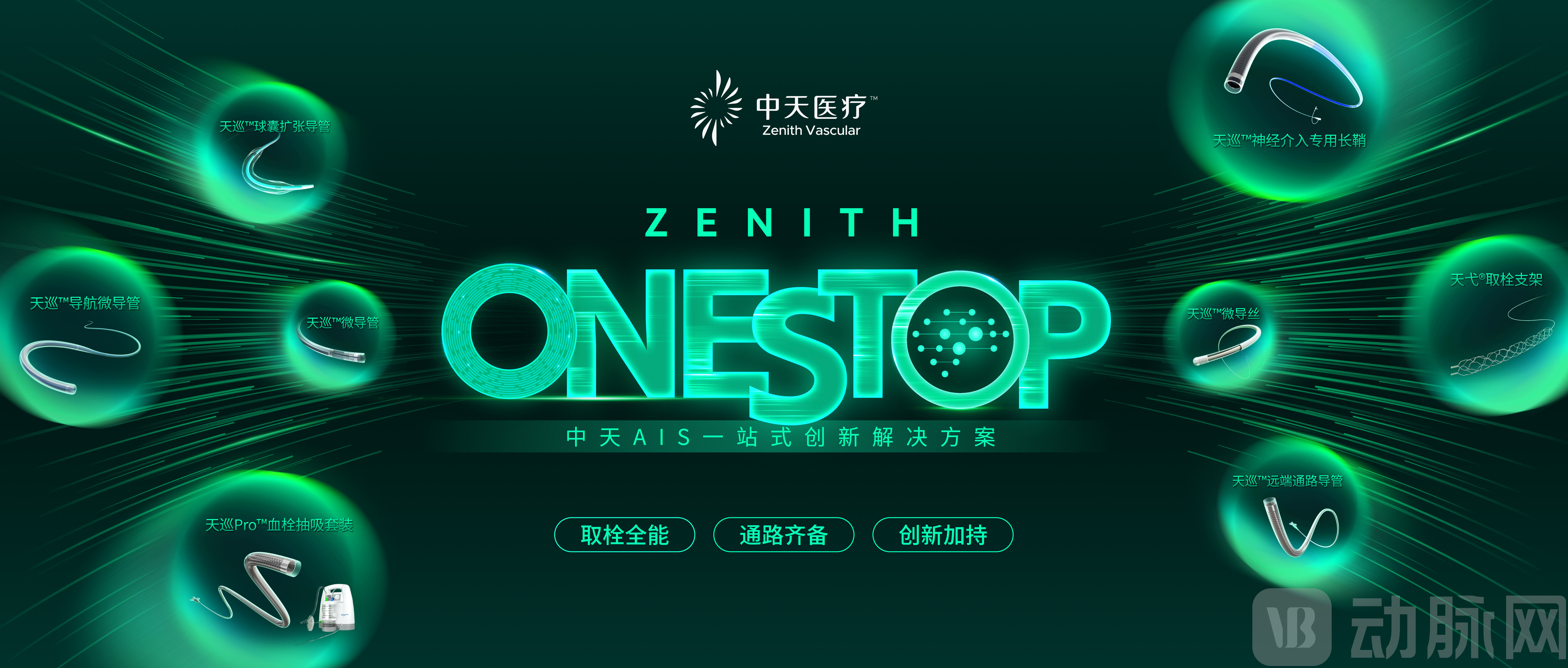
In the field of thrombectomy devices, Zenith Vascular has developed aspiration thrombectomy systems and stent retrievers; in the category of access devices, the company has launched distal access catheters, long sheaths specifically for neurointervention, microcatheters, microwires, and navigational microcatheters.Enabling multiple procedural techniques, including aspiration thrombectomy, stent retriever thrombectomy, and combined thrombectomy。
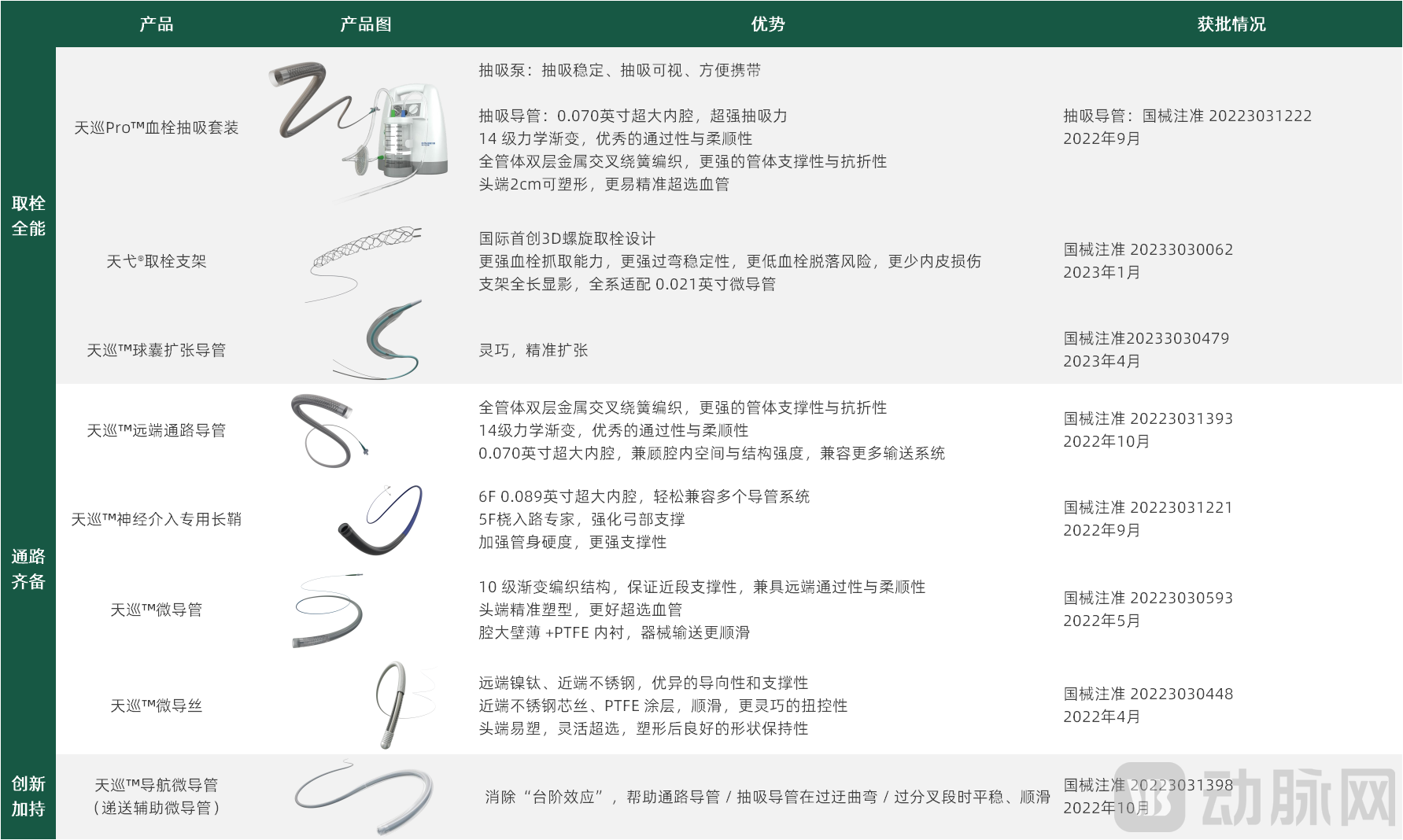
Building on its one-stop solution, the company remains committed to delivering high-quality, innovative single products, progressively achieving “parity, iteration, innovation, and surpassing” from a clinical perspective.
To address issues such as thrombus detachment and subsequent re-embolism during the thrombectomy process with existing stent retriever products, Tianyi®Thrombectomy Stents Achieve “Iteration.” This product surpasses the traditional thrombectomy approach of “radial cutting and engagement” combined with “axial traction.”Added the actions of “tangential rotational wrapping” + “centripetal curling and winding”., reducing the rate of thrombus escape while providing enhanced cornering stability.
Furthermore, Tianyi®All specifications of the thrombectomy stent can be delivered through a microcatheter with an inner diameter of 0.021 inches, and multiple specifications are compatible with 0.017-inch microcatheters. The entire length of the stent is radiopaque, enhancing the safety of thrombectomy procedures.Clinical trial results show that Tianyi®The thrombectomy stent demonstrated superior performance to overseas brands in key metrics, including the average number of retrieval attempts, success rate, and rate of favorable outcomes.
For example,Tianxun, developed by the company in collaboration with Professor Jiao Liqun's team at Xuanwu Hospital of Capital Medical University™The navigable microcatheter is an exclusive innovation developed to address challenges such as the difficulty in reaching the target location due to the “windowsill effect” when clinical intermediate catheters pass through the ophthalmic artery.This product effectively eliminates the "stent-jail effect," reduces the incidence of dissection complications, and makes neurointerventional procedures simpler, faster, and safer.
Currently, the core products of Zenith Vascular’s AIS one-stop innovative high-quality solution have all received regulatory approval and are being progressively implemented in clinical practice, earning recognition from leading clinical experts. Meanwhile,In this year’s centralized procurement of high-value medical consumables in Henan Province, all of Zenith Vascular’s core products were selected as winning bidders, which is expected to further promote the clinical application of its products.
Interventional devices, particularly neurointerventional devices, have high entry barriers and significant development challenges, with increasingly fierce competition in the sector. Zenith Vascular has managed to ensure product innovation and high quality while pursuing a “broad and comprehensive” portfolio, enabling it to rapidly capture market share after product approval.How Did This Company, Established Only Five Years Ago, Achieve This?
At the five-year milestone, Xia Jie, founder of Zenith Vascular, attributes the company’s rapid growth to its substantial accumulated expertise and forward-looking strategic planning. “Since its inception, Zenith Vascular has been committed to independent research, development, and manufacturing, ensuring that core technologies and processes remain firmly under our control. Meanwhile, recognizing clinical needs as the foundation for product development, we have consistently pursued a path of medical-engineering collaboration.”
Xia Jie comes from a clinical background, with years of experience in frontline clinical practice, hospital project management, and work at medical device companies. She founded a company in the United States, where she led the R&D and FDA registration of the world’s first dual-lumen catheter, accumulating extensive expertise in clinical insights, device development, and corporate management. Meanwhile, Zenith Vascular has established long-term collaborations with top clinical experts both domestically and internationally, enabling timely incorporation of clinical feedback. As a result, the company boasts substantial technological accumulation and a strong clinical foundation.
Zenith Vascular is committed to independent research and development, with all core products possessing fully independent intellectual property rights. To date, the company has been granted 32 patents, including 4 invention patents, and has an additional 80 patent applications pending.Zenith Vascular has established eight advanced technology platforms, including high-end braided catheter manufacturing, laser engraving, precision braiding, balloon processing, drug coating, and spring fabrication. Leveraging its robust foundational technical expertise, the company rapidly develops and iterates its product portfolio, laying a solid foundation for its “one-stop, high-quality” product strategy.
Meanwhile, Zenith Vascular adheres to the principle of “medical-enterprise collaborative innovation,” developing products in joint efforts with clinical experts in vascular intervention both domestically and internationally, always starting from clinical needs. With the support of innovative products, it enhances the clinical benefits of comprehensive disease solutions, making surgical treatments simpler, more efficient, and safer.Skyscanner™The navigational microcatheter is a product jointly developed with experts from Xuanwu Hospital. It took only 21 months from the initial concept proposed by Professor Jiao Liqun’s team to the product’s market launch.
This May, Zenith Vascular launched the “Medical-Enterprise Innovation” incubation platform under the Zenith Research Institute for the first time. The platform enables experts to propose ideas, which are then rapidly translated into practical applications through Zenith Vascular’s technical platform, thereby facilitating the implementation of more clinical innovations. Xia Jie emphasized, “We listen to physicians’ voices, respect their opinions, and protect their intellectual property rights. For any idea originating from clinical practice, Zenith Vascular will fully safeguard physicians’ rights and interests throughout the incubation process.”
At the production level, Zenith Vascular has achieved fully independent manufacturing and established a complete supply chain to ensure product production efficiency and quality, while effectively controlling costs.In May this year, the company’s new 7,400-square-meter factory officially commenced production, significantly boosting capacity, with annual consumables output projected to exceed 200,000 units.
At the market level, Zenith Vascular boasts a professional and highly effective sales team that drives efficient and rapid business expansion. In fact, the company began building its sales and marketing teams as early as 2020, before any of its products had received regulatory approval. As a result, the current team members have undergone long-term, systematic training and work together seamlessly, enabling them to provide specialized product services for clinical applications.
Meanwhile, the company actively conducts clinical education and training to support the professional development of grassroots neurointerventional physicians. Since 2022, it has launched the “Seeing Neurointervention” interview series to amplify the voices of clinical “core practitioners.”
It is precisely with the support of these multifaceted capabilities that Zenith Vascular has achieved such rapid development. The company has successively obtained 11 registration certificates and launched a range of innovative, high-quality products. In 2022 alone, its core products and services benefited over 10,000 patients, and in 2023, it rolled out its comprehensive AIS one-stop innovative solution. Meanwhile,The company’s flagship “Beyond” product, the first innovative second-generation device in the 25-year history of carotid artery stent development in China—the world’s first single-layer dense-mesh carotid stent—has completed full clinical enrollment.
This carotid artery stent features an innovative single-layer micron-sized mesh design, which reduces plaque embolization during and after the procedure, significantly enhancing procedural safety. Furthermore, the stent offers a semi-deployable and retrievable function, greatly improving operability and deployment accuracy. It also boasts excellent kink resistance and radial support force, allowing it to better conform to the vessel wall across varying degrees of stenosis and adapt to vessels with different levels of tortuosity, thereby addressing unmet clinical needs currently left by imported carotid stents.
At its inception, Xia Jie proactively proposed “Intervention First, Implantation Second; Acute Before Chronic; Neuro Before Peripheral” development path. Currently, the company is also building one-stop solutions around disease areas such as carotid artery stenosis and peripheral vascular disease. In the future,Zenith Vascular expects to submit applications for at least 16 more registration certificates, while rapidly advancing the R&D and clinical trials of its one-stop interventional solution for pulmonary embolism, further expanding its pan-vascular intervention business layout.。
Against the backdrop of centralized procurement for high-value medical consumables and tighter health insurance cost controls, the era in which a single blockbuster product could sustain a multi-billion-dollar market has passed. One-stop solutions have become key to corporate growth. The current challenge lies in maintaining professionalism and differentiated advantages within a “comprehensive and all-encompassing” strategic layout. Zenith Vascular’s development offers new insights into addressing this issue.
It is reported that this “dark horse” in the neurointerventional fieldZenith VascularThe Series C financing round has been launched, with the proceeds planned to be used for new product research and development, clinical studies, and overseas market expansion.

Reference Article:
《Temporal trend and attributable risk factors of stroke burden in China, 1990–2019: an analysis for the Global Burden of Disease Study 2019》
"Eco Medical Prospectus"
“Zenith Vascular”®"Thrombectomy Stents: Innovative Technology Leads the Era of Intracranial Thrombectomy Stents 4.0" — Shenjie News
《Specifications for Clinical Application and Management of Neurovascular Interventional Diagnosis and Treatment Techniques (2019 Edition)》