

Futuo Zhida Files for IPO: Pioneering AI-AR Navigation for Precision Minimally Invasive Lung Nodule Resection
On June 5, 2023 (U.S. time), Apple unveiled the Apple Vision Pro, a product seven years in the making, captivating audiences worldwide. The Vision Pro is a brand-new XR headset. XR is an umbrella term encompassing technologies such as VR (Virtual Reality), AR (Augmented Reality), and MR (Mixed Reality). It is widely believed within the industry that Apple’s first XR device will drive growth across the entire sector, including the niche segment of MXR (Medical XR, as classified by the FDA).
As early as 2015–2016, the FDA approved several medical devices incorporating XR technology, primarily for 3D reconstruction in medical imaging. Subsequently, the application scenarios of MXR expanded into the field of surgical navigation. With technological maturation and a significant reduction in hardware costs, MXR has rapidly developed and is regarded as having substantial market potential. According to a report by Fact&Factors, the global MXR market size is projected to surge from $2.7 billion in 2020 to $40.98 billion in 2026, with a forecasted compound annual growth rate (CAGR) of 34.89% from 2021 to 2026.
Shanghai JediCare Medical Technology (hereinafter referred to as “JediCare”) targets AR navigation systems, develops minimally invasive surgical innovations, and creates an integrated solution for the early diagnosis and treatment of tumors and pulmonary nodules.
JediCare was established in Zhangjiang, Shanghai, in 2018. Prior to this, its founder, Sun Fei, had accumulated many years of full-industry-chain experience in the development and marketing of minimally invasive interventional surgical devices and large-scale imaging equipment.

Fei Sun, CEO of JediCare
In 1995, Sun Fei, at the age of 15, was admitted to the Department of Applied Physics at Tsinghua University, where he built China’s first optical coherence tomography (OCT) imaging system during his undergraduate studies.
After graduating with a master’s degree in 2002, Sun Fei joined the marketing department of GE Healthcare as a Clinical Research Scientist, where he subsequently developed MRI-based “PET-like” technology.
In 2004, magnetic resonance-guided focused ultrasound (MRgFUS) technology, jointly developed by GE and the Israeli company InSightec, received approval from the U.S. FDA for the non-invasive treatment of uterine fibroids.
In 2008, foreseeing that MRgFUS would not be introduced into China in the short term (China approved its first MRgFUS registration certificate in 2013), Sun Fei came up with an idea,Can Chinese people develop more innovative solutions tailored to their own needs—ones that Americans have not created?Consequently, Sun Fei resigned from GE and embarked on his first entrepreneurial venture, successfully developing non-invasive equipment for breast nodule assessment and non-invasive renal denervation (RDN). However, due to a lack of funding, all projects were unfortunately halted during the commercialization process.
From 2011 to 2014, Sun Fei returned to GE, serving as an Upstream Product Manager for the global market, where he learned and practiced how to transform innovative technologies into products tailored to the needs of diverse healthcare scenarios worldwide.
In 2015, Sun Fei embarked on his second entrepreneurial venture by joining Broncus Medical. From 2015 through 2017, the entire team was dedicated to developing minimally invasive diagnostic and therapeutic technologies based on bronchoscopic pulmonary navigation. While the “minimally invasive” aspect was achieved, the airway route is susceptible to mechanical influences, making it unsuitable for precise localization in the treatment of early-stage pulmonary nodules.
In 2018, JediCare was established with investment and empowerment from Fosun Pharma.Focusing on early diagnosis and treatment of tumors and precision surgery as the R&D direction, we are developing innovative minimally invasive surgical techniques based on an AI-powered AR navigation system platform.。
When discussing the challenges encountered during product development with VCBeat, Sun Fei stated, “Our core focus is on developing novel minimally invasive surgical instruments based on AR navigation. The most complex aspect lies in precisely integrating visual and imaging algorithms with the structural design of interventional surgical devices to create innovative surgical solutions. However, the greatest challenge in the R&D process was actually team collaboration and communication. Our team members come from diverse professional backgrounds, and it takes considerable time to achieve cross-disciplinary alignment and consensus. Moreover, one must maintain a very open mindset—in plain terms, being receptive to criticism and feedback. Only by addressing these two issues could our entire R&D team move forward together.”
The JediCare team is a typical R&D-focused group. Of its current workforce of over 40 employees, more than 70% are engaged in research and development, with the majority hailing from domestic and international medical device companies such as Siemens, GE, United Imaging, Medtronic, and Shanghai MicroPort., with years of experience rooted in domestic clinical departments and a globally leading perspective in the fields of image-guided navigation and interventional consumables.
Since its establishment in 2018, JediCare has been fully self-reliant in research, development, and manufacturing, spanning from software algorithms to hardware consumables. The company possesses multiple independently developed core software algorithms, proprietary production processes for core consumables, and associated production equipment.Over 30 Invention Patents Published。
As a shortlisted high-potential entity in the Ministry of Industry and Information Technology’s “Open Competition” initiative for AI medical device innovation, JediCare has actively responded to the national policy of “early diagnosis and early treatment.” It has developed the world’s first series of precision surgical systems under AR navigation, leveraging technological innovation to reduce surgical risks associated with early-stage tumor treatment and lower the threshold for performing precision surgeries. This strategic positioning aligns with the concept outlined in the 14th Five-Year Plan for National Health, which calls for “expanding coverage of early cancer diagnosis and treatment through multiple channels.”
The company has successfully developed two major product lines centered on the urgent clinical need for minimally invasive treatment of small pulmonary nodules:1. AR-Navigated Intraoperative Puncture Localization System for Pulmonary Nodules; 2. AR-Navigated Puncture and Resection System for Small Pulmonary Nodules。
Lung cancer is the leading cause of cancer-related deaths worldwide. In China, both the incidence and mortality rates of lung cancer remain persistently high, ranking first globally. According to the "Blue Book on Early Screening and Diagnosis of Lung Cancer in China" by Frost & Sullivan Insights, there were 2.269 million new cases of lung cancer worldwide in 2021, with 978,000 cases in China, accounting for 43.1% of the global total.
Pulmonary nodules refer to focal, round opacities of varying sizes with well-defined or ill-defined margins and a diameter ≤3 cm on lung imaging. With the application of low-dose CT in lung cancer screening, the detection rate of "small pulmonary nodules" has been rising year by year, while the clinical demand for safe, effective, and precise minimally invasive treatment techniques continues to increase.
AR-Navigation System for Intraoperative Puncture Localization of Pulmonary Nodules
In standard pulmonary treatment protocols, patients undergo CT-guided transthoracic puncture prior to surgery to mark the lesion location through methods such as coil implantation, anchor wire placement, or local injection of contrast agents, thereby facilitating intraoperative lesion identification and determination of the surgical resection margin.
In recent years, the emerging electromagnetic navigation bronchoscopy (ENB) technology relies on bronchoscopes guided by electromagnetic field navigation to reach the range of airways visible on CT scans within the lungs, addressing the limitations of traditional bronchoscopy and percutaneous lung biopsy techniques in accessing certain areas. ENB has been widely promoted in pulmonary surgery; however, it presents significant technical challenges. Establishing a precise correlation between the location reached via the airway under navigation and the surgical field visible under thoracoscopy is difficult, and the navigation process is susceptible to interference from complex electromagnetic environments.
JediCare's precision portable AR navigation puncture positioning system is the world's first percutaneous lung puncture navigation,Combining Monocular Tracking Technology in Computer Vision with AR Display Technology, while achieving precise localization, it has optimized the localization process, enabling more primary-care hospitals to perform precise thoracoscopic surgery.
Under general anesthesia, the physician simply dons AR glasses, which function as a Beidou navigation system to directly guide the handheld puncture device to the target site for marker deployment. This approach enables precise localization of small pulmonary nodules or diseased lung regions based solely on a single preoperative non-contrast CT scan.
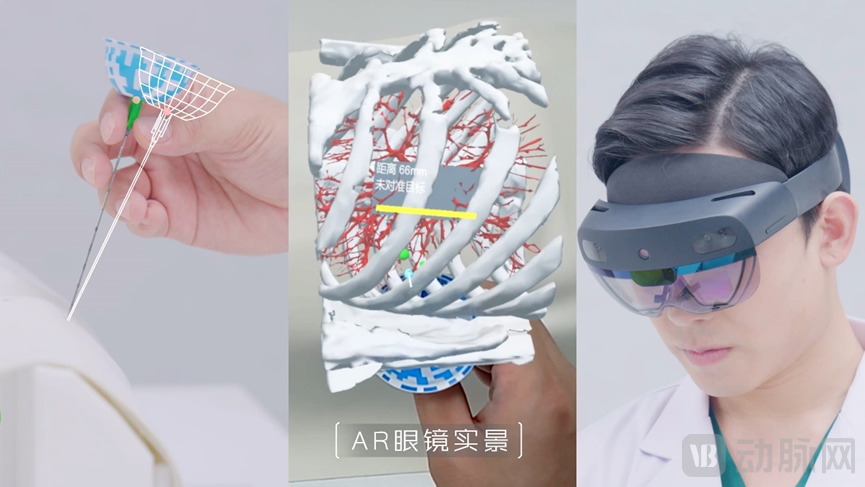
This product features the following characteristics:
1. Ultra-fast learning curve: With 2 hours of preoperative training and hands-on practice on no more than four cases, physicians can achieve proficiency in using the system. This technology is well-suited for young doctors to rapidly master and apply;
2. Short CT scan time: The system requires only a single non-contrast CT scan of less than 5 minutes to obtain the navigation and localization plan. Compared with traditional CT navigation or bronchoscopic navigation-guided procedures, which occupy equipment for 20 to 30 minutes and require corresponding procedural time from interventional physicians, this system is more suitable for adoption and promotion in primary care hospitals;
3. High positioning accuracy and short duration: The laboratory accuracy of the AR navigation-guided puncture localization system reaches 1.8 mm, which is comparable to or even superior to the 2–3 mm positioning accuracy of traditional systems based on fixed navigation equipment. Meanwhile, the average single-case localization time for AR navigation is 4.7 minutes, demonstrating a significant advantage over the 7.4–15 minutes required for other traditional localization surgeries;
4. The patient is free from distress: Under traditional CT-guided localization, patients must remain awake during needle placement for marker insertion and endure a waiting period of 1 to 10 hours before surgery. With AR-navigated intraoperative localization, physicians perform marker placement via needle puncture after the patient is under general anesthesia, followed immediately by thoracoscopic surgery. This approach significantly reduces patient discomfort, and postoperative satisfaction is generally higher than with traditional localization methods.
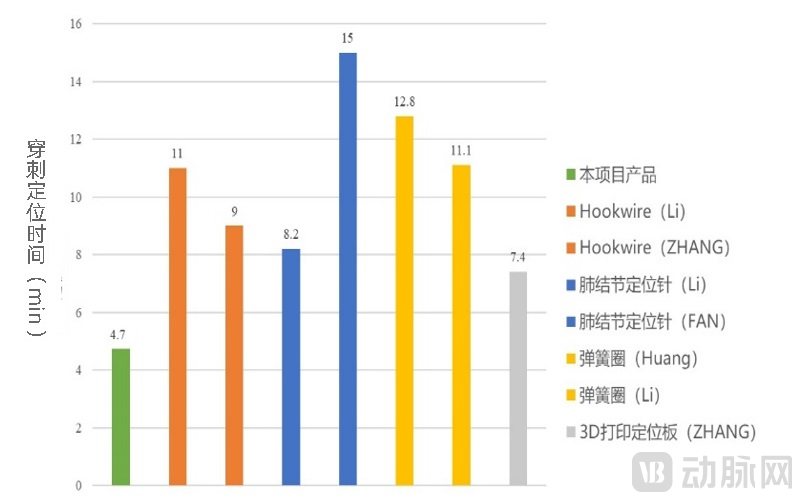
Time Comparison Between AR Navigation Puncture Positioning System and Other Positioning Methods
As of October 2022, the AR-guided navigation puncture localization system has completed patient enrollment for its multi-center registration clinical trials, with participating institutions including national medical centers, regional Grade A tertiary hospitals, and local tertiary hospitals. The system is currently under review by the National Medical Products Administration (NMPA), with regulatory approval and commercialization expected in 2024.
AR Navigation System for Puncture and Resection of Pulmonary Nodules
Pulmonary nodules are classified by size as follows: 1. Micronodules: diameter <5 mm; 2. Small nodules: diameter 5–10 mm; 3. Nodules: 10–30 mm. Based on nodule density, they are categorized as: 1. Solid nodules: the lesion completely obscures the lung parenchyma; 2. Part-solid (mixed) nodules: the lesion partially obscures the lung parenchyma; 3. Pure ground-glass nodules: the lesion does not obscure the lung parenchyma, and bronchi and blood vessels remain identifiable.
Pulmonary nodules are generally not treated with surgical resection when they lack obvious malignant imaging features, solid and part-solid nodules are less than 8 mm in diameter, and pure ground-glass nodules are less than 10 mm. This is because the majority of such nodules are indolent in the early stages and do not progress over a prolonged period. Meanwhile, existing surgical techniques cause significant damage to normal lung tissue, often leading to a marked decline in postoperative cardiopulmonary function. Therefore, physicians typically recommend regular follow-up to monitor changes in the nodules. Surgical intervention is usually advised only if progressive enlargement or imaging features suggestive of malignant progression are observed during follow-up.
JediCare’s vision is that in the near future, when physicians detect small pulmonary nodules in patients, they will no longer need to monitor and wait for the nodules to enlarge or become malignant before proceeding with surgical intervention; instead, a day surgery will suffice.Under brief anesthesia, guided by imaging and AR glasses, a 2–3 mm percutaneous incision is made to completely resect nodules measuring 8 mm or smaller., completely removing the "ticking time bomb" from the body.
In the field of colorectal neoplasms, similar surgical techniques for early intervention in early-stage lesions have been supported by evidence demonstrating patient benefits. According to data from the 2017 U.S. Cancer Statistics report,After 40 years of continuous colorectal cancer screening combined with polypectomy, the incidence of colorectal cancer decreased by 40%, and mortality decreased by 51%.。
Currently, JediCare’s pulmonary nodule puncture and resection system has completed long-term follow-up in animal studies and is poised to initiate the world’s first-in-human clinical trial.
“From an industry perspective, or in terms of overall medical demand, I am very confident in AR navigation technology itself. However, to enable this technology to realize its unique high accessibility in China, there needs to be disruptive, concentrated breakthroughs in a wider variety of minimally invasive treatment options,” said Sun Fei.
From product imitation to technological innovation, and then to the establishment of independent domestic brands, this is the development path of China’s medical device industry. Abroad, multiple AR-guided surgical navigation and positioning systems have received regulatory approval, such as Novarad’s VisAR spinal surgery navigation system, Augmedics’ xvision navigation system for thoracic, lumbar, and sacral spine surgeries, and Surgalign Holdings’ HOLO Portal spinal surgery navigation system.Notably, Augmedics closed an $82.5 million Series D financing round on June 27, bringing its total funding to $140 million, which underscores the significant clinical potential of this direction.。
In China, AR navigation technology is not as mature as it is abroad. There is still a long way to go from barely meeting the minimum standards to achieving technological maturity, successful commercialization, and gradual widespread adoption.
JediCare has made significant strides in the field of AR navigation technology, holding promise for delivering greater economic and social benefits to the Chinese market in the future. With controllable product costs, it aids the nation in achieving early diagnosis and treatment, thereby alleviating the burden of medical expenses and relieving cost pressures on grassroots hospitals, particularly township health centers and secondary and tertiary community hospitals. Furthermore, its products are easy to learn and use, making them suitable for young physicians and hospitals in resource-scarce regions, thus providing more survival opportunities for residents in remote areas of China.