

China's Largest Fitness Platform Keep Goes Public in Hong Kong with 2022 Revenue of RMB 2.21 Billion
After nine years of entrepreneurship and two previous filings of its prospectus, Keep officially launched its initial public offering (IPO) on the Hong Kong Stock Exchange today, with the stock code 3650. For this listing, Keep set the final offer price at HK$28.92 per share, raising approximately HK$192 million in net proceeds from the global offering.
As a star enterprise founded in 2014, Keep has attracted significant attention throughout its journey.On one hand, it is among the few companies that managed to break through the fierce competition of the internet startup boom and successfully go public. On the other hand, this venture, founded by entrepreneurs born in the 1990s, has attracted significant investment and support from numerous well-known institutional investors during its development.
According to Tianyancha, Keep had completed eight rounds of financing prior to its IPO, raising a total of over US$550 million (approximately RMB 3.47 billion). The investor roster included prominent firms and corporations such as GGV Capital, Source Code Capital, Tencent, Ventech China, SoftBank Vision Fund, Hillhouse Capital, Times Capital, and BAI Capital. Among these, GGV Capital, Source Code Capital, Tencent, and Times Capital participated in multiple financing rounds of Keep.
In terms of revenue, Keep also demonstrated strong profitability.According to the prospectus, Keep’s revenue has grown continuously since 2019, rising from RMB 663 million in 2019 to RMB 2.21 billion in 2022—a 2.4-fold increase—while its gross margin has remained consistently above 40%.
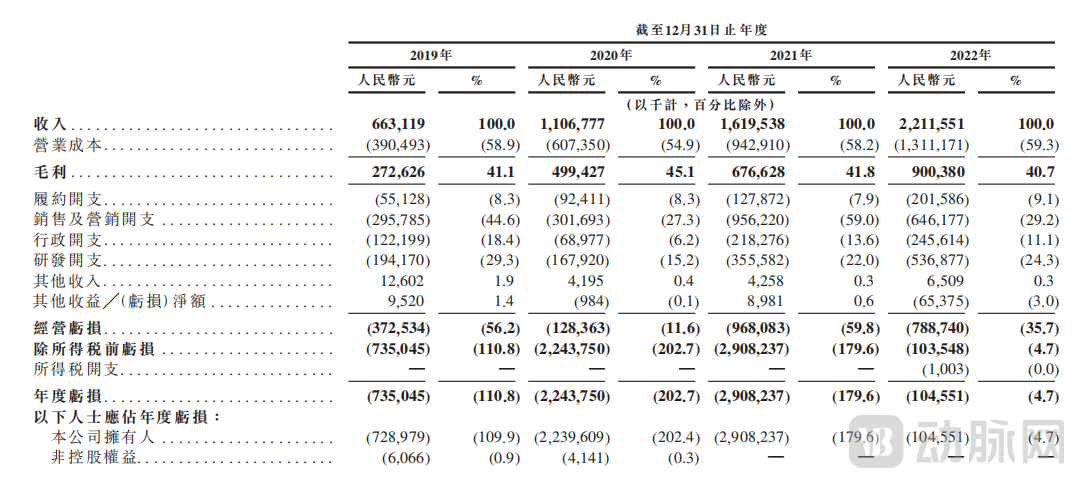
(Image source: Prospectus)
It is worth highlighting that the prospectus mentions,Based on monthly active users and the number of workouts completed by users in 2022, Keep is China's largest fitness platform.It is evident that Keep currently holds a leading position in the industry.
Of course, it cannot be ignored that,Keep’s Losses Continue. The prospectus shows that from 2019 to 2022, Keep's adjusted net losses were RMB 366 million, RMB 106 million, RMB 827 million, and RMB 667 million, respectively, with a total net loss of RMB 1.966 billion over the four-year period.
With revenue climbing steadily yet losses persisting, what exactly is Keep’s business logic? Can its IPO unlock greater growth potential? What challenges remain unresolved? And what implications does this hold for the sports and fitness industry? Drawing on Keep’s historical performance, strategic approaches, and data disclosed in its prospectus, this article attempts to analyze and answer these questions.
Post-90s Young Man Taps into the Sports and Fitness Market,
How Do the Three Core Businesses Build a Sports Ecosystem?
In 2014, the release of a policy document spurred the vigorous development of the sports and fitness industry.
In October of that year, the State Council issued the “Several Opinions on Accelerating the Development of the Sports Industry and Promoting Sports Consumption,” which set a goal to achieve “500 million people participating in sports and a sports industry output value of RMB 5 trillion” by 2025. This indicates that the sports and fitness market has received policy support and impetus.
At that time, Wang Ning, a post-90s graduate of Beijing Information Science and Technology University, decided to develop a mobile fitness app. He aimed to share his personal experience of successfully losing weight from 85 kg to 65 kg with a broader audience, thereby addressing the pain point of fragmented and disorganized online fitness information. In late 2014, he successfully launched Keep.
In an era with few comparable competitors, Keep became an instant hit upon its launch, garnering over one million users within just 105 days of going live.
Buoyed by impressive user growth and policy support, Keep quickly attracted numerous investment firms for due diligence, securing three rounds of funding totaling tens of millions of U.S. dollars within just one year.
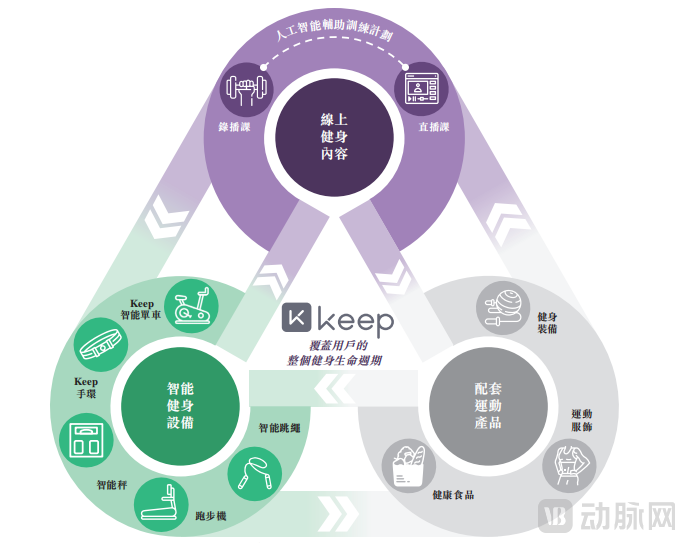
With ample “ammunition,” Keep has begun to continuously explore new pathways and pursue greater commercial possibilities.: from building user communities, refining fitness course systems, selling fitness equipment and food products, to paid knowledge services, and even digital pharmaceutical marketing,Keep has gradually established three major business systems.
As of the IPO, the three major business segments were online fitness content, smart fitness equipment, and complementary sports products, which together constitute Keep’s comprehensive fitness solution.
(Image source: Prospectus)
From Keep’s perspective, its three business lines are mutually reinforcing. Keep boosts user engagement by motivating users to maintain regular exercise routines. In this process, users utilize Keep’s content products for guided workouts and may convert into subscribed members, while also being encouraged to purchase Keep’s proprietary branded sports products (such as fitness equipment, apparel, and food). These branded products, in turn, have the potential to drive traffic back to Keep’s online fitness content.
So, what is the actual situation? The answer lies in the financial data.
According to the prospectus, Keep categorizes its revenue into three major business segments. Proprietary branded fitness products account for the largest share of total revenue at 51.4%; membership subscriptions and online paid content rank second, contributing 40.4%; while advertising and other services represent the smallest portion, at 8.2%.
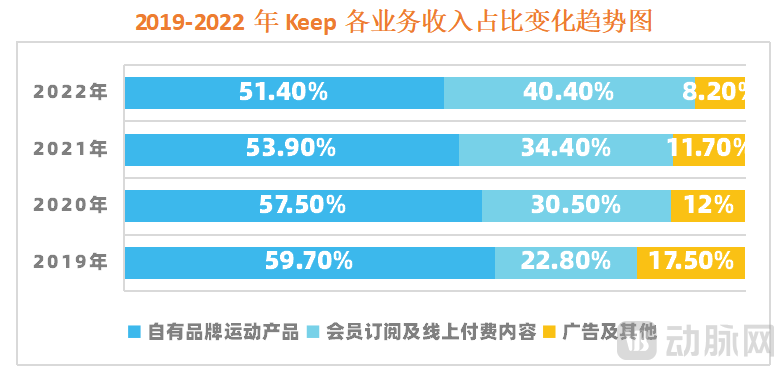
(Data source: Prospectus; Graphic by VCBeat)
As can be seen, sales of Keep’s proprietary-brand fitness products account for half of its revenue:“Product sales” is undoubtedly a key pillar of its revenue.
Upon closer examination, among the top ten major sports products disclosed, small items contributed significantly to revenue. The prospectus shows that the highest-revenue product in 2022 was the Keep Band B3, with sales approaching RMB 100 million. In addition, low-priced items such as smart scales, fitness mats, and counting jump ropes, with unit prices ranging from tens to just over one hundred yuan, also generated tens of millions of yuan in revenue.
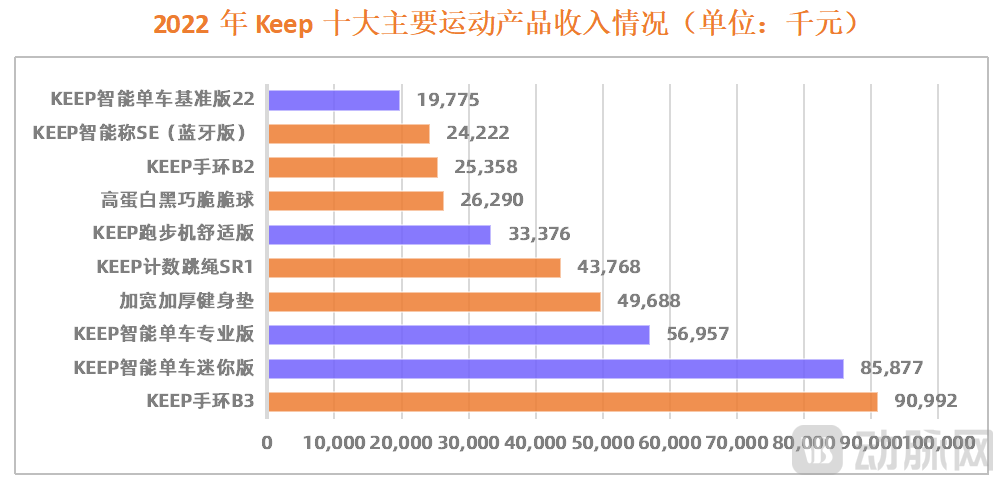
(Data source: Prospectus; Chart by VCBeat)
Public information indicates that Keep adopts an OEM model for its private-label sports products, with sales channels encompassing both direct-to-consumer (DTC) and wholesale. The DTC channel includes leading e-commerce platforms, such as the JD.com and Tmall flagship stores, as well as Keep’s self-operated online store; the wholesale channel also includes partners like JD.com. This demonstrates that Keep relies heavily on the conversion of online traffic.
In terms of membership subscriptions and online paid content, Keep primarily focuses on producing recorded and live classes, both of which are developed in-house or created by third parties (such as influencers and other fitness content providers). According to the prospectus, Keep has accumulated over 20,000 recorded courses, covering a wide range of exercise categories including fitness, yoga, running, meditation, and dance.
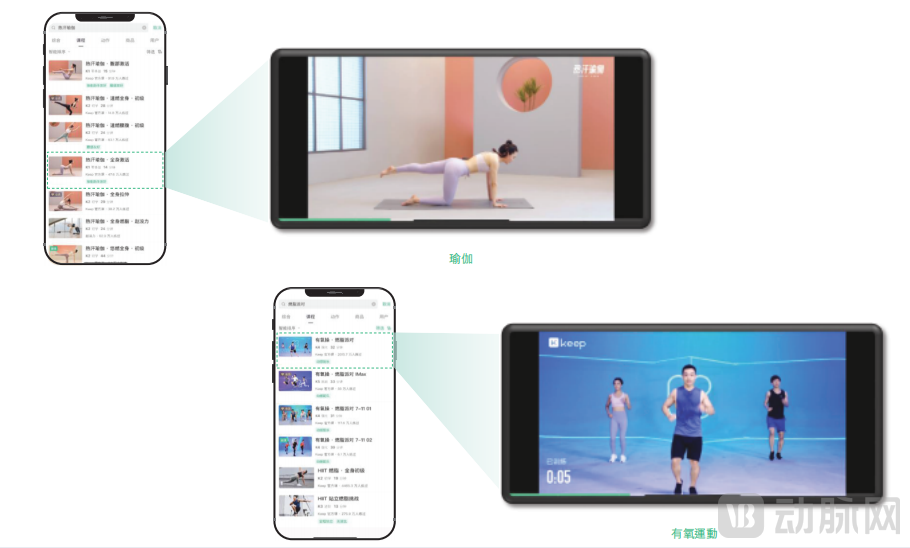
(Recorded courses on the Keep platform; image source: prospectus)
To ensure the professionalism of its course content, Keep conducts comprehensive research on in-house developed courses, covering aspects such as movement design and audiovisual presentation, enabling users to achieve fitness results progressively. Building on this foundation, Keep has established its own intellectual property (IP) and developed proprietary IP-based courses, such as “Elegant Ballet” and “Fat-Burning Party,” thereby enhancing user stickiness.
However, this is not enough. To enhance content diversity, Keep has continuously collaborated with PUGC creators and brand agencies, building an open platform to attract internationally renowned fitness IPs such as Pamela Reif and Zoey (Zhou Liuye), thereby meeting users’ diverse needs.
It can be said that the establishment of super IPs has provided Keep with a solid commercial moat, enabling it to move towards a more comprehensive sports and fitness ecosystem with IP at its core.
Currently, the membership penetration rate on the Keep platform has grown steadily, rising from 6.4% in 2020 to 9.5% in 2021, and further increasing to 10.0% in 2022.
Advertising and other services are primarily targeted at B-side brand partners, reflecting the traditional internet approach to monetizing traffic.
Logically speaking, membership subscriptions and online paid content serve primarily as customer acquisition products targeting fitness enthusiasts. These asset-light offerings boast high user stickiness. Leveraging this traffic base, Keep can provide advertising and other services to B-side brand partners, while its proprietary brand products deliver in-depth services to core user segments, thereby expanding revenue potential and broadening commercial boundaries.
In other words, during its business development, Keep abandoned the ad-dependent business model typical of internet fitness tools, and gradually shifted toward a platform or consumer brand strategy with greater growth potential. Financial data has also validated the feasibility of this approach.
Of course, following today’s IPO, Keep urgently needs to narrow its losses and validate its profitability model to instill greater confidence in the capital markets.
As the first sports and fitness company to go public, Keep outlined its future strategic directions in its prospectus.
For instance, Keep will continue to roll out more fitness categories and hardware devices, while seeking synergy between courses and equipment to enhance course interactivity, improve the online experience, and drive hardware product sales.
Furthermore, starting from 2019,Keep is also striving to cultivate a community atmosphere, aiming to transform its image from a tool-based platform into a community-driven one, thereby creating more opportunities for monetization.
In terms of social engagement, the most popular item has been the Keep medals that previously went viral on social media platforms. These are completion medals for virtual sports events within the Keep app, typically priced at 39 yuan. Upon their release, they sparked widespread discussion on platforms such as Xiaohongshu (Little Red Book) and Douyin (TikTok).

(Discussions about Keep medals on platforms such as Xiaohongshu and Douyin. Screenshot from VCBeat.)
According to Keep’s official statement, online virtual races are typically running events covering distances of up to 5 kilometers. These events feature extended participation periods and low pace requirements, thereby lowering the barrier to entry. Meanwhile, the introduction of physical medals has enhanced the social appeal of virtual races.
How Lucrative Are Medals? Official statistics from Keep show that the "Cinnamoroll Cloud Run" event attracted over 400,000 paying users. Among them, more than 200,000 newly registered users viewed the Cinnamoroll page and signed up within 10 minutes, with over 100,000 becoming paying customers. Based on these figures and a price of 39 yuan per medal, this online running event generated 15.6 million yuan in revenue for Keep.
Leveraging the viral popularity of its medals, Keep has attracted more college students, white-collar workers, and trendy toy enthusiasts, while also boosting its membership conversion rate. According to the prospectus, during the eight-month period comprising the fourth quarter of 2021 and the first five months of 2022, the number of paying users participating in Keep’s virtual events exceeded 1.1 million, with a total gross merchandise volume (GMV) surpassing RMB 50 million. This achievement mirrors the success of Pop Mart’s blind boxes, leading many to believe that Keep has tapped into its second growth curve.
But in fact,Emphasizing social stickiness and building shared beliefs have always been Keep’s strengths.In the early stages of Keep’s startup journey, as its user base surged, Wang Ning realized that fitness content constituted only a soft barrier. This did not create a differentiated perception among users regarding Keep compared to other information providers such as Baidu, Zhihu, or fitness forums. Consequently, Wang Ning re-evaluated user needs and redefined Keep’s brand image.
A typical example is that, after accumulating 30 million users, Keep produced an advertising campaign and introduced the iconic slogan, “Self-discipline gives me freedom.” For a time, through extensive advertising promotion, “Self-discipline gives me freedom” became a motto or catchphrase for many fitness enthusiasts, thereby solidifying users’ brand perception of Keep.
This is not a sustainable long-term strategy. After all, the hype surrounding medals is only temporary; as user enthusiasm wanes, the social and emotional value derived from these medals will rapidly decline, eventually returning to normal levels.
Therefore, how to enhance community stickiness and deliver greater added value to users will remain one of the key challenges Keep needs to address in the foreseeable future.
The sports and fitness market was once a sector at the “eye of the storm.”
For instance, around 2015, in addition to Keep securing funding for its IPO, nearly 40 companies such as Joyrun, Codoon Sports, Quan Cheng Re Lian, and Jianmeile successively closed multiple rounds of financing. Well-known enterprises and investment firms, including Tencent, Qihoo 360, SoftBank China, Hillhouse Capital, and SIG Asia Investments, competed to enter the market.
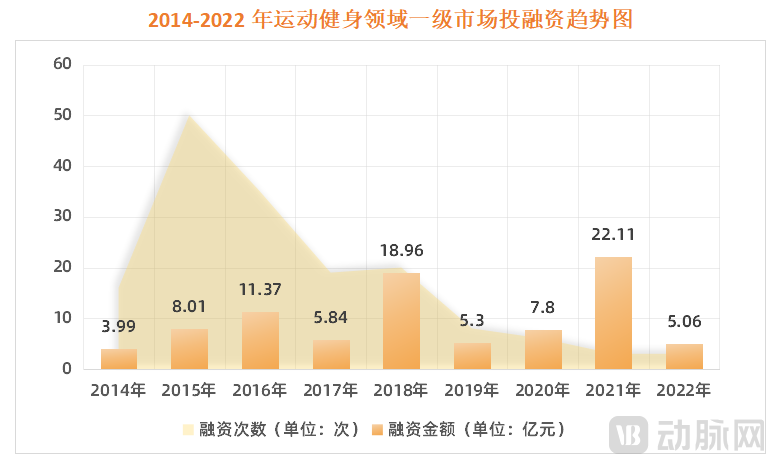
(Data source: Artery Orange Database; Chart by VCBeat)
After the fierce competition among numerous players, by 2020, a large number of companies in the market gradually disappeared as the industry tide receded. On one hand, leading enterprises had emerged and captured significant market share, resulting in market saturation and the manifestation of the Matthew effect. On the other hand, the financing boom cooled down, with capital concentrating on top-tier companies, making it increasingly difficult for newly established enterprises to secure funding.At this juncture, the industry’s critical point has shifted from barbaric growth and land-grabbing to a phase of rapid commercialization and monetization.
From Keep's current achievements, commercialization has been realized, but profitability needs to be improved.
It is worth mentioning Peloton, the benchmark company for Keep. After its stock price surged in the early stages of the COVID-19 pandemic, Peloton’s market capitalization has fallen from a high of over $50 billion to approximately $9 billion currently, representing a decline of more than 80%. The core reason behind this drop is that Peloton has yet to make substantial progress toward profitability. According to Peloton’s financial report for the third quarter of fiscal year 2023, its net loss for the fourth quarter reached $275.9 million, indicating significant pressure on profitability.
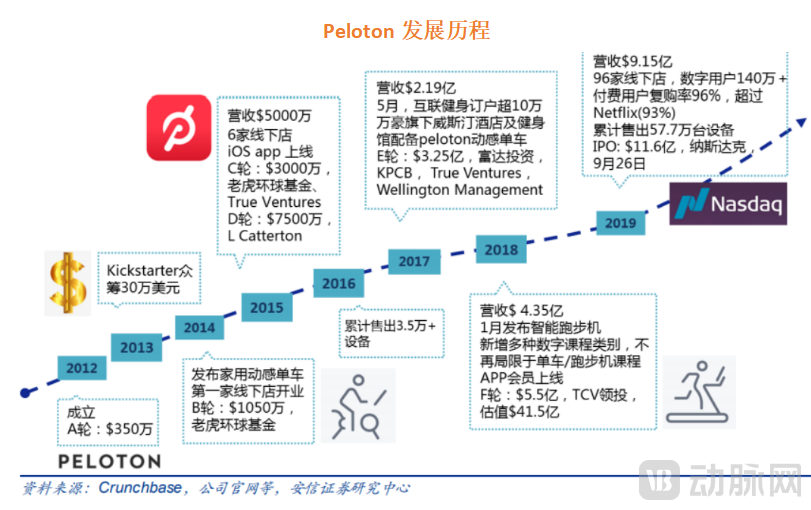
(Image source: Essence Securities)
It is not difficult to see that the two internet fitness giants in China and the United States are facing similar problems.
Certainly, from a longer-term perspective, fitness and exercise remain a vast market. According to a report by Frost & Sullivan, China had 374 million fitness participants in 2022, ranking first globally, and this figure is projected to reach 464 million by 2027. However, the average annual spending per fitness participant in China was RMB 2,518.3 in 2022, significantly lower than the $16,425 per person in the United States, indicating substantial growth potential.
Opportunities are vast, but how should the industry choose the right path? The answer lies in understanding user needs.
According to the "2022 China Fitness Industry Data Report,"Three Major Trends in the Demand Side of the Current Sports and Fitness Industry
First, women have become the main force in the fitness consumption market.Surveys indicate that in 2022, female fitness consumers accounted for 61.93% of the market, marking a rapid increase from 2021 and widening the gap between female and male participation in the fitness consumption sector. In terms of expenditure, women’s spending on fitness services and related products exceeding RMB 10,000 was higher than that of men in 2022. This suggests that further exploring and meeting the exercise and fitness needs of female users will become a key growth driver for relevant businesses in the future.
Second, individuals born in the 1980s and 1990s constitute the largest consumer group for sports and fitness.In terms of age structure, the largest sports consumption group is young people aged 26-35, accounting for more than 40%, followed by the groups aged 36-50 and 19-25. For industry enterprises, gaining insight into the consumption tendencies of the younger generations born in the 1980s and 1990s, such as home fitness scenarios, may reveal new commercialization opportunities.
Third, tier-1 and new tier-1 cities are the primary hubs for fitness consumers.Based on data from cities across China, Shanghai leads significantly in the number of fitness consumers, accounting for 19.63% of the total. It is followed by Beijing, Chongqing, Tianjin, Guangzhou, and Shenzhen, which together account for 50% of the total. In terms of fitness expenditure, Shanghai and Beijing demonstrate the strongest spending power; their share of consumption in the RMB 5,000–10,000 range is, on average, 3.7 percentage points higher than the national average.
Furthermore, as public awareness of exercise and fitness continues to rise, the industry will witness an increasingly pronounced trend toward segmentation.
Companies that excel at identifying trends and continuously creating greater value for users will ultimately secure more opportunities for growth.