

RadynHealth Advances as a Global Leader in AI-Powered Medical Imaging Reconstruction with Breakthrough Domestic Innovations
In June 2022, the National Health Commission formulated the Interim Provisions on Outpatient Quality Management in Medical Institutions, which states: “Medical institutions shall improve the operational efficiency of medical technology departments, shorten the appointment waiting time for examinations such as CT and MRI, and issue examination reports within the prescribed time limits.”
Per capita ownership of large-scale medical imaging equipment (such as MR, PET, SPECT, and CT) in China is relatively low, amounting to only a fraction of that in developed countries like Japan and the United States. Meanwhile, radiology departments in most tertiary hospitals face significant pressure to reduce costs and improve efficiency, with an urgent need to shorten appointment wait times for outpatient imaging examinations. However, achieving these goals is no easy feat given the continuous growth in outpatient volume and limited equipment resources.
Leveraging artificial intelligence (AI) is likely the most effective approach to breaking through this bottleneck. Currently, Yingdong Medical has deployed its domestically developed AI-based reconstruction and enhancement systems at top-tier tertiary hospitals in China, including Peking Union Medical College Hospital, Peking University Third Hospital, and The First Affiliated Hospital of Zhengzhou University. These systems aim to improve the efficiency and quality of magnetic resonance imaging (MRI) and positron emission tomography (PET) scans, reduce potential radiation risks associated with imaging examinations, and enable hospitals to perform more examinations within the same timeframe.
"The director of the radiology department at a Grade 3A hospital provided us with feedback, stating: 'The equipment from Yingdong Medical not only shortens imaging examination time but also maintains or even enhances the original image quality, which is precisely what we need most.'"
Recently, Shadow Medical achieved a milestone in its deployment of AI-powered medical image reconstruction and enhancement products. The company’s self-developed AI-based solutions for CT and SPECT, RaDynCT and RaDynSPECT, have successfully obtained registration approval from the National Medical Products Administration (NMPA). Following the approval of RaDynMR and RaDynPET in 2022, Shadow Medical now holds more than four registration certificates, marking it as the manufacturer with the largest number of approved registrations and the broadest coverage of niche markets globally in this field. Notably, its ultra-high-resolution enhancement technology for CT and ultra-fast scanning enhancement technology for SPECT are internationally pioneering, surpassing industry giants such as GPSU.
Since its establishment in 2020, Yingdong Medical’s products have received repeated industry recognition. The recent certification of the RaDynCT and RaDynSPECT products underscores the company’s strong momentum in continuously advancing its product pipeline and enriching its strategic portfolio in related fields. Prior to the commercial translation of these technologies, Yingdong Medical had already collaborated with top-tier domestic specialized hospitals, such as Shanghai Changzheng Hospital and Shanghai Dongfang Hospital, published multiple technical and clinical papers in prominent international academic journals, and secured several domestic and international PCT patents. These achievements signify that Chinese-made AI-powered medical image reconstruction and enhancement devices are gradually achieving pioneering status and global leadership.
RaDynCT is designed to provide hospitals and third-party imaging centers with image enhancement solutions for high-quality, low-radiation CT. Leveraging image reconstruction enhancement technology, RaDynCT significantly improves the spatial resolution of CT imaging data while reducing image noise and ionizing radiation, thereby enhancing patient safety during examinations. Collaborative achievements between Yingdong Medical and Shanghai Changzheng Hospital have been published in *Medical Physics* and the *Chinese Journal of Computerized Tomography*.
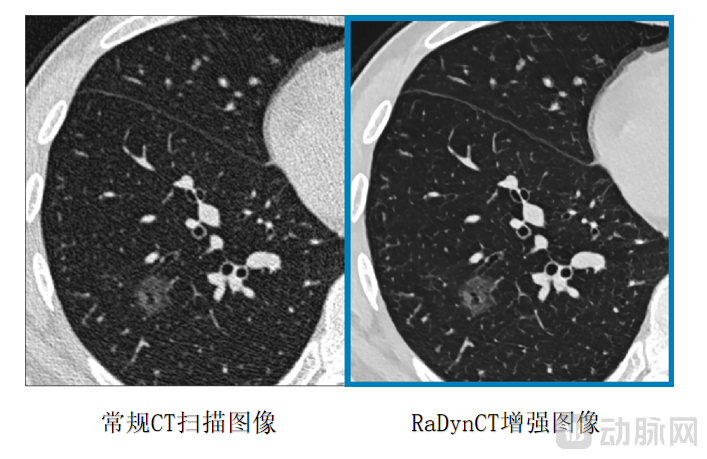 RaDynCT Super-Resolution Enhancement Comparison Chart
RaDynSPECT is the world’s first SPECT image reconstruction and enhancement software based on deep learning technology. It aims to provide hospitals and third-party imaging centers with rapid, low-dose SPECT image enhancement solutions, enabling cost-effective equipment upgrades. By integrating deep learning with image enhancement techniques, RaDynSPECT improves SPECT acquisition efficiency while maintaining image quality, significantly reducing tracer-related risks. For instance, it can shorten bone tomographic imaging from 20 minutes to just 3 minutes. Collaborative research outcomes between Yingdong Medical and Shanghai East Hospital have been published in *EJNMMI Physics* and *Physics in Medicine & Biology*.
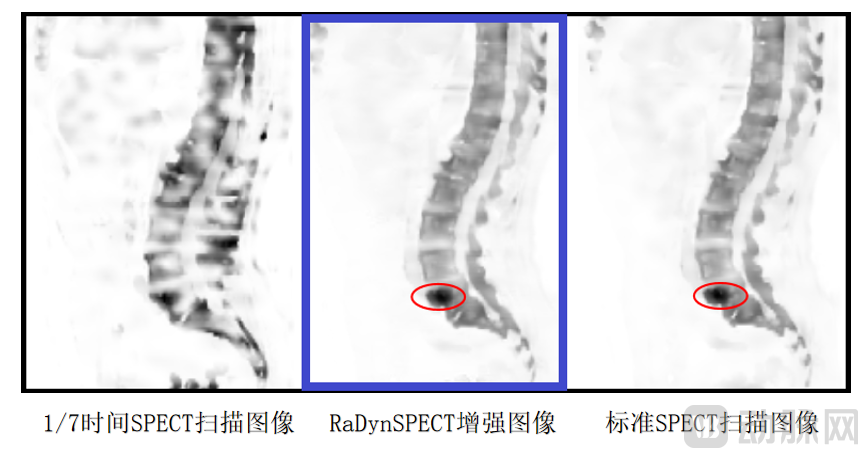 RaDynSPECT Accelerated Scan Contrast-Enhanced Image
RaDynPET leverages vast amounts of high-quality clinical data and deep learning technologies to provide hospitals and third-party imaging centers with image enhancement solutions for rapid, low-dose PET scanning. This approach improves imaging efficiency and reduces tracer-related risks while ensuring image quality. Relevant achievements by Yingdong Medical and its partner hospitals have been published in the Journal of Nuclear Medicine (SNMMI).
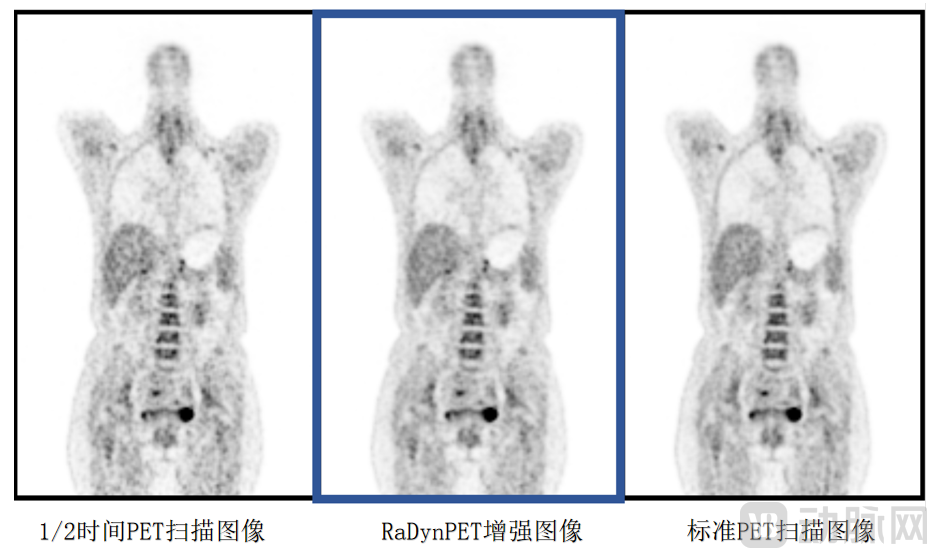 RaDynPET Accelerated Scan Enhanced Contrast Image
RaDynMR is a product under Yingdong Medical, specifically developed for clinical MRI imaging. Leveraging Yingdong Medical’s deep learning and image reconstruction enhancement technologies, it employs algorithms that reduce image noise and improve resolution. This ensures diagnostic-quality images while significantly accelerating MRI scan speeds, thereby increasing patient throughput by 30%–50%.
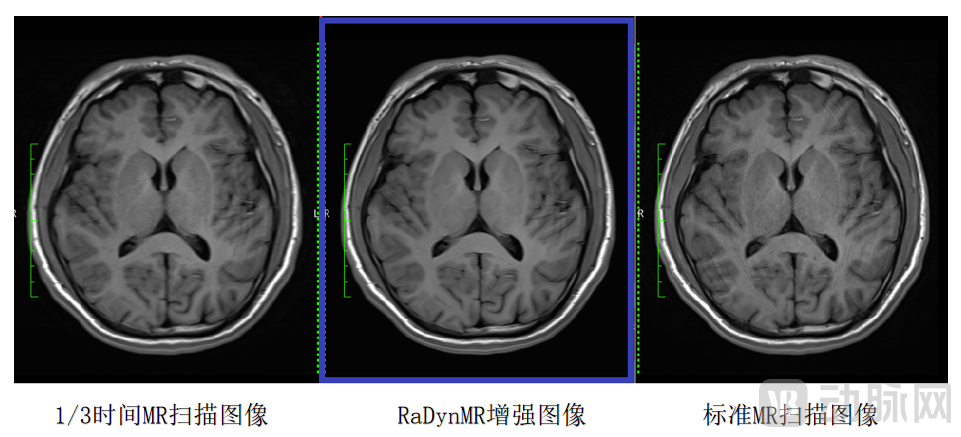 RaDynMR Accelerated Scan Enhancement Contrast Map
About Yingdong Medical
Yingdong Medical was founded by Dr. Gong Nanjie in 2020 and incubated by the Tsinghua Strait Research Institute. Its core expert team hails from renowned domestic and international institutions, including Tsinghua University, Peking University, Stanford University, and the University of California, Berkeley.
Yingdong Medical leverages AI medical imaging, combined with deep learning and image reconstruction enhancement technologies, to optimize medical image quality and diagnostic workflows. It transforms time-consuming, low-quality, and high-risk (high radiation dose) medical imaging examinations into processes that are more efficient, higher in quality, and safer, thereby creating cost-effective and efficiency-enhancing AI medical imaging solutions.
The company’s independently developed imaging reconstruction and enhancement software products—RaDynMR, RaDynPET, RaDynSPECT, and RaDynCT—have all been launched and deployed in major hospitals and health examination centers for clinical use and business collaboration. The company has obtained more than 20 domestic patents (with additional applications pending), secured multiple PCT international patents, and registered numerous software copyrights. In collaboration with Shanghai Changhai Hospital, Shanghai Changzheng Hospital, and Shanghai Oriental Hospital, the company has published multiple international academic papers; its related technologies are pioneering in China and leading globally. Yingdong Medical has received numerous honors, including the First Prize in the Artificial Intelligence Category at the 3rd China Medical Device Innovation and Entrepreneurship Competition in 2020, and a Top 10 finish in the Global Finals of the 7th Tsinghua Alumni Triple-Competition (Healthcare Sector).
The company’s team has established cutting-edge collaborations with dozens of leading hospitals, third-party imaging centers, and prominent industry enterprises worldwide, successfully achieving commercial implementation. Domestic partners include Peking Union Medical College Hospital, Peking University Third Hospital, Shanghai Changzheng Hospital, Shanghai Changhai Hospital, and Shanghai Oriental Hospital. Furthermore, the company engages in joint technology development with upstream and downstream enterprises such as Yiyi Medical, Kaiying Medical, and Regato Medical.