

Traditional Chinese Medicine Production-Sales Consortium Launches 'Three Transparencies' Initiative to Ensure Direct Supply and Combat Price Surges
Since the beginning of this year, the price index for traditional Chinese medicinal (TCM) materials has repeatedly hit record highs. An unusual phenomenon of “strong demand during the off-season” has emerged in summer, with prices for many TCM herbs fluctuating significantly within a single day and continually breaking through previous price ceilings. The widespread surge in TCM material prices has increased the financial burden on patients; some have found that the cost of their prescriptions has risen by 50% compared to pre-hike levels, while others have seen increases of up to two-thirds. Additionally, some patients have encountered difficulties in obtaining necessary medicinal ingredients. Industry analysis points out that a major driver of this round of price increases is speculative hoarding, which has exacerbated supply-demand imbalances and diverted TCM materials from their fundamental purpose of treating diseases and saving lives.
In response to the current challenges, various stakeholders in the traditional Chinese medicine (TCM) industry have proactively launched and organized initiatives and actions to curb unreasonable price hikes and safeguard the healthy development of the sector. Recently, the China Association of Traditional Chinese Medicine called on the industry to procure TCM raw materials in a scientific and rational manner, overcome pressures to ensure drug supply throughout the procurement cycle, encourage direct docking between production and sales, and minimize speculative intermediaries. Subsequently, the Shandong Internet Traditional Chinese Medicine (Herbal Materials) Trading Center (hereinafter referred to as the “TCM Trading Center”) responded swiftly by issuing the “Initiative on Promoting ‘Direct Supply and Direct Sales’ of TCM Herbal Materials and Decoction Pieces to Curb Unreasonable Price Increases” (hereinafter referred to as the “Initiative”), and launching the “TCM Production and Sales Consortium Action” to guarantee the direct supply and sales of TCM herbal materials and decoction pieces.
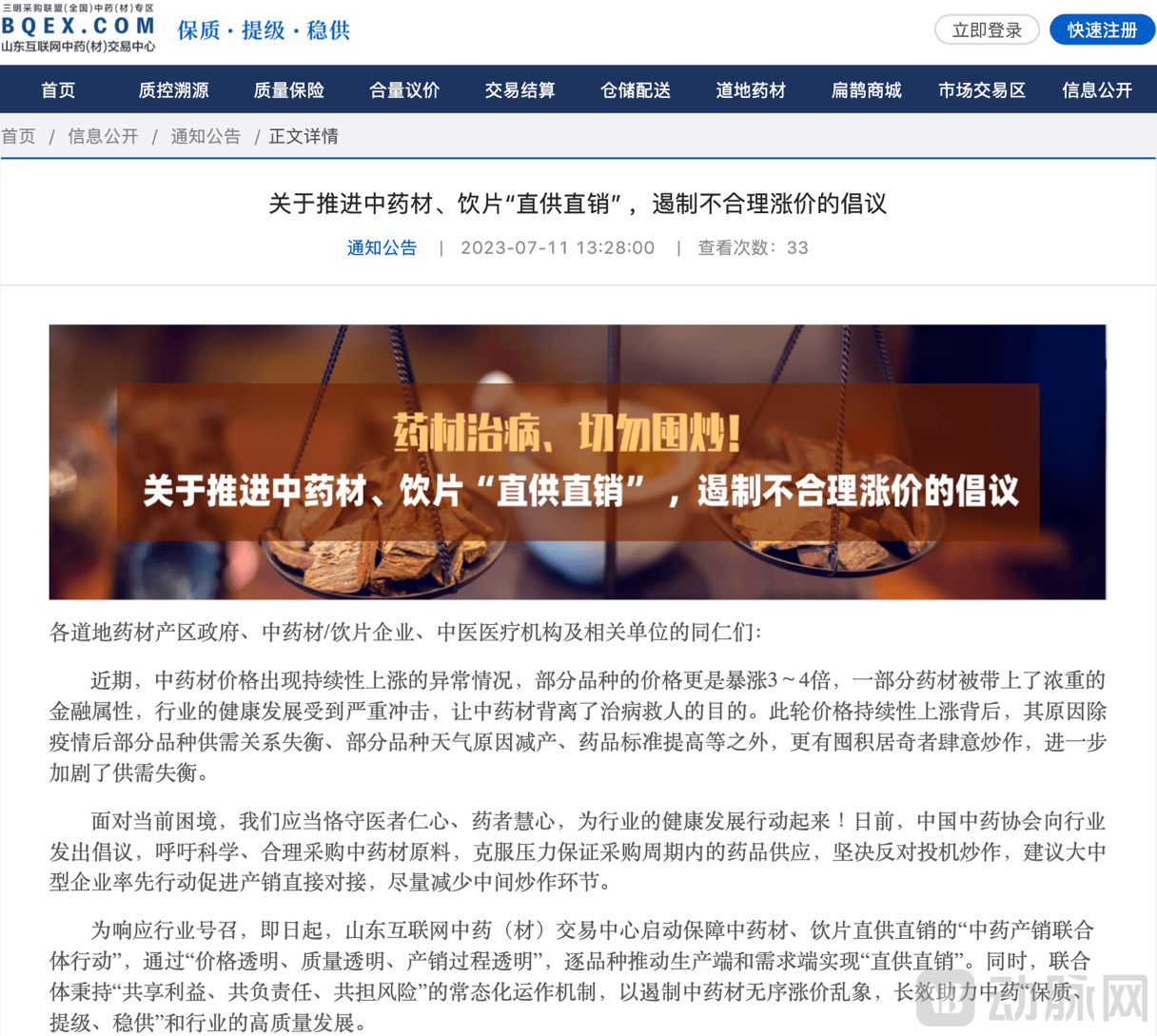
Figure | Shandong Internet Traditional Chinese Medicine (Herbal Materials) Trading Center Launches “TCM Production and Marketing Consortium Initiative”
Under the initiative, the “Traditional Chinese Medicine (TCM) Production and Sales Consortium” will leverage the digital platform advantages of the TCM Trading Center to establish a “Triple Transparency” system characterized by transparent pricing, quality, and production-sales processes. This system will effectively ensure the direct supply and sales of TCM medicinal materials and decoction pieces, eliminating multi-layered markups typical of traditional market transactions and curbing hoarding and speculative trading. Meanwhile, the consortium will adhere to a normalized operational mechanism based on “shared benefits, shared responsibilities, and shared risks,” aiming to curb disorderly price hikes in TCM medicinal materials and provide long-term support for stable pricing, stable supply, and quality assurance of TCM (medicinal materials), thereby promoting high-quality industry development.
It is understood that the Traditional Chinese Medicine (TCM) Trading Center has co-established a digital management platform with production-side stakeholders, covering all stages of the entire process. This platform ensures full-process traceability for authentic TCM materials and adopts a “transparent cost method” to make costs at each stage clearly visible, thereby achieving price transparency and quality transparency in the trading of TCM materials and prepared slices. Leveraging the advantages of its digital platform, the Trading Center has also established big data monitoring and early-warning mechanisms. These provide data support for planting and production as well as for procurement by medical institutions, while facilitating supply-demand matching and transaction services through a “direct supply and direct sales” model, thus realizing transparency throughout the production and sales process.
The sustained surge in prices of traditional Chinese medicinal (TCM) materials has not only raised concerns about the high cost of medication for patients but also plunged the industry into a severe crisis. Experts point out that if TCM loses its advantages of being “simple, convenient, effective, and affordable,” patients’ willingness to choose TCM therapies and remedies will inevitably decline, thereby weakening the momentum for the industry’s overall development. Meanwhile, hoarding and speculative trading have severely hindered the circulation of TCM materials, leading to a persistent situation where prices are quoted but transactions are scarce, significantly impeding inventory digestion. On the upstream side, growers generally focus solely on planting profits while ignoring existing market stockpiles. Under blind expansion of cultivation, categories with currently soaring prices will likely experience another surge in production, potentially causing a cliff-like drop in prices for these varieties in the future. All these factors pose serious challenges to the inheritance, innovation, and revitalization of Traditional Chinese Medicine in China.
Analysis data from the Traditional Chinese Medicine Trading Center shows that by the end of June 2023, the Comprehensive 200 Index for Chinese Medicinal Materials reached 3,574 points, representing a 26.18% increase compared to 2,832.48 points in January 2023. Specifically, the growth rates in the first and second quarters of 2023 were 7.23% and 17.68%, respectively, indicating sustained strong momentum.
Abnormal surges and declines in the prices of Chinese herbal medicines will cause long-term harm to the industry. The “Chinese Medicine Production and Sales Consortium Initiative” launched by the Chinese Medicine Trading Center is regarded by the industry as an effective model to combat hoarding and speculation, which will effectively address the issue of skyrocketing prices and help “cool down” the current disorderly price hikes in the Chinese herbal medicine market.
As the initiator of the “Traditional Chinese Medicine (TCM) Production and Sales Consortium Initiative,” the TCM Trading Center previously provided service support for China’s first joint procurement of TCM decoction pieces. This joint procurement was regarded by the industry as “the most challenging in terms of scheme design and operational complexity within the pharmaceutical sector, specifically for TCM decoction pieces.” It attracted 328 decoction piece manufacturers, with 100 companies ultimately selected, achieving an average price reduction of 29.5%. The center has established five core systems—“quality control and traceability, quality insurance, volume-based price negotiation, transaction settlement, and quality-assured warehousing”—which effectively address pain points such as low efficiency and difficult traceability in traditional TCM transactions, while also establishing a guarantee system that ensures “premium quality at premium prices.”
According to the initiative, the “Action Plan for the Consortium of Traditional Chinese Medicine (TCM) Production and Distribution” involves all segments of the industry chain, including governments of authentic TCM herb-producing regions, TCM herb/decoction piece enterprises, and TCM medical institutions. For each participating entity, the initiative calls on governments of authentic TCM herb-producing regions to actively organize and guide enterprises and farmers in establishing modernized planting bases, thereby enhancing standardized cultivation and supply guarantee capabilities in these regions. It urges medical institutions across provinces and municipalities to actively join the Sanming Procurement Alliance’s Inter-Provincial TCM (Herb) Procurement Alliance, sharing the “high quality at reasonable prices” supply capacity achieved through national centralized procurement of TCM decoction pieces. Furthermore, it encourages TCM decoction piece manufacturers, TCM product manufacturers, medical institutions, pharmacies, and other entities to join the consortium, enabling direct procurement and supply from authentic producing regions, thereby resisting manipulation by market speculators.