

Muxin Tech Files IPO Prospectus: Pioneering Domestic Medical-Grade Hearing Aid Chips to Break Foreign Monopoly
“The biggest pain point for domestic hearing aid manufacturers in China is that their high-end products are unable to challenge the ‘Big Five,’ while their mass-market products lack available chips.”
Shenzhen Muxin Technology Co., Ltd. (hereinafter referred to as“Muxin Technology” COO Xi Jinmiao sharply pointed out the current predicament of domestically produced hearing aids, which is entirely due to a tiny chip inside the hearing aid.
Despite the emergence of countless domestic hearing aid manufacturers in recent years, striving to break through the monopoly of the “Big Five” and provide high-quality, cost-effective hearing aids for Chinese consumers, the first major obstacle facing these companies is the “chip.” As the critical component of hearing aids, the chip not only enables algorithm integration and secondary development but also directly determines product sound quality, power consumption, and cost.
Looking at the global hearing aid industry, leading brands worldwide independently develop and design their own hearing aid chips. Due to a later start, domestic hearing aid manufacturers in China mainly rely on chip supplies from companies such as Onsemi and IntriCon in the United States. As the maturity and penetration rate of China’s hearing aid market still lag behind those overseas, foreign brands have limited resource allocation for the Chinese market; consequently, some long-standing products with relatively high power consumption continue to be sold in China.
Breakthroughs in chip technology not only enhance companies’ resilience to risks but also serve as a key factor in breaking the current monopoly, supporting future hearing aid development, and reducing hearing aid costs.
Currently, few companies in China possess the capability for independent chip manufacturing, and those specializing in medical chip development are even rarer.Muxin Technology, established in 2020, is one such rising “chip” star.
Muxin Technology is a high-tech enterprise dedicated to the development, manufacturing, and sales of specialized chips for healthcare and medical applications. The company focuses on the R&D of high-performance ICs, software algorithm design, and ultra-low-power system integration. Its team members possess extensive experience in semiconductor chip design and development, as well as related marketing and management.
According to Xi Jinmiao, COO of Muxin Technology, the chips used in current high-end domestically produced hearing aids mainly rely on Onsemi, while low-end analog hearing aids adopt a solution comprising “analog PA + MCU + LDOs + MOS.” Due to the lack of hearing protection features, prolonged use by wearers not only fails to safeguard their hearing but may also cause hearing damage.
As hearing aids gradually become a new essential need, the market has raised higher requirements for them, such as more refined and compact designs, convenient online fitting, and natural and comfortable sound perception. Correspondingly, this has also brought many severe challenges to technology, such as ultra-low power consumption, extremely small size, various forms and application circuits, and mixed-signal processing.
After years of dedicated research and overcoming significant challenges, Muxin Technology has developedMA1180: A Professional Medical-Grade Single-Chip Hearing Aid for the High-End Product MarketandMT2110: A Single-Chip Digital Entry-Level Hearing Aid for the Mass Consumer Market
Woodcore MA1180 Chip: China’s First Smart Digital Hearing Aid Chip with Power Consumption Under 1 mW
The MuXin MA1180 is a professional medical-grade single-chip hearing aid designed for the high-end product market, providing SIP chip solutions for OTC devices, professionally fitted medical-grade hearing aids, non-fitted hearing aids, and hearable headphone products.
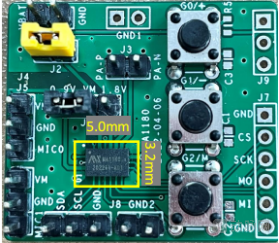
MuXin MA1180, SIP System-on-Chip, Ultra-Small Chip Size
The MuXin MA1180 features ultra-low power consumption with an operating current of <0.4mA@1.4V (whereas industry-leading professional hearing aids typically consume around 1mA@1.4V), enabling over a week of battery life, making it the digital hearing aid IC with the lowest power consumption in the industry to date. It adopts a SIP single-chip design with a latency of <5.0ms and chip dimensions of 5.00mm x 3.20mm x 1mm. The overall weight of the chip is less than 1g. With 32K wideband audio sampling, it ensures high-fidelity sound quality.Features ultra-low power consumption, ultra-compact size, ultra-low latency, wideband high-definition audio quality, and high cost-effectiveness.
Regarding the algorithmic component, the Muxin MA1180 comprises five core algorithm modules: beamforming, adaptive noise suppression, multi-channel dynamic noise compression/expansion, frequency adjustment, and feedback suppression.
MuXin MT2110 Chip: A Cost-Effective Digital Hearing Aid Chip, Single-Chip Upgrade Solution for Digitally Controlled Analog Devices
The MT2110 chip from Muxin is suitable for hearing aid products, offering a cost-effective alternative to analog circuits and digital chips. It can operate directly with zinc-air or lithium batteries without requiring external DC-DC converters or LDOs, resulting in a simpler system design and lower production costs.
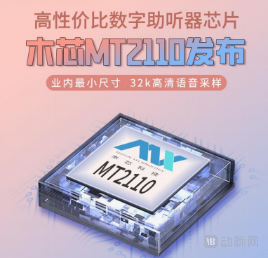
MT2110 Offers a Cost-Effective Digital Chip Solution
The MT2110 chip, built on TSMC’s 180nm MSRF process, features an ultra-compact 3mm x 3mm footprint, ultra-low power consumption of 0.6mA, and ultra-low latency of 1ms, ensuring extended battery life. Its unique sound effect mode adjustment and dynamic volume compression functions deliver a more comfortable listening experience for end users.
Furthermore, the MT2110 chip combines subthreshold and long-channel technologies, enabling operation across a wide voltage range of 0.96–4.3 V. The signal chain features an ultra-low-power design, reducing current consumption to as low as 600 µA during full-speed operation. Additionally, the MT2110 integrates a digital filter bank specifically designed for hearing aids, providing flexible filtering characteristics to accommodate various external devices.
Furthermore, the MuXin MT2110 reserves a Bluetooth chip interface, supporting integration with Bluetooth chips to enable wireless control via a mobile app, thereby making operation simpler and more efficient.
Whether it is the MA1180 or the MT2110, compared with similar products from foreign manufacturers, Muxin Technology, a domestic enterprise, can more quickly and accurately capture the needs of Chinese manufacturers, respond flexibly, tailor-make solutions, and provide more suitable chips to help upgrade the "core" of domestically produced hearing aids.
It is reported that the Muxin MA1180 and Muxin MT2110 officially entered mass production in November 2021 and July 2022, respectively, and have established mass-production partnerships with dozens of institutions, including Huier Hearing and Tianjian Medical. Moving forward, the company will vigorously expand its distribution channels to equip more domestically produced hearing aids with Chinese chips.
In addition to hearing aid chips, the company is also engaged in the research and development of blood glucose monitoring chips.
Notably, in June 2023, Muchip Technology was invited to attend the TSMC 2023 China Technology Forum and participated in the Innovation Zone of the forum as a startup customer. Also invited were 21 other emerging chip and semiconductor companies, including NIO, Fullhan Microelectronics, and Xiwei Technology.
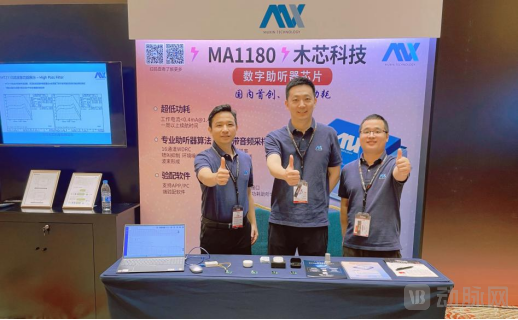
Muxin Technology’s Booth at the TSMC Technology Forum.
From left to right: COO Xi Jinmiao, CTO Zhan Chang, and Application Department Manager Zhuo Guangming.
Medical chips are the key source technology enabling a leap in device system performance. They have long been the focus of intense competition at the pinnacle of the industry and represent a critical technological barrier that China’s high-end medical equipment sector urgently needs to overcome.
In December 2021, the “14th Five-Year Plan for the Development of the Medical Equipment Industry,” jointly issued by the Ministry of Industry and Information Technology and nine other departments, explicitly called for breakthroughs in medical-grade wearable monitoring devices and artificial organs based on novel sensors, new materials, microfluidic controllers, specialized medical chips, artificial intelligence, and big data.
Amid heightened global uncertainty, mastering core chip capabilities is paramount. We look forward to Muxin Technology rising to prominence, infusing domestically produced medical devices with “chip”-driven power and reaching new “chip”-enabled heights.