

Integrating Global Market Access Strategies from Product Inception to Accelerate Time-to-Market: A Talk by Hong Xiaoming, Founder and Chairwoman of Haihe Biomedical Technology Group
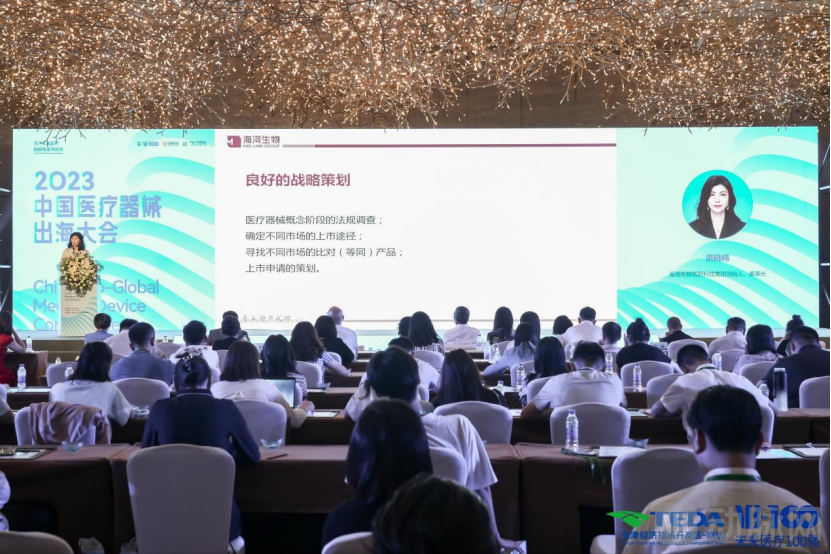
On June 30, 2023, at the 2023 China Medical Device Global Expansion Conference held in the Binhai New Area of Tianjin,Founder and Chairman, Haihe Biopharmaceutical Technology GroupHong Xiaoming delivered a keynote speech titled “Introducing Global Market Access Strategies at the Product Initiation Stage to Accelerate Time-to-Market.”
Hong Xiaoming introduced that accelerating product market entry by incorporating global market access strategies during the product initiation phase requires robust strategic planning, a comprehensive quality management system, adequate staffing, sound design and development processes, clear user requirements, and thorough verification and validation. She also emphasized that post-market compliance should be given high priority; domestic medical device manufacturers must adhere to laws and regulations, operate in compliance, and promptly report adverse events.

[The following text is compiled from the on-site presentation, with some content omitted]
We believe that the entire product development process can be divided into four stages. The first is the seed stage, which begins with an initial idea and focuses on transforming scientific research achievements from academic and research institutions into viable, market-ready products. During this stage, various feasibility studies must be conducted to assess the potential for commercialization.
Only after R&D is completed do companies begin to consider regulatory registration, type testing, and other legally mandated experiments. At this stage, they often encounter numerous new challenges. Failure to meet requirements during type testing means that the entire product development process must be scrapped and restarted—a daunting prospect. Over the years, we have accompanied many enterprises through their growth journeys.
Good Strategic Planning
Regulatory Due Diligence in the Concept Phase of Medical Devices: What Should Be Investigated? Will national regulators permit such a product to enter the market? Can it at least be promoted within the domestic market, and can it secure approval in other countries? When formulating a product development strategy, it is essential to forecast its market prospects and assess whether the investment will yield positive returns—a critical consideration. What are the market requirements for your product over the next 5–10 years? Will China allow such a product to be marketed? This reflects a practical reality: even a superior product must be launched at the right time.
We need to conduct regulatory research to determine market access pathways in different regions. For instance, the listing requirements for the same product vary across China, the United States, and many countries in the European Union. We must adopt an international mindset and maintain a global perspective. While aiming for rapid product monetization, we must account for regulatory differences among markets. Specifically, we should explore whether it is possible to leverage these disparities by launching the product in other jurisdictions first, thereby collecting real-world data to facilitate subsequent regulatory acceptance in China.
It is also essential to benchmark products across different markets. Certain products may be highly effective and have obtained regulatory approval in China, yet face significant challenges when expanding into international markets due to the absence of comparable precedents, particularly in markets such as the United States. Conversely, some products may already be marketed in the United States but have never been launched in China, making it difficult for a company to pioneer their entry. In such scenarios, it is crucial to assess whether similar products have been approved in your target market, as this can facilitate regulatory acceptance. If no comparable products exist, your offering would be considered breakthrough and innovative, implying that substantially more time, effort, and cost will be required. Companies must therefore make adequate preparations.
Robust Quality Management System
Medical device products in every country are subject to their own quality management systems for market access. We recognize that post-market regulatory oversight of medical devices is now extremely stringent. Failure to comply with the regulatory requirements of the target countries can lead to significant challenges, making overseas distribution exceedingly difficult and potentially resulting in a ban on market entry. Therefore, careful planning is essential to effectively integrate multiple quality management systems into a unified framework.
Many companies begin type testing and focus on their quality management systems only after their products have been finalized. This approach often reveals a significant issue: incomplete R&D data, a problem that is particularly pronounced for companies developing medical devices and software. Therefore, it is essential to integrate the quality management system from the earliest stages of R&D. Doing so offers the advantage of clearly identifying the applicable national and regional regulations, standards, and clinical requirements that must be incorporated into the development process.
Adequate Staffing
As a high-tech enterprise, we need personnel who are well-versed in regulatory affairs. Otherwise, critical information may fail to be collected during the research and development (R&D) process, making subsequent testing extremely difficult. If the information required for registration can be gathered proactively, the overall pathway will be significantly shortened. For example, many products currently require repeated experimentation and validation during R&D, including preliminary feasibility studies involving animal testing. If the team remains entrenched in its own mindset without considering regulatory requirements, the direction of validation may be incorrect. An incorrect validation direction implies that all processes may need to be redone from scratch during formal testing, a risk that must be fully taken into account.
User Requirements
User needs are critically important. In my view, while regulatory approval is obtained for the purpose of sales, securing such approval does not necessarily guarantee strong market performance. For instance, although our company has assisted clients in obtaining FDA clearance in the United States, only a rare few have achieved robust sales. Different markets encompass distinct user bases with corresponding unique needs. This is a nuanced matter that must be considered during the design and development phase. Doing so can help companies accelerate product launches, streamline regulatory approval, and facilitate genuine market entry, which is ultimately the most critical factor.
Validation and Verification
During corporate portfolio validation, requirements from China, the United States, the European Union, and even global standards are taken into account. We must conduct thorough internal planning; as discrepancies sometimes exist that preclude parallel implementation, our solutions must address these variations.
Many companies applying for EU CE certification inevitably face the question of whether clinical trials must be conducted in the European Union. This issue must be fully considered when designing clinical protocols, as different regions may impose additional requirements. Although regulations vary by location, there are essentially only two options: conducting clinical trials or not. The gray area between these two choices is extremely limited, if it exists at all. To determine what is acceptable and what is not, one must revert to the earlier selection of comparator products. The chosen comparator should support a regulatory pathway that enables market authorization in all target jurisdictions, which represents the most fundamental requirement.
Many regulatory requirements in China are increasingly aligning with those in Europe and the United States, which is a highly positive development. We fully understand that enterprises are reluctant to conduct additional clinical trials; however, many differences cannot be overlooked. We must address this issue squarely. Scientific theories must be robust, and we should strive for consistency without discrepancies. Even when adopting identical standards—where every word appears the same aside from the language difference between Chinese and English—significant disparities may emerge when reports are prepared using chemical tabulation methods. Such subtle differences must be thoroughly understood to avoid potential complications.