

BariaTek Medical Unveils BariTon™: First-in-Class Non-Invasive Endoscopic Device for Diabesity Treatment, Enters Clinical Development with 20-Minute Implantation and 20–25% Expected Weight Loss at 1 Year

BariaTek Medical
Medical Device Developer
Type 2 diabetes and obesity are inextricably linked. The medical community defines the co-occurrence of diabetes and obesity as "diabesity," a portmanteau of "diabetes" and "obesity." These two global epidemics affect hundreds of millions of patients worldwide.1, according to scientific research, diabesity may shorten a person's life expectancy by more than 20 years2。
According to data from the Chinese Center for Disease Control and Prevention, the World Health Organization, the World Diabetes Foundation, the American Diabetes Association, and other official organizations, more than 700 million adults worldwide suffer from obesity, and over 450 million adults have type 2 diabetes. China has the largest number of diabetic patients in the world, with approximately 16% of its adult population also suffering from obesity.3, making it the world’s largest potential market for the treatment of diabesity.
At the current stage, GLP-1 drugs have demonstrated compelling results in patients with obesity, but lifelong medication is required.4, which poses a significant challenge to patient adherence and cost, while the long-term side effects of prolonged medication use remain unknown. For instance, patients in the United States spend approximately $1,300 per month on GLP-1 medications, amounting to over $15,000 annually. Furthermore, while GLP-1 drugs demonstrate favorable weight-loss efficacy in patients with simple obesity, their effectiveness is diminished in those with comorbid diabetes, making them suboptimal for individuals with diabesity. Recently, GLP-1 medications have also raised concerns regarding long-term adverse effects and have been repeatedly placed under investigation by European regulatory authorities, a development that may serve as a reference for Chinese regulatory bodies.
To date, metabolic surgery remains the only method recommended by clinical guidelines for effectively reversing diabetes and obesity with comorbid chronic diseases.5Gastric bypass surgery is one such procedure. It involves resecting a portion of the stomach to reduce its volume and anastomosing the distal segment of the intestine to the reduced stomach to create a bypass, allowing food to circumvent the proximal intestine. The aim of the surgery is to achieve both glycemic control and weight loss. By imposing dietary restrictions, it enables patients to consume less food and experience prolonged satiety. Meanwhile, as food directly bypasses the proximal intestine, it does not mix with biliary and pancreatic secretions, ultimately leading to reduced nutrient absorption.
The aforementioned surgical plan requires general anesthesia. Furthermore, gastrectomy is irreversible, entails significant trauma to the patient, and may lead to long-term complications.
VCBeat recently interviewed the French company BariaTek Medical, which has independently developed BariTon™, the world’s first non-invasive endoscopic implant device for the treatment of obesity and type 2 diabetes. Combining gastric volume-reducing balloon technology with an intestinal bypass sleeve, the device can be implanted non-invasively via the oral cavity under endoscopic guidance within 20 minutes. Similar to gastric bypass surgery, it simultaneously reduces food intake, prolongs satiety, and decreases intestinal absorption, thereby achieving weight loss and blood glucose reduction.
In an interview, Youssef Biadillah, CEO of BariaTek, shared that this year marks his 20th year in medical device development. Prior to this, Youssef had an impressive track record in the commercialization of medical devices. The projects he helped incubate, including Baylis (later acquired by Boston Scientific for $1.75 billion), Sadra (later acquired by Boston Scientific for $450 million), and Symetis (later acquired by Boston Scientific for $435 million), are all representative cases in the field of international M&A of medical devices. He is very optimistic about the field of diabesity, as he realized that diabesity is the most common problem among patients with pain, spinal, and cardiovascular diseases that he had previously focused on. This field also has the potential to become the next high-growth market, just as coronary stents replaced coronary artery bypass grafting surgery. BariTon™ will replace traditional metabolic surgery and cover the group of diabesity patients who cannot be treated with medication. Truffle Capital, a well-known medical device venture capital firm based in Paris, decided to establish a company to address the issue of diabesity, so he joined this adventure as the company’s first employee and CEO.
Youssef’s philosophy in product development is that “time is the most expensive commodity.” When building the BariaTek team, he prioritized a balance between solid experience and innovative passion. Team members were expected to possess extensive invention experience in innovative medical devices while maintaining creative enthusiasm for developing technologies that improve quality of life. Driven by a consistent pursuit of purpose and efficiency, this globally diverse talent pool completed the product design and preclinical animal studies for BariTon™ within just two years. The first-in-human clinical trial is scheduled to launch in Europe in the third quarter of 2023.
Unlike all global solutions currently under development or already commercialized, BariTon™ combines gastric volume reduction balloon technology with an intestinal bypass sleeve, pioneering the first endoscopic, non-invasive gastric bypass procedure. The implantation treatment for patients with severe obesity (BMI ≥ 30) and type 2 diabetes complicated by obesity can be completed in just 20 minutes. It truly offers a weight-loss solution that is more thorough than pharmacotherapy and safer than traditional surgery, while providing the additional benefit of glycemic control.
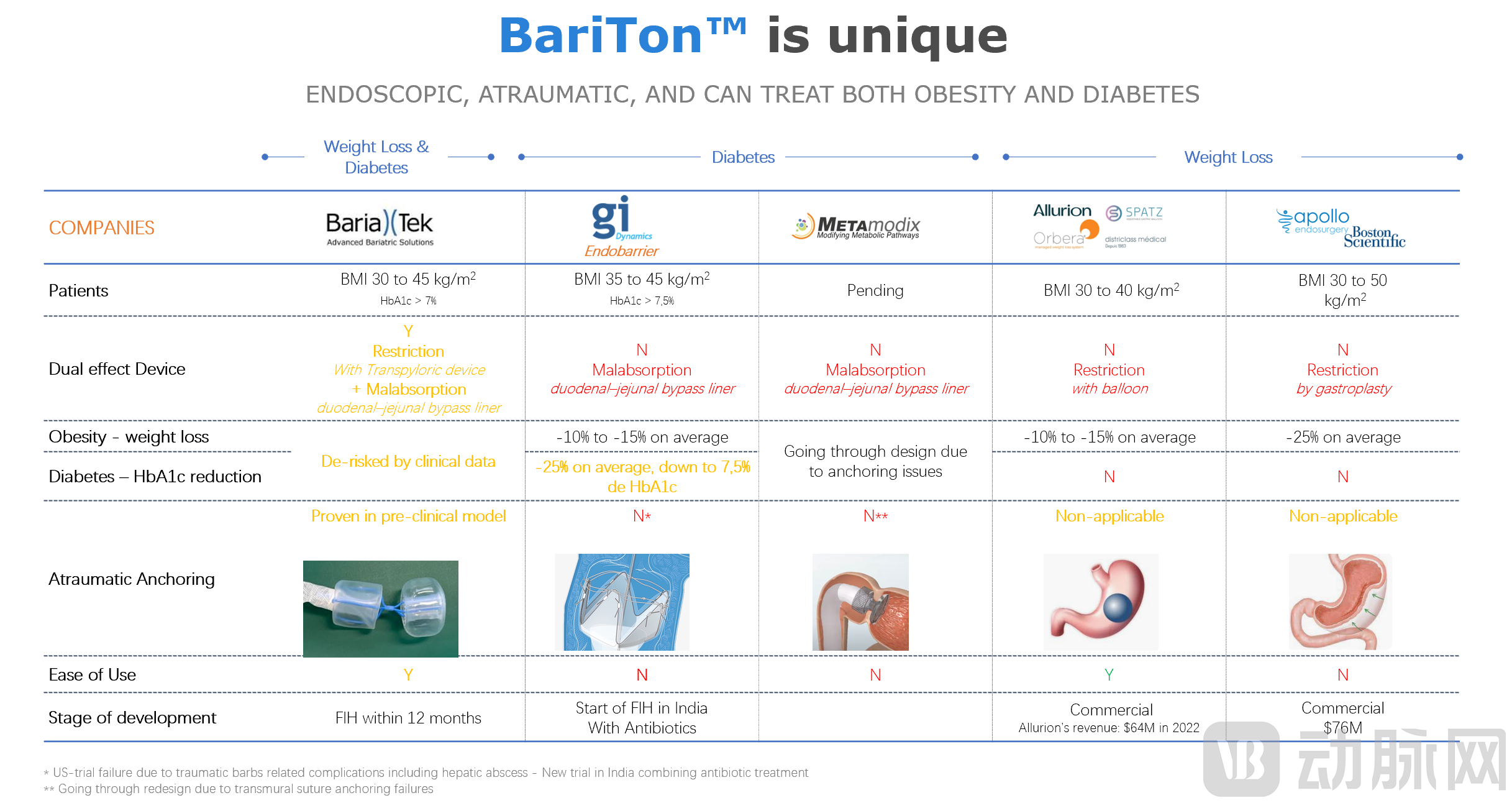
(Competitive Analysis Chart: Gastric weight-loss balloons are indicated solely for weight reduction, with commercialization already achieved by overseas companies; duodenal bypass sleeves are indicated for both glycemic control and weight reduction, but no company has achieved commercialization due to severe complications arising from their invasive fixation methods.)
BariTon™ consists of two components: a transpyloric weight-loss balloon and a duodenal bypass sleeve. This technology has secured comprehensive patent protection globally, including in China. The transpyloric weight-loss balloon slows gastric emptying and enhances satiety, enabling patients to eat less, feel full faster, and experience delayed hunger, thereby reducing total daily energy intake to achieve weight loss. Additionally, the balloon serves as an ingenious non-invasive anchoring mechanism to secure the duodenal bypass sleeve, which blocks intestinal absorption, thus simultaneously achieving synergistic effects in both weight reduction and glycemic control.
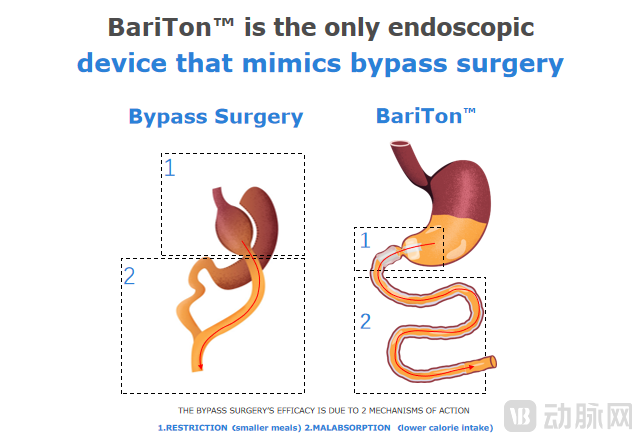
(The left figure illustrates the therapeutic mechanism of open gastric bypass surgery; the right figure illustrates the therapeutic mechanism of BariTon™)
From a clinical operational perspective, the BariTon™ procedure is as simple as performing a gastroscopy, compared to traditional open or laparoscopic surgeries. It employs a non-traumatic sleeve fixation method that breaks through industry barriers, eliminating the need for sutures or staples around the pylorus, resulting in negligible trauma during implantation. Meanwhile, the device and its delivery system are pre-assembled, allowing physicians to simply unpack and use them immediately. Following an approximately 20-minute digestive endoscopy procedure, patients can truly achieve “admission in the morning, discharge in the afternoon,” freeing themselves from the burden of hospitalization associated with traditional metabolic surgery. More notably, BariTon™ does not remain permanently in the patient’s body but is fully retrievable. According to Youssef, physicians can safely and non-invasively retrieve the device within 10 minutes, significantly enhancing treatment efficiency.
To date, BariTon™ has completed 50 animal studies. Follow-up assessments conducted at three-month intervals demonstrated no migration of the implant into the intestinal tract, thereby fully validating its safety and stability.
As the world’s first innovative device of its kind, BariTon™ secured approval from European regulatory authorities for its first-in-human clinical trial application at a remarkable pace. This rapid approval was primarily due to the extensive historical data validating the efficacy of gastric volume reduction balloons and intestinal bypass sleeve technologies separately. More importantly, scientists have already confirmed the preliminary safety and efficacy of combining gastric volume reduction balloon technology with intestinal bypass sleeve technology in humans.6, the scientist currently serves as a clinical advisor to BariaTek Medical.
The first-in-human clinical trial of BariTon™ will focus on individuals aged 30–65 years with a body mass index (BMI) of 30–45, including patients with type 2 diabetes.
To accelerate the development of BariTon™ into a therapeutic option that is more thorough than medication and safer than traditional surgery, BariaTek™ is collaborating with global clinical and commercial partners. The company expects to complete its global commercial translation within three to five years, aiming to become the global leader in endoscopic treatment for obesity and diabetes. During the interview, Youssef clearly expressed interest and intention to conduct relevant clinical trials in China. With its large population of patients with type 2 diabetes and obesity, China represents a significant market. The company is currently in active discussions with relevant Chinese enterprises to identify the optimal cooperation model for the Chinese region.
From a personal perspective, Youssef is an entrepreneur with a deep passion for Chinese culture. He has traveled extensively across many cities and regions in China, including Beijing, Shanghai, Xi’an, Wuhan, Chengdu, Guilin, and Harbin. Through his travels, Youssef has gained a richer and more diverse understanding of the “Chinese spirit” and “China speed.” He looks forward to fostering productive collaborations in China in the future, bringing BariTon™, a next-generation non-invasive solution, to patients with obesity and diabetes.
References:
1. Ng, A.C.T., Delgado, V., Borlaug, B.A. et al. Diabesity: the combined burden of obesity and diabetes on heart disease and the role of imaging. Nat Rev Cardiol 18, 291–304 (2021). https://doi.org/10.1038/s41569-020-00465-5
2. Nianogo RA and Arah OA (2022) Forecasting Obesity and Type 2 Diabetes Incidence and Burden: The ViLA-Obesity Simulation Model. Front. Public Health 10:818816doi:10.3389/fpubh.2022818816
3. Epidemiology and determinants of obesity in China, Lancet Diabetes Endocrinol 2021; 9: 373-92
4. Wilding, JPH, Batterham, RL, Davies, M, et al. Weight regain and cardiometabolic effects after withdrawal of semaglutide: The STEP 1 trial extension. Diabetes Obes Metab. 2022; 24( 8): 1553- 1564. doi:10.1111/dom.14725
5. Guidelines for the Prevention and Treatment of Type 2 Diabetes in China (2020 Edition)
6. Sartoretto, A., Marinos, G., & Sui, Z. (2019). Concurrent Placements of a Duodenal-Jejunal Bypass Liner and an Intragastric Balloon Among Severely Obese Patients: A Case Series. ACG Case Reports Journal, 6(6). https://doi.org/10.14309/crj.0000000000000101