

Chinese Medical Parks Offer Up to ¥600M for Projects and ¥100M for Talent in Fierce Recruitment Drive
Investment promotion activities in the healthcare sector are becoming increasingly active.
Since the first half of 2023, investment promotion delegations from provinces such as Shandong, Hunan, and Liaoning have flocked to innovation hubs like Beijing, Shanghai, Guangzhou, and Shenzhen to promote their respective industrial environments and investment prospects.
Supportive policies and ancillary investments are the most direct conditions for attracting enterprises; to attract sufficiently top-tier projects or talent, some cities have even offered subsidies or rewards amounting to hundreds of millions of yuan.
As more cities and industrial parks across China lay out their healthcare industry, the market ecosystem is undergoing subtle changes...
The resumption of offline events has spurred an increase in face-to-face interactions across various industries, and investment promotion for industrial parks is no exception.
In March 2023, the High-Tech Zone of Yantai, Shandong Province, visited the Suzhou Institute of Biomedical Engineering and Technology, Chinese Academy of Sciences in Suzhou for inspection and conducted investment promotion activities. This visit established a cooperative intention between both parties to jointly build a medical device achievement transformation base in the Yantai High-Tech Zone. They will select a batch of innovative and high-value-added projects for industrialization in areas such as in vitro diagnostic instruments, medical equipment, reagents and core raw materials, and drug screening.
Investment promotion delegations from Changsha, Changde, Xiangtan, and other cities in Hunan Province conducted industry promotion campaigns in Shenzhen and Shanghai, respectively, in May 2023.
Among them, Haiping International Changsha Economic and Technological Development Zone Medical Device Industrial Park introduced Hunan Province’s medical device approval policies, the park’s distinctive policies, and its industrial development advantages. The Changde Economic and Technological Development Zone Biopharmaceutical Industrial Park offers low-cost power plant waste heat and industrial reclaimed water resources within Hunan Province, with a focus on attracting manufacturers and institutions in the fields of active pharmaceutical ingredients (APIs), synthetic biology, pharmaceutical formulations, medical devices, and pharmaceutical R&D.
Point-to-point investment promotion efforts are also being intensively carried out.The industrial park reaches target enterprises through centralized visits, capital matchmaking, and other forms.
Chengdu Gaotou Biomedical Park Management Co., Ltd. is the operator of Tianfu Life Science Park. A relevant company official told VCBeat that previous investment promotion efforts primarily consisted of attending government promotional events, publishing advertorials, and handling inquiries from interested companies. “This year, in response to changes in national industry policies and the broader macroeconomic environment, we have adopted a more proactive approach to investment promotion. We are leveraging multiple channels to identify early-stage projects and facilitate the translation of cutting-edge scientific achievements into commercial applications. Furthermore, as companies face greater financing challenges compared to previous years, we are using our industrial fund’s project pipeline as a source, proactively screening high-quality projects in major hubs such as Beijing, Shanghai, and Guangzhou, and attracting companies to establish operations here through equity investments.”
After all, the supply of ready-made projects is limited; in some regions, scientists and their research achievements are directly brought in to attract enterprises to establish operations locally for commercialization.
In April 2023, the Xiamen University Technology Achievements Release Conference (Beijing Biomedical Special Session) and the Xiamen Biomedical Industry Investment Promotion Conference were held in Beijing. At the conference, several experts and scholars introduced the major translatable scientific research achievements from their respective schools or research groups.
Overall, the industrial park is leveraging various industry exchange opportunities to extensively search for and screen high-quality projects with utmost determination.
Behind the enthusiastic investment promotion efforts in industrial parks lies the vigorous construction of biomedical industrial parks.
The biopharmaceutical industry is a strategic emerging industry in China, and multiple provinces across the country have proposed to build highlands for the biopharmaceutical industry.
According to incomplete statistics by media outlets on local government work reports, 29 provinces, autonomous regions, and municipalities across China—including Beijing, Tianjin, Guangdong, and Zhejiang—have designated pharmaceutical manufacturing and the bioindustry as advantageous or priority industries. Among the 399 national-level industrial parks in China, more than 200 have identified biopharmaceuticals as a key focus for development.
Among China’s biopharmaceutical industry clusters, long-established parks such as Zhangjiang Hi-Tech Park, Zhongguancun Science Park, and Suzhou BioBAY have developed substantial appeal through their mature industrial ecosystems. Building on this solid foundation, leading regions have continued to advance the phased planning and construction of industrial space.
In Beijing, the Airport Economic Zone of Daxing International Airport has planned specialized industrial parks, including the Biopharmaceutical Incubator in the Comprehensive Bonded Zone, the International Regenerative Medicine Industrial Park, and the International Medical Device Industrial Park. Among these, the Biopharmaceutical Incubator in the Comprehensive Bonded Zone is scheduled to commence operations in the near future.
In April 2023, Shanghai, in its "Policy Measures on Strengthening Investment Promotion and Accelerating the Construction of a Modern Industrial System in the New Era," proposed to launch 8 million square meters of carrier space for the "three leading industries" over the next three years. Among these, 5 million square meters of low-cost, standardized biomedical properties will be planned moderately in advance and developed in contiguous areas, featuring distinct characteristics, established brands, supporting services, and dedicated operational entities.
In October 2022, construction commenced on Phase I of the first stage of the Suzhou BioBAY Phase VII Project in the Eastern District of the Dushu Lake Science and Education Innovation Zone. Covering an area of approximately 130,000 square meters, with a planned total gross floor area of around 500,000 square meters, the project will significantly address enterprises’ industrialization needs, promote the clustering of industrial projects, and provide a large-scale, comprehensive R&D and production base for Suzhou’s biomedical industry.
Meanwhile,New industrial parks are springing up across the country, particularly in prefecture-level cities that offer more space and lower costs for various resources.
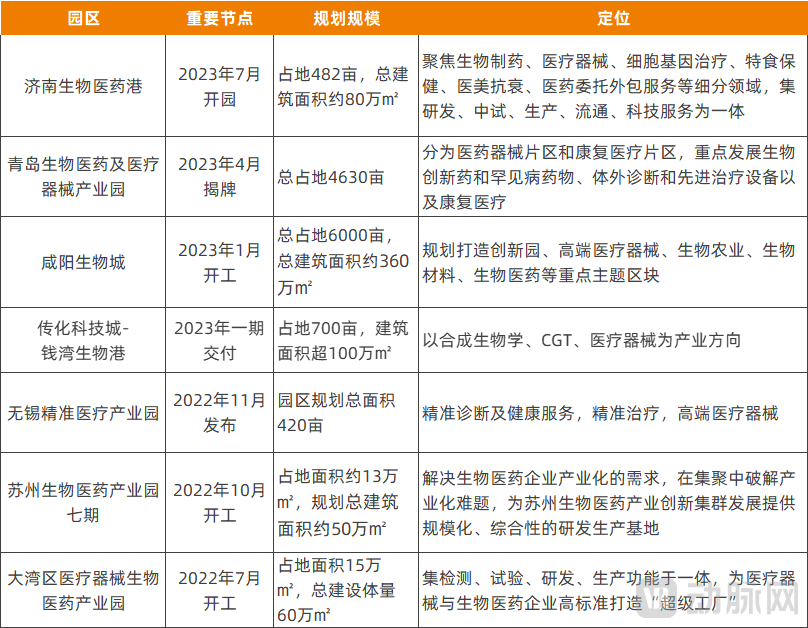
Selected Industrial Parks with Significant Progress in the Past Year, Source: Public Reports
In April 2023, the Qingdao Biopharmaceutical and Medical Device Industrial Park was officially unveiled. Covering a total area of 4,630 mu, the park is divided into two zones: the Pharmaceuticals and Medical Devices Zone and the Rehabilitation Medicine Zone. It focuses on the development of innovative biologics and orphan drugs in the biopharmaceutical sector, in vitro diagnostics and advanced therapeutic equipment in the medical device sector, as well as rehabilitation medicine. On May 25, the park conducted investment promotion activities in Beijing.
In January 2023, construction commenced on the Xianyang Bio-City, a project benchmarked against the Wuhan Optics Valley Bio-City. The Xianyang Bio-City covers a total area of approximately 6,000 mu, with a total floor area of about 3.6 million square meters. Currently under construction is Phase I, the Bio-City Innovation Park, which focuses on aggregating enterprises in biopharmaceuticals, modern traditional Chinese medicine, cell R&D, and medical devices. To date, 20 companies, including Yujun Biotech, Aoluxin Biotech, and Optics Valley Chuangxin Pharmaceutical, have signed agreements to locate there.
In November 2022, Hangzhou Transfarpolis unveiled the “Qianwan BioPort,” a brand for its one-million-square-meter biopharmaceutical space. Covering an area of 700 mu with a gross floor area exceeding one million square meters, Qianwan BioPort focuses on synthetic biology, cell and gene therapy (CGT), and medical devices. The first phase of the project began phased delivery in the first half of 2023.
Biopharmaceutical R&D facilities and manufacturing plants demand high construction standards, while the incubation cycle for enterprises is lengthy. With regions across the country vying to plan and build new industrial parks, it has become imperative to carry out investment promotion efforts without delay.
For startups, subsidy policies and matching funds are key factors in site selection and establishment.
In May 2023, at the 7th Future Healthcare Top 100 Conference held by VCBeat at the Zhangjiang Science Hall in Shanghai, the Chengdu Shuangliu District Government and its Big Health Industry sector conducted a promotional presentation. At the event, companies showed widespread interest in subsidy policies and supporting funds.
Furthermore, Chen Miaomiao, General Manager of the Investment Promotion Department at Hangzhou Transfarpolis Co., Ltd., noted that regions are fiercely competing to attract projects with total investments exceeding RMB 1 billion. The incentives typically offered include land provision at lower costs, commissioned construction of factory buildings, rent-free periods for factory spaces, and investment from local government guidance funds. “Both subsidies and fund investments can directly bolster a company’s cash flow. This is particularly crucial when companies are expanding, selecting new locations for establishment, or making additional investments. Such incentives have become standard practice in investment promotion. Under the new circumstances, regional ecological value and service capabilities have become key areas of focus for enterprises.”
Phased Subsidies: Selecting the Best Projects Through Rigorous Screening
In fact, local governments across the country formulate varying degrees of support policies for key industries, covering aspects such as facility construction, talent acquisition, technological innovation, clinical trials, product registration, and scaled operations.
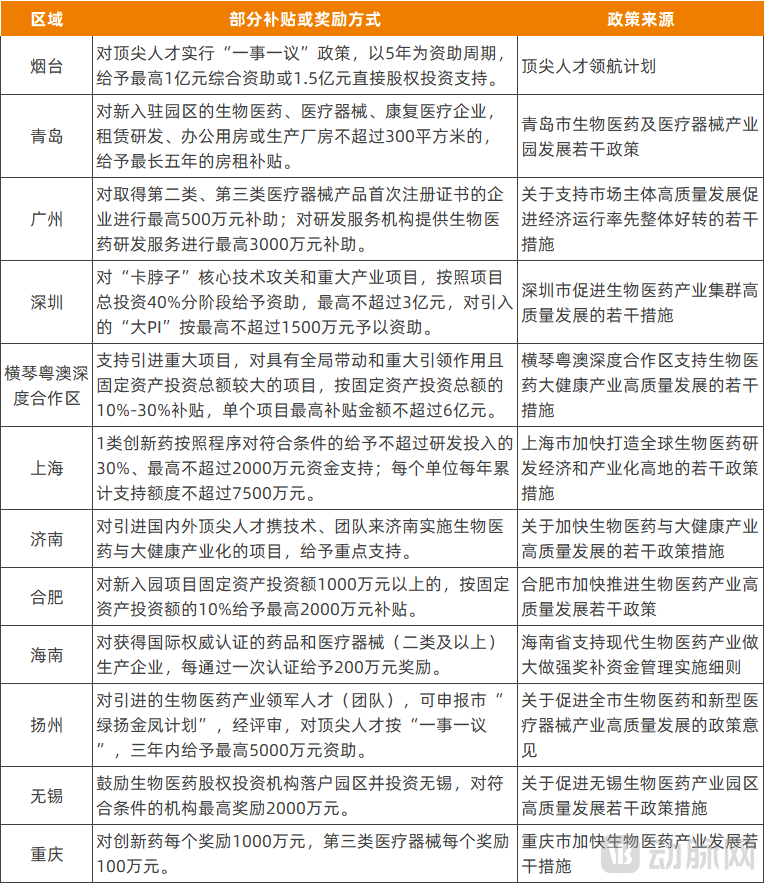
Cities That Have Formulated Subsidy or Reward Policies in the Past Year, Source: Official Websites of Local Governments
Economic development levels and fiscal conditions vary across regions, leading to differences in subsidy intensity. Overall, however, substantial subsidies or rewards are provided to leading enterprises that drive local industrial ecosystems, high-level talent, innovative drugs and innovative enterprises, and companies with high operating revenues.
For example, in accordance with the "Several Measures of the Hengqin Guangdong-Macao In-Depth Cooperation Zone to Support the High-Quality Development of the Biopharmaceutical and Big Health Industries," local authorities provide subsidies equivalent to 10%-30% of the total fixed asset investment for projects that exert comprehensive driving and significant leading effects on the development of the biopharmaceutical and big health industries and involve substantial total fixed asset investment. The maximum subsidy for a single project shall not exceed RMB 600 million.
In terms of talent, Yantai, Shandong Province has implemented the Top Talent Navigation Plan, adopting a “case-by-case” policy for top-tier talents. With a five-year funding cycle, it provides comprehensive financial support of up to RMB 100 million or direct equity investment support of up to RMB 150 million.
In addition to physical enterprises, high-quality financial institutions are also key recipients of incentives; for instance, Wuxi encourages biomedical equity investment firms to establish a presence in its industrial parks and invest in the city, offering eligible institutions rewards of up to RMB 20 million.
In general,Subsidies and incentives are increasingly being disbursed in phases, with a greater emphasis on tangible outcomes. This approach aims to both secure high-potential projects and ensure funds are allocated where they yield the greatest impact, thereby selecting the best of the best.
GP-led Investment Promotion: Deep Integration of Venture Capital Funds with Enterprises
“Investment-driven attraction and coordinated investment-recruitment” has become a common model for investment promotion in industrial parks.Local governments partner with general partners (GPs) to establish sub-funds through government guidance funds, attracting companies to set up operations by imposing local reinvestment requirements. Industrial parks may also establish direct investment funds to invest more directly. In recent years, as this model has continued to evolve, the ecological integration among industrial parks, funds, and enterprises has become increasingly close.
In May 2023, Lingyi Bio, a gene therapy R&D company, completed its Series A financing round of nearly RMB 100 million. The round was co-led by Yifeng Capital and Huafang Capital, with participation from Transfar Capital, Sequoia China, and Huaiji Capital. Following the completion of this financing, Lingyi Bio will establish its headquarters at Qianwan Bioport in Transfar Science & Technology City.
Among these, Transfar Capital’s investment was directly linked to Lingyi Bio’s establishment in the park. “Our fund operates on an EVC model, which is ecosystem-based investing. This concept requires that investments deliver both financial returns and industrial ecosystem value,” said Chen Miaomiao.
Relevant officials from Tianfu Life Science Park also noted that the healthcare industry has strong public welfare attributes, and companies typically seek support from state-owned platform enterprises. “In the past, it was relatively difficult for companies to secure financing within Sichuan Province. However, in recent years, the High-Tech Zone has provided support to biopharmaceutical companies at various stages—including seed, angel, and growth phases—through Ceyuan Capital, Bio-City Fund, and Gaotou Venture Capital. As a result, these companies have also gained endorsement through state-owned equity holdings.”
The capital and resources brought by venture capital funds help promote the rapid growth of enterprises. As these enterprises expand, they begin to “give back” to the park’s venture capital funds by becoming limited partners (LPs) and engaging in continuous ecosystem investment.
Aiboyi Medical, an ophthalmic device company located in the Changping Science and Technology Park in Beijing, received investment from Changfazhan, the park’s investment platform, during its Series D financing round in 2018. Subsequently, Changfazhan optimized spatial resources to help Aiboyi Medical address its need for expanded production capacity.
In July 2020, Aierbo Medical listed on the STAR Market. In the same year, Changfa Development and Aierbo Medical jointly established a healthcare direct investment fund, with Aierbo Medical becoming a significant limited partner (LP) of Changfa Development. Data from Qichacha shows that, to date, this fund has invested in nearly 10 enterprises located in the Changping Science Park.
Under this model, the industrial park’s investment platform can more rapidly address a portion of its fundraising needs. Companies within the park possess the financial strength to serve as limited partners (LPs), while also acting as “living advertisements” that help attract more high-quality enterprises to the park.
Subsidy policies, venture capital funds, and other factors are crucial for investment promotion in industrial parks; however, these require support from higher-level local authorities and must be led by local governments in their formulation or implementation. Within the parks, various differentiated advantages are being established to attract high-quality enterprises with more comprehensive competitiveness.
For example, pursuing incremental development amid the pressure of existing stock.
In the venture capital and private equity sector, “investing early and investing in small ventures” has become a mantra frequently cited by investment firms. This reflects a broader backdrop: opportunities in existing markets are dwindling, and industrial park investment promotion is facing a similar reality.
In June 2023, a centralized signing ceremony was held for a batch of enterprises in the Airport Economic Zone of Beijing Daxing International Airport. From January to May, the zone saw 800 newly registered enterprises, including 46 foreign-funded ones. To date, the cumulative number of registered enterprises in the zone has exceeded 5,000.
Wang Shuochun, the head of investment promotion for the life and health industry at the Daxing Airport Economic Zone, stated that while attention is often focused on leading enterprises in the sector, their demand for new investment is limited. “On one hand, we are prioritizing the development of an international platform for the distribution, display, and trading of pharmaceuticals. On the other hand, we are focusing on niche areas of cutting-edge medical technology to build an integrated platform for industrial translation that combines medical care, education, and research, thereby facilitating international medical cooperation. In summary, our strategy emphasizes generating new growth, avoiding competition for existing market share, and preventing homogenized competition.”
Since 2022, the National Precision Medicine Industry Innovation Center, Tianfu Jincheng Laboratory (Frontier Medical Center), and Peking University Chengdu Institute of Frontier Interdisciplinary Biotechnology have successively settled in the Tianfu Life Science Park. By collaborating with universities such as Peking University and Sichuan University, they are advancing technology transfer and new project incubation to facilitate corporate establishment.
For another example, building application scenarios for innovative products and therapies for enterprises.
The industrial park provides enterprises with industrial space, addressing their needs across the entire process from product R&D to production. In differentiated competition, the park may also help enterprises establish application scenarios.
“According to the industrial plan of the Daxing Airport Economic Zone, the focus will be on innovative enterprises in fields such as cell and gene therapy, stem cells, and high-end medical devices. The zone aims to build an integrated ecosystem combining medicine, pharmaceuticals, and healthcare, with medical research at its core and supported by the pillar industries of pharmaceutical translation and production as well as medical services. It will introduce Grade A tertiary hospitals, research-oriented hospitals, specialized hospitals with distinctive features, and international hospitals, with the goal of establishing an international hub for pharmaceutical distribution and a center for international clinical research and translation. Ultimately, a closed-loop system spanning R&D, translation, production, and clinical application will be formed within the Airport Economic Zone,” introduced Wang Shuochun.
In fact, corporate location decisions are influenced by multiple factors, including talent availability, product registration and regulatory compliance, industrial supply chains, transportation infrastructure, and support services. To attract enterprises, industrial parks must also strengthen their efforts across various dimensions, such as physical infrastructure, public service platforms, streamlined approval processes, resource matchmaking, and empowerment of the industrial supply chain.
An increasing number of industrial parks are positioning themselves in the biopharmaceutical sector, providing enterprises with broader industrial space. The attraction of enterprises by these parks is a process of mutual selection. As competition intensifies among parks and the relationship between parks and enterprises becomes more synergistic, the industry as a whole will evolve in a more positive direction.