

Vertex Pharmaceuticals Advances Stem Cell Therapies for Type 1 Diabetes Amid Over $90 Billion Market Valuation
Vertex
Breakthrough Small Molecule Drug Developer
With changes in dietary patterns and lifestyles, the number of people with diabetes continues to rise. According to the IDF Diabetes Atlas (10th edition) released by the International Diabetes Federation (IDF), there were 537 million adults (aged 20–79 years) with diabetes worldwide in 2021, of whom more than 90% had type 2 diabetes mellitus (T2DM) and approximately 5%–10% had type 1 diabetes mellitus (T1DM).
Type 1 diabetes mellitus (T1DM) is an autoimmune disease characterized by the loss of insulin-producing cells, which impairs the body’s ability to maintain normal blood glucose levels. The primary clinical treatment for T1DM is exogenous insulin injection; however, this approach does not fundamentally alter disease progression and may even lead to complications such as nephropathy/renal failure, cardiovascular disease, stroke, and neuropathy.
Therefore, there is a need to develop novel therapies for patients with type 1 diabetes mellitus (T1DM). In recent years, cell therapy has emerged as one of the most prominent sectors in the biopharmaceutical industry, primarily encompassing immune cell therapy and stem cell therapy. Stem cell therapy involves transplanting healthy stem cells into patients to repair damaged cells or regenerate normal cells and tissues. Owing to their capabilities in multilineage differentiation, immunomodulation, and cytokine secretion, stem cells have become a core focus of cell therapy research.
Globally, many biopharmaceutical companies are actively positioning themselves in this sector, including CellTrans, Creative Medical Technology, Sigilon Therapeutics, and PharmaCyte Biotech. Most of their pipelines are in the early stages of research and development. CellTrans’s allogeneic islet cell therapy, Lantidra, was approved for market launch on July 3, 2023.To become the first approved cell therapy for T1DM.
Vertex Pharmaceuticals (hereinafter referred to as “Vertex”) is a company in the T1DM stem cell therapy sector.On June 23, 2023, Vertex announced positive results from its Phase I/II trial of VX-880 in patients with type 1 diabetes mellitus (T1DM),All six patients who received treatment secreted endogenous insulin, improving glycemic control while reducing or eliminating the need for exogenous insulin.This data brings hope for a functional cure to patients with type 1 diabetes mellitus (T1DM).
>>>>
Type 1 Diabetes Mellitus (T1DM)
Stem cell therapy for T1DM focuses on three key areas: protecting residual β-cells, restoring β-cells, and providing immune protection for β-cells.
1.Protection of Residual β-Cells: Stem cells secrete paracrine cytokines and deposit extracellular matrix, providing a favorable microenvironment.
2.Restoring β-Cells: Stem cells exert their functions of self-renewal and differentiation, induce differentiation into insulin-secreting cells, and activate endogenous stem cells to promote the regeneration of pancreatic islet β-cells.
3.β-Cell Immune Protection: Stem cells improve islet cell function by suppressing inflammatory injury and immune-mediated rejection.
VX-880 is Vertex’s first investigational product, a stem cell-derived, fully differentiated, insulin-producing allogeneic islet cell therapy for the treatment of type 1 diabetes mellitus (T1DM). VX-880 is administered via infusion into the portal vein, whereby the infused islet beta cells secrete insulin to restore islet cell function and the body’s ability to regulate glucose levels. However, VX-880 requires concomitant chronic immunosuppressive therapy to protect the islet cells from immune rejection. VX-880 has currently advanced to Phase II clinical trials.
In addition to VX-880, Vertex’s VX-264 has also entered clinical development. VX-264 is a stem cell-derived, fully differentiated islet cell therapy that releases cell-generated insulin while protecting the cells from immune rejection.
Compared with VX-880, VX-264 encapsulates these stem cells in an outer shell; after infusion into the hepatic portal vein, patients are protected from immune system attacks without the need for immunosuppressants.This advantage can expand the population of T1DM patients covered by this investigational therapy. On March 9, 2023, the FDA approved the Investigational New Drug (IND) application for VX-264, which is currently undergoing Phase I/II clinical trials in Canada.
The third candidate, VCTX-211, is a gene-edited, allogeneic, stem cell-derived therapeutic candidate for the treatment of T1DM, currently undergoing Phase I/II clinical trials.
Cystic Fibrosis (CF)
In addition to type 1 diabetes mellitus (T1DM), Vertex has a clinical pipeline for other serious diseases, encompassing small molecules, cell therapies, and gene therapies. Its therapeutic areas include cystic fibrosis (CF), sickle cell disease, beta-thalassemia, APOL1-mediated kidney disease, pain, and alpha-1 antitrypsin deficiency. Among these, the CF pipeline is the most advanced in development.
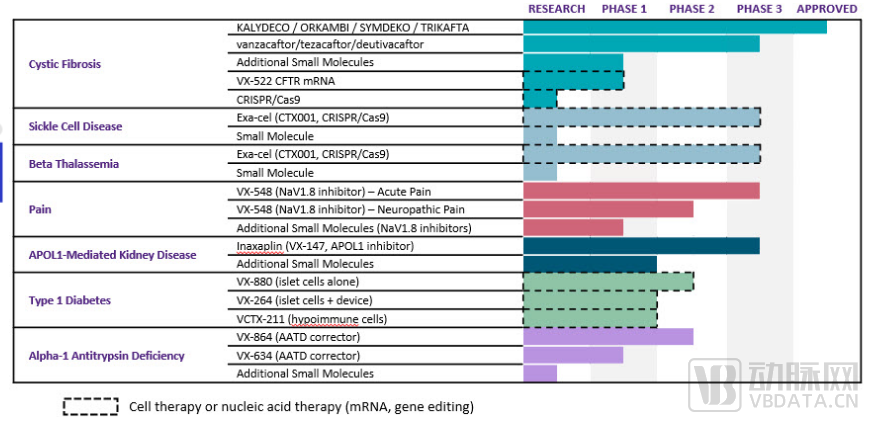
Vertex’s Pipeline in Development Source: Vertex Annual Report
Cystic fibrosis (CF) is the most common autosomal recessive genetic disease among Caucasians in Western countries, caused by mutations in the cystic fibrosis transmembrane conductance regulator (CFTR) gene. Patients with CF lack functional CFTR in airway epithelial cells, leading to dehydration and acidification of the airway surface liquid. This subsequently results in recurrent pulmonary infections and increased airway secretions, ultimately progressing to respiratory failure.
According to data from the Cystic Fibrosis Foundation (CFF), there are nearly 40,000 CF patients in the United States, with an estimated 100,000 patients worldwide, and the average age at death is 30.8 years.
Vertex is the leading enterprise in the field of cystic fibrosis (CF) drug therapy. To date,Vertex Has Launched Four CF Drugs, All Targeting CFTR, the Key Protein in the Pathogenesis of CF, the pipeline also includes several ongoing clinical and research programs. Marketed drugs include Kalydeco, Orkambi, Symdeko, and Trikafta, with the first three treating approximately 40,000 patients worldwide.
Trikafta is an oral triple-combination therapy (elexacaftor, ivacaftor, and tezacaftor) that increases the quantity and function of CFTR protein on the cell surface. On April 27, 2023, the FDA approved Trikafta for the treatment of cystic fibrosis (CF) in children aged 2 to 5 years, expanding its indication to cover approximately 90% of CF patients worldwide.
Vertex was founded in 1989, with its primary business focused on the production and sale of drugs for treating lung diseases, kidney diseases, hematological disorders, and other conditions. However, Vertex officially entered the field of T1DM stem cell therapy research and development only thirty years after its establishment.
In 2019, Vertex acquired Semma Therapeutics for $950 million. Semma was a biotechnology company developing stem cell therapies for patients with type 1 diabetes mellitus (T1DM) who depend on insulin injections. The company utilized human induced pluripotent stem cells (iPSCs) to generate large quantities of pancreatic beta cells for transplantation into patients, thereby reducing their reliance on insulin. Through the acquisition of Semma, Vertex obtained the stem cell therapy VX-880 and officially entered the field of T1DM stem cell therapy research and development.
In May 2022, Vertex announced the Phase I/II clinical trial data of VX-880 for the treatment of T1DM, but further clinical trials involving dose escalation were halted by the FDA. In July of the same year, shortly after the FDA lifted the clinical hold on VX-880, Vertex announced the acquisition of ViaCyte for $320 million, bringing three cell therapies for diabetes under its portfolio to accelerate the development of VX-880.
Compared to Semma, which was founded in 2015, ViaCyte, established in 1999, is a veteran in the biotechnology sector. It focuses on developing novel stem cell-derived islet cell replacement therapies for the treatment of type 1 diabetes mellitus (T1DM), as well as “next-generation” therapies for insulin-requiring type 2 diabetes mellitus (T2DM).
In March 2023, Vertex entered into a new agreement with CRISPR Therapeutics, paying $100 million upfront and $230 million in bonuses to secure non-exclusive rights to CRISPR Therapeutics’ CRISPR/Cas9 gene-editing technology.
Vertex and CRISPR have been collaborating since 2015, focusing on developing novel therapies that target the underlying genetic causes of human diseases. Through this partnership, Vertex is leveraging gene-editing technology to modify the genetic composition of stem cells, thereby enhancing their acceptance by the host body. This approach is being used to develop VCTX-211, a third cell therapy for type 1 diabetes mellitus (T1DM), which will provide additional treatment options for patients with T1DM.
Vertex (stock ticker: NASDAQ: VRTX), headquartered in Boston, successfully went public in 1991, less than three years after its founding. Over the past decade, Vertex’s stock price has continued to rise.In 2022, its stock price still surged by more than 30%, even as major stock indices plummeted. As of now, Vertex’s market capitalization has exceeded $92 billion, ranking it among the top 30 pharmaceutical companies worldwide.
Vertex initially earned its first pot of gold through hepatitis C drugs, later shifting its focus to the rare disease cystic fibrosis (CF). Currently, all of Vertex’s product sales are derived from four CF therapies. Due to the near absence of competitors, the company enjoys high profit margins.
On August 1, Vertex just released its H1 2023 performance results. The data shows that,Total product revenue in H1 2023 was $4.868 billion, a year-on-year increase of 13%;Among them, the triple therapy for cystic fibrosis (CF), Trikafta/Kaftrio, achieved strong sales of $4.337 billion, a year-on-year increase of 19%;Revenue from other CF drugs continued to shrink, reaching $531 million. Based on the strong sales performance of Trikafta/Kaftrio, Vertex raised its full-year 2023 revenue forecast for CF products from the previous range of $9.55 billion to $9.7 billion to a new range of $9.7 billion to $9.8 billion.
As of December 31, 2022, Vertex’s cash reserves increased from $7.5 billion as of December 30, 2021, to $10.8 billion. The company’s total R&D expenses were $3.9 billion and $3.6 billion in 2021 and 2022, respectively. Based on its pipeline, several drug candidates are poised to enter Phase III clinical trials, and the therapy for sickle cell disease and beta-thalassemia, CTX001, is nearing approval. Consequently, R&D spending is expected to increase compared with the previous year, accompanied by new promotional expenses.
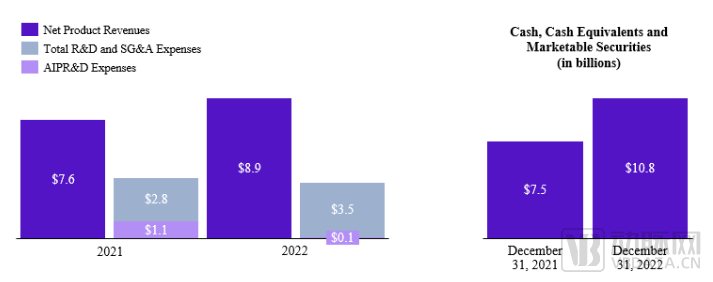
R&D Expenses and Cash Reserves Data Source: Vertex Official Website
Vertex stated that the company is poised to launch five new drugs over the next five years, thereby accessing new markets and revenue streams. It forecasts at least several billion dollars in new revenue, which will support its pipeline projects alongside CF therapies that generate sustained income for the company.