

Over 500 FDA-Approved AI Medical Devices, Nearly 20 from China Emerge as Global Representatives

Lepu Medical
Developer and Manufacturer of Cardiac Interventional Medical Devices and Pharmaceuticals
Subtle Medical
Medical Imaging Software Developer

Infervision
Artificial Intelligence Product Developer

United Imaging
High-end Medical Device Developer

Mindray
Medical Device R&D Manufacturer
Over the past six months, the new wave of AI enthusiasm, led by generative artificial intelligence (AI), has remained at a high level. Although generative AI is still in its early stages of development and indeed possesses tremendous potential to disrupt industries, we should not overlook the fact that the successful implementation of AI in various application scenarios has also served to “endorse” the generative AI boom. Taking healthcare as an example alone, medical AI has achieved unimaginable progress over the past decade, playing a substantial role in empowering the healthcare sector.
The United States is one of the most proactive countries in adopting new medical technologies globally and is also a global leader in the AI industry. As the regulatory agency for the healthcare sector, the FDA has maintained a positive stance toward medical AI, approving the first AI-based medical device as early as 1995. By the end of 2022, the FDA had cumulatively approved 521 AI-based medical devices, making the United States the country with the highest number of approved AI medical devices worldwide.
Learning from Others’ Experience: VCBeat (WeChat ID: VCBeat) Analyzes and Summarizes Over 500 FDA-Approved AI Medical Devices to Provide Insights for Industry Development
In the FDA’s classification, medical devices empowered by AI are referred to as “AI/ML-Enabled Medical Devices,” i.e., medical devices incorporating artificial intelligence and deep learning. Here, several easily confused concepts need to be clarified.
First, the connotation of AI. With the continuous advancement of technology, the connotation of AI has been constantly evolving and changing. Currently, the technologies adopted by AI include models based on statistical data analysis, expert systems primarily relying on “if-then” rules, and ML (Machine Learning), among others.
Among these, machine learning (ML), a concept frequently mentioned in recent years, is a subset of artificial intelligence (AI). It refers to algorithms designed and trained using machine learning techniques that can learn from data and take actions. Developers can leverage machine learning to create algorithms with “fixed” functionality; in contrast, “adaptive” algorithms can change their behavior in response to data updates or over time.
Based on different learning paradigms, machine learning algorithms can be categorized into supervised learning (e.g., classification problems), unsupervised learning (e.g., clustering problems), semi-supervised learning, ensemble learning, deep learning, and reinforcement learning. Among these, deep learning—which leverages deep convolutional neural networks that mimic the human brain’s neural architecture to achieve learning—has witnessed remarkable progress and widespread application over the past decade, nearly becoming synonymous with machine learning and even artificial intelligence (AI).
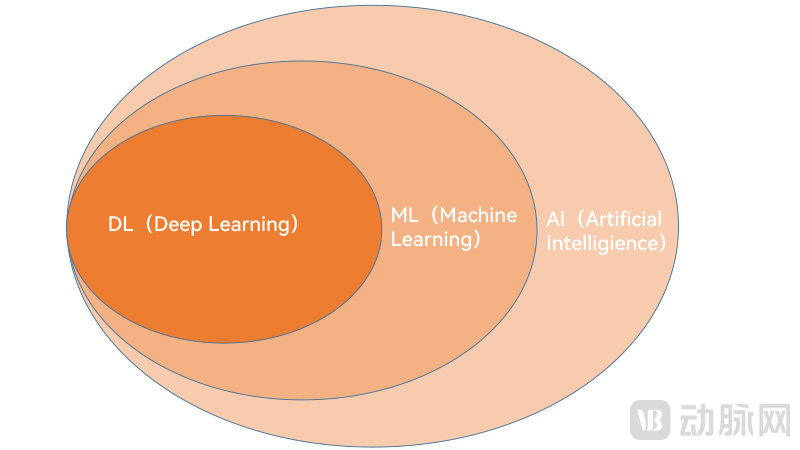
The Relationship Between DL, ML, and AI (Graphic by VCBeat)
The FDA’s definition is not original but rather the result of consensus reached by the International Medical Device Regulators Forum (IMDRF), which comprises medical device regulatory authorities from various countries. Consequently, China has also adopted this framework and issued corresponding regulatory guidelines based on it.
The FDA approved AI medical devices at an early stage—according to statistics published by the FDA on its official website,In November 1995, Neuromedical Systems’ Papnet Testing System became the first AI-assisted medical device approved by the FDA.。
This device has long been discontinued. Based on information remaining online, this instrument for pathology departments leverages AI to assist in the analysis of cervical smear images, displaying identified abnormal cell images on a monitor for expert review. It is evident that this is a typical AI-powered pathology device.
As the first AI medical device, this equipment was cautiously classified by the FDA as a Class III medical device, requiring rigorous clinical trials and laboratory testing, and approved through the stringent Premarket Approval (PMA) pathway.
However, in the more than ten years that followed, only a few AI medical devices received FDA approval. It was not until 2010 that the number of FDA-approved AI medical devices exceeded 10.
Just two years later, in 2012, the now wildly popular deep learning reached a milestone. The CNN-based AlexNet, developed by a research team led by Geoffrey Hinton, the “father of neural networks,” made its debut in the ImageNet image recognition competition. It claimed the championship by decisively outperforming the runner-up (which used SVM methods) in classification accuracy, sparking intense industry interest in deep learning. In the following years, deep learning continued to be refined and was increasingly deployed in real-world applications.
Since then, the number of AI-based medical devices approved by the FDA has begun to grow rapidly and continuously. The surge in applications has gradually made the FDA realize that traditional medical device approval processes are ill-suited for artificial intelligence-enabled medical devices. In response, the FDA has issued a series of documents and guidelines to steer regulatory reform and innovation in the medical device sector.
In July 2017, the FDA’s Center for Devices and Radiological Health (CDRH) released the Digital Health Innovation Action Plan, introducing new regulatory approaches for medical software. The plan aims to foster continuous innovation in digital health products.
Subsequently, the FDA launched the Pre-Cert for Software Pilot Program. As a key component of the FDA’s Digital Health Innovation Action Plan, this initiative has been discussed in our previous articles. It aims to establish new, more effective regulatory approaches by taking into account the unique characteristics of software products.
In June 2019, the FDA released the “Proposed Regulatory Framework for Modifications to Artificial Intelligence/Machine Learning (AI/ML)-Based Software as a Medical Device (SaMD),” dividing the lifecycle of SaMD into three major phases: product development, product registration, and post-market surveillance, with the aim of proposing a regulatory framework aligned with the lifecycle of AI-based medical devices.
As an outcome of this framework, the FDA released its first action plan specifically targeting AI/ML-enabled SaMD in 2021, which outlined five approaches to enhance the FDA’s oversight of AI/ML-based SaMD.
Judging from subsequent developments and actual approval outcomes, this series of measures has indeed significantly accelerated the U.S. regulatory approval process for AI-based medical devices.
According to official statistics, as of the end of 2022, the FDA had approved 521 AI-based medical devices. These devices cover a wide range, including not only Software as a Medical Device (SaMD), such as AI-assisted diagnostic software commonly referred to, but also numerous hardware devices with built-in AI capabilities, such as CT scanners, MRI machines, and even electronic stethoscopes.
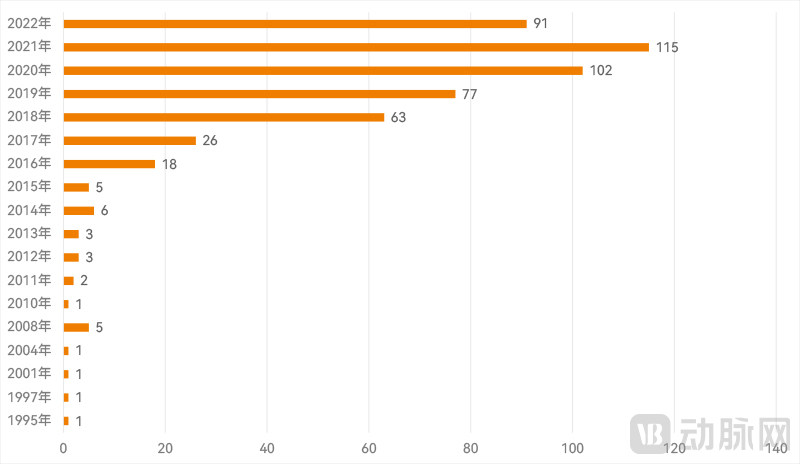
Distribution of FDA-Approved AI Medical Devices Over the Years (Chart by VCBeat)
In terms of approval dates, most of these devices were approved within the past five years. Over the twenty-year period from 1995 to 2015, the number of AI medical devices approved annually was either in the single digits or zero.
2016 marked the first watershed year, with the number of approved products reaching double digits for the first time. 2018 represented another watershed, as the number of approved products surged to 63, a 2.4-fold increase from the 26 approved in the previous year. In 2021, the number of AI-based medical devices approved by the FDA peaked at 115.
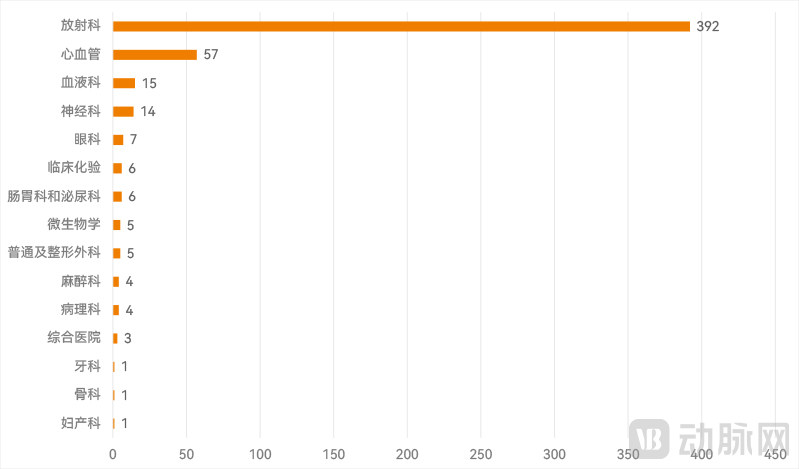
Distribution of FDA-Approved AI Medical Devices by Application Area Over the Years (Chart by VCBeat)
From the perspective of application areas,Radiology is the dominant category, with a total of 392 products dedicated to the field, accounting for a significant 75.2%. Cardiovascular applications follow, with 57 products, representing 10.9% of the total.. AI medical devices in just these two areas account for more than 80% of the total.
In addition,FDA-cleared AI medical devices also cover hematology, neurology, ophthalmology, gastroenterology and urology, clinical laboratory testing, microbiology, general and plastic surgery, pathology, anesthesiology, general hospital care, orthopedics, obstetrics and gynecology, and dentistry.。
Apart from the radiology field, which is dominated by AI-based imaging, many products in other application areas are also AI-powered medical imaging devices. Therefore, medical imaging remains the area where artificial intelligence has the broadest impact in healthcare.
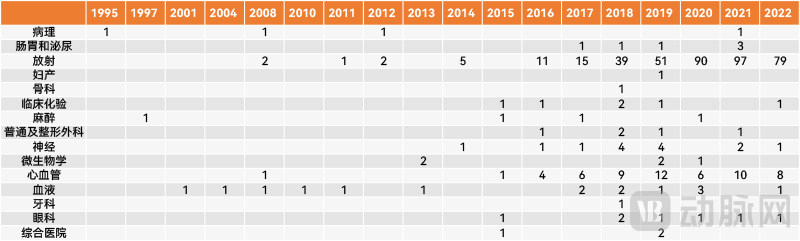
Distribution of FDA-Approved AI Medical Devices by Year and Application Area (Chart by VCBeat)
When examining application domains in conjunction with timelines, it becomes evident that the peak period of FDA approvals for AI-based medical devices closely coincides with the rise of AI in medical imaging. In 2016, when the number of approved AI medical devices first exceeded ten, there were as many as 11 radiology-focused AI medical devices, accounting for over 60% of the total. In the following years, both the absolute number and the proportion of radiology-focused AI medical devices approved annually increased rapidly, rising from approximately 60% to over 80%.
In addition to radiology, the same applies to AI-based medical devices in cardiovascular applications. Furthermore, as previously mentioned, numerous products in other application areas also fall under the category of AI medical imaging.
Additionally, we also used “software” as a keyword to filter the SaMD.A total of 148 AI SaMD applications have been approved for market launch over the years, and the period characterized by a rapid increase in the number of these approvals and their proportion among all AI medical devices approved in the same year coincided with the period of rapid growth in the total volume.。
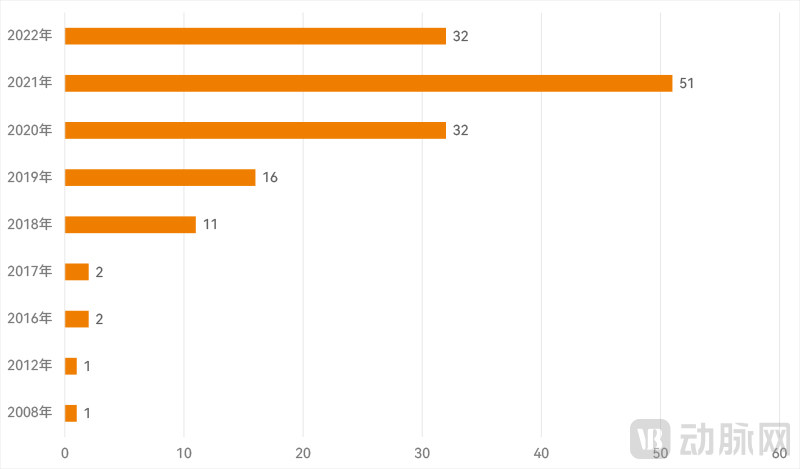
Distribution of FDA-Approved AI Software Medical Devices by Year (Chart by VCBeat)
For instance, SaMD has also experienced rapid growth since 2016. Meanwhile, 2020, 2021, and 2022 were the three years with the highest number of AI-based medical device approvals by the FDA, during which the proportion of SaMD reached new highs of 31.4%, 44.3%, and 35.2%, respectively.
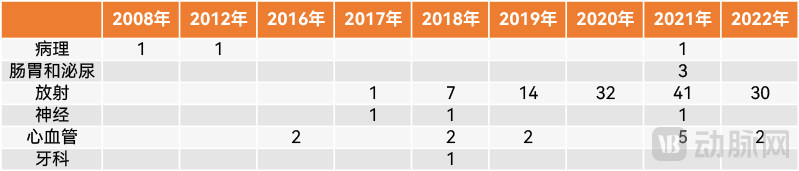
Distribution of FDA-Approved AI Software Medical Devices by Year and Application Area (Chart by VCBeat)
Given that most of these SaMD products are AI-based imaging solutions, it is no exaggeration to say that the surge in AI imaging has driven the peak in FDA approvals of AI medical devices; conversely, one could also argue that the FDA’s proactive approval process has fueled the boom in AI imaging.
In addition,Approximately 80% of approved AI-based medical devices primarily operate using X-ray imaging. The targeted pathological sites are concentrated in the head, breast, and chest, with approximately 10% of the devices capable of being used for multiple anatomical regions.。
These AI medical devices are primarily classified as Class II medical devices and approved via the 510(k) (premarket notification) pathway, totaling 500 products, which accounts for as high as 96% of the total.. Since the 510(k) pathway only requires demonstrating, through comparison with legally marketed medical devices, that the subject device is at least as safe as or safer than predicate devices and raises no new questions regarding safety and effectiveness, this process can significantly enhance approval efficiency.
In addition to 510(k),A total of 18 AI medical devices have sought market authorization via the De Novo pathway over the years. Since the De Novo pathway is analogous to China’s Class II innovative medical devices, it indicates that these AI-based medical devices possess a certain degree of innovativeness. Products approved for market entry through the De Novo pathway have also paved the way for the rapid market launch of subsequent similar products.
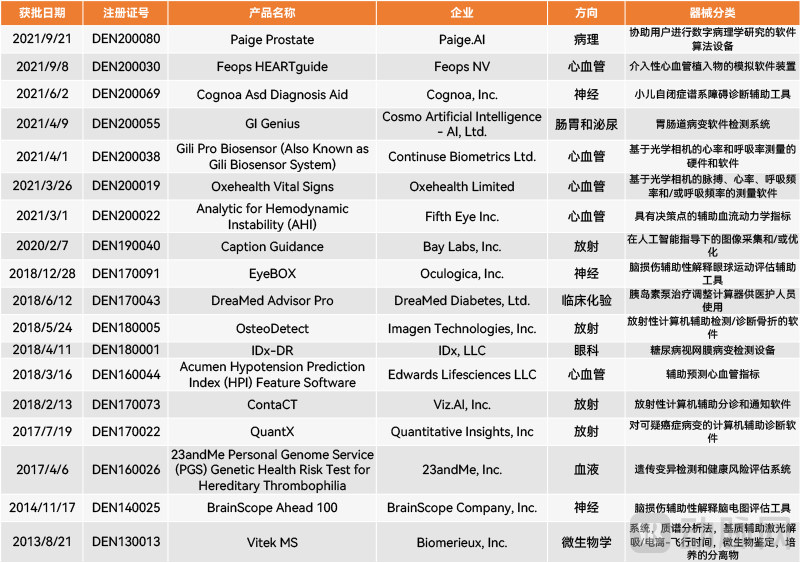
AI Medical Devices Approved by the FDA via the De Novo Pathway Over the Years (Chart by VCBeat)
Historical YearsOnly three AI medical devices have been approved for market launch via the PMA (Pre-Market Approval) pathway., all of which are AI-based imaging products. Generally, the PMA pathway represents Class III medical devices with higher risks.

AI Medical Devices Approved by the FDA via the PMA Pathway Over the Years (Chart by VCBeat)
A notable exception is the QVCAD System, which was approved in 2016. At the time of its approval, it was cleared as a Class III medical device under the category of “Analyzers, Medical Imaging.” However, in January 2020, the FDA reclassified AI-assisted diagnostic devices for breast cancer (X-ray), breast lesions (ultrasound), pulmonary nodules (X-ray), and dental caries (X-ray) as Class II medical devices. Since then, five additional AI-based medical devices have been approved and launched under the “Analyzers, Medical Imaging” category. Consequently, subsequent regulatory submissions have followed the 510(k) pathway applicable to Class II medical devices.
Over the past three decades, a total of 521 AI-based medical devices have been approved, with only three products classified as Class III medical devices. This is somewhat surprising. On one hand, it suggests that the FDA tends to adopt a more relaxed regulatory approach toward AI to encourage its development; on the other hand, the FDA’s traditional tolerance for higher-risk devices may also be a contributing factor.

Differences in Medical Device Classification Across Countries and Regions (Chart by VCBeat)
The most typical example lies in the classification of moderate- to high-risk medical devices. The FDA categorizes such devices as Class II, requiring only a 510(k) premarket notification demonstrating substantial equivalence; however, China, also adhering to a three-tier classification system but prioritizing medical safety, classifies moderate- to high-risk medical devices as Class III, which mandates rigorous clinical trials.
Taking Infervision’s “InferRead CT Stroke.AI,” an AI-assisted triage software for intracranial hemorrhage CT images, as an example, the FDA cleared the product for market entry via the 510(k) pathway in August 2021, classifying it as a Class II medical device; however, in China, it is regulated as a Class III medical device and was approved for market entry in June 2022.
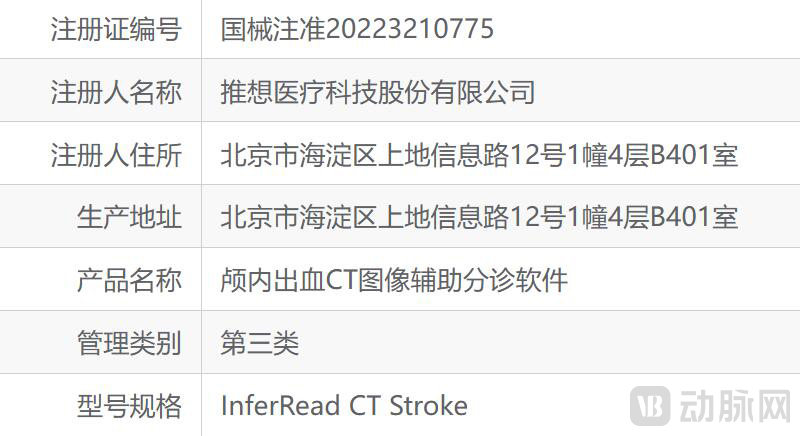
Infervision’s “CT Image-Assisted Triage Software for Intracranial Hemorrhage” has been approved in China as a Class III medical device (screenshot from the NMPA official website)
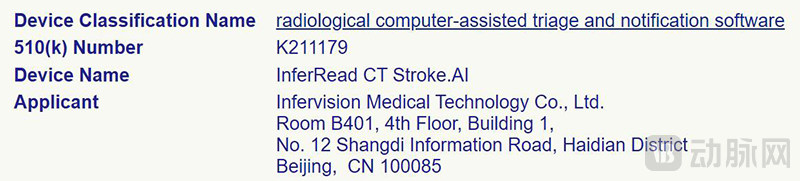
It was approved as a Class II medical device by the FDA (screenshot from the FDA official website)
Of course, this is just an illustrationThe regulatory authorities of the two countries have adopted regulatory strategies for AI-based medical devices that are better suited to their respective realities, with no distinction in terms of superiority or inferiority.。
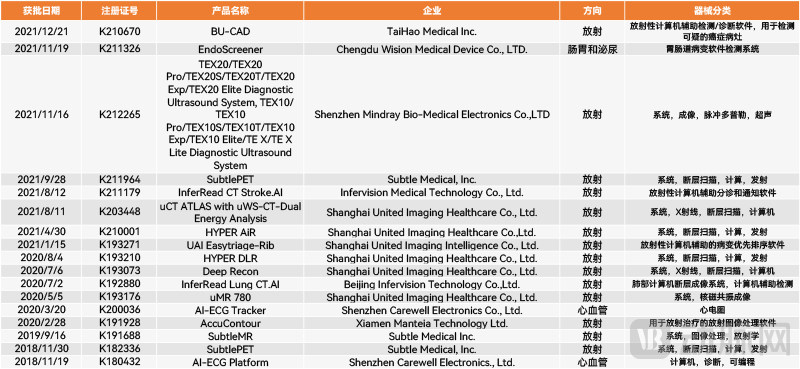
Chinese AI Medical Devices Approved by the FDA (Graphic by VCBeat)
According to incomplete statistics, 17 AI medical devices from China have already received FDA approval.. They belong to United Imaging, Subtle Medical, Lepu Medical, Infervision, Weizhi Medical, Mindray, Manteia Technologies, and Taihao Biomedical. Among them, United Imaging has had six medical devices approved, while Subtle Medical, Infervision, and Lepu Medical have also had more than one AI medical device approved.
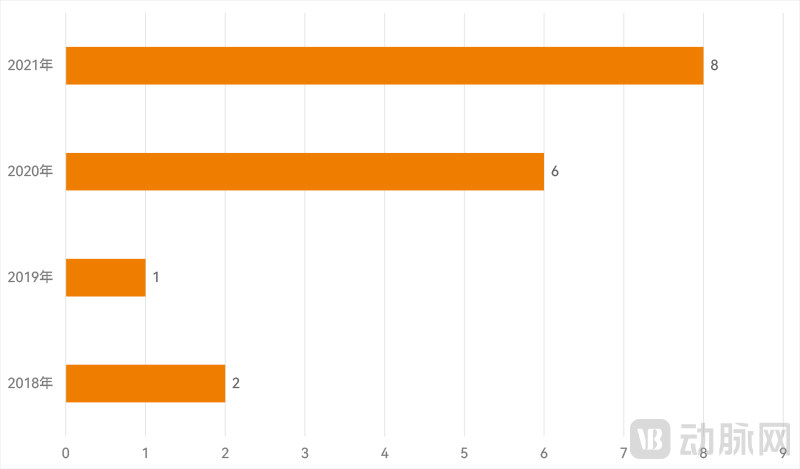
Distribution of Chinese AI Medical Devices Cleared by the FDA Over Time (Chart by VCBeat)
From the perspective of approval time,All of these medical devices were approved between 2018 and 2021, with peaks in 2021 and 2020, during which seven and six devices were approved, respectively.. This also demonstrates that China has vigorously developed its medical device industry in recent years, achieving substantial progress.
The industry for AI-enabled medical devices is heavily regulated, with cautious evaluation of product safety and efficacy. In particular, technologies represented by artificial intelligence are essentially black-box algorithms driven by massive datasets and characterized by rapid updates and iterations, posing numerous challenges to regulatory oversight. The FDA began exploring this field early on and has achieved remarkable results.
In contrast, although China started later, it has made leapfrog progress in artificial intelligence technology in recent years and is catching up in the regulatory field as well. Since 2019, the National Medical Products Administration has taken the lead in establishing 19 cross-departmental, cross-disciplinary, and cross-industry working groups to accelerate the translation and application of AI technological achievements in the medical device sector.
Seizing this opportunity, China has rapidly achieved a breakthrough from scratch in the development of technical review guidelines for AI-based medical devices, while the review guidance system is being accelerated.To date, eight review principles and approval key points for AI medical devices have been released., particularly the "Key Points for Review of Medical Device Software with Deep Learning-Assisted Decision-Making" and the "Guiding Principles for Registration Review of Artificial Intelligence Medical Devices," which, based on the characteristics of deep learning technology and in combination with the usage scenarios and core functions of the software's intended use, focus on data quality, control algorithms, generalization capability, and clinical use risks, thereby effectively promoting industry development.
In 2022,China also spearheaded the first global standard in the field of AI medical devices—the IEEE P2801 international standard for “Quality Management of Medical Artificial Intelligence Datasets”—which proposed a management framework for the dataset lifecycle for the first time, filling a gap in relevant international standards.。
Just a few days ago, on July 10, the Center for Medical Device Evaluation of the National Medical Products Administration issued the “Technical Review Points for Imaging Ultrasound Artificial Intelligence Software (Process Optimization Functions),” “Review Points for Performance Evaluation of Pathology Image Artificial Intelligence Analysis Software,” “Review Points for Clinical Evaluation of Pathology Image Artificial Intelligence Analysis Software,” and “Review Points for Performance Evaluation of Artificial Intelligence Analysis Software for Hematological Flow Cytometry.” These documents provide a regulatory basis for AI medical devices in these fields, thereby promoting industry development.
As of March 2023, China has approved 48 AI-based Software as a Medical Device (SaMD) products., with data types covering various imaging, physiological information, and in vitro diagnostic data, while product types encompass assisted diagnosis, assisted detection, assisted triage, and assessment. Meanwhile,14 AI SaMD Products Have Entered the Innovation Pathway, including CT imaging, color fundus photography, and digestive endoscopy-assisted diagnosis, as well as surgical planning assistance.
Building on the experience accumulated from these explorations, China is poised to stand at the global forefront in the impending wave of integrating generative AI with healthcare. Just asOn July 13, China released the Interim Measures for the Management of Generative Artificial Intelligence Services, which will take effect on August 15, 2023.This is also one of the world’s first regulatory frameworks for generative AI. VCBeat will continue to closely monitor developments in this field and provide firsthand reporting.
References:
“China Medical News,” May 25, 2023, Page 05: “Overview of Regulatory Framework for AI Medical Devices”
Yan Ruoyu, China Medical Devices News: “Building a Scientific Review and Guidance System to Promote Real-World Data Research: The AI Medical Device Innovation Cooperation Platform Achieves Remarkable Results”
Denaro TJ, Herriman JM, Shapira O. PAPNET Testing System. Technical update. Acta Cytol. 1997 Jan-Feb;41(1):65-73. doi: 10.1159/000332307. PMID: 9022728.
Geeta Joshi, Aditi Jain, Sabina Adhikari, Harshit Garg, Mukund Bhandari. FDA approved Artificial Intelligence and Machine Learning (AI/ML)-Enabled Medical Devices: An updated 2022 landscape. medRxiv 2022.12.07.22283216; doi: https://doi.org/10.1101/2022.12.07.22283216.