

Government Guidance Funds Surge—Has It Become Easier for Scientific Research Commercialization Projects to Secure Funding?
In 2023, government-guided funds experienced a comprehensive surge.Chongqing, Guangzhou, Shanghai, and other regions have successively announced plans to establish funds with a scale of hundreds of billions of yuan. According to incomplete statistics, the total scale of guidance funds established in various regions since the beginning of 2023 has exceeded one trillion yuan.
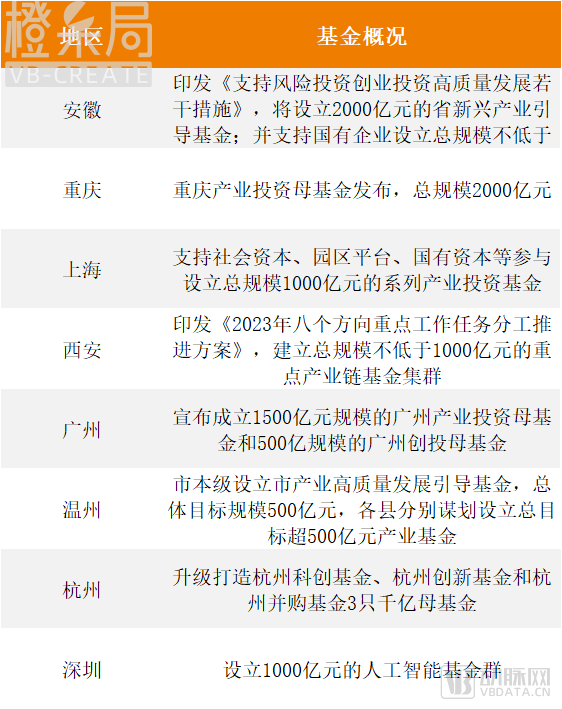
Overview of Selected Government-Guided Funds in 2023, Sourced from Public Information
Compared to the situation during the pandemic when investors had “no money to review deals,” the primary market in 2023 appears to show signs of revival. However,“Fundraising is difficult, and financing is hard to secure.”“It remains the current predicament in the primary market.” A professor focused on the commercialization of scientific research achievements stated in an interview with Chengguo Bureau, “Even though many government-guided funds have been launched recently, I still hear from many entrepreneur friends that fundraising is currently very difficult.”
This inevitably raises a question: What have government guidance funds contributed to the commercialization of scientific and technological achievements, and why do early-stage translation projects face financing difficulties? The reasons are as follows:When the investment industry as a whole is in a downturn, the commercialization of scientific and technological achievements is not a priority; only a few projects with innovative and translational value gain visibility.
When the Government Becomes the Primary LP
In fact, 2023 was an exceptionally challenging year for professionals across every industry. After three years of the pandemic, the overall economic outlook remained grim. The sudden lifting of restrictions brought a stark realization: shrinking end-user demand began to spread rapidly, sending shockwaves through every sector.
During this period, venture capital (VC) firms also struggled, with fundraising difficulties becoming the hottest topic.
One reason for the lack of funds among venture capital (VC) firms isPrivate capital weakens,Many large private limited partners (LPs) are beginning to transition toward managing their own investments, while on the other hand,The Great Retreat of U.S. Dollar LPs, US dollars, primarily from North American LPs, are accelerating their exit from the Chinese market.
“Private capital currently lacks vitality, and fundraising difficulties have become the norm. Some institutions have failed to raise any funds in the past two to three years. In 2022, not only RMB-denominated funds faced fundraising challenges, but US dollar funds investing in China also encountered similar difficulties,” said investor Tan Yi (pseudonym), bluntly describing the current plight facing venture capital and private equity firms.
This predicament persisted into 2023. According to data from Zero2IPO, in the first quarter of 2023, the number and total amount of newly raised funds in China’s VC/PE industry were 1,601 and RMB 353.212 billion, representing year-on-year declines of 7.6% and 33.0%, respectively. On the investment side, the market slowdown continued, with a total of 1,722 investment deals, a year-on-year decrease of 44.2%. The total investment amount reached RMB 130.030 billion, while early-stage investments plummeted by more than 60%.
“Investment institutions face fundraising difficulties, coupled with the impact of the pandemic in recent years, the overall economic situation is not optimistic, and it is common for institutions to hold cash and wait for opportunities, soEarly-stage funds have become more cautious..” said Zhang Shanliang, Managing Director of Hetang Venture Capital.
It is worth noting that while the sources of capital for domestic RMB funds have indeed diminished, a closer look at the venture capital sector reveals that government guidance funds and state-owned capital have instead surged.
“In terms of overall funding volume and sources, the government’s share has increased in recent years..” Tan Yi remarked. In recent years, state-owned capital’s participation in equity investment has gradually increased. Limited partners (LPs) such as government agencies, government-funded platforms, and government guidance funds have effectively leveraged their advantages of “large-scale, stable capital,” becoming a significant supporting force in the market.
According to data from Zero2IPO Research, the disclosed committed capital by government agencies and government-funded platforms exceeded RMB 420 billion in 2022, a year-on-year increase of 7.2%, with their share rising from 21.8% in 2021 to 26.9%. Government guidance funds maintained a stable investment pace in 2022, with committed capital exceeding RMB 100 billion, accounting for 7.1%. Looking at newly raised funds in 2023, state-owned managers accounted for 94.7% of funds with a size of over RMB 10 billion; for funds sized between RMB 1 billion and RMB 3 billion, and between RMB 5 billion and RMB 10 billion, the proportions were basically 67% and 77%, respectively. In the fund-of-funds sector, state-owned capital also accounted for 80%.
In reality, it is not easy for investment institutions to secure government funding. This is because,The government is not a pure LP.
“Government funding comes with more requirements than market-based capital,” said Tan Yi. Faced with a series of non-market-oriented demands from the government, many investment institutions have expressed mixed feelings—“love-hate” relationships. While they seek government funds, they must also contend with associated restrictions, such as local reinvestment mandates, participation in decision-making, and principal guarantees.
In today’s hyper-competitive market, where demand far outstrips supply, it is undeniable that the capital held by investment institutions is predominantly government-funded, thereby reshaping the rules of the game.
“Guidance funds still primarily invest through subsidiary funds.”
By leveraging the amplification effect from fund-of-funds to sub-funds, government guidance funds aim to mobilize more social capital into key industries and revitalize local economies. This is also the primary mechanism through which guidance funds facilitate the commercialization of scientific and technological achievements—Sub-Fund Investment。
This first requires the government to screen for outstanding General Partners (GPs) and assist them in project investment. According to a report by Zero2IPO Research, the due diligence conducted by government guidance funds on GPs covers five areas: management team, historical fund performance, fund investment strategy and its execution, decision-making mechanisms and risk control processes, and overall fund operations.
When government-guided funds screen for General Partners (GPs), team quality and past investment performance are the most critical factors. Generally, two types of GPs stand out in the competition.
One type isHeavily Vertical-Focused GPs, for example, Honghui Capital is an institution focused on investing in healthcare, covering the entire medical sector including the biotechnology industry chain (innovative drugs, CROs, bioengineering, etc.), health equipment (medical consumables, diagnostic equipment, etc.), and health consumption (chain hospitals, personal care, pet care, etc.). This type of investment firm has already established differentiated and prominent capabilities within the industry;
Another type isUniversity-Affiliated GPs, for example, Hetang Venture Capital, which leverages the abundant resources of Tsinghua University and adopts a “fund investment + incubation” model, specializes in investing in and incubating projects involving the commercialization of major scientific and technological achievements from universities, research institutes, and top-tier Grade A tertiary hospitals. Such investment institutions possess China’s premier repositories of original innovation resources and have accumulated extensive experience in technology incubation.
Both categories of GPs share a common characteristic:The fund manager has extensive information sources, enabling access to high-quality projects at the source, and demonstrates strong professionalism and influence.
During this period, funds dedicated to the commercialization of scientific and technological achievements began to emerge. Most of these funds are strategically aligned with research institutes and universities, focusing their investments on laboratory findings with market potential, pilot-scale R&D projects, major innovative outcomes that achieve breakthroughs in key core technologies, and projects facilitating the translation of scientific and technological achievements into applications within key industries and future-oriented sectors.
As early as 2011, the Ministry of Science and Technology and the Ministry of Finance jointly launched the nationalTechnology Transfer Guidance Fund. In 2021, the National Fund for Technology Transfer and Commercialization cumulatively established 36 sub-funds, with a total capital size reaching RMB 62.4 billion. In the recently concluded year of 2022, at least ten new technology transfer and commercialization funds of varying sizes were newly established or launched across various regions, with a combined scale approaching RMB 100 billion.
“This is one approach advocated by guidance funds to promote the translation of scientific and technological achievements, channeling private capital toward original innovation and technological innovation,” said Tan Yi.
In addition, there have been instances where governments have directly invested in projects for the commercialization of scientific and technological achievements. A joke circulating in the venture capital community goes, “They look down on projects above water, but cannot dig out those underwater; they do not understand early-stage projects, and cannot afford late-stage ones.” As general partners (GPs) show lackluster investment performance and face increasing difficulties in fundraising, not only have private limited partners (LPs) increasingly shifted toward direct investments, but state-owned capital and government guidance funds have also rushed into the primary market.
"Especially now, as slogans for translating scientific research achievements into practical applications are loudly promoted across various regions, government investment in such projects has become a more visible demonstration of political achievement. Coupled with successful cases like Hefei’s direct investment in NIO, many guidance funds have shown strong interest in direct investments."It is currently a window period for state-owned capital to make direct investments..” said Tan Yi.
However, compared with mature investment institutions, governments do not have many advantages in making direct investments. First, most government guidance funds lack direct investment talent and relevant experience, and thus do not possess the capability for direct investment. Second, government direct investment projects face higher risks. Under the existing institutional mechanisms, government guidance funds are not yet capable of bearing the corresponding investment risks, making them unsuitable for large-scale direct investment activities.
“At present, direct government investment remains relatively limited; generally speaking,”The model of government-guided funds investing in sub-funds is more efficient and secure..” said Zhang Shanliang.
Beyond Providing Capital, What Else Can Government Guidance Funds Do?
When it comes to funds, many people’s immediate association is financial support. As investors, governments indirectly channel cash flows to research institutions and enterprises, facilitating the translation of scientific achievements into marketable products and their subsequent commercialization. This funding not only alleviates the financial constraints faced by research projects and enterprises during the translation process but also enables them to more effectively carry out marketing activities and brand building, thereby enhancing their competitiveness in the market.
However, for government guidance funds, the functional positioning by local governments extends far beyond this. “If utilized properly, guidance funds can certainly play a positive role in helping local governments attract projects and talent, as well as upgrade industries,” said Zhang Shanliang. ““Guidance funds generally adopt a dual-pronged approach: providing financial support and attracting talent.”
Guidance funds typically collaborate with local governments and universities to introduce high-level talent during the process of technology transfer, thereby providing enhanced expertise and innovation capabilities. These high-caliber professionals often possess extensive research experience and practical skills, offering critical support for the market promotion and industrialization of scientific and technological achievements.
“The introduction of high-level local talent can be achieved by recruiting overseas returnees and outstanding researchers, as well as by collaborating with universities and research institutions to attract professionals from various fields. Additionally, talent can be brought in ‘by attracting enterprises,’ said Tan Yi. When introducing high-end talent, guidance funds typically provide corresponding financial support and policy incentives to attract more outstanding individuals to participate in the commercialization of scientific and technological achievements.”
Will the Translation of Scientific Research Achievements Become Easier?
# Why Are Government Guidance Funds Increasingly Active, Yet Commercialization of Scientific Achievements Remains Challenging?
In fact, government-guided funds can promote the transformation of scientific and technological achievements to a certain extent, making it easier for such projects to secure funding. As mentioned above, first, government-guided funds possess substantial financial resources and can provide capital support; second, they often come with talent recruitment services, facilitating the commercialization of local scientific and technological achievements.
However, despite the funding and policy support provided by government guidance funds, the commercialization of scientific and technological achievements remains challenging.
“We continue to adopt an allocation-based investment approach, with the commercialization of scientific research achievements constituting a significant component of our investment strategy.“Zhang Shanliang stated. It is understood that technology transfer projects from past investments account for approximately one-third of Hetang Venture Capital’s portfolio.”
“GPs should always consider matters from the LPs’ perspective. Simply put, while LPs also seek returns, projects involving the commercialization of scientific and technological achievements tend to have relatively long cycles and higher risks.”"In each fund, we adopt a portfolio approach that combines early-stage, mid-stage, and late-stage investments, with the aim of enabling LPs to realize returns earlier."“Zhang Shanliang stated.
From the perspective of investment institutions, the commercialization of scientific research achievements is merely a component of their investment portfolio. A higher proportion in this area only indicates a slightly greater degree of exploratory activity by the institution and is insufficient to influence its overall investment strategy.
Furthermore, although research outcome translation projects in the medical field demonstrate significant economic value, they themselvesIt is a capital-intensive and high-risk process., factors such as the technical feasibility of the research findings themselves, market prospects, and business models all influence whether they can be successfully transformed into commercialized products or services, which inevitably requires substantial capital investment for validation.
andGovernment Guidance Funds Have Limited Resources, there are also limits to the screening and funding of scientific research achievements. Therefore, not all scientific research achievements can receive support from guidance funds,Only truly valuable and genuinely innovative translational projects will be seen.