

To AI or Not to AI: Recursion Embraces Generative Models While Schrödinger Downplays the Label Amid Evolving Market Sentiment
Recent news about AI-driven drug discovery has been somewhat contradictory: on one hand, Recursion secured a $50 million investment from NVIDIA, the current darling of the AI world; on the other, Schrödinger, regarded as one of the “star companies in AI-driven drug discovery,” claims that it is not an AI company.
Since 2022, enthusiasm for technology-platform biotech companies in the capital markets has waned. AI-driven drug discovery firms remain some distance away from demonstrating revolutionary capabilities and scalable business models, while the pharmaceutical industry has continued to view the actual utility of AI with skepticism. Alex Zhavoronkov, CEO and founder of Insilico Medicine, once stated, “About ten years ago, every time I approached venture capitalists for funding, they never gave me money.” This remark may once again hold some relevance today.
“Using Complexity to Solve Complexity”: AI-Driven Drug Discovery Has Yet to Find a Way to Advance Pipelines to Later Stages of Clinical Trials. According to data from Zhiyaoju, among the 80 AI-driven drug pipelines globally approved for clinical trials, only 29 have advanced to Phase II clinical trials, with none progressing to later stages. Nevertheless, the rapid development of AI cannot be overlooked, particularly this year’s explosion of AI applications represented by OpenAI and Bard, the day-to-day advancements in large language models (LLMs), and the continuous emergence of new companies centered on AI technology.
Some companies are shedding the AI label to emphasize computing and pharmaceuticals,Schrödinger’s stock price has surged nearly 200% over the past year, driven by sustainable revenue from computational software and R&D collaboration payments with multiple partners, even as technology platform companies fall out of favor.
Some companies are still spinning AI “stories” and continuing to iterate and update.It also received a positive response from the market. NVIDIA’s investment, labeling it an “AI winner,” sent Recursion’s shares soaring in the secondary market and boosted a host of AI-driven innovative drug companies whose stock prices had been sluggish for a long time.
Perhaps both paths will be viable in the future, but it is already clear that the concept of AI-driven drug discovery is being reevaluated.
Recursion: If It’s True AI, Bet on Large Models
Recursion is a unicorn company that many AI-driven pharmaceutical firms seek to emulate. Its CEO, Chris Gibson, states that Recursion gains insights into biology, chemistry, and their interactions by analyzing the entire genome and over one million compounds. The company has conducted nearly 200 million experiments in its proprietary large-scale automated laboratories, predicted 4 trillion relationships, and stored them within a web-based application.
Recursion’s approach is unprecedented in the traditional pharmaceutical industry, with its biological and chemical datasets exceeding 23 petabytes (PB). Jensen Huang, founder and CEO of NVIDIA, stated that Recursion is developing the world’s largest generative AI model for biomolecules. The two companies will subsequently collaborate to develop and optimize the model, delivering it to other biotech firms via NVIDIA’s cloud services.
Some argue that the favorable momentum in AI-driven drug discovery is less about the sector itself gaining favor and more about NVIDIA, the “AI shovel seller,” continuing to expand its application scenarios and customer base. NVIDIA’s investment in Recursion proved highly cost-effective: Recursion received a $50 million investment and used $40 million of it to purchase AI chips from NVIDIA. In return, NVIDIA acquired approximately 4% equity stake in Recursion, secured a large order, and made another forward-looking strategic move in the biotech sector—betting on breakthroughs by large models in new molecule generation, particularly in generating novel molecules based on spatial structural data.
“Constrained by the pace of technological advancement, the efficiency of biopharmaceutical R&D has long remained suboptimal. AI represents a significant variable; large language models hold the potential to be a ‘game changer’ in the field of novel molecule generation, enabling the development of drugs targeting sites that are intractable with traditional methods. However, it remains uncertain whether existing data can support the development of the desired large models. This is particularly challenging given the multimodal nature of data in biopharmaceutical R&D and the difficulty of effectively normalizing and integrating such data. Furthermore, data silos persist across different companies’ R&D efforts, and generating high-quality data from scratch also requires considerable time,” stated Dr. Shen Yuan from BlueRun Ventures.
Currently, Recursion has three AI-driven drug candidates in Phase II clinical trials for the treatment of cerebral cavernous malformations, neurofibromatosis type 2, and familial adenomatous polyposis. Additionally, more than 10 projects targeting rare diseases, oncology, neuroscience, and immunology are in the early discovery stage.
Recursion’s grand vision is to advance its AI pipeline across all domains, but Chris Gibson himself has warned that “we must be wary of those who peddle hype, as they are tarnishing the field.” He believes that even though AI is a highly useful tool, it will not eliminate the need for laboratory scientists.
Schrödinger: It’s the Computing, Not AI, That Is Revolutionary
Schrödinger is a leader in leveraging new technologies to accelerate drug discovery. As early as 2021, NVIDIA announced a collaboration with Schrödinger to “further expand its influence in the AI healthcare sector.”
Schrödinger has spent decades developing software that leverages physics, machine learning techniques, and computing to simulate atoms and molecules, thereby accelerating drug discovery. The company has invested substantial resources, employing more than 200 scientists to continuously improve its computational software.
After years of iterative development, Schrödinger has created an exceptional molecular force field, which has become a significant competitive moat for the company. Molecular force fields are key to explaining how drugs interact with biological systems, helping to predict drug efficacy and guide the drug design and development process. Although an increasing number of pharmaceutical companies are seeking to explore new avenues for drug discovery through computational methods, no company has yet demonstrated that its molecular force field surpasses Schrödinger’s. This is precisely why the company has been able to sustain revenue growth exceeding 30%.
For this very reason, Schrödinger emphasizes that it is not an AI company; its strength lies in physics rather than in leveraging artificial intelligence.
One of Schrödinger’s major achievements in recent years is the TYK2 inhibitor co-developed with Nimbus, a company it founded, which was acquired by Takeda for $6 billion. TYK2 inhibitors are members of the Janus kinase (JAK) family and are associated with immune-mediated diseases, including rheumatoid arthritis, psoriasis, inflammatory bowel disease, and lupus.
TYK2 inhibitors were once hailed as “AI-driven drug discovery,” but in fact, they were developed by Schrödinger and Nimbus through Free Energy Perturbation (FEP) calculations to optimize molecular structures based on those published by Bristol Myers Squibb (BMS). FEP calculations can predict changes in relative binding free energy among homologous compounds and, benefiting from the rapid advancement of computational power in recent years, have become a mainstream method for studying free energies in drug design.
Schrödinger is a key driver of FEP calculations; AI-driven drug discovery companies such as Shuodi Biopharma, as well as major pharmaceutical firms like Eli Lilly and Sanofi, frequently collaborate with Schrödinger by leveraging its commercial FEP tool, “FEP+.”
Schrödinger’s use of AI lies in integrating its computational software with machine learning, a approach that is faster and more precise than traditional methods for predicting the molecular properties of new drugs and materials. However, the company takes a cautious view of AI’s potential: machine learning can only build predictive models based on knowledge derived from training data, covering merely a “tiny fraction” of the total number of molecules that could potentially be developed. Similarly, generative AI can only recombine existing knowledge in novel ways, rather than producing entirely new outputs.
In Schrödinger’s view, AI is a general-purpose tool capable of accelerating drug discovery and development. Nimbus Therapeutics and Schrödinger share a common vision; rather than defining their platforms primarily through AI and related buzzwords, the companies prefer to emphasize the critical role of medicinal chemists in drug development and the guiding position they hold over AI applications.
AI Labels: To Adopt or Not?
The promise of AI in the LLM era for various industries lies in transforming the traditional paradigm of technological development. Previously, the themes and spatiotemporal dimensions of industry, academia, and research were fragmented, with a lengthy chain separating scientific discovery from commercial deployment. LLM technology, however, may usher in a new paradigm that truly integrates industry, academia, and research.
But can the paradigm of clinical pharmaceuticals be transformed in this way?
Currently, it is clearly impossible for AI to directly produce drugs; its primary role is to empower the identification of more scientific and efficient clinical trial protocols, thereby “reducing costs and increasing efficiency” in new drug development. While integrating AI technologies at various stages has become standard practice for multinational corporations (MNCs) and biotech companies alike, a significant gap remains between AI and clinical science. In drug development, the quality of decision-making is more critical than speed or cost. Formulating the right questions and clearly defining problems and clinical endpoint metrics is no easy task, even for experienced R&D professionals, clinicians, or seasoned Chief Medical Officers (CMOs).
In the process of exploring business models and positioning within the industrial chain, domestic AI drug discovery companies have also diverged into different strategic niches. Some emphasize their identity as being driven by large AI models, while others highlight their strengths in areas such as molecular dynamics and computational chemistry beyond their AI capabilities. Still others have expanded their operations into the energy or materials sectors.
Pharmaceutical companies and biotech firms are more inclined to claim that they have leveraged AI technologies or employed automated laboratories in the drug manufacturing process, so as to demonstrate the efficiency of their R&D.
Regardless of whether AI labels are applied, these companies aim to highlight the strengths of either AI firms or pharmaceutical companies, rather than concentrating on the vulnerabilities of both.
Dr. Shen Yuan concluded, “The market has higher expectations for the certainty of business models among AI-driven pharmaceutical companies; simply pitching a platform narrative is no longer sufficient to gain recognition. Companies must either excel in service delivery, securing sustainable orders from top-tier clients, or operate as biotech firms that deliver high-quality drug molecules—those difficult to screen or generate using traditional methods—backed by robust preclinical or even clinical data.”
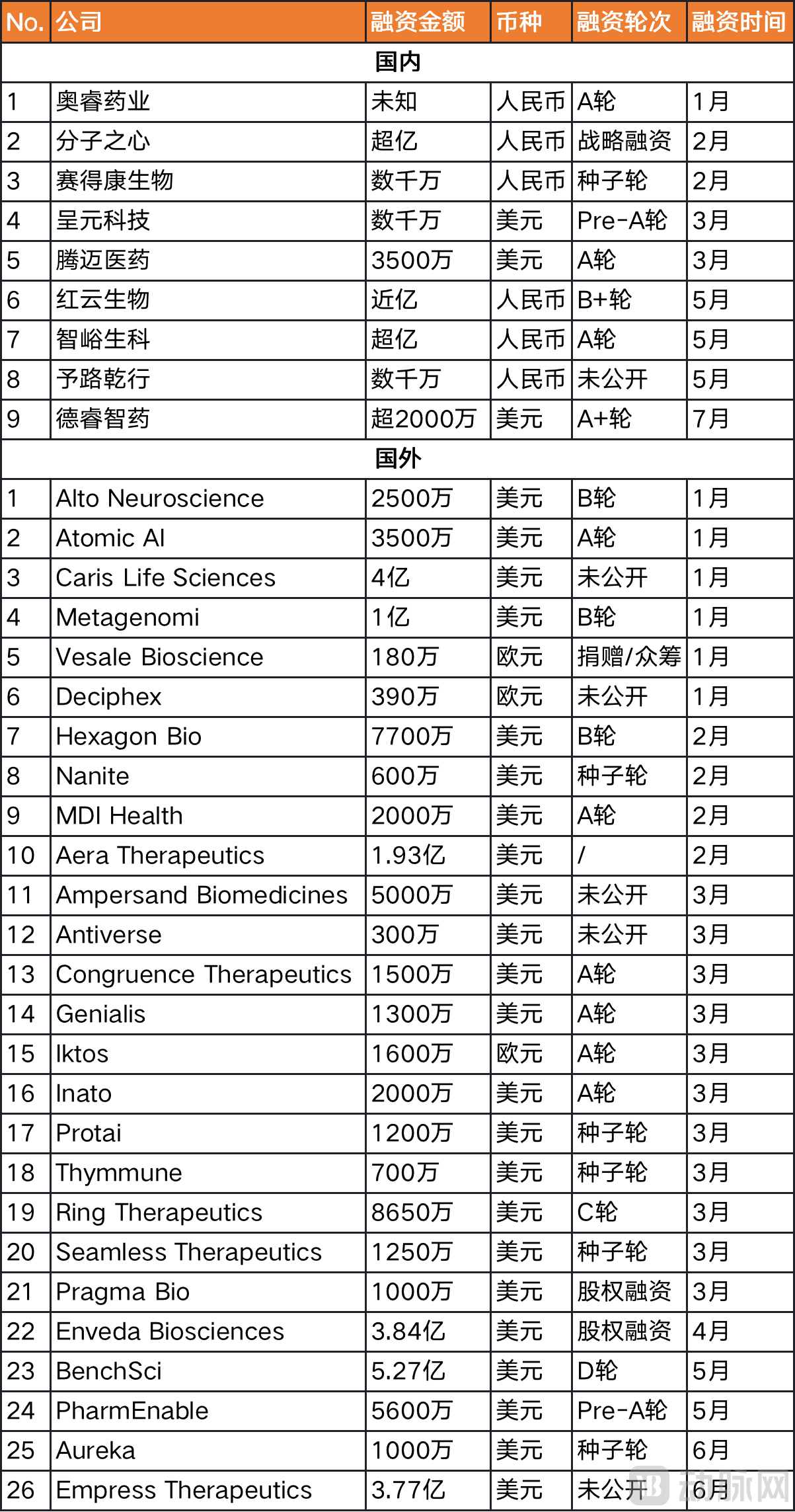
Appendix: Financing Status of AI-Driven New Drug Companies in China and Abroad in 2023
References:
1. WaveAndParticle:OverseasAI-Enabled LifeAppreciation of Pharmaceutical Companies (VIII): The King of FEP, Schrödinger
2. Selaginella99: AI-Designed MoleculesHow does it perform in clinical practice?