

Why Are CXO Firms Like WuXi XDC, Viva Biotech Shanghai, and GenScript BioSpa Pursuing Spin-off Listings in 2026?
WuXi XDC
End-to-End CDMO Service Provider for Biologics Conjugation Drugs
Recently, news that WuXi Biologics plans to spin off WuXi XDC for a listing in Hong Kong has drawn attention.
WuXi XDC, established in December 2020, is a CRDMO enterprise specializing in end-to-end services for bioconjugate drugs such as antibody-drug conjugates (ADCs). For its Hong Kong IPO, WuXi XDC has appointed Morgan Stanley, Goldman Sachs, and JPMorgan Chase as joint sponsors. In addition to these top-tier institutions, the company is backed by two major entities within the WuXi AppTec ecosystem. According to the prospectus, WuXi Biologics currently holds approximately 60% of WuXi XDC’s shares directly, while the remaining approximately 40% is held by STA Pharmaceutical, a subsidiary of WuXi AppTec.
Since WuXi AppTec delisted from the New York Stock Exchange in 2015, the WuXi AppTec ecosystem has successively spun off five publicly listed companies to date:
WuXi AppTec subsidiary, April 2015WuXi STAListed on the National Equities Exchange and Quotations (NEEQ); in June 2017, WuXi AppTec’s wholly-owned subsidiaryWuXi BiologicsListed in Hong Kong; May 2018,WuXi AppTecListed on the A-share market, WuXi AppTec also achieved a listing on the Hong Kong Stock Exchange in December of the same year; in November 2020, its subsidiaryWuXi JienuoListed in Hong Kong; on July 9, 2023, according to documents from the Hong Kong Stock Exchange,WuXi XDCListing application submitted to the Hong Kong Stock Exchange.
Through multiple spin-offs and listings, WuXi-affiliated companies have secured a significant foothold in China’s pharmaceutical sector. At their peak, the combined market capitalization of WuXi-affiliated listed companies approached RMB 1 trillion.
Amid the ADC Fever,Why Did WuXi Biologics Choose to Spin Off WuXi XDC for Listing at This Juncture?
In addition to WuXi XDC, Viva Biotech recently announced that it would consolidate its other domestic and overseas CRO assets into Shanghai Viva Biotech for future independent operation and an A-share listing. Earlier this year, GenScript ProBio completed a $220 million Series C financing round. It is understood that GenScript also intends to spin off its CDMO business this year.Spin-offand listed on the A-share market.
The spin-off listing of pharmaceutical companies seems to have become a trend,Why Have CXO Companies Been Eager to Spin Off and List Since the Beginning of This Year? What Signals Does This Send to Investors?
“Icebreaking” or “Setting Sail,”
Why spin off and list at this juncture?
Why Did WuXi Biologics Choose to Spin Off WuXi XDC for an IPO at This Juncture? Is It Setting Sail Amid the Current ADC Boom, or Breaking the Ice in a Capital Winter?
Focusing first on the XDC sector where WuXi XDC specializes, the field of bioconjugate drugs has seen frequent major deals and strategic moves in recent years. Industry leaders such as Pfizer, GSK, Merck & Co., and Daiichi Sankyo have all announced projects worth hundreds of millions or even billions of dollars over the past one to two years.
In terms of market size, according to Frost & Sullivan data, the global market for antibody-drug conjugate (ADC) drugs is projected to grow from $7.9 billion in 2022 to $64.7 billion in 2030, representing a compound annual growth rate (CAGR) of 30.0%. Regarding clinical programs, as of the end of May 2023, there were 134 XDC products (excluding ADCs) undergoing clinical trials globally; as of the end of March 2023, 222 ADC candidates had entered clinical stages globally. At this year’s American Society of Clinical Oncology (“ASCO”) Annual Meeting, more than 100 abstracts related to ADCs were presented by the industry.
According to industry insiders, “compared with the outsourcing rate of over 30% for biologics, the outsourcing rate in the ADC field can reach 70%.”“Because ADC molecules are highly complex, preclinical and clinical data cannot be correlated; without advancing to Phase III clinical trials, it is essentially impossible to determine whether an ADC will succeed.”
The large number of bioconjugates in clinical development, along with a 70% outsourcing rate for ADCs, highlights the immense potential of the XDC market.
China has emerged as a leader in the field of antibody-drug conjugate (ADC) development, occupying a prominent position in the global market. In recent years, China has been the primary licensor in outbound ADC licensing deals, with 35 transactions recorded from 2022 to May 2023, compared to 25 transactions from the United States during the same period.
According to the prospectus, from 2022 to June 30, 2023, a total of 10 Chinese pharmaceutical and biotechnology companies entered into 14 outbound licensing deals for antibody-drug conjugates (ADCs) with overseas partners, with a combined value of up to $22 billion.Among these 10 Chinese companies, 8 are clients of WuXi XDC.
Leveraging its comprehensive one-stop service platform for bioconjugate drugs, WuXi XDC’s share of global market revenue rose from 1.8% in 2020 to 4.6% in 2021, and further increased to 9.8% in 2022. According to Frost & Sullivan data, by the end of 2022, WuXi XDC had a total of 94 ongoing projects, accounting for more than 35% of the total number of global outsourced bioconjugate drug projects in the same year. Its customer base expanded significantly from 49 clients in 2020 to 167 clients in 2022.
As of the end of May 2023, WuXi XDC has secured all ADC development contracts in China for ADC candidates that have filed dual IND and/or BLA submissions in both China and the United States.
The steady stream of orders has naturally generated substantial revenue for WuXi XDC. For the years ended December 31, 2020, 2021, and 2022, and for the three months ended March 31, 2023, WuXi XDC’s revenues were RMB96.4 million, RMB311.1 million, RMB990.4 million, and RMB487.6 million, respectively. During the same periods, its net profits were RMB26.3 million, RMB54.9 million, RMB155.7 million, and RMB80.7 million, respectively.
Ranked by 2022 revenue and the total number of ADC and other bioconjugate drug projects, WuXi XDC isThe World's Second LargestCRDMO for Bioconjugate Drugs such as ADCs,China's LargestCRDMO for Bioconjugated Drugs Such as ADCs.
In addition to the revenue currently disclosed, as of May 31, 2023,WuXi XDC has $373 million in outstanding orders.
It is easy to see that, as a CRDMO in the XDC field, WuXi XDC has immense potential for growth amid this surge of enthusiasm.At this point, spinning off WuXi XDC would allow for a compelling narrative with significant upside potential, both in terms of market buzz and commercial prospects.
Of course, WuXi XDC’s spin-off and listing plan is also built upon the successful model established by the prior spin-off and listing of WuXi Biologics. Past evidence has demonstrated that WuXi Biologics better realized its intrinsic value following its spin-off. It is evident that WuXi XDC will achieve faster and superior growth as an independent entity than it would have remained within the WuXi system.
On the other hand, influenced by macroeconomic factors, global financing in the biopharmaceutical sector has declined. As key service providers to the industry, domestic pharmaceutical CXO companies have seen a slowdown in performance growth this year, with the sector facing downward pressure in the short term. As a large-scale CRDMO enterprise, WuXi XDC has a global order portfolio; while its performance may not face existential threats, its overall pace of development is likely to slow due to the broader economic environment.
WuXi Biologics is a company with 12,000 employees, where internal resource allocation follows prioritized tiers. If WuXi XDC were to develop within this system, decision-making would inevitably become slower, hindering its growth. As an independent business unit, WuXi XDC can accelerate its own development internally; its 800-strong team enables faster decision-making and the ability to seize more opportunities.
Moreover, WuXi Biologics will maintain its controlling stake in WuXi XDC, allowing it to financially benefit from WuXi XDC’s business growth while ensuring WuXi XDC’s independent development and maximizing its growth potential.
Following the spin-off listing, WuXi XDC will rapidly expand its production capacity in the next phase.
First, WuXi XDC will expand the production capacity of its home base in Wuxi. Its future capacity will cover a full range of products from antibody intermediates to finished drugs, achieving self-sufficient operations and meeting the demands of multiple late-stage bioconjugate drug development and manufacturing projects. Currently, WuXi XDC is constructing additional facilities in Wuxi for clinical or commercial production. According to the prospectus, these facilities are scheduled to commence GMP-compliant operations this year.
Outside of China, WuXi XDC also plans to establish a manufacturing facility in Singapore, which will comprise four production lines for clinical and commercial manufacturing. Currently, WuXi XDC has begun the design phase for this facility and expects to commence GMP-compliant operations by 2026.
Behind the Spin-off Listing
Beyond the WuXi group, numerous domestic pharmaceutical companies have chosen to spin off and list in recent years.Leading Chinese pharmaceutical companies such as Kelun, Viatris, Huapont, and GenScript have all undertaken spin-off listings in recent years. Among them, companies like Kelun and Huapont have spun off more than one subsidiary for separate listing.Public records indicate that Kelun has spun off and listed Chuanning Biotechnology and Kelun-Biotech, while Huapont has spun off and listed Nutrichem and Kaisheng New Materials. GenScript has spun off and listed Legend Biotech, and also holds controlling stakes in ProMab Biotechnologies and Bestzyme.
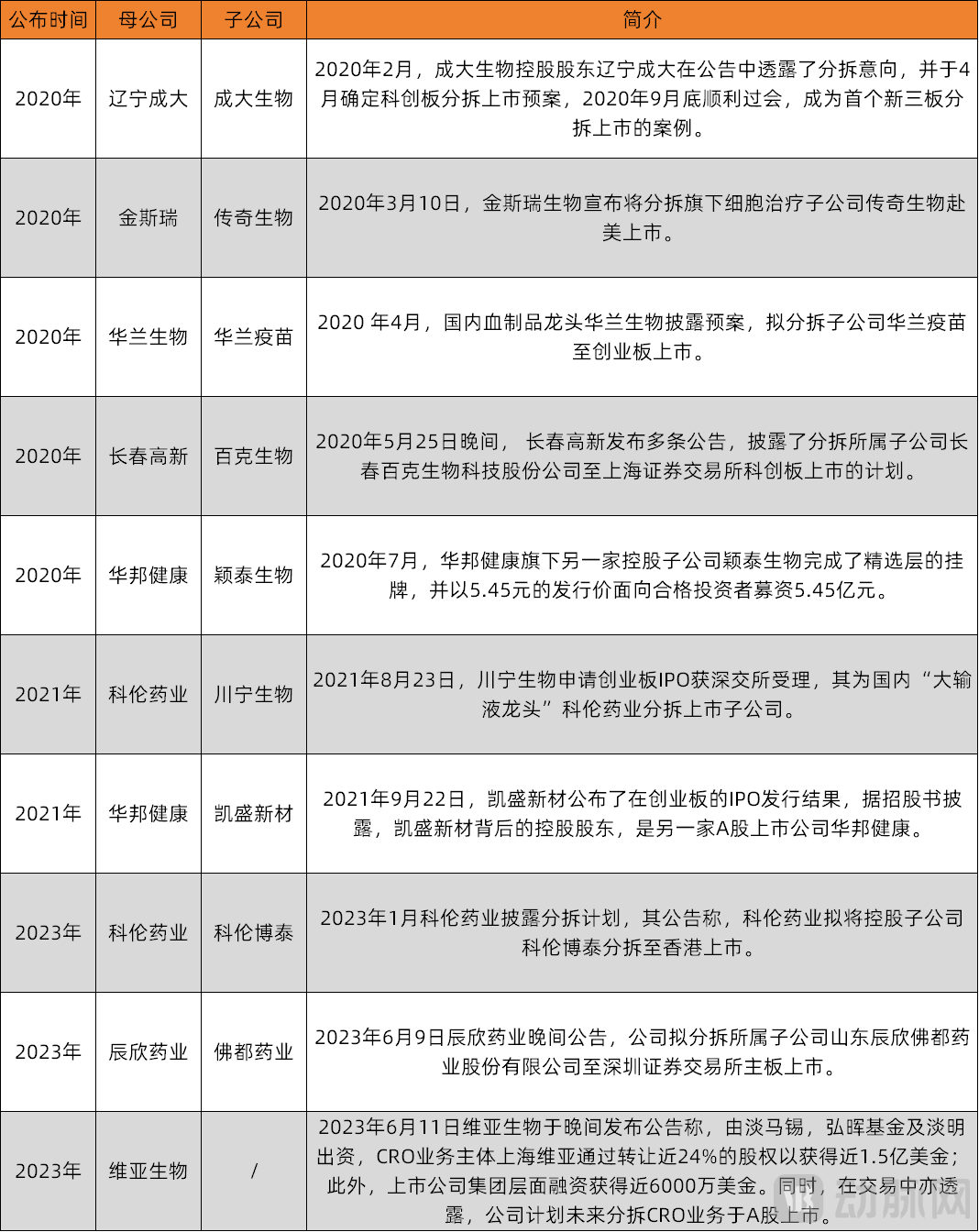
Pharmaceutical Companies Listed via Spin-offs in China Since 2020 (Source: Public Information)
According to incomplete statistics, since 2020, there have been 10 cases in China where companies announced spin-off plans, excluding those from the WuXi AppTec group. Among these, it is not uncommon for a single enterprise to pursue multiple spin-off listings within a few years.
Spin-off listings appear to be becoming a trend.Since the beginning of this year, this trend has been particularly evident in the CXO industry.
As previously mentioned, after the spin-off, subsidiaries can achieve faster and better development, while parent companies can also obtain favorable returns through their shareholdings. This is perhaps the primary reason why most pharmaceutical parent companies choose to spin off their subsidiaries for independent listing.
In addition to securing favorable future returns, inAmid the current downturn in the capital markets and the biopharmaceutical industry,Spin-off listings may also help resolve some of the challenges faced by pharmaceutical companies.
Taking WuXi Biology, a leader in the CRO niche sector, as an example, its market capitalization plummeted from a peak of HK$20 billion to HK$2 billion, representing a nearly 90% decline in share price. Coupled with substantial debt maturing within the year, this has led to a significant undervaluation of WuXi Biology’s stock.
To resolve its debt crisis, Viva Biotech announced on June 11 that it had secured nearly $150 million in investment from strategic investors Temasek, HHLR Fund, and Danming by transferring nearly 24% of the equity in its CRO business, at a pre-money valuation of approximately RMB 4.388 billion. Furthermore, the announcement revealed that Viva Biotech plans to spin off its CRO business for a separate listing on the A-share market in the future.
Through internal restructuring and the divestment of equity stakes in core subsidiaries, Viva Biotech has ultimately resolved this debt crisis. Once the liquidity crisis facing the listed company is eliminated, its equity value is poised for significant appreciation in the short to medium term, provided it successfully completes a spin-off listing on the A-share market.
Thus, spin-off listings also provide investment institutions with a new round of entry opportunities.
Earlier this year, GenScript ProBio completed a $220 million Series C financing round,It is understood that behind thisGenScript Biotech aims to spin off its CDMO business for a separate listing on the A-share market. This undoubtedly presents funds with an excellent opportunity to enter and continuously increase their positions. The Series C financing round of GenScript ProBio was led by Legend Capital, with participation from Honghui Fund, C&D Emerging Investment, Lianxin Capital, the Service Trade Innovation Development Guidance Fund, Huatai Zijin, GF Xinde, and Industrial Securities Guoxin. Existing shareholder Hillhouse Investment also participated again in this financing round.
Overall, CXO companies such as WuXi AppTec, Tigermed, Porton Pharma, Pharmaron, Medicilon, and Joinn Laboratories,As the “water sellers” of the pharmaceutical industry, they are inevitably affected by capital market fluctuations and industry cycles, yet their long-term value continues to be favored by professional institutional investors.