

Beyond GLP-1: Lilly, Ionis, and Vertex Bet on Next-Gen Metabolic Disease Therapies
This year has seen a surge of excitement in the metabolic disease field. Not only have GLP-1 therapies continued to deliver strong performance, as evidenced in the quarterly reports of multinational corporations (MNCs), but biotech companies focused on metabolism have also repeatedly garnered market favor.
GLP-1 Drugs: Efficacy Is Clear, but Safety Concerns Remain Unresolved:The EMA has indicated that GLP-1 receptor agonists may be associated with an increased risk of thyroid cancer and has required Eli Lilly, AstraZeneca, and Sanofi to submit supplementary information on these drugs by July 26. Subsequently, following reports of suicidal ideation in patients using these medications, the EMA announced the initiation of a review of three Novo Nordisk products: Ozempic, Saxenda, and Wegovy.
Furthermore, companies are actively developing oral formulations with higher compliance and better efficacy. However, once-daily oral formulations require greater attention to safety issues compared to once-weekly injectable formulations. Taking semaglutide as an example, the dose of the oral version is nearly 100 times higher than that of the injectable version.
At present, long-term medication remains unavoidable; however, with advances in stem cell therapy, small nucleic acid drugs, and gene editing technologies, the industry is pursuing a “one-and-done” solution for metabolic diseases.
In June this year, CellTrans’s cell therapy drug Lantidra was approved for marketing by the U.S. FDA, marking theThe world’s first approved allogeneic islet cell therapy derived from pancreatic cells,For the treatment of type 1 diabetes.
Just yesterday, Roche licensed Alnylam’s RNAi therapy for hypertension, Zilebesiran, for $2.8 billion, transforming the antihypertensive regimen from twice-daily dosing to just two administrations per year.“Obesity + siRNA Brings MNCs Back to the Metabolic Space.”An industry insider pointed out.
Eli Lilly has already taken the lead in market capitalization through its existing marketed GLP-1 drugs and multiple drugs under development,However, fully aware of the potential impact of innovative therapies on existing drugs, therefore inIntensified Investment in Metabolic Health Assets:including the $1.925 billion acquisition of Versanis Bio, a biotech company focused on developing novel drugs for cardiometabolic diseases; the $300 million acquisition of Sigilon Therapeutics to bolster the development of cell therapies for diabetes; and a total commitment of $525 million to partner with Verve Therapeutics on in vivo gene editing therapies targeting Lp(a).
In the long race within the metabolic disease field, can these innovative therapies emerge as winners? Which approach holds greater advantages or deserves more attention? Are there any Chinese companies participating in this competition?
Islet Cell Therapy: Striving to Break Free from Immunosuppressants
Stem cell therapy leverages the capacity of stem cells to undergo multipotent differentiation and proliferation under specific conditions. By inducing their differentiation into insulin-secreting beta-like cells, this approach aims to regenerate and enhance islet cell function, ultimately achieving a cure. Furthermore, stem cells participate in immunomodulation and the induction of immune tolerance, thereby helping to restore immune homeostasis within the pancreatic islets. Numerous pharmaceutical companies are striving to establish a presence in this field. Currently, major players such as Eli Lilly, Novo Nordisk, and Sanofi, along with biotechnology firms including Vertex, ViaCyte, Sernova, AltuCell, Semma Therapeutics, and Beta-O2, have all made strategic investments in this area.
Among the most closely watched products in development isVertex’s VX-880, an allogeneic stem cell-derived, fully differentiated, insulin-secreting islet cell therapy.Vertex reported that all six patients with type 1 diabetes who received VX-880 therapy in the Phase I/II study produced endogenous insulin, with two patients able to discontinue insulin therapy after receiving VX-880 treatment for at least one year.
However,VX-880 requires long-term immunosuppressive therapy to prevent cellular rejection.This also represents a major challenge in islet cell therapy. Even with outstanding efficacy, patients still require immunosuppressants to prevent immune rejection. Moreover, immunosuppressants may increase the risk of adverse events such as infections, tumors, and renal impairment, necessitating regular examinations and monitoring. A patient with long-standing diabetes remains under the threat of prognosis-related risks associated with immunosuppression, even after 40 years.
Therefore,Vertex has also developed VX-264, in which islet cells are encapsulated within a “channel array device” designed to protect the cells from the human immune system,VX-264 is designed for surgical implantation and received IND approval in March of this year. However, the encapsulation device materials may limit the cells’ ability to respond to blood glucose levels.
Lantidra, which has been approved by the FDA, also faced multiple questions from the FDA before its launch. The clinical trials for Lantidra included two phases of non-randomized, single-arm studies, with a total of 30 patients participating. Among them, five subjects did not respond well and were unable to discontinue insulin use. Additionally, most participants experienced at least one serious adverse event related to immunosuppressive therapy. Therefore, the FDA experts convened an advisory committee meeting to discuss the robustness of Lantidra's clinical data and its safety profile.
“Cell therapies derived from stem cells may also cause teratomas.” Dr. Yan Shunfei of Lingang Lanwan Capital pointed out, “Diabetes does not directly lead to patient death; it merely complicates daily life. However, teratomas induced by incompletely differentiated stem cell therapies pose a serious risk. There have been previously reported cases, and such a cost is excessively high.”
“Meanwhile, insulin delivery methods are becoming increasingly advanced. For instance, companies like Medtronic are developing artificial pancreas systems (closed-loop CGM and insulin pump systems), which offer efficient, safe, and cost-effective solutions. In contrast, islet cell therapy is expensive, and its safety and efficacy still require long-term validation; patients will inevitably weigh the economic considerations and the risk-benefit profile to determine whether it is worthwhile.”
The annual treatment cost of Lantidra is expected to average over $300,000, excluding the cost of immunosuppressants.
None of these have dampened the momentum behind islet cell therapy. The day after Lantidra’s approval, Eli Lilly announced it would acquire Sigilon Therapeutics for more than $300 million. Sigilon will collaborate with Eli Lilly to develop encapsulated cell therapies for the treatment of type 1 diabetes.
Domestic companies have also begun to enter this field. Yisheng Biotech, founded in 2021, has established a drug pipeline based on pluripotent stem cell-derived islets (ESN5800) and has developed an encapsulation technology that combines biomaterials for the production of islet or other cell-like products.
Gene editing remains in its very early stages
Cell therapy and gene editing are closely related. In February 2022,CRISPR Therapeutics and ViaCyte’s VCTX210 made history by performing the first human transplantation of gene-edited, stem cell-derived pancreatic cells to treat type 1 diabetes.ViaCyte has been acquired by Vertex.
VCTX210 utilizes CRISPR gene-editing technology to knock out the expression of proteins involved in T-cell-mediated attacks, thereby protecting transplanted cells from immune rejection. This means that patients receiving VCTX210 cell therapy do not require immunosuppressants. Currently, dosing has been completed in the Phase I clinical trial evaluating the safety and tolerability of VCTX210 for the treatment of type 1 diabetes.
Another biotech company, Genprex, published the results of an animal study in February 2023, introducing its pipeline candidate GPX-002, which explores a gene-editing approach for treating type 1 diabetes.
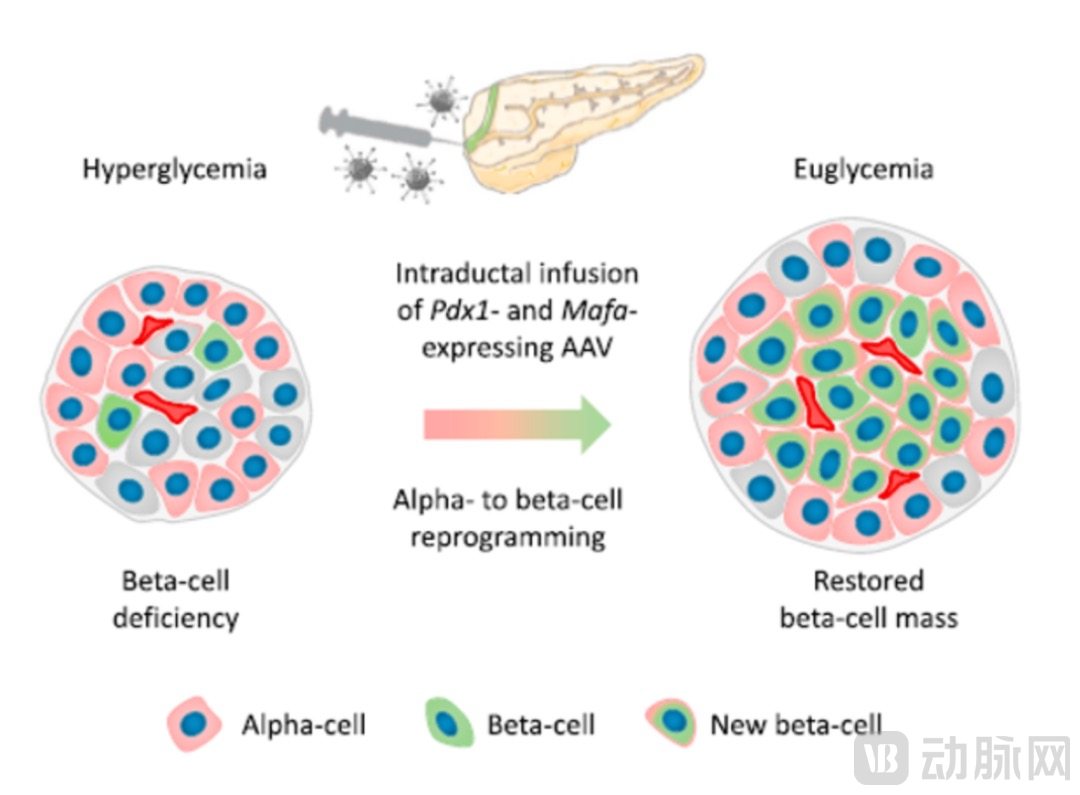
Schematic Diagram of the Mechanism of GPX-002
GPX-002 uses an AAV vector to deliver the Pdx1 and MafA genes to the pancreas,The proteins expressed by these two genes can convert pancreatic alpha cells into functional beta-like cells. These beta-like cells are capable of producing insulin but differ significantly from native beta cells, allowing them to evade the human immune system. In animal studies, GPX-002 restored blood glucose levels in diabetic mice to normal ranges and maintained this effect for four months.
In the field of gene therapy for lipid lowering, recent significant news comes from Eli Lilly, which has placed a $525 million bet on its collaboration with Verve Therapeutics for in vivo gene editing therapies targeting lipoprotein(a) [Lp(a)]. Verve will advance the development of the Lp(a) program by completing Phase 1 clinical development. Eli Lilly will be responsible for the subsequent development, manufacturing, and commercialization of the Lp(a) program.
One of the most closely watched pipelines in the lipid-lowering field was Verve’sVERVE-101, a PCSK9-targeting therapy for the treatment of heterozygous familial hypercholesterolemia,The first patient was dosed in July 2022. According to the company, the drug can “prevent heart disease with a single injection,” but it was put on clinical hold by the FDA last December. VERVE-101 combines in vivo editing and base editing capabilities, prompting the FDA to require Verve to provide additional safety data.
Gene editing therapies are more potent, but altering the genomic architecture carries various risks of mutations or carcinogenesis. Currently, many metabolism-related gene therapies remain in very early stages, far from market approval and the FDA’s requirement for 15 years of post-treatment follow-up. For metabolic diseases that do not directly threaten patient survival, it remains questionable whether gene therapies—offering a potential one-time cure but entailing higher potential risks and costs—will be favored.
Oligonucleotides: More “Grounded and Reliable”?
For chronic diseases, small nucleic acid drugs offer significant advantages: due to their long half-life in the human body, they typically allow for dosing once every six months to a year, greatly improving patient adherence. Currently, five siRNA therapies have been approved for marketing, treating rare and common liver-driven metabolic diseases.
As the first small nucleic acid drug targeting hyperlipidemia, a common condition, inclisiran saw its revenue surge by 833% to $112 million in 2022 after entering the U.S. market. This siRNA therapeutic, which targets PCSK9, provides sustained efficacy for six months following a single injection. More recently, zilebesiran, an RNAi therapeutic developed by Alnylam and Roche, has emerged as a potential game-changer in hypertension management. These developments underscore the growing appeal of small nucleic acid drugs.
“The modality of small nucleic acid drugs is highly promising, offering excellent target specificity and selectivity. Moreover, several small nucleic acid therapeutics have already received regulatory approval, demonstrating a favorable safety profile. In terms of efficacy, long-term follow-up data for Inclisiran, for instance, show an average 44.2% reduction in LDL-C over four years, which is sufficient for the majority of patients. Currently, marketed small nucleic acid drugs with robust clinical data primarily target lipid and cholesterol metabolism. Future approvals may expand into areas such as weight management and glycemic control, potentially even exploring combination therapies with GLP-1 receptor agonists,” stated Dr. Yan Shunfei.
Ionis, a leader in small nucleic acid therapeutics, is currently developing aASO Therapy Targeting the Glucagon Receptor: IONIS-GCGRRxGlucagon is a hormone secreted by pancreatic alpha cells that counteracts the effects of insulin and increases hepatic glucose production. In patients with type 2 diabetes, elevated glucagon levels contribute to fasting hyperglycemia. Glucagon may also play an important role in lipid metabolism.
Phase II clinical trials conducted in patients with type 2 diabetes receiving metformin therapy demonstrated that IONIS-GCGRRx significantly reduced glycated hemoglobin (HbA1c) levels.
Currently, Ribo Life Science has secured exclusive rights for the research, development, and commercialization of this drug in China. In February this year, Ribo Life Science announced the successful completion of two Phase II clinical trials for type 2 diabetes, both of which met their primary endpoints.
According to Ribo Life Sciences, this product exerts its glucose-lowering effects through a dual mechanism of action: it reduces hepatic glucose production while simultaneously increasing GLP-1 levels to provide pancreatic protective effects. It is expected to meet the clinical needs of patients who respond poorly to therapies targeting only the insulin pathway.
“Among the several emerging directions, I am personally more optimistic about the small nucleic acid sector. Whether in terms of risk and cost-effectiveness, or current maturity and druggability, small nucleic acids more closely resemble drugs in the conventional sense,” summarized Dr. Yan Shunfei.