

Strive Health Files for IPO After Raising $166M Series C to Scale AI-Driven Kidney Care Platform
Strive Health
Remote Kidney Care Service Provider
The kidneys serve as the body’s vital “blood purification plant,” yet they function as a “silent factory.” In many cases, when kidney damage occurs, the body may not detect it in time. Consequently, patients with kidney disease often face critical and complex conditions upon hospitalization, leading to substantial medical costs.
According to estimates by the American Society of Nephrology (ASN), the European Renal Association–European Dialysis and Transplant Association (ERA-EDTA), and the International Society of Nephrology (ISN), as many as 850 million people worldwide currently have impaired kidney function. In the United States, where kidney disease has become the fastest-growing non-communicable disease, more than 37 million adults (approximately 14% of the population) suffer from chronic kidney disease (CKD), with 90% of them unaware of their condition. Kidney disease-related expenditures account for approximately one-quarter of annual U.S. Medicare spending.
Chronic disease management is an indispensable sector in digital health. To leverage digital tools for safeguarding kidney health in a manner that is comprehensive, efficient, high-quality, and cost-effective, Strive Health, founded in Denver in 2018, offers a “online-plus-offline” community-based service model.
Strive Health is a value-based kidney care support provider. By leveraging an AI-powered big data management platform for kidney disease, specialized community care teams, and integrated industry chain resources—including nephrologists, renal physicians, Medicare, and Accountable Care Organizations (ACOs)—it delivers a comprehensive, personalized, community-integrated solution covering the entire care continuum for patients with chronic kidney disease.
In May this year, Strive Health announced the completion of its Series C financing round, raising $166 million. According to Rock Health’s semi-annual report on U.S. digital health funding, “H1 2023 digital health funding: A Brave New (lower funding) World,” this round was the largest financing deal in the “value-based care enablement” segment during the first half of the year.
It was April 2020, and the United States was in the midst of the pandemic.
In April 2020, the United States was in the midst of the pandemic.
Strive Health Launches CareMultiplier™, Its Proprietary AI-Powered Big Data Management Platform for Kidney Care. Chris Riopelle, CEO and Co-Founder, stated, “We partnered with SSM Health to complete deployment in the St. Louis region in just 90 days, managing 700 patients with chronic kidney disease (CKD).”
CareMultiplier™ is a kidney disease management platform that covers the entire spectrum from chronic kidney disease (CKD) to end-stage kidney disease (ESKD). In serving patients, it collects large-scale patient data and leverages a suite of predictive analytics models to gain deep insights into individual patient profiles. The platform then feeds these analytical results back to Strive Health’s community care team (Kidney Heroes™), enabling physicians and the care team to collaboratively develop personalized, holistic care plans for CKD patients.
The implementation of the care plan is carried out by the community nursing team. Through this “online + offline” model, interventions for CKD patients are increased prior to costly events (such as unplanned emergency department visits), thereby achieving the goal of “cost reduction and efficiency improvement” in CKD patient care.
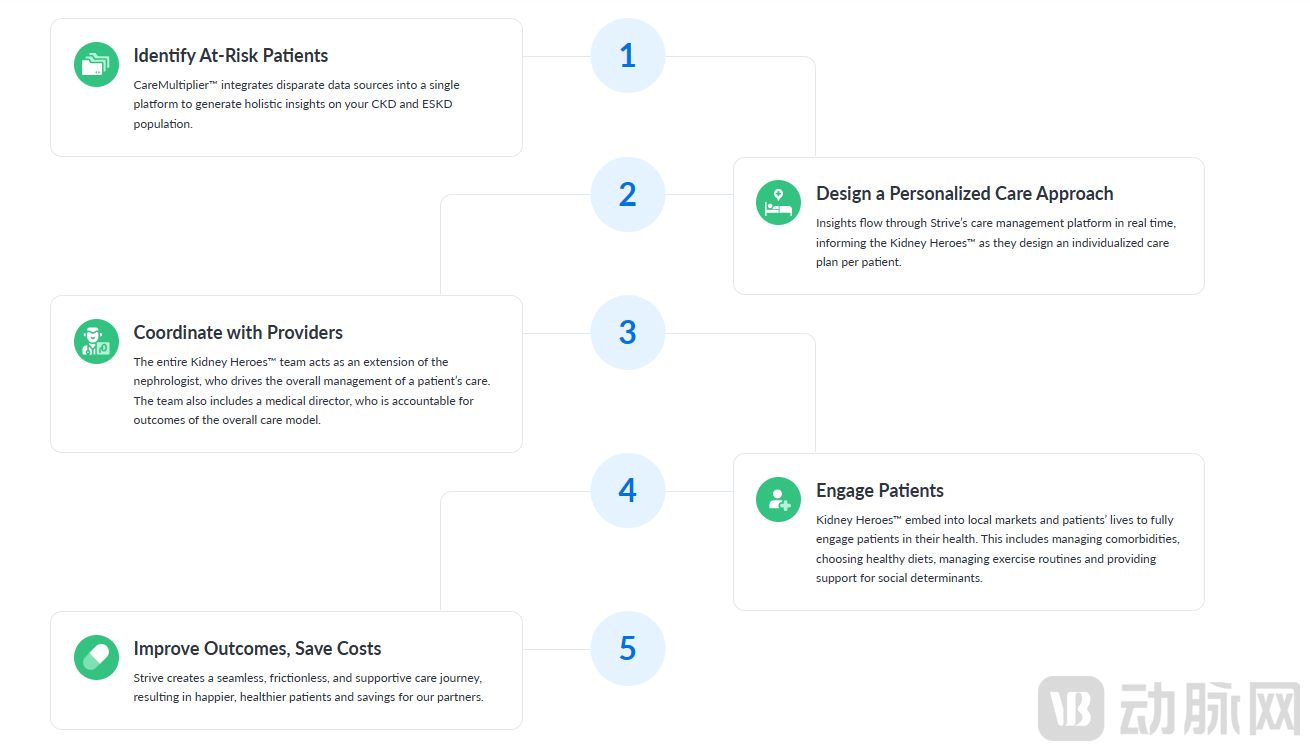
Strive Health Service Model Image Source: Official Website
Chris Riopelle believes that American nephrologists spend at least 50% of their day on administrative tasks. Therefore, the Strive Health model aims to help physicians optimize work efficiency and expand their scope of services.He positions Strive Health as an extension of nephrologists’ offices, stating, “Nephrologists continue to lead clinical decision-making, while we provide data and technical resources, administrative support, and community care teams.”
It is reported that the CareMultiplier™ platform currently holds over 150 billion patient data points, providing collaborating healthcare providers with on-demand access. For nephrologists, CareMultiplier™ serves as a tool to enhance diagnostic and treatment efficiency.
In addition to leveraging digitalization, the community care team (Kidney Heroes™) is also a key component of Strive Health’s care model.
Strive Health believes that patient care is a long-term team effort, over a period of six months or longer,The patient’s care team, composed of a nephrologist and a community care team, with the former serving as the “center” accountable for the outcomes of the entire medical model, and the latter acting as the “extension” driving the patient’s health management.
Among them, the community nursing team is integrated and provided by Strive Health, comprising nurse practitioners, dietitians, pharmacists, licensed clinical social workers, and other professionals. They actively engage in patient health management through telephone consultations or home visits, including managing comorbidities, providing dietary guidance, developing exercise plans, and delivering home dialysis services, to ensure the quality implementation of treatment protocols. Currently, Strive Health’s in-house care team consists of more than 500 employees.
According to data from the Strive Health website, the implementation of this service model has yielded significant results: overall sample care costs were reduced by at least 20%, hospital admissions decreased by 42%, timely initiation of renal replacement therapy increased by 67%, and the 30-day readmission rate declined by 36%.
As of May 2023, Strive Health managed care for 80,000 kidney disease patients across 30 U.S. states, and its technology platform, CareMultiplier™, achieved certification from the Health Information Trust Alliance (HITRUST). Its case management and population health programs have been recognized by the National Committee for Quality Assurance (NCQA).
Strive Health’s rapid market validation is attributable to the development of value-based care in the United States.
Accountable Care Organizations (ACOs) in the U.S. healthcare system are provider networks centered on primary care physicians, encompassing hospitals at various levels and diverse medical institutions such as rehabilitation centers. These organizations emphasize “the integration of services across hospitals, communities, and health insurance plans” and “accountability for healthcare quality.” In other words, while ensuring that medical services meet established quality standards, ACOs aim to reduce healthcare expenditures; the greater the cost savings achieved, the higher the performance-based incentives awarded to the ACOs.Therefore, the proactive management capability for various chronic diseases is a key business competency for ACOs.
Particularly in the management of chronic kidney disease (CKD). According to internal statistics from Strive Health, the prevalence of CKD among Americans aged 65 and older was 38% in 2017. As the condition progresses, the average annual cost per patient with end-stage renal disease (ESRD) exceeds $100,000. This indicates that although only a relatively small proportion of patients progress to ESRD, it still has a significant impact on organizational performance.
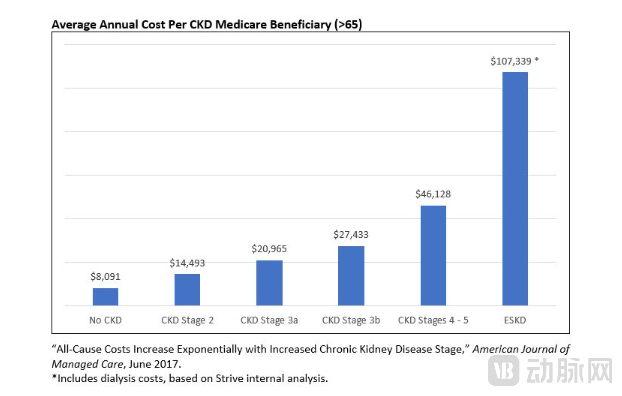
Image source: official website
However, previously, due to the lack of digital diagnostic and therapeutic tools, it was difficult for primary care physicians to intervene early in CKD patients (before stages 4–5).
Through extensive collaborations with ACOs, Strive Health rapidly acquired a large user base. This user data, combined with Strive Health’s service capabilities, provides healthcare organizations and related practitioners with abundant clinical cases, data, and on-the-ground service support. “We evaluated several potential partners and ultimately chose Strive Health because its model is the most patient- and provider-centric,” said Dr. Tony Samaha, a nephrologist and managing partner at the Cincinnati Kidney and Hypertension Center in Ohio.
Currently, Strive Health’s partners fall primarily into four categories: public health systems, health insurers, nephrologist/physician groups, and nephrology medical groups. As a result, Strive Health is capable of integrating regional kidney care resources.
In the management of high-risk patients with advanced CKD and ESKD, Strive Health has, since 2022, partnered with nephrologist groups to establish Kidney Care Entities (KCEs) and apply for participation in the Comprehensive Kidney Care Contracting (CKCC) program.
CKCC isIn 2019, the U.S. Centers for Medicare & Medicaid Services (CMS) introduced a new payment model for end-stage renal disease (ESRD). Its key components include: (1) slowing the progression from chronic kidney disease (CKD) to ESRD; (2) supporting patients during the transition to dialysis; (3) providing support throughout the transplantation process; and (4) managing post-transplant health care. This payment framework incentivizes nephrologists and healthcare organizations to delay disease progression in critically ill patients and improve care for those with end-stage renal disease.
In practice, Strive Health manages these Key Episode Categories (KECs), assuming responsibility for patients’ total cost of care and quality outcomes. It makes its data capabilities, administrative support, and service infrastructure available to collaborating medical experts and healthcare organizations. Strive Health shares risk with its partners and captures the financial benefits derived from “cost savings achieved through equivalent clinical outcomes.”
Currently, Strive Health operates Kidney Care Enterprises (KCE) in 11 states, including Texas, California, Illinois, and Indiana, managing over $2.5 billion in medical expenditures.
In early 2023, the National Center for Chronic and Noncommunicable Disease Control and Prevention of the Chinese Center for Disease Control and Prevention, jointly with the China Academy of Information and Communications Technology, released the “Notice on Publicizing the Results of the Collection and Selection of the First Batch of Typical Digital Products and Services for Chronic Disease Prevention and Control,” which included relatively few enterprises and products related to chronic kidney disease management.
Founded in 2018, the company is a technology-driven enterprise dedicated to collaborating with leading research-oriented medical institutions for the innovative research and development of digital therapeutics. In 2019, it launched the “Digital Therapeutics Application Platform for Nephrology (DTx-Clinical for Nephrology).” According to previous reports, the platform has enrolled and managed hundreds of thousands of patients with kidney diseases and rheumatic immune disorders, and the company has established its presence across major cities nationwide.
Funding Status:
Secured angel-round funding in 2020, led by Medlinker; raised tens of millions of RMB in Pre-A round financing in 2021, led by Changling Capital.
Founded in 2015, Kidney Medical provides a comprehensive disease management platform for patients with chronic kidney disease (CKD). Through its official WeChat account “Kidney Online” and the “Pocket Nephrologist” mobile app, the company delivers professional knowledge and information in the field of nephrology, while helping patients connect with suitable nephrologists to achieve long-term, end-to-end management of their condition. It has already built a patient community of over one million members. Meanwhile, Kidney Medical is exploring the establishment of a specialized Health Maintenance Organization (HMO) system for kidney disease, collaborating with multiple insurance providers such as ZhongAn Insurance, Zhonghui Mutual Insurance, and Aixin Life Insurance to deliver a comprehensive healthcare service system to users in specific regions who voluntarily enroll in the program.
Financing Status:
Completed RMB 100 million in Series A+ financing in 2021, led by MSA Capital, with participation from Yidu Tech, Shunwei Capital, Kaifeng Venture Capital, and other institutions. Previously, it had completed four rounds of financing, but the amounts were not disclosed.