

How National-Level Biomedical Incubators Are 'Mass-Producing' Unicorns

VectorBuilder
Gene Delivery Technology Developer

Vision Medicals
Genetic Testing Service Provider
Recently, the Ministry of Science and Technology announced the list of national-level technology business incubators for 2022, with 194 incubators across China making the list. Among them, ten biopharmaceutical incubators were selected, including the Huawei Tianda Big Health Industry Base, the Jiuzhou Digital Medical Health Industrial Park, and the Taicang Biopharmaceutical Enterprise Incubator.
The biomedical industry is characterized by high entry barriers, substantial capital requirements, complex processes, and elevated risks. Incubators provide tenant enterprises with essential production factors and specialized technical platforms, thereby reducing infrastructure investments for startups and accelerating the integration of industrial resources. They play an indispensable role in technology transfer and enterprise development.
Tall buildings rise from the ground up, and this is especially true for biopharmaceutical enterprises driven by innovative R&D. Laying a solid foundation in the early stages is a prerequisite for constructing skyscrapers, and incubators serve as partners for startups to accumulate early-stage momentum during this phase. National-level technology business incubators represent the first tier of incubation capabilities and are more powerful partners for startups.
Globally, countries with advanced biopharmaceutical industries all boast high-quality incubators. The growth and expansion of the five major biotechnology hubs in the United States have largely benefited from local incubators’ cultivation of innovative enterprises; for instance, Boston and the San Francisco Bay Area are home to renowned biotechnology incubators such as Lab Central and IndieBio.
In China, VCBeat has compiled data from the Ministry of Science and Technology along with other publicly available information, revealing that there are currently 1,620 national-level technology business incubators across the country. Biopharmaceutical incubators also occupy a significant place within this landscape, with their distribution pattern aligning closely with that of biopharmaceutical industry clusters; provinces such as Guangdong, Jiangsu, and Shandong account for a relatively high proportion.
Among the national-level technology business incubators newly accredited in 2022, there were 10 specialized biopharmaceutical incubators.
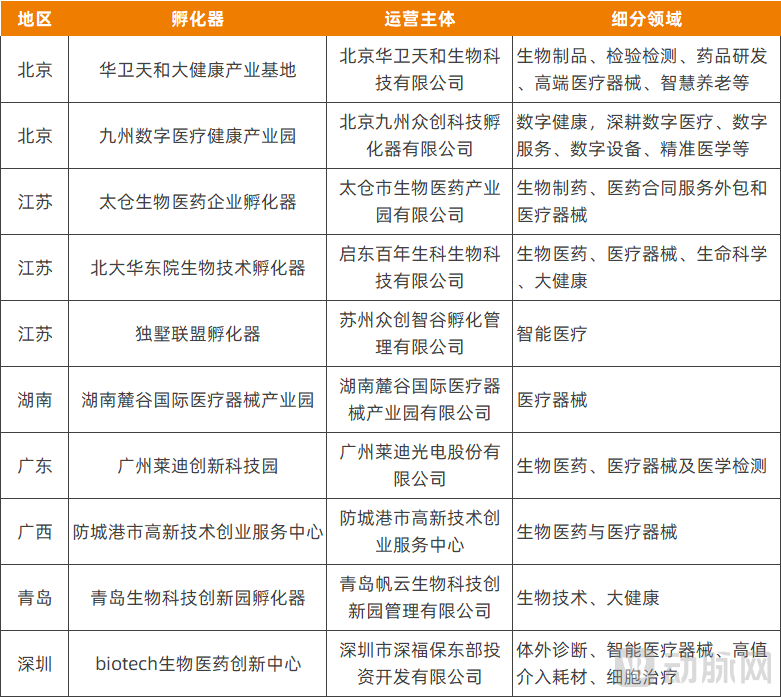
Biomedical Incubators Rated as National-Level Science and Technology Enterprise Incubators in 2022, Source: Ministry of Science and Technology, Public Reports
In accordance with the "Administrative Measures for Science and Technology Enterprise Incubators" issued by the Ministry of Science and Technology, certain requirements are stipulated regarding the floor area of incubation facilities, the scale of incubation funds, professional incubation service personnel, enterprises under incubation, and graduated enterprises when certifying national-level science and technology enterprise incubators.
Professional Incubators: Enterprises engaged in R&D and production within the same industrial sector shall account for more than 75% of the total number of incubated enterprises. These incubators must provide precise incubation services tailored to specific industry segments, possess independently operable public service platforms, and be capable of delivering specialized technical services such as research and development, inspection and testing, and small-scale and pilot-scale trials. Such entities may be accredited and managed as professional incubators.
The Torch High Technology Industry Development Center of the Ministry of Science and Technology has also established an evaluation mechanism for national-level business incubators, annually classifying them into four categories—A, B, C, and D—corresponding to Excellent, Good, Qualified, and Unqualified, respectively.
Under the evaluation mechanism, the "Evaluation Indicator System for Technology Business Incubators" assesses incubators across four major dimensions: service capability, incubation performance, sustainable development, and bonus indicators. These are further broken down into 21 specific sub-indicators, covering aspects such as the construction of public technical service platforms and the provision of technical services, industry-university-research collaboration, and the promotion of integration among large, medium, and small enterprises.
To date, a number of high-quality biomedical incubators have emerged as standouts. In the “2021 National-Level Technology Business Incubator Evaluation Results” released by the Ministry of Science and Technology at the end of 2022, 38 biomedical incubators received Class A ratings, with many having earned this distinction multiple times in succession.
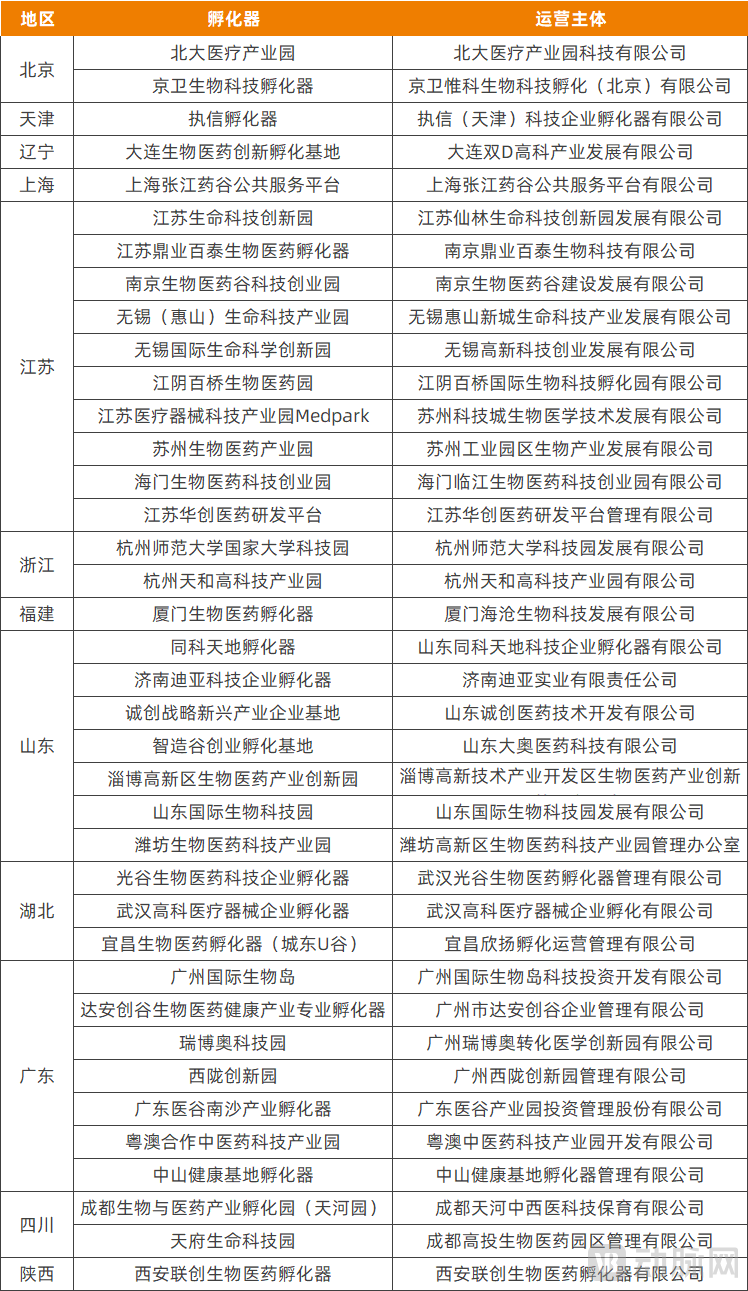
National-level Biomedical Technology Business Incubators Rated as Class A in 2021; Source: Ministry of Science and Technology, Public Reports
The accreditation and evaluation of national-level technology business incubators are based on multidimensional criteria that comprehensively consider the technological entrepreneurship ecosystem across the entire industry. For the biopharmaceutical sector, incubators selected into the “national team” or rated as Class A hold distinct value.
The development of the biopharmaceutical industry typically involves multiple stages, including basic research, preclinical studies, clinical trials, regulatory registration and approval, industrialization, and clinical application. Given the numerous subsectors within this field, each may have distinct requirements across these stages. Furthermore, enterprises at different incubation stages exhibit varying demands for infrastructure, capital, and other essential resources.
Typically, incubators provide enterprises with basic services such as workspace, project and capital matchmaking, and product registration, whereas national-level technology business incubators undertake more extensive initiatives in professional services, incubation value chains, funding allocation, and industrial ecosystems.
First, establish public technical platforms to reduce early-stage investment costs for enterprises.
Biopharmaceutical startups face high investment costs, the majority of which stem from early-stage R&D. In addition to labor costs, a significant portion of early-stage R&D expenditure is attributed to laboratory facilities and equipment, making the “shared” model an effective approach to reducing these costs.
This industry characteristic requires biomedical incubators to provide specialized facilities aligned with the key sub-sectors within their parks, such as new drug R&D, pilot-scale scale-up, and CRO services, by either building these capabilities in-house or sharing resources with research institutions and universities, thereby meeting enterprises’ demands for professional technical services.
At the Shanghai Zhangjiang Pharma Valley Public Service Platform, incubated enterprises can access over 30,000 square meters of incubation and laboratory space, with nearly 150 incubation units available for use as specialized biological and chemical laboratories. Additionally, they can benefit from the professional technical services provided by the Pharma Valley platform.
Within the incubator of the Qingdao Biotechnology Innovation Park, four specialized technical service platforms have been established, including a laboratory equipment sharing platform and a public technical service platform for chromatography/mass spectrometry testing. Among the incubated enterprises, 82.35% are engaged in R&D, pilot production, and services in the fields of biopharmaceuticals and medical devices.
Fangchenggang High-Tech Entrepreneurship Service Center was originally a comprehensive incubator. In recent years, with the development of the Fangchenggang International Medical Open Pilot Zone, it has gradually transformed and upgraded into a specialized incubator focused on cultivating the biomedical industry. During this process, the center has established public technical service platforms for biomedicine and public service platforms for food and drug inspection, gradually attracting more companies with relevant expertise. Over the past three years, it has served more than 100 biomedical enterprises.
As a connecting platform, biopharmaceutical incubators bring together multiple small-scale enterprises, integrate their common needs, and share essential resources such as specialized equipment and technical services. This effectively addresses issues faced by startups, including high equipment costs and low utilization rates after investment.
Second, establish a “co-creation space–incubator–accelerator” chain to facilitate the rapid growth of enterprises.
The primary objective of an incubator is to enhance corporate survival rates by providing various public resources and services. Once a company survives, it will inevitably face challenges related to production, capacity expansion, and market development.
Seeking these resources outside the incubator inevitably incurs additional information search and resource coordination costs for enterprises. To establish a comprehensive, end-to-end innovation resource system for incubated companies, incubators can leverage their own facilities or collaborate with external platforms to build an incubation chain comprising “makerspaces–incubators–accelerators.”
Huawei Tianhe Big Health Industrial Base is located in the Daxing Biomedical Industry Base within the Zhongguancun High-Tech Park. Leveraging the advantages of the local industrial ecosystem, Huawei Tianhe Big Health Industrial Base has successively established two parks over the past two years: the Pharmaceutical and Healthcare Accelerator and the International Science and Trade Innovation Center. These facilities serve as carriers extending the functions of business incubators both upstream and downstream. Specifically, the International Science and Trade Innovation Center provides services such as shared office spaces and professional collaboration platforms, while the Accelerator enables enterprises to construct GMP-compliant manufacturing plants and pilot-scale production workshops.
The Biotech Innovation Center serves as the incubation platform for the Shenzhen Biopharmaceutical Innovation Industrial Park. Leveraging the park’s and surrounding area’s biotechnology industry resources, the Center provides technical development, achievement commercialization, sci-tech finance, and third-party professional services to entrepreneurial talent and startups. As enterprises grow and mature through this incubation process, the Center guides them to production facilities within the industrial park or to adjacent industrial spaces.
Furthermore, incubators such as the Optics Valley Biopharmaceutical Technology Enterprise Incubator and the Nanjing Bio-Medicine Valley Science and Technology Entrepreneurship Park can leverage the resources of their large-scale industrial parks to provide more comprehensive incubation services, thereby accelerating corporate growth.
Third, introduce or establish industrial funds to better address corporate financing challenges.
The certification criteria for national-level technology business incubators require that incubators possess their own seed funding or partnered incubation funds with a scale of no less than RMB 5 million. This funding threshold, however, may be merely a drop in the bucket for the biomedical industry, which pursues original innovation and breakthroughs in cutting-edge technologies.
To broaden financing channels, it has become standard practice for incubators to introduce investment institutions, organize venture capital activities, and build bridges between enterprises and capital. Some well-capitalized incubators have also established their own industrial funds to make direct investments in selected portfolio companies.
In 2014, Da An Gene established the Da An Chuanggu Biopharmaceutical and Health Industry Incubator in Guangzhou, launching an incubation model based on “capital + industrial resources.” According to data released by the Guangzhou Municipal Science and Technology Bureau, Da An Chuanggu currently has its own direct investment funds as well as industry investment funds co-established with external partners, with a total scale exceeding RMB 5 billion. To date, it has cumulatively invested in and incubated more than 300 biopharmaceutical enterprises with independent innovation capabilities.
The Wuxi International Life Science Innovation Park has also attracted a number of investment teams and established dedicated funds. To date, the park has gathered 53 venture capital firms, with a total committed capital of RMB 21.113 billion.
In 2022, the Wuxi International Life Science Innovation Park established a special fund focused on identifying investment opportunities within AstraZeneca’s industrial chain and ecosystem enterprises, investing in hard-tech companies, and facilitating the industrialization and localization of innovative biopharmaceutical projects in the Wuxi High-Tech Industrial Development Zone.
By establishing a direct investment fund, the incubator not only addresses enterprises’ financing needs but also enables the industrial park to make equity investments in these companies, thereby pursuing future financial returns or supply chain synergies.
Fourth, incubators drive regional industries and activate regional innovation momentum.
At present, the development of the biopharmaceutical industry is uneven across different regions in China, with significant variations in resource endowments and key industrial sectors. Nevertheless, on the national biopharmaceutical industry map, several well-known industrial clusters share a common advantage: a high concentration of universities, a relatively abundant talent pool, and strong scientific research capabilities.
As more provinces designate biomedicine as a key industry, industrial clusters are “descending” to prefecture-level and county-level cities, and even small towns, making the need for the flow of scientific research and talent resources more urgent. Incubators play a crucial connecting role in this process.
Qidong is a county-level city under the administration of Nantong City, Jiangsu Province. In 2016, the Qidong Municipal People’s Government and the School of Life Sciences at Peking University signed an agreement to jointly establish the Peking University East China Industrial Research Institute for Life Sciences (hereinafter referred to as “PKU East China Institute”).
Previously, Qidong City had already attracted well-known brands such as Bayer and Gaitianli, establishing a certain industrial foundation. Benefiting from numerous biopharmaceutical support policies in Jiangsu Province and its geographical proximity to Shanghai, the city has become an attractive hub. Since the establishment of Peking University’s East China Institute in Qidong, a total of 28 biopharmaceutical projects have been introduced, along with more than 30 high-level talents holding doctoral degrees or above.
Peking University East China Hospital’s Biotechnology Incubator integrates services such as startup incubation, achievement transformation, equity investment, pilot-scale testing, platform support, and talent development to facilitate the growth of introduced projects, thereby further invigorating the local biopharmaceutical industry.
In Chengdu, Tianfu Life Science Park is vigorously promoting the incubation of innovative enterprises and advanced technologies, fostering university-local government collaborations, and attracting leading industry players. To date, the park has incubated listed companies such as HitGen, Keymed Biosciences, and Haichuang Pharmaceutical; gathered research institutions including the National Precision Medicine Industry Innovation Center, Tianfu Jincheng Laboratory (Frontier Medical Center), and Peking University Chengdu Institute for Frontier Interdisciplinary Biotechnology; and introduced major enterprises such as AstraZeneca China and Better Pharmaceutical.
These institutions and enterprises, along with their upstream and downstream industrial chains, will not only drive the development of the park itself but also radiate to boost the biopharmaceutical industry in Chengdu and even the broader Southwest China region.
Clearly, biomedical incubators have long ceased to be mere “sublessors”; instead, they serve as the genesis for the growth of both enterprises and regional industrial ecosystems.
Across the landscape of technological innovation, becoming a "gazelle" or a "unicorn" is virtually an inevitable path for companies evolving into industry giants. These two animal metaphors are frequently used to describe a company's innovativeness and growth potential.
Within biomedical incubators, cultivating gazelle and unicorn companies has become a key objective for operators. In recent years, as the professional service capabilities of incubators have improved, and bolstered by breakthroughs in frontier technologies, support from sci-tech innovation policies, and preferential access to innovative funding, these incubators are seeing a “batch” emergence of gazelle and unicorn enterprises.
In December 2022, the Guangzhou Science and Technology Innovation Enterprise Association announced the 2022 Guangzhou Unicorn Innovative Enterprises List. Based on the enterprise cultivation and growth ecosystem, the list is categorized into three tiers: Seed Unicorns, Future Unicorns (valued between $100 million and $1 billion), and Unicorns (valued at $1 billion or above). Among them, 24 biopharmaceutical companies were included in the Future Unicorns list, and 8 biopharmaceutical companies were included in the Future Unicorns list.
Many of the listed companies originate from incubators.
Guangzhou Laidi Innovation Science and Technology Park has incubated five future unicorn innovative enterprises: VISION MEDICALS, Ruifeng Biotechnology, Kangwei, Guangzhou Huajin Pharmaceutical Technology Co., Ltd., and Guangzhou Huayin Healthcare Group Co., Ltd. These companies focus on areas such as genetic diagnosis and precision medicine for infectious diseases, gene-editing therapeutics, innovative anti-tumor drugs, and medical laboratory testing and pathological diagnosis. Many of them have received investment from institutions including GTJA Capital, Yinyue Medical Fund, CICC Capital, and Legend Star.
When the aforementioned list was announced, VectorBuilder, located at the Guangzhou International Enterprise Incubator, was included in the Future Unicorn List. By May 2023, VectorBuilder had completed its C+ round of financing with a valuation of RMB 7 billion, becoming a unicorn.
During the establishment and growth of VectorBuilder, Guangzhou International Business Incubator provided a range of services, including policy guidance, investment and financing support, specialized biopharmaceutical technical expertise, and international exchange and cooperation.
As of now, the Guangzhou International Enterprise Incubator has cultivated more than 1,000 technology-based enterprises, including over 20 Gazelle Enterprises in the Guangzhou Development District, establishing itself as an incubation platform with significant regional influence.
At the Jiangsu Medical Device Technology Industrial Park (Medpark), ten companies, including Zeda Xingbang and Depin Medical, were recognized as provincial-level Gazelle Enterprises in 2022. Five companies—Kangduo Robotics, Yidao Biotechnology, Nuoyi Mai’er, Xinqing Medical, and Huqiu Imaging—were included in the GEI China Potential Unicorn List. In the GEI China Unicorn Enterprise List released in June 2023, Kangduo Robotics had ascended to unicorn status.
Leveraging the resources of the Suzhou Institute of Biomedical Engineering and Technology, Chinese Academy of Sciences, Medpark has introduced innovation platforms such as the Suzhou Medical Device Research Institute of Southeast University, incubation platforms including the Suzhou Collaborative Innovation Institute for Medical Robots and the Guoqian Innovative Medical Technology Research Institute, and service platforms like the Suzhou Branch of the Jiangsu Provincial Medical Device Testing Institute and the Medical Device Usability Testing Platform, providing robust support for enterprise incubation.
Furthermore, some incubation carriers with substantial industrial capacity have also nurtured listed companies. In addition to the Tianfu Life Science Park mentioned earlier, notable examples include Kangtuo Medical from the Xi’an Lianchuang Biomedical Incubator and Angelalign from the Wuxi (Huishan) Life Science Industrial Park. However, given the significant differences in service requirements and industrial resources needed by listed companies, this article will not delve into these cases.
In addition to the analysis from the aforementioned perspectives, biopharmaceutical incubators can also be categorized by their developers and operators, allowing for an examination of those run by public institutions, state-owned enterprises, and private entities. Differences in developers and operators determine variations among incubators in terms of tenant selection, service offerings, and incubation mandates.
However, an incubator is inherently a physical entity situated within a specific space and must synergize with the various social resources available in its location. Therefore, regardless of the type, all incubators need to collaborate closely with local government agencies, investment firms, and third-party service providers to jointly serve enterprises. For regions that have genuinely designated biomedicine as a priority industry, it is advisable to leverage incubators as the starting point for implementation.
Note: The biopharmaceutical incubators mentioned in this article are primarily identified based on public information from the Ministry of Science and Technology, local government departments, and industrial parks. They refer to national-level technology business incubators with core industries focused on biopharmaceuticals, medical devices, and general health, excluding incubators that cover multiple industries (with biopharmaceutical-related industries being only one of them).